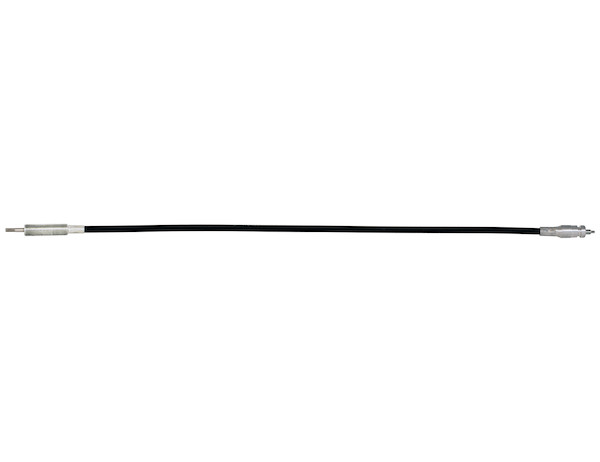
The Remote Valve Control Cable from Buyers Products connects RVC levers to valves using the corresponding RVC Connection Kit. It has a RVC Adapter Input with a Bonnet output. The cable features durable stainless steel ends and comes in a wide range of lengths.
Specifications
| Conduit Color | Black |
| Bulkhead Thread Size | 3/4-16 " |
| Cable Diameter (in.) | 132 " |
| Cable Length (in.) | 132 " |
| End Type | Valve Bonnet Connection |
| Cable Series | RVC Adapter |
| Rod End Thread Size | 1/4-28 " |
| Total Travel (in.) | .56 " |
The 132-inch Remote Valve Control Cable from Buyers Products represents a critical component in the intricate realm of hydraulic and pneumatic system control, specifically designed for applications demanding precise and reliable remote actuation. This cable is engineered to bridge the mechanical interface between a Remote Valve Control (RVC) lever and a compatible valve, forming an essential link in systems where direct manual operation of the valve is impractical or undesirable due to spatial constraints, safety requirements, or ergonomic considerations. Its robust construction and meticulously defined specifications ensure optimal performance and longevity in demanding operational environments.
At its core, the function of this cable is to transmit mechanical motion from an operator interface—the RVC lever—to the control mechanism of a valve. This transmission is achieved through a push-pull action, a fundamental principle in mechanical control systems where a force applied at one end of the cable results in a corresponding movement at the other end. The designation "RVC Adapter Input with a Bonnet output" precisely defines the interface points of the cable. The "RVC Adapter Input" signifies the end of the cable designed to connect seamlessly with an RVC lever, typically via a specialized RVC Connection Kit. This connection kit is crucial for establishing a secure and efficient mechanical linkage, ensuring that the lever's translational or rotational motion is accurately converted into the linear displacement required by the cable. The "Bonnet output" indicates that the opposing end of the cable is specifically configured to interface with the bonnet of a valve. Valve bonnets often house the stem that controls the valve's opening and closing mechanism, making this a common and effective point of actuation for remote control applications. This design specificity ensures compatibility with a wide range of industrial and mobile hydraulic valves.
The stated "Cable Diameter (in.)" and "Cable Length (in.)" both as "132 inches" in the specifications require clarification for accurate interpretation. While the "Cable Length (in.)" of 132 inches (equivalent to 11 feet) is a standard and practical measurement for remote control applications, indicating the overall operational reach, the "Cable Diameter (in.)" being listed as 132 inches is almost certainly a typographical error. A cable diameter of 132 inches would imply an extremely massive cable, inconsistent with typical remote control cable applications. It is highly probable that this specification refers to a different parameter, or is an error, and the actual cable diameter would be significantly smaller, typically measured in fractions of an inch or millimeters, relating to the internal core or outer conduit dimensions. For the purpose of this technical expansion, we will interpret "Cable Length (in.)" as the operative length of 132 inches, acknowledging the potential typographical anomaly in the "Cable Diameter" specification and focusing on the practical implications of a cable of this substantial length.
A length of 132 inches (11 feet) provides considerable flexibility in system design, allowing for the remote positioning of control levers away from the actuated valves. This is particularly advantageous in scenarios such as heavy equipment operation, municipal vehicle applications (e.g., dump trucks, snowplows), and industrial machinery where the operator's cabin or control station is physically separated from the hydraulic power unit or valve manifold. This extended reach contributes to enhanced operator safety by removing personnel from potentially hazardous areas near moving parts or high-pressure lines, improves ergonomics by allowing for optimal control station placement, and facilitates more compact machine designs by freeing up space around the valves themselves.
Material selection is paramount for components subjected to mechanical stress and environmental exposure. The specification highlights "durable stainless steel ends." Stainless steel is chosen for its exceptional properties, including high tensile strength, resistance to corrosion, and durability. In an application like a remote valve control cable, the ends are critical stress points, experiencing repetitive push-pull forces and potential abrasion during connection and disconnection. The corrosion resistance of stainless steel is particularly vital in outdoor, marine, or industrial environments where exposure to moisture, chemicals, salt spray, or extreme temperatures could compromise the integrity of lesser materials, leading to premature failure. This ensures a long operational life and consistent performance even in harsh conditions.
The "Conduit Color" specified as "Black" is more than just an aesthetic choice; it often indicates the material composition and protective properties of the outer casing. Black conduits are commonly made from various polymers (e.g., polyethylene, PVC, nylon) that offer good UV resistance, abrasion resistance, and protection against minor impacts. The conduit serves as a crucial protective sheath for the internal working components of the cable, shielding the core wire from contaminants, physical damage, and environmental degradation, thereby maintaining smooth operation and preventing premature wear.
Delving into the specifics of the connection points, the "Bulkhead Thread Size" is given as "3/4-16 inches." This refers to the threading on the bulkhead fitting, which is typically used to secure the cable conduit through a panel or chassis. A 3/4-16 thread is a common size in industrial and automotive applications, indicating a robust connection suitable for securely mounting the cable. The "3/4" denotes the nominal outside diameter of the thread in inches, and "16" signifies 16 threads per inch (TPI). This UNC (Unified National Coarse) thread standard ensures compatibility with corresponding nuts and mounting points, providing a stable and vibration-resistant installation.
The "Rod End Thread Size" is specified as "1/4-28 inches." The rod end is the terminal component on the cable's inner core wire that connects directly to the valve bonnet mechanism. A 1/4-28 thread is a finer thread pitch (UNF - Unified National Fine) compared to the bulkhead thread. Fine threads offer superior holding power and adjustability for precision applications, making them ideal for the final connection to the valve, where precise adjustment of the cable's effective length might be necessary for accurate valve actuation and calibration. The "1/4" indicates the nominal diameter, and "28" represents 28 threads per inch.
The "End Type" is explicitly stated as "Valve Bonnet Connection." This re-emphasizes the primary application of the cable, confirming its design for direct mechanical interface with the bonnet assembly of a valve. This typically involves a specific clevis, eyelet, or threaded rod end that mates with the valve's control arm or stem, facilitating the push-pull motion required to open or close the valve, or to modulate its flow in proportional control systems.
The "Cable Series" is identified as "RVC Adapter." This nomenclature indicates that the cable is part of a specialized product line designed to work in conjunction with RVC (Remote Valve Control) systems. This suggests a level of standardization and interoperability within Buyers Products' RVC ecosystem, ensuring that this cable is compatible with their proprietary RVC levers and connection kits, simplifying procurement and integration for system designers and maintenance personnel.
Finally, "Total Travel (in.)" is specified as ".56 inches." This is a crucial functional parameter, defining the maximum linear displacement that the inner core of the cable can achieve. A total travel of 0.56 inches (approximately 14.22 mm) dictates the stroke length of the actuated valve. For many hydraulic and pneumatic valves, a stroke within this range is sufficient to move the spool or poppet from a fully closed to a fully open position, or to achieve various intermediate positions for flow modulation. Understanding this parameter is vital for engineers to ensure that the cable's travel capacity matches the required actuation stroke of the target valve. Insufficient travel would prevent full valve operation, while excessive travel might indicate an inefficient design or lead to over-stressing of components at the travel limits.
The design principles underlying this remote valve control cable are rooted in achieving high efficiency and reliability in mechanical motion transfer. The cable typically consists of a multi-strand steel core wire, chosen for its flexibility and high tensile strength, operating within a low-friction polymer liner encased by a protective outer conduit. The polymer liner, often made from materials like PTFE (Polytetrafluoroethylene) or Nylon, minimizes friction between the moving core and the stationary conduit, ensuring smooth and consistent operation over the cable's lifespan. This low-friction characteristic is essential for reducing operator effort and preventing hysteresis, where the output motion does not precisely follow the input motion due to internal friction.
The 132-inch length of this cable introduces specific engineering considerations. For longer cables, phenomena such as backlash and compressive resilience become more pronounced. Backlash refers to the slack or lost motion in the system, which can arise from manufacturing tolerances or slight elasticity in the cable materials. While minimized through precise engineering, it's a factor to consider in highly accurate positioning systems. Compressive resilience refers to the slight compression of the cable conduit and internal components when the cable is in a push state. Buyers Products' design likely incorporates robust conduit materials and precise internal component clearances to mitigate these effects, ensuring that the 0.56 inches of total travel is achieved with minimal deviation and maximum responsiveness even across the 11-foot span.
Installation of the 132-inch Remote Valve Control Cable typically involves several steps. First, the RVC Connection Kit is used to secure the input end of the cable to the RVC lever. This kit often includes specialized brackets, fasteners, and pivot points to ensure a robust and flexible connection. The cable is then routed along the desired path, which might involve navigating around structural elements of the vehicle or machinery. Proper routing is essential to prevent sharp bends, kinking, or abrasion of the conduit, which could impede cable movement or cause premature wear. The bulkhead fitting, with its 3/4-16 thread size, plays a crucial role in securing the cable's conduit at intermediate points or as it passes through a control panel, ensuring stability. Finally, the "Valve Bonnet Connection" end, with its 1/4-28 rod end thread, is attached to the valve. This connection often requires precise adjustment to align the cable's travel range with the valve's full stroke, ensuring proper calibration of the control system.
The applications for this particular cable are extensive, primarily focusing on mobile hydraulic equipment and industrial machinery where precise remote control is a necessity. Examples include:
- Utility and Municipal Vehicles: Operating auxiliary functions on snowplows (blade angle, lift), salt spreaders, refuse compactors, and tow trucks.
- Construction Equipment: Controlling functions on excavators, backhoes, and loaders where joysticks or levers in the cab translate into hydraulic valve movements.
- Agricultural Machinery: Actuating implements, spray booms, or harvesting mechanisms.
- Marine Applications: Controlling steering, throttle, or trim tabs on vessels where the helm is distant from the engines or hydraulic actuators.
- Industrial Automation: Remotely operating valves on production lines, material handling systems, or processing equipment, especially in environments where direct access is restricted or hazardous.
The professional and technical attributes of the 132-inch Remote Valve Control Cable make it a superior choice for system integrators and engineers. Its adherence to specific threading standards (3/4-16 for bulkhead, 1/4-28 for rod end) ensures compatibility and ease of integration into existing or new designs. The specified total travel of 0.56 inches allows for precise functional mapping to valve stroke requirements, which is critical for achieving desired flow rates or actuator positions. The "RVC Adapter" series designation signifies a systematic approach to control solutions, offering a cohesive product family. By meticulously defining these parameters, Buyers Products provides a component that can be confidently specified, ensuring reliable performance and contributing to the overall efficiency and safety of the hydraulic or pneumatic control system it integrates with.