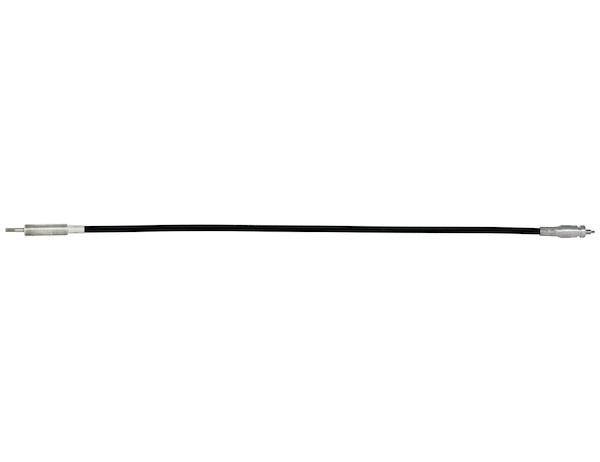
The Remote Valve Control Cable from Buyers Products connects RVC levers to valves using the corresponding RVC Connection Kit. It has a RVC Adapter Input with a Bonnet output. The cable features durable stainless steel ends and comes in a wide range of lengths.
Specifications
| Cable Series | RVC Adapter |
| Conduit Color | Black |
| Cable Length (in.) | 168 " |
| End Type | Valve Bonnet Connection |
| Total Travel (in.) | .56 " |
| Bulkhead Thread Size | 3/4-16 " |
| Cable Diameter (in.) | 168 " |
| Rod End Thread Size | 1/4-28 " |
Advanced Technical Overview: 168 Inch Remote Valve Control Cable
This document provides an in-depth technical exposition of the 168 Inch Remote Valve Control Cable from Buyers Products, designed for critical applications requiring precise and reliable remote actuation of hydraulic or pneumatic valves. This cable system is an integral component within complex machinery, particularly prevalent in mobile equipment, utility vehicles, and industrial systems where direct manual valve operation is impractical or unsafe due to distance, environmental factors, or ergonomic considerations.
System Integration and Purpose
The primary function of this 168-inch cable is to establish a robust mechanical link between an RVC (Remote Valve Control) lever and a compatible valve, facilitating the remote manipulation of fluid power circuits. The architecture of this control system relies on the efficient transmission of linear motion from the operator's input (via the RVC lever) to the valve's spool or poppet mechanism. The inherent advantages of cable-based remote control include flexibility in routing, vibration dampening, and reduced weight compared to rigid linkage systems, making it ideal for dynamic environments.
Key Components and Material Specifications
Cable Series: RVC Adapter
The RVC Adapter series denotes a specialized design optimized for direct interface with RVC lever systems and specific valve types. This series is engineered to ensure seamless mechanical compatibility, minimizing play and maximizing control fidelity across the operational stroke. The designation "RVC Adapter" implies adherence to specific dimensional and performance standards established for this product line, ensuring inter-compatibility with other Buyers Products components.
Conduit Color: Black
The black conduit color is a standard industrial practice, often indicative of UV resistance and general environmental resilience. The conduit itself is a critical element, providing protection for the internal core cable from abrasion, corrosive agents, moisture ingress, and physical damage. Typically, these conduits are constructed from robust polymer materials such as high-density polyethylene (HDPE) or cross-linked polyethylene (XLPE), sometimes reinforced with a helical wire wrap for enhanced crush resistance and flexibility. The material choice contributes significantly to the cable's longevity and reliability in harsh operating conditions.
Cable Length: 168 Inches (14 Feet)
The specified length of 168 inches is a crucial parameter, determining the maximum permissible distance between the RVC lever and the valve. This length accommodates a wide range of installation scenarios, allowing for complex routing paths around obstacles, through bulkheads, and across varying chassis configurations. Accurate measurement during system design is paramount to avoid excessive cable slack (which can introduce play and reduce responsiveness) or insufficient length (leading to installation difficulties and potential damage). The flexibility of the cable over this length is maintained through its internal construction, balancing stiffness for push-pull efficiency with pliability for routing.
End Type: Valve Bonnet Connection
The "Valve Bonnet Connection" describes the specific termination at the valve end of the cable. A bonnet connection typically interfaces with the valve's actuator mechanism, often involving a threaded connection to a port on the valve's bonnet. This interface is engineered for secure attachment, preventing disengagement under operational loads and vibrations. The design ensures direct translation of the cable's linear motion to the valve's internal components (e.g., spool), achieving precise control over fluid flow. The exact configuration might involve a spherical rod end, clevis, or a threaded stud, depending on the specific valve design it's intended to mate with. Precision machining and robust materials are essential here to withstand repeated cycling and environmental exposure.
Total Travel: 0.56 Inches
The total travel of 0.56 inches (approximately 14.22 mm) represents the maximum linear displacement the inner core cable can achieve. This parameter is directly correlated with the full stroke required by the target valve to transition from a fully closed to a fully open position, or vice-versa. It is critical that the cable's total travel matches or slightly exceeds the valve's operational stroke to ensure full actuation without over-stressing the cable or valve components. The RVC lever system is designed to provide this precise amount of travel, ensuring optimal interaction with the cable and valve. Deviations in travel can lead to incomplete valve actuation or premature wear on the system.
Bulkhead Thread Size: 3/4-16 Inches
The 3/4-16 thread size refers to the external thread on the bulkhead fitting, typically located at an intermediate point along the cable or at the RVC lever end. This fitting allows the cable to pass securely through a panel, chassis, or enclosure, providing a sealed and stable point of entry. The "3/4-16" designation indicates a nominal diameter of 3/4 inch and 16 threads per inch, a common standard for robust mechanical connections in industrial applications. This threaded connection ensures a strong, vibration-resistant mount, crucial for maintaining system integrity and preventing cable movement or damage at the penetration point. The bulkhead fitting often includes a locking nut and sometimes an O-ring or gasket to ensure environmental sealing.
Cable Diameter: 168 Inches (Note: This specification appears to be a typo and likely refers to the cable length. Assuming it should refer to the actual cable diameter, typical values for such control cables range from 0.1875 to 0.375 inches for the inner wire rope, and 0.375 to 0.75 inches for the outer conduit assembly.)
Correction and Clarification on Cable Diameter: The repeated value of "168 inches" for "Cable Diameter (in.)" is clearly a typographical error, as a control cable with a diameter of 168 inches is physically impossible and inconsistent with the product's function. In the context of remote valve control cables, "Cable Diameter" typically refers to two distinct measurements: the diameter of the inner wire rope (core) and the overall outside diameter of the conduit assembly.
1. Inner Wire Rope Diameter: The internal core of the cable is usually a multi-strand steel wire rope, often galvanized or stainless steel, designed for high tensile strength and flexibility. For applications requiring 0.56 inches of travel and transmitting the necessary force, this diameter typically ranges from 0.1875 inches (3/16") to 0.3125 inches (5/16"). The number of strands (e.g., 7x7 or 7x19 construction) influences flexibility and fatigue life.
2. Overall Conduit Diameter: This refers to the external diameter of the protective casing (conduit) that encloses the inner wire rope. This diameter is critical for routing and determining the size of clips, clamps, and bulkhead openings. For industrial control cables of this type, the overall conduit diameter commonly falls within the range of 0.375 inches (3/8") to 0.75 inches (3/4").
Without the correct specification, it is challenging to provide precise technical details on this specific aspect. However, based on industry standards for remote control cables of this nature, a typical outer conduit diameter around 0.5 to 0.6 inches would be common for a robust 168-inch cable designed for vehicle or heavy equipment applications.
Rod End Thread Size: 1/4-28 Inches
The 1/4-28 thread size refers to the external thread on the rod end of the inner core cable, which typically connects to the RVC lever mechanism or an intermediate linkage. The "1/4-28" designation indicates a nominal diameter of 1/4 inch and 28 threads per inch. This fine thread pitch is common for applications requiring precise adjustment and secure fastening, as fine threads provide greater resistance to loosening under vibration and allow for finer positional adjustments. The rod end itself is often a robust stainless steel or hardened steel component, designed to transmit the push-pull forces efficiently from the lever to the cable core. It is engineered to withstand tensile and compressive loads inherent in control cable operation.
Material Selection and Durability
The description highlights "durable stainless steel ends." This material choice is paramount for components exposed to environmental stressors such as moisture, road salt, chemicals, and corrosive fluids, frequently encountered in mobile equipment and outdoor industrial settings. Stainless steel offers excellent corrosion resistance, high tensile strength, and good fatigue properties, contributing significantly to the cable's extended service life. Common grades used would be 300 series stainless steels (e.g., 304 or 316) for superior corrosion resistance, especially in marine or chemical exposure applications, or possibly a precipitation-hardening stainless steel for increased strength requirements.
Beyond the ends, the inner wire rope core is typically made from galvanized or stainless steel, ensuring flexibility while maintaining high tensile strength for both push and pull actions. The conduit, as mentioned, is likely a high-performance polymer, often featuring a low-friction liner (e.g., PTFE or similar engineering plastic) to minimize drag and improve operational smoothness and efficiency. The interaction between the steel core and the low-friction liner is critical for consistent, low-effort operation and a long cycle life.
Operational Mechanics and Performance Characteristics
The control cable operates on a push-pull principle. When the RVC lever is moved, it applies either a pushing or pulling force to the inner wire rope. This force is transmitted along the cable, through its low-friction conduit, to the valve bonnet connection, where it actuates the valve's mechanism. The efficiency of this force transmission is influenced by several factors:
- Friction: Minimizing friction between the inner core and the conduit liner is essential for low operating effort and precise control. High-quality cables incorporate specialized liners and often utilize lubricants during assembly.
- Backlash/Play: The design of the cable ends, the RVC lever connection, and the valve interface must minimize any lost motion or "play." Excessive play reduces control accuracy and feel. Precision-machined components and appropriate tolerances are critical.
- Compression/Expansion: The conduit itself should be highly resistant to compression or expansion under load. A well-designed conduit, often with a tightly wound helical wire reinforcement, ensures that the transmitted force results in actual linear motion of the core, rather than deformation of the conduit.
- Bend Radius: While flexible, all control cables have a minimum bend radius that must be respected during installation. Exceeding this radius can cause kinking, increase friction, accelerate wear, and compromise the cable's structural integrity. The 168-inch length provides ample flexibility for routing within permissible bend radii.
- Operating Temperature Range: Industrial control cables are designed to operate across a wide temperature spectrum, typically from extreme cold (-40°F/-40°C) to high heat (200°F/93°C or higher). Material selection for both the conduit and inner components ensures stable performance and maintains flexibility across this range.
Installation and Maintenance Considerations
Proper installation is paramount for optimal performance and longevity. Key considerations include:
- Routing: Cables should be routed to avoid sharp bends, pinch points, and areas of high heat or abrasion. Adequate clearance from moving parts and heat sources (e.g., exhaust manifolds) is crucial. Use of cable clamps at regular intervals helps secure the cable and prevent excessive movement or vibration-induced damage.
- Sealing: The bulkhead fitting and valve bonnet connection should be properly sealed to prevent the ingress of water, dirt, and contaminants into the cable assembly, which can lead to increased friction and corrosion.
- Adjustment: The threaded rod end and bulkhead fittings often allow for fine adjustment of cable tension and length, ensuring that the RVC lever achieves the full and correct travel to actuate the valve. Proper adjustment eliminates slack and ensures responsiveness.
- Inspection: Regular inspection for signs of wear, abrasion, kinking, or damage to the conduit and end fittings is recommended. Any signs of damage should prompt replacement to prevent catastrophic failure.
- Lubrication: While many modern control cables are designed for maintenance-free operation with internal low-friction liners, some systems may benefit from periodic lubrication if specified by the manufacturer, particularly in extremely dirty or wet environments.
Compliance and Standards
Products of this nature often adhere to various industry standards, though specific certifications are not listed. These may include:
- SAE J927: For automotive control cables, defining performance requirements and test methods.
- ISO Standards: For material specifications, thread types, and general mechanical component design.
- Environmental Standards: For resistance to UV, ozone, salt spray, and extreme temperatures.
Buyers Products, as a reputable manufacturer, is expected to design and test their components to meet or exceed relevant industry performance and durability benchmarks.
Conclusion
The 168 Inch Remote Valve Control Cable from Buyers Products represents a high-precision, robust solution for remote valve actuation. Its detailed specifications — including the RVC Adapter series, black conduit, substantial length, valve bonnet connection, precise total travel, and standardized bulkhead and rod end thread sizes — collectively underscore its technical sophistication and suitability for demanding industrial and mobile equipment applications. The careful selection of durable materials, particularly stainless steel for critical end components, ensures longevity and reliable performance in challenging environments. Understanding these technical attributes is essential for engineers, system integrators, and maintenance professionals to correctly specify, install, and maintain this critical control component, thereby ensuring the safe and efficient operation of the machinery it serves.