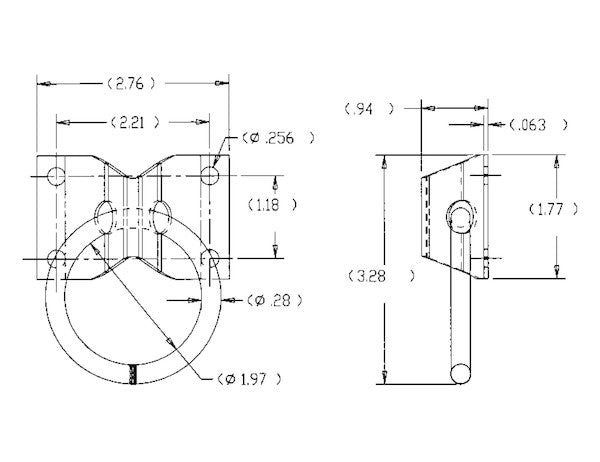
The Rope Ring with Integral Bracket from Buyers Products is ideal for internal use such as inside work vans and trailers. Complete with an integral bracket, the approximately 2 in. internal diameter ring is zinc-plated for corrosion resistance. Rope rings are not approved for lifting.
Specifications
| Finish | Zinc Plated |
|---|---|
| Min. Breaking Strength (lbs) | 528 |
| Mount Type | Surface |
| W.L.L. (lbs) | 176 |
Technical Overview: Surface Mounted Rope Ring with 2-Hole Integral Mounting Bracket, Zinc Plated
The Surface Mounted Rope Ring with 2-Hole Integral Mounting Bracket, Zinc Plated, offered by Buyers Products, represents a robust and versatile cargo securement solution engineered for a diverse range of internal applications. This product is meticulously designed to provide reliable tethering points for securing various types of cargo within enclosed environments such as work vans, utility trailers, cargo containers, and commercial vehicles. Its integrated design, combining a durable rope ring with an integral two-hole mounting bracket, streamlines installation and enhances overall structural integrity, making it an indispensable component for professionals requiring efficient and secure load management.
Design and Construction
The core of this product's utility lies in its intelligent design. The rope ring boasts an approximate 2-inch internal diameter, a dimension carefully selected to accommodate a wide array of rope, strap, and bungee cord sizes commonly employed in cargo securement. This optimal sizing ensures compatibility with standard securing equipment while preventing excessive slack or binding that could compromise load stability. The ring itself is manufactured from high-strength steel, providing the foundational robustness required to withstand the dynamic forces associated with shifting cargo during transit.
Integral to the rope ring's design is the two-hole mounting bracket. This bracket is not merely an attachment point but an integrated component that significantly contributes to the unit's strength and ease of installation. By having the bracket directly formed or welded to the ring, potential weak points often found in multi-part assemblies are eliminated, thereby enhancing the overall load-bearing capacity and fatigue resistance. The two-hole configuration is a strategic choice, offering superior stability and resistance to rotational forces compared to single-hole designs. This distributes the stress over a larger surface area on the mounting substrate, minimizing the risk of pull-out or deformation, particularly when subjected to varying directions of tension.
Material and Finish: Zinc Plating for Enhanced Durability
A critical feature differentiating this rope ring is its zinc-plated finish. Zinc plating (electrogalvanization) is a widely recognized and highly effective surface treatment employed to protect steel components from corrosion. In the context of internal vehicle environments, while not exposed to the same harsh external elements as exterior components, humidity, condensation, and incidental contact with corrosive substances can still lead to rust and degradation over time. The zinc coating acts as a sacrificial layer, preferentially corroding before the underlying steel, thereby extending the service life of the component significantly.
The zinc plating process involves depositing a thin layer of zinc onto the steel substrate through an electrolytic process. This creates a durable, adherent coating that provides excellent resistance to oxidation and mild chemical exposure. The typical thickness of a commercial zinc plating ensures robust protection without unduly affecting the dimensional tolerances of the part. This finish not only contributes to the longevity of the rope ring but also maintains its aesthetic integrity, which is particularly relevant in professional environments where equipment appearance reflects operational quality. The choice of zinc plating underscores a commitment to providing a product that performs reliably over an extended period, reducing the need for frequent replacement and contributing to a lower total cost of ownership.
Performance Specifications
Understanding the performance metrics of any securement hardware is paramount for safe and effective operation. This rope ring is characterized by two key specifications: Minimum Breaking Strength (MBS) and Working Load Limit (WLL).
Minimum Breaking Strength (MBS): 528 lbs
The Minimum Breaking Strength (MBS), specified at 528 lbs, represents the minimum force at which a new and unused component, when subjected to a static tensile load, will fail. This value is determined through rigorous destructive testing in controlled laboratory environments. It is a critical safety parameter that quantifies the ultimate structural integrity of the rope ring. The MBS serves as a baseline for engineers and users to understand the absolute limit of the component before catastrophic failure. It is important to note that the MBS is a theoretical value for failure and should never be approached during actual use, as it does not account for dynamic loads, fatigue, or potential damage to the component.
Working Load Limit (WLL): 176 lbs
The Working Load Limit (WLL), set at 176 lbs, is arguably the most crucial specification for practical application. The WLL is the maximum force or load that a piece of lifting equipment or cargo securement hardware is designed to safely support under normal operating conditions. It is derived by applying a safety factor to the MBS. For cargo securement devices, safety factors typically range from 2:1 to 5:1, depending on the application and industry standards. In this case, with an MBS of 528 lbs and a WLL of 176 lbs, the implicit safety factor is approximately 3:1 (528 lbs / 176 lbs = 3). This 3:1 safety factor is a common and robust standard for general cargo securement applications, providing a significant margin of safety against unexpected stresses, minor impact loads, or slight variations in material properties and manufacturing tolerances. Adhering strictly to the WLL is essential for preventing equipment failure, cargo damage, and potential injury to personnel.
It is imperative for users to always ensure that the total weight of the cargo being secured, combined with any potential dynamic forces (e.g., from acceleration, deceleration, or road bumps), does not exceed the WLL of the rope ring or any other component in the securement system. When multiple rope rings are used to secure a single item, the WLL of each ring contributes to the overall securement capacity, but careful calculation is needed to ensure even distribution of forces and prevent overloading individual points.
Mount Type: Surface
The designation "Surface Mount" indicates that the rope ring and its integral bracket are designed to be affixed directly onto the surface of a panel, floor, or wall. This contrasts with flush-mount or recessed designs, which require cutting out a cavity for installation. The surface mount design offers several advantages:
- Simplicity of Installation: Installation is straightforward, typically requiring only drilling pilot holes and securing the bracket with appropriate fasteners (e.g., bolts, screws, rivets) suitable for the substrate material.
- Versatility: It can be mounted on virtually any flat, structurally sound surface, including wood, composite panels, steel, or aluminum, providing great flexibility in placement within a vehicle or trailer.
- Accessibility: Being surface-mounted, the rope ring remains readily accessible for securing and releasing cargo.
- Structural Integrity of Substrate: It avoids compromising the structural integrity of thin panels or floors that might be weakened by large cut-outs required for flush-mount hardware.
The two-hole integral mounting bracket provides a stable attachment point, minimizing leverage forces on the fasteners and the mounting surface, especially when tension is applied from various angles. The selection of appropriate fasteners (e.g., carriage bolts with backing plates for through-bolting, self-tapping screws for sheet metal, or lag screws for wood) is critical and should be chosen based on the substrate material and thickness to ensure the combined strength of the rope ring and its mounting system meets or exceeds the WLL.
Application Considerations and Limitations
The product description explicitly states: "Rope rings are not approved for lifting." This is a crucial safety directive. While the rope ring possesses significant breaking strength and a defined WLL for cargo securement, its design and intended application are strictly for tethering and restraint, not for overhead lifting. Devices designed for lifting applications (e.g., lifting eyes, hoist rings) are engineered to different standards, with often higher safety factors and specific geometries to accommodate hooks and slings, and are subject to more stringent regulatory requirements. Attempting to use this rope ring for lifting operations could lead to catastrophic failure, severe injury, or property damage due to the application of loads for which it was not designed or tested.
Its primary application is internal use within work vans, utility trailers, cargo containers, and other enclosed commercial vehicles. This includes securing tools, equipment, spare parts, furniture, appliances, recreational gear, and various forms of palletized or loose cargo. The surface-mounted design allows for flexible placement, enabling users to create customized securement patterns tailored to the specific dimensions and nature of the items being transported. For optimal securement, it is often recommended to use multiple rope rings in conjunction with appropriate cargo straps or ropes, forming a "four-point" securement system or equivalent, to distribute forces and prevent cargo movement in all directions.
Maintenance and Inspection
Although the zinc-plated finish offers excellent corrosion resistance, regular inspection and minimal maintenance are recommended to ensure the continued safe operation and longevity of the rope ring. Users should periodically check for:
- Corrosion: While zinc-plated, severe scratching or exposure to harsh chemicals can compromise the plating. Any signs of red rust should be noted.
- Deformation: Inspect the ring and bracket for any bending, flattening, cracks, or other signs of deformation, which could indicate overloading or impact damage.
- Mounting Integrity: Verify that the fasteners are tight and that the rope ring remains securely affixed to the mounting surface. Loose fasteners can lead to accelerated wear, damage to the substrate, and reduced securement effectiveness.
- Wear: Check for excessive wear on the inner surface of the ring where straps or ropes make contact, especially if abrasive materials are frequently used.
Any rope ring exhibiting signs of damage, significant corrosion, or deformation should be immediately removed from service and replaced to prevent potential failure during cargo transport.
Compliance and Industry Standards
While specific regulatory compliance for a component of this nature can vary by region and application, products from reputable manufacturers like Buyers Products are generally designed with an understanding of industry best practices and standards for cargo securement. These often include guidelines from organizations such as the Department of Transportation (DOT) in the United States, which mandate securement criteria for commercial vehicles. Adherence to the WLL and proper installation practices, as outlined by the manufacturer, is crucial for compliance and operational safety.
Conclusion
The Surface Mounted Rope Ring with 2-Hole Integral Mounting Bracket, Zinc Plated, by Buyers Products, is a meticulously engineered and highly reliable component for internal cargo securement. Its robust construction from high-strength steel, coupled with a durable zinc-plated finish, ensures excellent corrosion resistance and an extended service life. The integral two-hole mounting bracket facilitates straightforward and secure installation, providing superior stability compared to simpler designs. With a precisely defined Minimum Breaking Strength of 528 lbs and a conservative Working Load Limit of 176 lbs (reflecting a 3:1 safety factor), this rope ring offers a dependable tethering point for a variety of loads, ensuring cargo remains stable and secure during transit. The explicit caution against using it for lifting applications underscores its specialized design for cargo restraint. For professionals requiring a durable, easy-to-install, and high-performance securement solution for their work vans, trailers, and other enclosed transport units, this rope ring represents an optimal choice, balancing strength, durability, and practical utility.