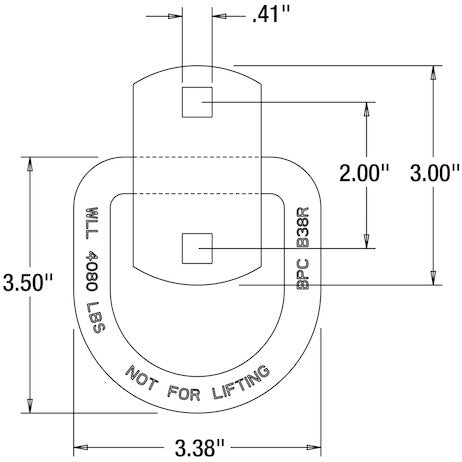
Secure your load with confidence using Bolt-On 1/2 Inch Forged D-Rings from Buyers Products. The D-rings feature C-1045 forged steel construction and a working load limit of 4,080 lb. Choose finish options to meet your needs. D-rings are not approved for overhead use.
Specifications
| Bracket Included (y/n) | Yes |
|---|---|
| Bracket Length (in.) | 3.00 |
| Bracket Mounting Type | 2-Hole |
| Bracket Thickness | 0.25 |
| Bracket Width (in.) | 1.75 |
| Finish | Plain |
| Inner Height (in.) | 2.50 |
| Inner Width (in.) | 2.375 |
| Made in USA | Yes |
| Min Break Strength (lbs.) | 12,240 |
| Mounting Hole Diameter | 0.375 |
| Mounting Hole Shape | Square |
| Ring Dia.(in.) | 1/2 |
| W.L.L. (lbs.) | 4,080 |
The Domestically Forged 1/2 Inch Forged D-Ring with 2-Hole Mounting Bracket represents a pinnacle of engineering excellence and manufacturing precision, designed to deliver uncompromising security for diverse cargo applications. This robust tie-down anchor is specifically engineered to meet the rigorous demands of professionals who require reliable and durable load securement solutions. Manufactured in the USA, this product exemplifies a commitment to superior quality, stringent material specifications, and advanced production techniques that set it apart in the market.
At the core of this D-ring's exceptional strength lies its C-1045 forged steel construction. C-1045 is a medium-carbon steel renowned for its excellent balance of strength, toughness, and wear resistance, making it an ideal choice for components subjected to significant tensile and shear forces. The forging process, a critical element in its superior performance, involves shaping the steel through localized compressive forces using hammers or presses. Unlike casting, which can introduce internal voids and inconsistent grain structures, or stamping, which often relies on lower-grade, thinner materials, forging refines the steel's grain structure. This refinement creates a uniform, continuous grain flow that follows the contours of the D-ring, significantly enhancing its strength-to-weight ratio, fatigue resistance, and impact toughness. The result is a D-ring that is inherently stronger and more resilient, capable of withstanding repetitive stress cycles and sudden load shifts without compromising its structural integrity. This metallurgical advantage directly contributes to the impressive working load limit (WLL) and minimum break strength (MBS) of the product, ensuring a robust safety margin for all cargo securement tasks.
The physical dimensions and design of the 1/2-inch forged D-ring are meticulously engineered for optimal functionality and compatibility. With an inner height of 2.50 inches and an inner width of 2.375 inches, the D-ring provides ample space for accommodating various cargo securement hardware, including webbing straps, chain hooks, and rope. The 1/2-inch nominal ring diameter signifies a substantial cross-section, which is crucial for distributing applied forces effectively and minimizing stress concentrations. This generous sizing ensures that the D-ring can seamlessly integrate into a wide array of cargo control systems, offering versatility without sacrificing strength. The forged, seamless nature of the D-ring's loop further reinforces its durability, eliminating potential weak points that could arise from welded or assembled components. This integrated design guarantees that the entire ring acts as a unified, high-strength load-bearing element, contributing to the overall reliability of the tie-down assembly.
Complementing the robust D-ring is a meticulously designed 2-hole mounting bracket. Fabricated with a length of 3.00 inches, a width of 1.75 inches, and a substantial thickness of 0.25 inches, this bracket provides a sturdy and stable foundation for secure attachment. The choice of a 2-hole mounting configuration is strategic, offering superior resistance to rotation and pull-out compared to single-hole designs. This dual-point attachment distributes forces more effectively across the mounting surface, reducing localized stress and enhancing the overall stability of the anchor point. Each mounting hole features a 0.375-inch (3/8-inch) diameter and a square shape. The square hole design is a deliberate engineering choice, specifically intended to accommodate carriage bolts or other square-necked fasteners. This feature prevents the bolt from rotating during the tightening process, allowing for single-tool installation and ensuring a consistently secure, high-torque connection. The bracket's material, typically a high-strength steel selected to match or exceed the D-ring's structural integrity, is dimensioned to provide optimal shear and tensile resistance, firmly anchoring the D-ring to the intended structure.
The performance metrics of this D-ring are a testament to its superior design and manufacturing. It boasts an impressive Working Load Limit (WLL) of 4,080 lbs (approximately 1,850 kg). The WLL represents the maximum static load that a tie-down component or assembly should be subjected to in normal operating conditions, ensuring a substantial safety margin. This product adheres to industry standards, where the WLL is derived by dividing the Minimum Break Strength (MBS) by a designated safety factor, typically 3:1 for D-rings. In this case, the D-ring features a Minimum Break Strength (MBS) of 12,240 lbs (approximately 5,550 kg), which is precisely three times its WLL. This 3:1 safety factor is critical; it accounts for dynamic loading, shock loads, material fatigue, and potential misuse, providing a robust buffer against unexpected failures. It is imperative to always operate within the specified WLL to maintain safety and prevent equipment damage or cargo loss. A critical safety directive for this product, clearly stated, is that these D-rings are not approved for overhead use. This distinction is vital as overhead lifting applications require specialized hardware designed with significantly higher safety factors and different design criteria to mitigate the catastrophic risks associated with suspended loads. The design, material properties, and testing protocols for overhead lifting equipment are fundamentally distinct from those for cargo securement D-rings.
The "Domestically Forged" designation and "Made in USA" status are more than just labels; they are indicators of profound quality assurance and operational advantages. Manufacturing in the United States ensures adherence to some of the world's most stringent industrial standards, including material traceability, precision engineering, and rigorous quality control protocols throughout every stage of production, from raw material sourcing to final inspection. This domestic origin allows for closer oversight of the forging process, guaranteeing that each D-ring benefits from optimal grain structure and metallurgical properties. Furthermore, domestic production supports supply chain resilience, reduces lead times, and ensures consistent product availability. It also implies a commitment to ethical labor practices and environmental stewardship, aligning with the values of discerning customers. The localized manufacturing process often facilitates quicker feedback loops for continuous improvement, contributing to a consistently high-quality product that users can trust implicitly for critical load securement applications.
Proper installation of the Domestically Forged D-Ring is paramount to achieving its rated performance and ensuring cargo safety. The 2-hole mounting bracket requires a flat, structurally sound mounting surface capable of withstanding the anticipated loads without deformation or failure. It is essential to select fasteners that are appropriate for the application and match the 0.375-inch square mounting holes. High-grade bolts, such as Grade 8 fasteners, are strongly recommended for applications where the WLL will be approached, as they offer superior shear and tensile strength. When installing, it is critical to use washers to distribute the clamping force evenly and prevent damage to the mounting surface or fastener head. For thinner or weaker mounting substrates, a backing plate made of appropriately thick steel should be used on the opposite side of the mounting surface. This backing plate helps to reinforce the attachment area, spread the load over a larger area, and prevent pull-through or deformation of the mounting material. All bolts should be tightened to the manufacturer's recommended torque specifications to achieve proper preload without over-stressing the fasteners or the bracket. Over-tightening can strip threads or weaken bolts, while under-tightening can lead to loosening and compromised security. Post-installation, a thorough inspection should be conducted to ensure all fasteners are secure and the D-ring assembly is rigidly affixed.
While the product is offered with a "Plain" finish as a standard option, allowing for versatility in end-user applications such as welding or custom coating, the "Choose finish options" note suggests the availability of other protective coatings to meet specific environmental and aesthetic requirements. A plain finish typically means the D-ring and bracket are supplied in their raw steel state, which is ideal for welding directly to a steel structure without having to remove a protective coating. However, for applications exposed to moisture, chemicals, or abrasive elements, additional finishes are often preferred. Common options include zinc plating, which provides a sacrificial barrier against corrosion and offers a clean, bright appearance. Powder coating offers a more durable and aesthetically pleasing finish, available in various colors, and provides excellent resistance to chipping, abrasion, and certain chemicals. For the harshest environments, hot-dip galvanizing, which involves immersing the steel in molten zinc, provides a thick, robust, and long-lasting corrosion protection that is highly effective against rust and oxidation. The selection of the appropriate finish extends the lifespan of the D-ring assembly, maintains its structural integrity over time, and preserves its functionality in challenging operating conditions.
The versatility of this Domestically Forged D-Ring makes it indispensable across numerous industries and applications. It is a fundamental component in trailer manufacturing, serving as a reliable tie-down point on flatbed trailers, utility trailers, enclosed trailers, and boat trailers. Commercial truck operators and fleet managers utilize these D-rings extensively in truck beds, cargo vans, and specialized transport vehicles for securing heavy machinery, equipment, and goods. In the construction sector, they provide essential anchor points for securing tools, materials, and scaffolding during transport. Agricultural equipment often requires robust tie-down solutions for moving implements and machinery, and these D-rings provide the necessary strength and reliability. Furthermore, they are widely adopted for recreational purposes, such as securing ATVs, motorcycles, and snowmobiles in transit. While not designed for overhead lifting, their robust construction makes them suitable for specific non-overhead vehicle recovery scenarios or as securement points within a recovery system. The D-ring's compatibility with a wide range of cargo straps, chains, and binders ensures its adaptability to virtually any cargo securement requirement, making it a critical asset for ensuring the safe and compliant transport of goods.
Maintaining the longevity and safety performance of the Domestically Forged D-Ring requires adherence to regular inspection and maintenance protocols. Before each use, a thorough visual inspection should be performed on the D-ring and its mounting bracket. Users should check for any signs of deformation, cracks, excessive wear, corrosion, or pitting, particularly at stress points and connection areas. The mounting bolts should also be inspected for looseness, rust, or damage. Any D-ring exhibiting significant damage, permanent deformation, or signs of material fatigue must be immediately removed from service and replaced. Operating with compromised tie-down hardware can lead to catastrophic cargo shifts, property damage, serious injuries, or even fatalities. Proper care also involves protecting the D-rings from unnecessary impact or abrasive contact when not in use, and, for plain finished units, considering a protective coating or regular oiling to prevent rust if exposed to corrosive environments. Understanding and adhering to the Working Load Limit is not merely a recommendation but a critical safety imperative. This product, through its superior materials, domestic forging, and precision engineering, is designed to be a durable and reliable component in your cargo securement system, reinforcing the commitment to safety and operational efficiency in all transport scenarios.