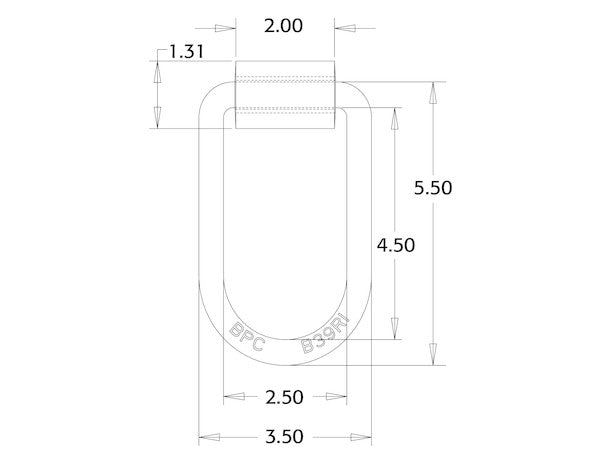
The Extended 1/2 Inch Forged D-Ring from Buyers Products features a long profile, making it ideal for attaching bulky hooks and large chains. The D-ring is made from C-1045 forged steel and carries a working load limit of 4,080 lb. D-rings are not approved for overhead use.
Specifications
| Bracket Included (y/n) | Yes |
|---|---|
| Bracket Length (in.) | 1.312 |
| Bracket Mounting Type | Weld-On |
| Bracket Thickness | 0.375 |
| Bracket Width (in.) | 2.00 |
| Inner Height (in.) | 4.50 |
| Inner Width (in.) | 2.50 |
| Min Break Strength (lbs.) | 12,240 |
| Mounting Hole Diameter | - |
| Mounting Hole Shape | - |
| Ring Dia.(in.) | 1/2 |
| W.L.L. (lbs.) | 4,080 |
The 1/2 Inch Forged Extended D-Ring with Integral Weld-On Mounting Bracket represents a superior engineering solution for robust load securement in demanding industrial, commercial, and transport applications. This product is meticulously designed and manufactured to provide an unyielding anchor point, ensuring the safe and compliant transportation of goods and equipment. Its integrated design, premium materials, and precise forging process underscore its reliability as an essential component in any heavy-duty tie-down system.
At the core of this D-ring's exceptional strength and durability is its construction from C-1045 forged steel. C-1045 is a medium carbon steel renowned for its excellent mechanical properties, including high tensile strength, good hardness, and adequate toughness, making it ideally suited for components subjected to significant stress and shock loads. The chemical composition typically features approximately 0.43-0.50% carbon, 0.60-0.90% manganese, and 0.10-0.30% silicon, which collectively contribute to its robust performance profile. The specific advantage of using C-1045 steel in a forged state cannot be overstated. Forging, a manufacturing process involving the shaping of metal through localized compressive forces, fundamentally alters the material's internal grain structure. Unlike cast or machined parts, forging refines the grain, eliminates internal porosity, and aligns the grain flow parallel to the component's contours. This optimized grain flow results in significantly enhanced mechanical properties, including superior impact strength, improved fatigue resistance, and an overall increase in the material's resistance to stress concentrations and crack propagation. For a critical load-bearing component like a D-ring, this translates directly into a higher degree of structural integrity and a prolonged service life under repetitive loading cycles, providing a safety margin that is paramount in load securement applications.
The design of this D-ring emphasizes functionality and versatility, notably featuring an "extended" profile. This extended geometry, characterized by its generous inner dimensions of 4.50 inches in height and 2.50 inches in width, is a deliberate design choice to enhance compatibility with a broader range of lashing equipment. The ample internal clearance allows for the effortless attachment of bulky hooks, oversized chain links, and multiple web straps, mitigating the common issues of binding, restricted articulation, or premature wear on both the D-ring and the connecting hardware. This design promotes optimal engagement angles for various tie-down components, thereby distributing loads more efficiently and reducing localized stress points. The 1/2 inch ring diameter further reinforces its robust nature, signifying the substantial material thickness of the D-ring loop itself. This diameter is a critical determinant of the D-ring's intrinsic load-bearing capacity and its resistance to deformation under extreme forces.
A defining feature of this product is its integral weld-on mounting bracket. The term "integral" signifies that the bracket is not merely an attached accessory but is designed as a cohesive unit with the D-ring, ensuring maximum structural continuity and optimal load transfer from the D-ring to the mounting surface. This monolithic design minimizes potential weak points that might exist in multi-component assemblies. The weld-on mounting type offers distinct advantages over bolt-on alternatives for permanent and high-strength securement applications. It facilitates a direct, unyielding bond between the D-ring assembly and the structural element of the trailer chassis, flatbed, or heavy equipment. This method provides superior shear strength and resistance to vibrational loosening, crucial for dynamic environments where significant forces and constant movement are present. The bracket's precise dimensions—1.312 inches in length, 2.00 inches in width, and 0.375 inches in thickness—are engineered to provide a substantial and stable welding surface. The 0.375-inch thickness, in particular, is critical; it ensures that the bracket itself possesses sufficient structural rigidity to absorb and distribute the concentrated forces exerted by the D-ring into the underlying base structure without succumbing to deformation. This robust platform is essential for creating a strong, durable, and reliable connection that maintains its integrity under the rated working load limit and beyond.
Understanding the specified load capacities is paramount for the safe operation of any load securement device. This D-ring boasts a Working Load Limit (WLL) of 4,080 lbs. The WLL represents the maximum static or dynamic load that the D-ring can safely support in a specific application, assuming proper installation and usage, over its intended lifespan. It is a conservative rating that accounts for various factors such as material fatigue, potential shock loads, and cyclic loading. Complementing the WLL is the Minimum Break Strength (MBS) of 12,240 lbs. The MBS indicates the average force at which the D-ring is expected to fail under controlled testing conditions. The ratio between the MBS and WLL establishes the safety factor, which in this case is 3:1 (12,240 lbs. / 4,080 lbs. = 3). A 3:1 safety factor is a widely accepted industry standard for load securement devices, providing a critical margin of safety against unforeseen circumstances, accidental overloads, or minor material inconsistencies. This robust safety margin ensures that the D-ring maintains its structural integrity well beyond its operational limits, enhancing overall system safety.
Crucially, the product explicitly states, "D-rings are not approved for overhead use." This is a fundamental safety directive that differentiates load securement D-rings from lifting hardware. While both categories involve managing heavy loads, their design parameters, safety factors, and intended applications are distinct. Load securement D-rings are engineered to withstand tension in tie-down applications, securing cargo against horizontal and vertical movement. Lifting D-rings, conversely, are designed for dynamic vertical lifting, often requiring significantly higher safety factors (typically 4:1, 5:1, or even 8:1 for personnel lifting), specialized material treatments, and stringent certification processes to account for unpredictable swinging, shock loading, and the catastrophic consequences of failure. Misusing a load securement D-ring for overhead lifting poses severe safety risks, including catastrophic equipment failure, injury, fatality, and significant legal liabilities. Adherence to this restriction is not merely a recommendation but a critical safety imperative for anyone involved in material handling and transport.
The versatility of the 1/2 Inch Forged Extended D-Ring makes it indispensable across a multitude of industries and applications. In the transportation sector, it serves as a critical tie-down point on flatbed trailers, semi-trailers, utility trailers, and car carriers for securing diverse cargo such as heavy construction equipment, agricultural machinery, logging, general freight, and vehicles. Its extended profile is particularly beneficial when securing bulky or irregularly shaped loads that necessitate robust and adaptable attachment points. Within the construction industry, these D-rings are frequently welded onto heavy machinery, modular building components, or structural elements to provide secure anchor points during transport, temporary anchoring on job sites, or as part of specialized rigging setups (excluding overhead lifting). Agricultural operations benefit from these D-rings for securing implements, tractors, and harvested goods on transport vehicles. Furthermore, in industrial settings, they can be utilized as permanent anchoring points within warehouses or manufacturing facilities for securing equipment during maintenance or for temporary storage, and by emergency services or towing companies as reliable tie-down points for disabled vehicles.
Proper installation and diligent maintenance are paramount to realizing the full potential and ensuring the long-term safety of the 1/2 Inch Forged Extended D-Ring. Installation of this weld-on component requires the expertise of qualified and certified welders. Prior to welding, the mounting surface must be thoroughly cleaned, free of rust, paint, oil, or any other contaminants that could compromise weld integrity. The selection of an appropriate welding process (e.g., Shielded Metal Arc Welding (SMAW), Gas Metal Arc Welding (GMAW)) and compatible filler metals suitable for C-1045 steel and the base material is crucial. Weld parameters must be optimized to achieve full penetration and an adequate weld bead size to ensure maximum strength and load transfer. Post-welding, allowing for slow cooling is advisable to mitigate thermal stresses. Following installation, the welded area and the D-ring should be protected with corrosion-resistant coatings to ensure longevity, particularly in outdoor or harsh environments.
Routine inspection is a non-negotiable aspect of maintaining safety and compliance. D-rings and their welds should be inspected frequently, ideally before each use in commercial transport applications. Inspectors should look for any signs of deformation, cracks, nicks, gouges, excessive wear, corrosion, or any damage to the welds. Elongation of the D-ring or any visible damage to the bracket or weld bead are critical indicators that the component's integrity may be compromised. Any D-ring exhibiting such damage must be immediately removed from service and replaced. D-rings are not designed for repair, and attempts to repair a damaged unit can lead to catastrophic failure. Adherence to these strict installation and inspection protocols ensures that the D-ring maintains its specified Working Load Limit and continues to provide reliable load securement.
A more detailed examination of the technical specifications highlights the precision engineering of this product. The inclusion of the bracket is integral to its identity as a weld-on solution, providing a ready-to-install anchor. The bracket dimensions of 1.312 inches in length, 2.00 inches in width, and 0.375 inches in thickness are carefully calculated to provide an optimal balance between structural rigidity, welding surface area, and overall profile. This robust bracket thickness is particularly vital for transferring the 4,080 lb. WLL into the base structure without localized yielding. The inner height of 4.50 inches and inner width of 2.50 inches underscore the "extended" nature, offering superior clearance for various securement hardware. The absence of specific mounting hole diameter and shape confirms its weld-on nature, eliminating mechanical fastener requirements and their associated potential for loosening or shear failure. Finally, the 1/2-inch ring diameter directly correlates to the D-ring's material cross-section, which is the primary factor in determining its inherent strength and its capacity to sustain the specified working load limit and minimum break strength of 12,240 lbs.
Quality assurance and adherence to industry standards are foundational principles for load securement components. While specific certifications for this D-ring might not be explicitly listed, reputable manufacturers like Buyers Products design and test their products to meet or exceed relevant industry benchmarks, such as those set by the Web Sling & Tie Down Association (WSTDA) or Department of Transportation (DOT) regulations for cargo securement. This commitment to quality ensures consistency in material properties, manufacturing precision, and performance reliability. Manufacturers typically employ rigorous testing protocols, including destructive testing to validate Minimum Break Strength values and non-destructive testing methods to ensure material integrity and detect any subsurface flaws. Traceability of materials and manufacturing processes is also a key aspect of quality control, allowing for detailed analysis and accountability from raw material to finished product.
In conclusion, the 1/2 Inch Forged Extended D-Ring with Integral Weld-On Mounting Bracket stands as a testament to advanced engineering and robust manufacturing. Its C-1045 forged steel construction delivers unparalleled strength and resilience, while its extended profile ensures maximum versatility with diverse securement hardware. The integral weld-on bracket facilitates a permanent, high-strength attachment, making it an indispensable component for securing heavy and valuable cargo. With a clearly defined Working Load Limit of 4,080 lbs. and a substantial safety factor, this D-ring provides dependable performance. However, strict adherence to its "not approved for overhead use" designation and proper installation and maintenance procedures are critical for operational safety. This D-ring is not just a component; it is a critical safety device designed to meet the rigorous demands of professional load securement, offering peace of mind through its durability, reliability, and precision engineering.