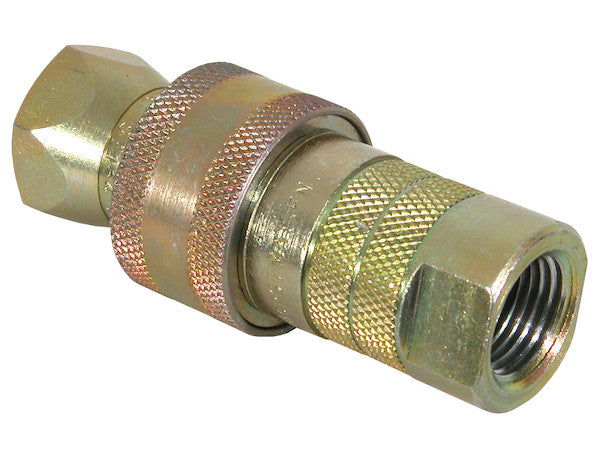
The Sleeve-Type Hydraulic Quick Coupler from Buyers Products is a rugged coupler with a single acting sleeve design. It connects when a system is not operating or when pressure has been relieved. The coupler assembly is zinc-plated for corrosion resistance.
Specifications
| Coupler Material | Carbon Steel |
|---|---|
| Flow Rate (GPM) | 9 |
| Size | 3/8 NPT |
| Type | NPT |
| Wing Material | Carbon Steel |
Technical Overview: 3/8 Inch NPTF Sleeve-Type Hydraulic Quick Coupler Assembly
The 3/8 Inch NPTF Sleeve-Type Hydraulic Quick Coupler Assembly from Buyers Products represents a cornerstone in fluid power connectivity, engineered for demanding hydraulic applications where reliable and secure connections are paramount. This comprehensive description delves into the intricate design, material science, operational principles, and performance characteristics that define this essential hydraulic component. Designed to facilitate rapid and efficient connection and disconnection of hydraulic lines, this quick coupler assembly is a critical interface in numerous industrial, agricultural, and mobile hydraulic systems, ensuring operational continuity and system integrity.
Design and Construction Principles
Single-Acting Sleeve Mechanism
At the core of this quick coupler's functionality is its single-acting sleeve design. This mechanism mandates that the male plug, or nipple, is inserted into the female coupler body while the sleeve is manually retracted. Upon full insertion of the plug, the sleeve is released, allowing internal locking balls or pins to engage with a groove on the plug, thereby securing the connection. This "single-acting" designation refers to the fact that only one component (the sleeve) requires manual manipulation for connection. For disconnection, the sleeve is again manually retracted, releasing the locking mechanism and allowing the plug to be withdrawn. This design is widely favored for its simplicity, robustness, and clear operational feedback, making it intuitive for operators. However, a key operational characteristic, as highlighted, is its requirement for connection when the hydraulic system is not operating or when pressure has been completely relieved. This is a critical safety and functional feature, preventing potential uncontrolled fluid release or damage to the coupler components during high-pressure engagement attempts.
Robust Carbon Steel Construction
The selection of carbon steel as the primary material for both the coupler and its wing components underscores a commitment to durability and performance in harsh operating environments. Carbon steel, renowned for its exceptional mechanical properties, offers a superior combination of tensile strength, yield strength, and hardness. This material choice ensures the coupler can withstand significant internal hydraulic pressures, external mechanical stresses, shock loads, and vibration inherent in heavy-duty machinery. The specific grades of carbon steel employed are typically selected to provide an optimal balance of strength and machinability, allowing for the precise manufacturing tolerances required for leak-free hydraulic connections. Furthermore, carbon steel exhibits good fatigue resistance, crucial for components subjected to repetitive connection cycles and continuous pressure fluctuations. The ruggedness imparted by carbon steel construction directly translates into extended service life and reduced maintenance requirements, offering a reliable solution for long-term operational demands.
Zinc-Plating for Advanced Corrosion Resistance
To augment the inherent strength of carbon steel, the entire coupler assembly undergoes a zinc-plating process. This surface treatment is a fundamental engineering solution for enhancing the component's longevity and reliability, particularly in environments exposed to moisture, chemicals, and abrasive elements. Zinc plating, often achieved through electroplating, forms a sacrificial layer over the carbon steel substrate. In the presence of corrosive agents, the zinc oxidizes preferentially to the steel, thus protecting the underlying ferrous material from rust and degradation. This galvanic protection is critical in hydraulic systems, where even minor corrosion can compromise the integrity of seals, leading to leaks, or interfere with the smooth operation of internal mechanisms. The zinc layer also provides a degree of abrasion resistance and contributes to the aesthetic appearance of the component. The durability of zinc plating is further enhanced by passivation treatments, which can improve the coating's resistance to white rust and contribute to a more robust, long-lasting protective barrier, ensuring the coupler maintains its structural and functional integrity throughout its operational lifespan.
Operational Characteristics and Thread Standard
Connection Under Relieved Pressure Conditions
A defining characteristic of this sleeve-type quick coupler is its design requirement for connection when the hydraulic system is de-energized or when hydraulic pressure has been fully relieved from the lines. This operational mandate is not a limitation but a deliberate safety and design feature. Attempting to connect quick couplers, especially those of the sleeve-type, under residual pressure can lead to several undesirable outcomes:
- Fluid Entrapment and Pressure Spikes: As the plug is inserted, trapped fluid can experience significant pressure spikes, potentially damaging seals or the coupler itself.
- Difficult Engagement: The force exerted by residual pressure against the internal valving or poppets makes full engagement of the locking mechanism extremely difficult, if not impossible, without applying excessive and potentially damaging force.
- Premature Wear and Seal Damage: Repeated attempts to connect under pressure can cause accelerated wear on the locking balls, sleeve, and internal seals, compromising the coupler's long-term sealing capability.
- Safety Hazards: Sudden, uncontrolled release of high-pressure hydraulic fluid is a significant safety hazard, posing risks of severe injury to personnel and damage to equipment.
This design emphasizes responsible system operation and maintenance procedures, ensuring that appropriate pressure relief mechanisms are integrated into the hydraulic circuit or that the system is properly shut down before connections are made. It aligns with best practices for maintaining the longevity and safety of hydraulic systems.
NPTF Thread Standard: 3/8 Inch
The coupler assembly features a 3/8 inch NPTF (National Pipe Taper Fuel) thread. The selection of NPTF is particularly significant for hydraulic applications due to its self-sealing characteristics. Unlike standard NPT (National Pipe Taper) threads, which rely on thread sealant (like PTFE tape or pipe dope) to achieve a leak-proof connection, NPTF threads are designed to create a metal-to-metal interference fit. This is achieved through carefully controlled truncation of the thread crests and roots, which crushes and deforms the mating threads upon tightening, forming a mechanical seal. This feature eliminates the need for external sealants, which can degrade over time, become dislodged, or contaminate the hydraulic fluid. Contamination from sealant particles can lead to premature wear of pumps, valves, and cylinders, making NPTF a superior choice for sensitive hydraulic systems. The "3/8 inch" designation refers to the nominal pipe size, which is a standard identifier in fluid power for compatibility with corresponding hydraulic hoses and hard lines. This size is commonly found in medium-duty hydraulic circuits requiring a balanced flow rate and pressure handling capability, often seen in agricultural equipment, compact construction machinery, and utility vehicles.
Performance Specifications and Operational Context
Flow Rate: 9 GPM (Gallons Per Minute)
The specified flow rate of 9 GPM (Gallons Per Minute) is a critical performance parameter for this hydraulic quick coupler. Flow rate directly influences the speed and power of hydraulic actuators (cylinders and motors) within a system. A 9 GPM rating indicates the maximum recommended volume of hydraulic fluid that can pass through the coupler per minute without incurring excessive pressure drop, heat generation, or turbulent flow conditions that could degrade system efficiency and component longevity.
Understanding the implications of flow rate:
- System Efficiency: Operating a coupler at or below its rated flow capacity ensures minimal energy loss across the connection. Excessive flow rates can lead to significant pressure drops, forcing the pump to work harder, generating more heat, and reducing overall system efficiency.
- Actuator Speed: The speed at which a hydraulic cylinder extends or retracts, or a hydraulic motor rotates, is directly proportional to the flow rate. A 9 GPM coupler is suitable for applications where moderate actuator speeds are required, preventing bottlenecks in the hydraulic circuit.
- Heat Generation: High fluid velocities and turbulence caused by undersized couplers or excessive flow can convert hydraulic energy into thermal energy, raising the fluid temperature. Elevated temperatures can degrade hydraulic fluid, shorten seal life, and reduce the efficiency of the entire system.
- Pressure Drop: Every component in a hydraulic circuit contributes to pressure drop. A properly sized coupler with a 9 GPM rating is designed to minimize this pressure loss, ensuring that adequate pressure is delivered to the actuators for effective work performance.
For applications where intermittent or continuous flow up to 9 GPM is typical, this coupler provides an optimal balance of size, pressure integrity, and minimal flow restriction.
Pressure Rating (Implied by Material and Design)
While a specific pressure rating is not explicitly listed in the immediate specifications, the use of carbon steel for both the coupler and wing material, coupled with a robust sleeve-type design, inherently suggests a high-pressure capability characteristic of standard industrial and mobile hydraulic applications. Typically, 3/8 inch hydraulic quick couplers made from carbon steel are engineered to withstand working pressures ranging from 2,500 PSI (pounds per square inch) to 3,500 PSI, and often burst pressures significantly higher. This robust construction ensures that the coupler can reliably operate within the common pressure envelopes of most medium-duty hydraulic systems. The integrity of the NPTF connection also contributes significantly to maintaining pressure containment, as the metal-to-metal seal is highly resistant to extrusion and failure under high static and dynamic pressures. It is always critical to ensure that the coupler's pressure rating is compatible with or exceeds the maximum operating pressure of the hydraulic system in which it is installed, a fundamental principle for hydraulic system design and safety.
Temperature Compatibility
The operational temperature range is another critical factor for hydraulic components. While not explicitly listed, carbon steel components typically maintain their mechanical properties across a broad range of temperatures, from sub-zero to elevated temperatures well over 200°C (392°F). The limiting factors for a complete quick coupler assembly usually reside with the elastomeric seals (O-rings, backup rings, and poppets) used internally to prevent leakage and facilitate valving. Standard nitrile (Buna-N) seals, commonly used in hydraulic applications, typically operate effectively between -40°C (-40°F) and 100°C (212°F). For applications outside this range, specialized seal materials like Viton (FKM) or EPDM would be required. The robust nature of the carbon steel body ensures that the structural integrity of the coupler is maintained across typical ambient and fluid operating temperatures encountered in most industrial and outdoor environments.
Applications and Industry Relevance
The 3/8 Inch NPTF Sleeve-Type Hydraulic Quick Coupler Assembly is a versatile component, finding extensive utility across a broad spectrum of industries and equipment types due to its reliability, ease of use (under specific conditions), and durable construction. Its design makes it particularly suitable for applications where hydraulic attachments or auxiliary equipment need to be frequently connected and disconnected.
Key application areas include:
- Agriculture: Tractors, harvesters, cultivators, sprayers, and other farm machinery frequently use quick couplers for connecting various implements such as loaders, plows, and seeders. The ability to quickly swap out hydraulic tools enhances operational efficiency during seasonal changes.
- Construction: Compact excavators, skid-steer loaders, backhoes, trenchers, and hydraulic power units benefit from quick couplers for attachments like hydraulic hammers, augers, grapples, and auxiliary circuits.
- Mobile Hydraulics: Dump trucks, utility vehicles, snowplows, and other municipal or service vehicles utilize these couplers for operating auxiliary hydraulic functions or connecting towed equipment.
- Industrial Machinery: In manufacturing plants, assembly lines, and material handling systems, quick couplers are used for connecting hydraulic tools, presses, and specialized equipment that may require occasional removal for maintenance or reconfiguration.
- Forestry: Log splitters, wood chippers, and other forestry equipment often employ quick couplers for interchangeable hydraulic components.
The 3/8 inch size is well-suited for medium-duty hydraulic circuits that require sufficient power for demanding tasks without necessitating the very large flow rates of heavy-duty machinery. Its NPTF threading ensures a secure, sealant-free connection, which is advantageous in environments where cleanliness and operational reliability are paramount.
Installation and Maintenance Best Practices
Proper installation and routine maintenance are paramount to maximizing the lifespan and ensuring the safe operation of any hydraulic quick coupler assembly.
Installation Guidelines:
- Cleanliness: Before connection, ensure both the coupler and plug faces, as well as the threads, are thoroughly clean and free of dirt, debris, metal shavings, or old sealant residue. Contaminants are a leading cause of hydraulic system failure.
- Thread Engagement: Carefully align the 3/8 NPTF threads and hand-tighten the coupler or plug until snug. NPTF threads require no additional sealant, as their design creates a metal-to-metal seal.
- Proper Torque: Using appropriate wrenches, apply the manufacturer-recommended torque specifications. Over-tightening NPTF threads can distort the components, potentially leading to cracking or premature failure, while under-tightening can result in leaks.
- System Pressure Relief: Crucially, ensure that the hydraulic system is fully depressurized before attempting to connect or disconnect the quick coupler assembly. This prevents fluid ejection, damage to the coupler, and potential injury.
- Visual Inspection: After installation, visually inspect all connections for proper engagement and absence of immediate leaks.
Maintenance Recommendations:
- Regular Cleaning: Keep coupler faces clean. Use protective dust caps and plugs when not connected to prevent ingress of contaminants.
- Inspection for Wear: Periodically inspect the coupler and plug for signs of wear, pitting, corrosion (despite zinc plating, severe environments can still challenge it), and mechanical damage. Pay close attention to the locking balls/mechanism, sleeve, and sealing surfaces.
- Seal Integrity: While not directly exposed, the internal seals are critical. If leaks are detected from the coupler itself, it often indicates seal degradation. Replacement of internal seals (if kits are available) or the entire coupler may be necessary.
- Lubrication: A thin film of clean hydraulic fluid on the plug nose or internal seals during connection can aid in engagement and prolong seal life.
- Pressure Check: If a system exhibits unexplained pressure drops or erratic behavior, the quick couplers should be among the first components inspected for internal bypass or damage.
Adherence to these practices ensures optimal performance, extends the service life of the coupler, and contributes significantly to the overall reliability and safety of the hydraulic system.
Conclusion
The 3/8 Inch NPTF Sleeve-Type Hydraulic Quick Coupler Assembly from Buyers Products stands as a testament to robust engineering and functional reliability in fluid power transmission. Its meticulously chosen carbon steel construction, fortified with a corrosion-resistant zinc-plated finish, guarantees exceptional durability against the rigors of demanding operational environments and challenging external conditions. The single-acting sleeve design, while necessitating connection under zero or relieved pressure, offers a straightforward and secure engagement mechanism, minimizing potential for operational errors and enhancing safety protocols within hydraulic systems. The integration of 3/8 inch NPTF threading provides a self-sealing, contaminant-resistant connection, a crucial attribute for maintaining the purity and efficiency of hydraulic fluid. With a consistent flow rate capability of 9 GPM, this coupler is ideally suited for a wide array of medium-duty hydraulic applications across agriculture, construction, and general industrial sectors. This quick coupler assembly is more than just a component; it is an integral solution designed to provide reliable, efficient, and safe hydraulic line connectivity, ensuring seamless operation and prolonged service life for critical machinery and equipment.