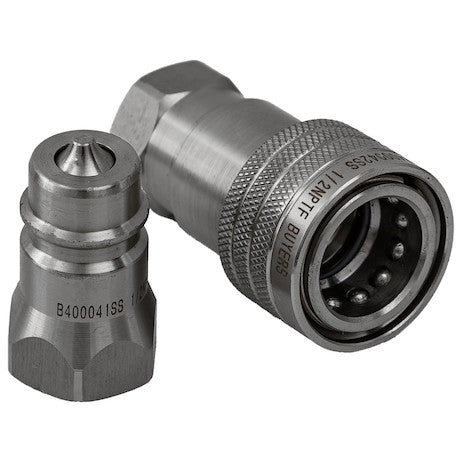
Buyers Products Stainless Steel Hydraulic Couplers are a general-purpose sleeve style coupler with poppet seal for a leak-free connection. The couplers are easy to connect when pressure has been relieved.
Specifications
| Color | Natural |
|---|---|
| Coupler Material | Stainless Steel |
| End (Male/Female/Full) | Male & Female Set |
| Flow Rate (GPM) | 40 |
| Size | 3/4 NPT |
Advanced Technical Overview: Buyers Products Stainless Steel Hydraulic Coupler Set
This comprehensive description details the technical specifications, operational principles, material science, and application considerations for the Buyers Products Stainless Steel Hydraulic Coupler Set. Designed for demanding hydraulic applications, this coupler set offers a robust and reliable solution for fluid power transmission, emphasizing durability, leak-free operation, and ease of maintenance in diverse industrial environments.
Product Architecture and Core Functionality
The Hydraulic Coupler Set comprises a male and female coupling component, meticulously engineered for seamless integration into hydraulic circuits. As a general-purpose, sleeve-style coupler featuring a poppet seal, it is inherently designed to provide a secure, leak-free connection crucial for maintaining system integrity and operational efficiency. The designation "3/4in NPTF" refers to the nominal pipe size and thread type, indicating a 3/4-inch National Pipe Taper Fuel thread, while "3/4in BODY" specifies the overall physical dimension of the coupler body, which is critical for compatibility with various hydraulic components and space constraints.
The fundamental function of a quick-disconnect hydraulic coupler is to facilitate rapid connection and disconnection of hydraulic lines without the need for tools, simultaneously minimizing fluid loss and preventing contaminant ingress. This particular set achieves this through its robust design and the specific sealing mechanism employed. The "easy to connect when pressure has been relieved" characteristic highlights a critical safety and operational feature, ensuring that connection can be performed reliably without encountering hydraulic lock or excessive force, which could damage the coupler or pose a safety risk to the operator.
Material Science: The Indispensable Role of Stainless Steel (SST)
The selection of Stainless Steel (SST) as the primary construction material for these hydraulic couplers is a deliberate choice driven by superior mechanical properties and chemical resistance, which are paramount in challenging industrial environments. Stainless steel, an alloy primarily composed of iron, chromium (typically 10.5% or more), and often nickel, molybdenum, and other elements, derives its remarkable properties from the passive chromium oxide layer that forms on its surface. This layer provides exceptional resistance to corrosion, rust, and staining, especially when compared to carbon steel or other ferrous alloys.
Key Advantages of Stainless Steel in Hydraulic Couplers:
- Corrosion Resistance: This is the most significant advantage. Hydraulic systems frequently operate in environments exposed to moisture, chemicals, salts, and other corrosive agents. Stainless steel effectively resists oxidation and chemical degradation, preventing material deterioration that could lead to leaks, reduced performance, or catastrophic failure. In applications such as marine, chemical processing, food and beverage, or outdoor construction, SST provides a much longer service life than other materials.
- Chemical Compatibility: Stainless steel exhibits broad compatibility with a wide range of hydraulic fluids, including mineral oils, synthetic fluids, and fire-resistant fluids, without experiencing adverse reactions or degradation over time. This ensures the integrity of the fluid and prevents contamination from corroding coupler material.
- High Strength and Durability: Stainless steel offers excellent tensile strength, yield strength, and hardness, enabling the couplers to withstand high operating pressures and repetitive mechanical stresses without deformation or fatigue. This inherent strength contributes directly to the longevity and reliability of the coupling under dynamic load conditions.
- Temperature Stability: Hydraulic systems can experience significant temperature fluctuations. Stainless steel maintains its mechanical properties across a broad temperature range, ensuring stable performance and structural integrity whether operating in extreme cold or elevated heat, making it suitable for diverse climatic conditions and industrial processes.
- Hygienic Properties: In industries requiring stringent cleanliness standards, such as food processing, pharmaceuticals, or medical equipment, the smooth, non-porous surface of stainless steel resists bacterial growth and is easy to clean and sanitize. While not explicitly food-grade certified, the material inherently offers a higher degree of hygiene compared to other metals.
- Aesthetic Appeal: The natural, uncolored finish of stainless steel provides a clean, professional appearance, which can be an advantage in certain applications where aesthetics are a consideration.
While specific grades of stainless steel (e.g., 304, 316) are not explicitly mentioned, the general benefits of "Stainless Steel" indicate a commitment to superior material performance, typically implying a workhorse grade offering a balance of corrosion resistance and mechanical strength suitable for industrial hydraulic applications.
Thread Specification: 3/4in NPTF – The Dryseal Standard
The "3/4in NPTF" specification denotes a critical aspect of the coupler's interface with the hydraulic system. NPTF stands for National Pipe Taper Fuel, a thread standard specifically designed to create a mechanical seal without the need for additional sealants in low-pressure applications, though sealants are often used for added security in high-pressure hydraulics.
Key Characteristics and Advantages of NPTF Threads:
- Tapered Design: Both the male and female NPTF threads are tapered. As the male thread is tightened into the female thread, the flanks of the threads compress, creating a metal-to-metal seal. This inherent taper differs from parallel (straight) threads, which require an external sealing mechanism like an O-ring or a gasket.
- Dryseal Feature: The "F" in NPTF signifies "Fuel" but also implies "Dryseal." Unlike standard NPT (National Pipe Taper) threads, NPTF threads are manufactured to stricter tolerances, ensuring that the crests and roots of the threads deform upon tightening, forming a more complete and reliable mechanical seal. This "dryseal" capability means theoretically, no thread sealant is required for sealing, making them highly effective for containing hydraulic fluids and gases. However, in practice, especially in high-pressure hydraulic applications, a high-quality thread sealant or PTFE tape is still recommended to lubricate the threads, prevent galling, and provide an additional layer of sealing security, especially to fill any microscopic imperfections.
- Size Compatibility: The "3/4in" refers to the nominal pipe size, not the actual measured diameter of the threads. This standardized sizing ensures interoperability with other 3/4-inch NPTF components within hydraulic systems, facilitating replacement, expansion, and design flexibility.
- System Integrity: Proper application of NPTF threads is crucial for preventing leaks, which can lead to fluid loss, reduced system efficiency, environmental contamination, and safety hazards. The tapered design, when properly torqued, provides a robust mechanical connection capable of withstanding significant internal pressures and external vibrations.
Understanding the NPTF standard is vital for correct installation and maintenance. Improper tightening (under- or over-torquing) or using incompatible thread types can compromise the seal integrity, leading to system failure.
Body Size and Flow Dynamics: 3/4in BODY & 40 GPM Flow Rate
The "3/4in BODY" specification refers to the overall physical size of the coupler body, which is dimensionally matched to the 3/4-inch NPTF thread size. This synchronization ensures that the internal flow path through the coupler is optimized for the intended fluid volume, minimizing pressure drop and turbulence.
The specified "Flow Rate (GPM): 40" is a critical performance parameter. GPM stands for Gallons Per Minute and indicates the maximum volume of hydraulic fluid that can pass through the coupler without excessive pressure drop or fluid velocity. A 40 GPM flow rate for a 3/4-inch body size is indicative of a coupler designed for medium-to-high flow applications commonly found in mobile hydraulics, agricultural machinery, construction equipment, and industrial power units.
Implications of Flow Rate and Body Size:
- Pressure Drop: Every component in a hydraulic circuit introduces some degree of pressure drop. A well-designed coupler minimizes this. The 3/4-inch body, coupled with internal poppet valve design, is optimized to achieve the 40 GPM flow with an acceptable pressure drop, ensuring that sufficient pressure is maintained for actuators downstream. Excessive pressure drop reduces system efficiency and can lead to overheating.
- Fluid Velocity: The internal diameter of the coupler body directly influences fluid velocity. At 40 GPM, the 3/4-inch body ensures that fluid velocity remains within acceptable limits. High fluid velocities can cause cavitation, erosion of internal components, noise, and excessive heat generation, all detrimental to system health.
- System Compatibility: The 3/4-inch body and 40 GPM flow rate make this coupler suitable for hydraulic systems with pumps and components designed for similar flow capacities. Mismatched components (e.g., a small coupler in a high-flow system) will severely restrict flow and create bottlenecks, while an oversized coupler might add unnecessary weight and cost.
- Heat Generation: Efficient fluid flow minimizes energy conversion into heat. The optimized design for 40 GPM contributes to a cooler running system, extending the life of hydraulic fluid and seals.
Sealing Mechanism: Sleeve Style with Poppet Seal
The coupler's design incorporates a "sleeve style" mechanism combined with a "poppet seal," two critical elements that define its operational characteristics and sealing integrity.
Sleeve Style Coupling:
Sleeve-style couplers are a widely adopted design for quick disconnects. The connection process involves retracting an outer sleeve on one half of the coupler (typically the female end), inserting the male half, and then releasing the sleeve. The sleeve slides forward under spring tension or manual actuation, engaging locking balls or pins that secure the male and female halves together. This mechanism provides a robust mechanical lock, preventing accidental disconnection under pressure or vibration.
Poppet Seal Mechanism:
The poppet seal is the core component responsible for the "leak-free connection" and minimizing fluid loss upon disconnection. Both the male and female halves of the coupler contain spring-loaded poppets (valves). These poppets are normally closed, sealing the fluid ports when the coupler halves are disconnected.
- Disconnection: When the coupler halves are separated, the spring-loaded poppets immediately close, sealing off the fluid lines. This action effectively prevents fluid spillage from the disconnected lines and stops air or contaminants from entering the hydraulic system.
- Connection: As the male and female halves are fully engaged, the poppets in both halves are pushed open by mutual contact. This action creates an unobstructed flow path for the hydraulic fluid. The robust design of the poppets ensures a positive seal when closed and a smooth, low-restriction flow when open.
- Leak-Free Operation: When connected, the poppets are fully open, and the primary seal is maintained by an O-ring or similar elastomeric seal within the coupler, which is compressed between the male and female halves. The combination of the secure sleeve lock and the internal seals guarantees a leak-free connection during operation.
The "easy to connect when pressure has been relieved" feature is directly related to the poppet seal design. If residual pressure exists in a hydraulic line, it exerts force on the face of the poppet. Attempting to connect two poppet-style couplers with pressure trapped in one or both lines can be extremely difficult or impossible due to the hydraulic force acting against the poppets. Relieving this pressure equalizes the forces, allowing the poppets to be easily pushed open during connection without resistance, thereby preventing damage to the seals and ensuring a proper, secure engagement.
Operating Environment and Applications
The general-purpose nature of this stainless steel coupler set, combined with its robust specifications, makes it suitable for a vast array of hydraulic applications across numerous industries:
- Construction and Heavy Equipment: Ideal for excavators, loaders, bulldozers, and other heavy machinery where resistance to dirt, debris, and harsh weather is crucial. The stainless steel construction also stands up to corrosive fluids and environmental elements.
- Agricultural Machinery: Tractors, harvesters, and implements often operate in demanding conditions with exposure to fertilizers, pesticides, and varying weather. SST couplers ensure long-term reliability.
- Marine Applications: Saltwater environments are highly corrosive. Stainless steel is a superior choice for hydraulic systems on boats, ships, and offshore platforms, preventing rust and ensuring operational safety.
- Chemical Processing: In facilities handling aggressive chemicals, stainless steel couplers provide the necessary chemical resistance to prevent degradation and ensure containment of process fluids.
- Food and Beverage Industry: Where hygiene and wash-down procedures are frequent, stainless steel resists corrosion from cleaning agents and bacterial growth, although specific food-grade certifications would be required for direct contact applications.
- Manufacturing and Industrial Hydraulics: General factory automation, presses, material handling equipment, and power units benefit from the durability and reliability of SST couplers, especially in environments where cleanliness or chemical exposure is a concern.
- High-Purity and Specialty Systems: In applications requiring minimal contamination, such as some medical equipment or research facilities, the non-corrosive and easily cleanable properties of stainless steel are highly advantageous.
The 40 GPM flow rate supports hydraulic circuits for powering cylinders, motors, and other actuators that require substantial fluid delivery for efficient operation.
Installation, Maintenance, and Safety Considerations
Proper installation and routine maintenance are paramount to maximizing the lifespan and performance of the Hydraulic Coupler Set.
Installation Guidelines:
- Cleanliness: Before installation, ensure all threads and mating surfaces are clean and free from dirt, metal shavings, or other contaminants. Contaminants are a leading cause of hydraulic system failure.
- Thread Sealant: Although NPTF threads are designed for a dryseal, applying a high-quality, hydraulic-compatible thread sealant or PTFE tape is highly recommended for added security, especially in high-pressure applications. Apply sealant only to the male threads, avoiding the first thread to prevent sealant from entering the system.
- Torque: Tighten the couplers to the manufacturer's recommended torque specifications using appropriate tools. Over-tightening can damage threads or distort components, while under-tightening will result in leaks.
- Alignment: Ensure proper alignment of the male and female halves during connection. Cross-threading can permanently damage the threads and lead to leakage.
Maintenance Practices:
- Regular Inspection: Periodically inspect the couplers for signs of wear, corrosion, physical damage, or leaks. Pay close attention to the sealing surfaces and the integrity of the external sleeve mechanism.
- Seal Replacement: The elastomeric seals (O-rings) within the coupler will eventually degrade due to age, chemical exposure, or temperature cycling. If leaks occur, seals should be replaced with genuine parts or compatible high-quality replacements.
- Cleaning: Keep the external surfaces of the couplers clean, especially around the connection points, to prevent dirt from entering the hydraulic system during connection.
- Lubrication: Light lubrication of the coupler sleeve mechanism with a hydraulic-compatible grease can ensure smooth operation and extend component life.
Safety Protocols:
- Pressure Relief: Always relieve system pressure before attempting to connect or disconnect hydraulic couplers. This prevents fluid ejection under pressure, potential injury from whipping hoses, and damage to the couplers. Refer to system manuals for proper pressure relief procedures.
- Personal Protective Equipment (PPE): Always wear appropriate PPE, including safety glasses and gloves, when working with hydraulic systems. High-pressure hydraulic fluid can penetrate skin, causing severe injury.
- System Compatibility: Ensure that the coupler's pressure, temperature, and flow ratings are compatible with the specific hydraulic system it is being used in. Using a coupler outside its rated parameters can lead to catastrophic failure.
- Environmental Considerations: Be mindful of potential fluid spills during connection/disconnection and have appropriate containment measures in place to prevent environmental contamination.
Conclusion
The Buyers Products Stainless Steel Hydraulic Coupler Set, featuring a 3/4in NPTF connection and a 3/4in body, represents a highly engineered solution for fluid power applications. Its construction from stainless steel ensures unparalleled corrosion resistance, chemical compatibility, and mechanical strength, making it ideal for the most demanding environments. The general-purpose sleeve-style design with a precision poppet seal guarantees a leak-free connection, minimizes fluid loss upon disconnection, and facilitates easy, secure engagement once system pressure is relieved. With a robust flow rate of 40 GPM, this coupler set is capable of supporting significant hydraulic power requirements while maintaining system efficiency and integrity. By adhering to proper installation techniques, implementing a regular maintenance schedule, and strictly following safety protocols, users can ensure the long-term reliability and optimal performance of this critical hydraulic component.