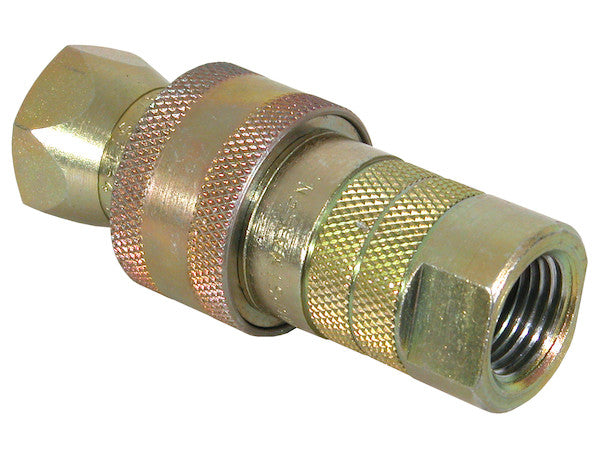
The Sleeve-Type Hydraulic Quick Coupler from Buyers Products is a rugged coupler with a single acting sleeve design. It connects when a system is not operating or when pressure has been relieved. The coupler assembly is zinc-plated for corrosion resistance.
Specifications
| Coupler Material | Carbon Steel |
|---|---|
| End (Male/Female/Full) | Male & Female Set |
| Flow Rate (GPM) | 80 |
| Size | 1 NPT |
| Type | NPT |
| Wing Material | Carbon Steel |
Technical Overview: 1 Inch NPTF Sleeve-Type Hydraulic Quick Coupler Assembly
The 1 Inch NPTF Sleeve-Type Hydraulic Quick Coupler Assembly from Buyers Products represents a robust and essential component for a wide array of hydraulic systems requiring efficient and reliable fluid transfer. This comprehensive male and female set is engineered for demanding industrial environments, providing a secure connection point within hydraulic circuits. Its design prioritizes operational safety and durability, making it a preferred choice for applications where system integrity and component longevity are paramount. This detailed exposition will delve into the technical specifications, operational principles, material science, performance characteristics, and practical applications of this critical hydraulic component.
Operational Mechanics of the Sleeve-Type Design
At the core of this quick coupler's functionality is its distinctive sleeve-type design, characterized by a single-acting sleeve. Unlike push-to-connect or ball-locking mechanisms that may allow for connection under residual pressure, this sleeve-type coupler is explicitly engineered to connect only when the hydraulic system is not operating or when system pressure has been entirely relieved. This fundamental characteristic is a critical safety feature, preventing inadvertent disconnection or dangerous fluid release under pressure, which could lead to severe injury or system damage.
The single-acting sleeve mechanism typically involves a spring-loaded sleeve on the female (coupler) half. To connect, the operator slides the sleeve back, allowing the male (nipple) half to be inserted. Once the nipple is fully seated, releasing the sleeve allows it to spring forward, securing the connection and engaging internal locking elements, often ball bearings or a poppet valve system. The precise engagement of these internal components ensures a leak-free seal and mechanical retention. Disconnection follows a similar principle: retracting the sleeve releases the locking mechanism, allowing the male nipple to be withdrawn. The design inherently requires manual manipulation of the sleeve, providing a tactile confirmation of secure connection or controlled disconnection.
The requirement for pressure relief prior to connection is not merely a design quirk but a crucial operational protocol. Hydraulic systems, especially those operating at high pressures, can retain significant residual pressure even when the pump is disengaged. Attempting to connect or disconnect a coupler under such conditions can be extremely hazardous. Pressurized fluid can eject the nipple with considerable force, or the sudden equalization of pressure during connection can cause component damage or dangerous fluid bursts. The sleeve-type design, by necessitating a depressurized state, inherently enforces a safer operational procedure, contributing to a reduced risk of accidents and extending the service life of both the coupler and the hydraulic system components.
Furthermore, the robust nature of the sleeve mechanism contributes to its longevity in harsh environments. The external sleeve provides a degree of protection for the internal locking components against impact, dust, and debris. Its simplicity also means fewer complex moving parts, reducing the potential points of failure often associated with more intricate quick-connect designs that might feature multiple seals or more elaborate locking detents. This design philosophy underscores the coupler's "rugged" descriptor, indicating its suitability for challenging operational contexts.
NPTF Thread Standard: Precision and Sealing Integrity
The title specifies a "1 Inch NPTF" connection, while the specifications table lists "1 NPT." It is crucial to clarify the distinction and significance of NPTF (National Pipe Taper Fuel) threads in hydraulic applications. While both NPT (National Pipe Taper) and NPTF threads are tapered and designed to create a seal through metal-to-metal interference, NPTF threads are specifically engineered for "dryseal" connections, meaning they do not typically require a sealant for effective sealing, unlike standard NPT threads which often rely on pipe dope or PTFE tape.
The primary difference lies in the crest and root truncation of the threads. NPTF threads have controlled crests and roots that interfere with each other when tightened, deforming the threads slightly to create a mechanical seal that prevents spiral leakage. This "controlled interference fit" is particularly advantageous in hydraulic systems where high pressures and the corrosive nature of some hydraulic fluids can compromise conventional sealants over time. The 1-inch size refers to the nominal pipe size, indicating a substantial connection capable of handling significant fluid volumes.
The use of a 1-inch NPTF connection ensures several benefits:
- Enhanced Sealing Reliability: The dryseal feature inherently reduces the risk of leakage associated with sealant degradation or improper application, critical for maintaining system pressure and preventing fluid loss in hydraulic circuits.
- Reduced Contamination Risk: Eliminating the need for external sealants minimizes the potential for sealant fragments to enter the hydraulic fluid, which can clog filters, damage pumps, and impair valve operation. This is paramount for the cleanliness of hydraulic systems.
- Robust Mechanical Connection: Tapered threads provide a strong mechanical joint that resists vibration and pressure fluctuations, crucial for the long-term integrity of the hydraulic line.
- Interchangeability: While NPTF is a specific variant, it is broadly compatible with standard NPT threads (though the dryseal benefit may be lost if connected to a standard NPT thread without sealant). This ensures a degree of versatility while adhering to a high-performance standard.
The selection of a 1-inch NPTF connection signifies a design choice aimed at achieving superior sealing performance and mechanical strength, essential attributes for a quick coupler operating in high-pressure hydraulic environments.
Material Science: Carbon Steel and Zinc Plating for Durability
The choice of materials is fundamental to the performance, longevity, and reliability of any hydraulic component. This quick coupler assembly is constructed from carbon steel and features a zinc-plated finish, a combination specifically selected to withstand the rigors of hydraulic applications.
Carbon Steel Construction
Carbon steel is a widely utilized material in hydraulic components due to its excellent balance of strength, ductility, wear resistance, and cost-effectiveness. The specific grade of carbon steel used for hydraulic couplers typically falls into the medium to high carbon range, providing the necessary tensile strength and hardness to resist the internal pressures, external impacts, and abrasive wear encountered in hydraulic systems. Its properties include:
- High Tensile Strength: Essential for components that must withstand significant internal fluid pressures without deformation or failure.
- Impact Resistance: Hydraulic couplers are often subjected to mechanical shock and vibration, especially in mobile equipment. Carbon steel's inherent toughness helps absorb these forces without fracturing.
- Wear Resistance: The constant coupling and uncoupling, along with the movement of internal parts, can cause wear. Carbon steel provides a durable surface that resists abrasion, contributing to a longer service life.
- Machinability: Carbon steel is readily machinable, allowing for the precise manufacturing of intricate thread forms, internal valve components, and locking mechanisms necessary for a leak-free and reliable coupler.
While carbon steel provides exceptional mechanical properties, it is susceptible to corrosion, particularly in humid or outdoor environments. This is where the protective coating becomes critical.
Zinc Plating for Corrosion Resistance
To mitigate the susceptibility of carbon steel to rust and enhance its environmental resilience, the coupler assembly undergoes a zinc-plating process. Zinc plating is a sacrificial coating that provides cathodic protection to the underlying steel. In the presence of an electrolyte (moisture), the zinc corrodes preferentially to the steel, thus protecting the base metal. This protection mechanism is highly effective and widely adopted across various industrial components.
The benefits of zinc plating for this hydraulic coupler include:
- Superior Corrosion Protection: Extends the operational life of the coupler by preventing the formation of rust, which can compromise seals, clog lines, and degrade mechanical integrity.
- Aesthetic Durability: Maintains the component's appearance, indicating a well-preserved part, which can be an indirect indicator of overall system maintenance.
- Resistance to Environmental Factors: Protects against common industrial hazards such as water, road salt (in mobile applications), and various chemicals that might be present in the operating environment.
- Cost-Effective Protection: Zinc plating offers a high level of protection at a relatively economical cost compared to more exotic materials or complex coatings.
Modern zinc plating often includes a passivate layer (e.g., clear, yellow, or black chromate conversion coating, typically trivalent chromium for environmental compliance) over the zinc layer to further enhance corrosion resistance and provide specific aesthetic finishes. This multi-layer protection ensures that the coupler can withstand prolonged exposure to harsh conditions without premature degradation, maintaining its structural and sealing integrity.
The combination of high-strength carbon steel and corrosion-resistant zinc plating makes this quick coupler exceptionally well-suited for heavy-duty applications where both mechanical robustness and environmental durability are non-negotiable requirements.
Performance Specifications: Flow Rate and System Integration
The specified flow rate of 80 GPM (Gallons Per Minute) for this 1-inch NPTF sleeve-type hydraulic quick coupler is a critical performance parameter that dictates its suitability for various hydraulic circuits. Understanding the implications of this flow rate is essential for proper system design and operation.
Significance of 80 GPM Flow Rate
A flow rate of 80 GPM indicates the maximum recommended volume of hydraulic fluid that can pass through the coupler without incurring excessive pressure drop, turbulence, or heat generation. For a 1-inch nominal size connection, 80 GPM represents a substantial flow capacity, suitable for:
- High-Power Hydraulic Systems: Applications involving large cylinders, powerful hydraulic motors, or rapid cycle times often demand high fluid volumes to achieve desired speeds and forces. Examples include heavy construction machinery (excavators, loaders), large agricultural implements (planters, sprayers), forestry equipment, and significant industrial presses.
- Efficient Energy Transfer: Maintaining an optimal flow rate through the coupler minimizes energy losses within the hydraulic system. Excessive restriction at the coupling point would necessitate higher pump pressures, leading to increased power consumption, greater heat generation, and reduced overall system efficiency. The 80 GPM rating suggests the coupler is designed to be a low-restriction component within appropriately sized circuits.
- System Sizing: The coupler's flow rate must be matched to the pump's output and the requirements of the actuators. Using a coupler with too low a flow rating for a given system can lead to cavitation, overheating, and premature component failure. Conversely, an oversized coupler offers no practical advantage and may add unnecessary cost and bulk. The 80 GPM rating helps engineers appropriately size the quick connect for specific applications.
While the product description does not explicitly state pressure ratings, a quick coupler designed for 80 GPM in a 1-inch NPTF configuration is inherently built to withstand the high pressures typical of industrial hydraulic systems, often ranging from 3,000 to 5,000 PSI (200 to 350 bar) or more, depending on its specific design and internal valving. It is imperative for users to consult the manufacturer's complete specifications for maximum operating pressure and burst pressure ratings to ensure compatibility with their system's pressure envelope.
Temperature Considerations
Operating temperature range is another vital factor for hydraulic couplers. While not specified, carbon steel and zinc plating, combined with common elastomeric seals (e.g., Nitrile, Viton, EPDM depending on fluid compatibility), typically allow for operation in temperature ranges from approximately -20°F to +250°F (-29°C to +121°C). Extreme temperatures outside this range can affect seal integrity, fluid viscosity, and material properties, potentially leading to leaks or reduced performance. Users should ensure the coupler's temperature capabilities align with their hydraulic fluid's operating range and ambient environmental conditions.
Applications and Versatility
The 1 Inch NPTF Sleeve-Type Hydraulic Quick Coupler Assembly is ideally suited for applications that demand robust, reliable, and high-flow hydraulic connections. Its design characteristics make it particularly valuable in industries where machinery operates in challenging conditions and requires frequent, yet safe, attachment and detachment of hydraulic lines.
- Agriculture: Widely used on tractors for connecting various implements such as plows, cultivators, balers, sprayers, and loaders. The ability to quickly connect/disconnect without special tools, combined with the ruggedness needed for outdoor, often dirty environments, makes sleeve-type couplers a staple. The "wing material: carbon steel" specification could also suggest it is compatible with older agricultural "wing-nut" style couplers, or simply refers to the robust construction of external components.
- Construction: Essential for heavy equipment like excavators, bulldozers, skid steers, and compact track loaders. These machines frequently swap attachments (e.g., buckets, hammers, grapples), requiring durable quick couplers for hydraulic power to various tools.
- Mining and Quarrying: In harsh, abrasive environments, the carbon steel construction and zinc plating provide the necessary resilience against wear and corrosion for heavy-duty mining machinery.
- Forestry: Log loaders, feller bunchers, and other logging equipment utilize these couplers for hydraulic lines to attachments that experience significant impact and environmental exposure.
- Industrial Manufacturing: Used in fixed plant applications for connecting hydraulic power units to test stands, custom machinery, or modular hydraulic systems where flexibility in setup is required.
- Material Handling: Forklifts and other material handling equipment, particularly those with hydraulic attachments for specialized tasks, benefit from the quick and secure connection offered by these couplers.
The requirement to connect only when pressure has been relieved is a critical consideration for operators, reinforcing safe handling practices and preventing accidental disconnection under load. This characteristic makes it less suitable for applications requiring hot-connect/disconnect under full pressure but ideally suited for systems where an orderly shutdown and depressurization sequence is part of the operational protocol.
Installation, Maintenance, and Longevity
Proper installation and routine maintenance are crucial for maximizing the longevity and reliability of the 1 Inch NPTF Sleeve-Type Hydraulic Quick Coupler Assembly.
Installation Guidelines:
- Cleanliness: Before installation, ensure both the male and female halves, as well as the hydraulic lines, are free from dirt, debris, and manufacturing contaminants. Cleanliness is paramount in hydraulic systems to prevent component damage.
- Thread Preparation: While NPTF threads are designed for dryseal, a minimal amount of high-quality, hydraulic-compatible thread sealant may be applied to the male pipe threads if local practices or specific conditions warrant it, ensuring it does not enter the fluid path. Avoid overtightening.
- Orientation: Ensure the coupler is installed in a manner that allows for easy access for connection/disconnection and does not create undue strain on the hydraulic lines or the coupler itself.
- Depressurization: Always confirm the hydraulic system is fully depressurized before attempting to connect the male nipple into the female coupler.
Maintenance Practices:
- Regular Inspection: Periodically inspect the coupler for signs of wear, damage (e.g., cracks, dents, corrosion), and fluid leakage. Pay close attention to the sleeve mechanism and the connection interface.
- Cleaning: Keep the coupler faces clean to prevent foreign particles from entering the hydraulic system. Dust caps and plugs (not included with the assembly but highly recommended) should be used on unconnected couplers to protect the internal mechanisms and prevent contamination.
- Seal Integrity: Internal seals (O-rings, backup rings) are consumable components. If leaks occur or if the coupler becomes difficult to connect/disconnect smoothly, it may indicate worn seals requiring replacement.
- Lubrication: A thin film of clean hydraulic oil on the male nipple's sealing surfaces can aid in connection and extend seal life.
- Pressure Relief: Ensure that proper procedures for relieving residual pressure in the hydraulic system are consistently followed before connecting or disconnecting the coupler.
The rugged carbon steel construction and zinc plating are designed for durability, but no component is impervious to neglect. Adherence to these practices will significantly extend the operational life of the coupler and contribute to the overall health of the hydraulic system.
Safety Considerations and Best Practices
The inherent design of this sleeve-type quick coupler, particularly its requirement for connection under depressurized conditions, underscores a fundamental principle of hydraulic safety. Operating with quick couplers demands strict adherence to safety protocols to prevent serious accidents.
- Depressurization Mandate: Reiterate that connecting or disconnecting this coupler while the system is under pressure is extremely dangerous. Residual pressure can cause the nipple to be forcefully ejected, leading to severe injury. Always cycle the system to release pressure, shut down the power source, and verify pressure gauges read zero before attempting to connect or disconnect.
- Fluid Hazards: Hydraulic fluid, especially under pressure, can penetrate skin, causing serious medical emergencies. Always wear appropriate personal protective equipment (PPE), including safety glasses and gloves, when working with hydraulic systems.
- Contamination Control: Ensure both halves of the coupler are clean before connection. Contamination introduced into the hydraulic system can lead to component wear, system malfunction, and potential safety hazards.
- Proper Connection: Always ensure the sleeve is fully engaged and locked after connection. A partially connected coupler can lead to unexpected disconnection under load.
- System Compatibility: Verify that the coupler's pressure rating, flow rate, and temperature range are compatible with the specific hydraulic system's requirements. Using an incompatible coupler can lead to failure.
By strictly following these safety guidelines and understanding the operational characteristics of the sleeve-type design, operators can ensure both their safety and the long-term reliability of their hydraulic equipment.
Conclusion
The 1 Inch NPTF Sleeve-Type Hydraulic Quick Coupler Assembly from Buyers Products is a testament to robust engineering and practical design for industrial hydraulic applications. Its carbon steel construction with zinc plating ensures exceptional durability and corrosion resistance, while the 1-inch NPTF thread standard provides a highly secure and leak-resistant connection capable of handling substantial flow rates up to 80 GPM. The single-acting sleeve design, which necessitates depressurization for connection, is a critical safety feature that minimizes operational hazards and extends component life. This coupler is an indispensable component for heavy-duty machinery across agriculture, construction, mining, and manufacturing, offering a reliable, high-performance interface for fluid power transfer. Its technical specifications and design principles align to deliver a product that ensures operational efficiency, system integrity, and long-term service in the most demanding environments.