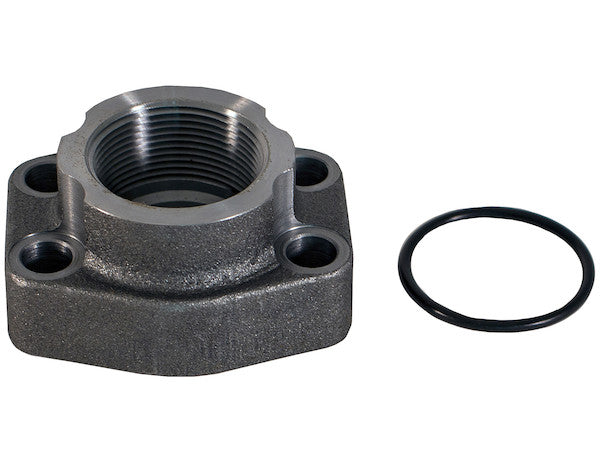
The 4 Bolt Flange Adapter Kit from Buyers Products converts a split flange into NPT porting for hydraulic filter lines. Every kit comes complete with bolts, lock washers, and O-ring.
Specifications
| Finish | Plain |
|---|---|
| Material | Carbon Steel |
| Shape | Flange Adapter |
| Side 1 | 1 1/4 NPT |
| Side 2 | 1-1/4 (-20 CODE 61) |
| Style | FF |
In the intricate world of hydraulic systems, precision, reliability, and compatibility are paramount. The ability to seamlessly integrate various components, despite differing porting standards, is critical for achieving optimal system performance and longevity. The 4 Bolt Flange 1-1/4 Inch Adapter Kit stands as a prime example of engineering ingenuity designed to address these challenges, specifically facilitating the conversion from a robust split flange connection to a universally recognized NPT (National Pipe Tapered) porting. This comprehensive kit from Buyers Products is engineered to meet the rigorous demands of hydraulic applications, particularly within the critical domain of hydraulic filter lines, ensuring secure, leak-free, and efficient fluid transfer.
Detailed Functional Overview: Bridging Hydraulic Porting Standards
The core function of this adapter kit is to provide a reliable interface between a hydraulic system component equipped with a 1-1/4 inch SAE Code 61 split flange port and a hose or pipe assembly utilizing a 1-1/4 inch NPT threaded connection. This conversion capability is indispensable in a multitude of hydraulic setups where system architects or maintenance professionals need to connect components that adhere to different international or industry-specific porting standards. Hydraulic filter lines, for instance, often require connections that can withstand fluctuating pressures, vibrations, and continuous flow while preventing contamination and fluid loss. The adapter serves as a robust conduit, ensuring that the integrity of the hydraulic circuit remains uncompromised.
A split flange connection, particularly the SAE J518 Code 61 standard (which this adapter supports on Side 2 with its 1-1/4" -20 configuration), is renowned for its high-pressure capability and superior sealing performance. It employs an O-ring for the primary seal, which is compressed between the flange head and the mating surface, offering excellent resistance to leakage, even under dynamic conditions. Conversely, NPT threads (represented by Side 1, 1-1/4" NPT) are ubiquitous in industrial piping and hydraulic systems for their simplicity and cost-effectiveness. They create a seal through metal-to-metal interference as the tapered threads are tightened, often augmented by thread sealant. The challenge arises when a high-performance flange connection needs to interface with an NPT-threaded line, and this adapter kit precisely solves that integration puzzle, offering the benefits of both worlds in a single, durable solution.
Engineering Design and Material Excellence: The Carbon Steel Advantage
The selection of materials and the precision of the manufacturing process are fundamental to the performance and durability of any hydraulic component. This 4 Bolt Flange Adapter Kit is meticulously crafted from Carbon Steel, a material celebrated for its exceptional strength-to-weight ratio, resilience, and cost-effectiveness in demanding industrial environments. Carbon steel is an ideal choice for hydraulic applications due to its inherent mechanical properties, which include high tensile strength, excellent yield strength, and superior fatigue resistance. These characteristics ensure the adapter can reliably withstand the internal pressures, external stresses, and cyclical loading characteristic of hydraulic systems without deformation or failure.
The Plain Finish on the carbon steel signifies that the adapter is supplied without additional surface coatings such as plating or painting. While a plain finish might necessitate proper environmental control or external corrosion protection in highly aggressive corrosive environments, it offers several distinct advantages. It provides a clean, unadulterated metallic surface, which can be beneficial for specific applications where galvanic corrosion with dissimilar metals needs to be avoided, or where a user intends to apply their own specific coating tailored to their unique operational conditions. Furthermore, the absence of a plating layer ensures that the precision machined tolerances of the fitting are maintained exactly as designed, facilitating optimal sealing and fit. The manufacturing process for such a flange adapter typically involves precision machining from forged or bar stock, ensuring tight dimensional control, smooth sealing surfaces, and consistent thread profiles—all critical for preventing leaks and ensuring long-term reliability.
The Shape of the product as a "Flange Adapter" specifically denotes its geometric configuration, which is designed to convert one type of hydraulic connection to another without compromising system integrity. The design must accommodate the distinct physical and sealing requirements of both the SAE Code 61 flange and the NPT threaded port, ensuring proper alignment, secure fastening, and effective fluid containment under pressure. The robust form factor of the adapter facilitates a seamless transition, maintaining the structural and sealing capabilities essential for hydraulic applications.
In-Depth Analysis of Porting Standards: NPT vs. SAE Code 61 Flange
Side 1: 1 1/4 NPT (National Pipe Tapered Thread)
The National Pipe Tapered (NPT) thread standard is one of the oldest and most widely adopted thread forms globally for general purpose piping and hydraulic connections. The defining characteristic of an NPT thread is its taper, typically 1:16, meaning that for every 16 units of length, the diameter changes by 1 unit. This taper allows the threads to wedge together when tightened, creating a mechanical interference fit that forms the primary seal. For effective sealing, especially in pressure applications, it is standard practice to use a thread sealant compound or PTFE tape to fill any helical leak paths that might exist between the male and female threads.
The "1 1/4 inch" designation refers to the nominal pipe size, which is a legacy term that does not correspond directly to the actual measured diameter of the threads or the pipe's bore. For 1-1/4 NPT, the actual thread diameters are significantly larger than 1.25 inches. NPT threads are specified under ASME B1.20.1 standards, ensuring interchangeability and consistent dimensions across manufacturers. Advantages of NPT connections include their widespread availability, ease of assembly (though proper torque and sealant are crucial), and relatively low cost. However, NPT connections can be susceptible to overtightening, which can distort fittings, and their sealing mechanism relies heavily on the quality of thread engagement and sealant application. Despite these considerations, 1-1/4 NPT remains a workhorse connection for many medium to high-pressure hydraulic circuits, particularly where quick assembly and broad compatibility are prioritized.
Side 2: 1-1/4 (-20 CODE 61) (SAE J518 Code 61 Flange)
The SAE J518 standard defines split flange connections, which are widely utilized in heavy-duty hydraulic applications requiring superior sealing, robust mounting, and ease of assembly/disassembly, especially in situations with high pressure, vibration, or shock. This adapter specifically interfaces with a Code 61 flange, which is the standard duty series of SAE J518 flanges, rated for pressures up to 3,000 PSI (21 MPa) depending on size. The "Code 62" series, in contrast, is the heavy-duty series, designed for pressures up to 6,000 PSI (42 MPa).
The "1-1/4" dimension in the context of the Code 61 flange typically refers to the nominal pipe or tube size it is designed to accommodate. The "-20" is a dash size, which is a standardized method of designating the nominal size of the flange, often corresponding to the maximum allowable tube outer diameter (OD) or port opening. For a 1-1/4 inch nominal size, the -20 dash size is common and indicates the specific dimensions for the bolt pattern and port diameter as defined by the SAE J518 standard. The Code 61 flange connection relies on an O-ring seal, which is seated in a precisely machined groove on the flange adapter's face (or the mating component's face). When the four bolts (provided in the kit) are tightened, the O-ring is compressed, creating a highly effective and reliable seal that is resistant to leakage even under pulsating pressures and mechanical stress. The 4-bolt pattern provides a uniform clamping force across the sealing surface, enhancing the integrity of the connection.
The primary advantages of SAE flange connections, particularly Code 61, include their superior resistance to leakage, especially in large sizes and high-pressure applications, reduced risk of thread galling or fatigue compared to threaded connections, and ease of assembly/disassembly, which simplifies maintenance and component replacement. They are especially prevalent in mobile hydraulics, construction equipment, agricultural machinery, and heavy industrial systems where robustness and serviceability are key.
Style: FF (Flange Fitting)
The "Style: FF" designation, within the context of this specific 4 Bolt Flange Adapter, indicates that it functions as a Flange Fitting. This means it is designed to create a secure, direct interface between a Code 61 flange connection and an NPT connection. While "FF" often means "Female-to-Female" in threaded fittings, for a flange adapter, it signifies its role as a dedicated flange interface. The adapter itself has a flange face on one side that mates with a Code 61 split flange and an NPT female port on the other side. This "Flange Fitting" style ensures a robust, standardized conversion from the high-integrity O-ring sealed flange connection to a widely used NPT threaded port, upholding system performance and fluid containment.
Comprehensive Kit Components: Ensuring a Complete and Reliable Connection
The efficacy of any hydraulic connection kit lies not only in the primary adapter but also in the quality and completeness of its accompanying hardware. The 4 Bolt Flange Adapter Kit from Buyers Products is supplied as a comprehensive assembly, including all necessary components for a secure and leak-free installation:
- Bolts: The kit includes four high-strength bolts, typically made from heat-treated alloy steel (e.g., Grade 8 or equivalent). These bolts are critical for creating the necessary clamping force to compress the O-ring within the flange connection and secure the adapter to the mating component. Their specified length and thread pitch ensure full engagement with the tapped holes of the mating flange block, providing robust mechanical retention. Proper torqueing of these bolts, often in a criss-cross pattern, is essential to achieve uniform clamping pressure and prevent localized stress points or uneven O-ring compression.
- Lock Washers: To complement the bolts, the kit includes lock washers, which are vital for maintaining bolt preload and preventing loosening due to vibration, thermal cycling, or dynamic pressure fluctuations inherent in hydraulic systems. Common types of lock washers used in such applications include split helical spring washers or internal/external tooth washers, which exert a spring force to resist unscrewing. By creating friction and increasing resistance to rotational movement, lock washers significantly enhance the long-term integrity and safety of the bolted flange connection, mitigating the risk of catastrophic failure due to loosened fasteners.
- O-ring: The O-ring is the cornerstone of the leak-free seal for the Code 61 flange connection. Typically made from a high-performance elastomer such as Nitrile (Buna-N) for general hydraulic oil service, or other materials like Viton® (FKM) for specific fluid compatibilities or higher temperature ranges, the O-ring is designed to sit in a precisely machined groove. When compressed by the tightening of the flange bolts, it deforms to fill any microscopic irregularities between the mating surfaces, creating a positive, low-friction seal against fluid leakage. The O-ring included in the kit is specifically sized and selected for the 1-1/4 inch Code 61 flange interface, ensuring optimal compression and sealing performance under specified operating conditions. Its correct installation, free from nicks or twists, is paramount for the integrity of the hydraulic circuit.
Applications and Versatility Beyond Filter Lines
While the initial description highlights the utility of this adapter kit for hydraulic filter lines, its application spectrum is considerably broader within industrial, mobile, and marine hydraulic systems. The need to transition between SAE flange and NPT connections arises in numerous scenarios:
- System Expansion and Modification: When expanding existing hydraulic systems or modifying equipment, engineers often encounter a mix of porting standards. This adapter provides a clean, reliable solution for integrating new components (e.g., valves, pumps, motors, cylinders) that may have NPT ports into a system predominantly using SAE flanges, or vice versa.
- Pump and Motor Connections: Many hydraulic pumps and motors utilize SAE flange connections for their inlet and outlet ports due to the high flow and pressure capabilities. This adapter allows for easy connection to NPT-threaded manifold blocks or hose assemblies.
- Valve Manifold Interfaces: Complex hydraulic manifolds often feature a variety of port types. The adapter facilitates connecting NPT-threaded auxiliary lines or pressure gauges to flange-ported manifold blocks.
- Integration of Auxiliary Equipment: Adding coolers, accumulators, or other auxiliary components to a hydraulic circuit frequently requires converting porting types. This kit offers a standardized method for such integrations.
- Retrofitting Older Systems: Older hydraulic machinery might use legacy or proprietary connections. While not directly replacing proprietary interfaces, this adapter enables the adoption of modern, standardized NPT components into systems that primarily use SAE flanges, extending equipment lifespan and improving serviceability.
- OEM and MRO Contexts: Original Equipment Manufacturers (OEMs) use such adapters to standardize their product lines or allow for customization based on customer requirements. In Maintenance, Repair, and Operations (MRO), these kits are essential for quick and effective repairs or upgrades.
Installation, Operation, and Maintenance Best Practices
Proper installation and adherence to operational guidelines are crucial for maximizing the performance and longevity of the 4 Bolt Flange 1-1/4 Inch Adapter Kit and the entire hydraulic system. Professionals should observe the following best practices:
-
Installation:
- Cleanliness: Ensure all mating surfaces (flange face, O-ring groove, NPT threads) are meticulously clean and free from dirt, debris, metal shavings, or existing sealant residues. Contaminants can compromise the seal and lead to premature failure.
- O-ring Seating: Carefully inspect the O-ring for any nicks, cuts, or deformities. Lightly lubricate the O-ring with a compatible hydraulic fluid before gently seating it fully into its groove. Ensure it is not twisted.
- Thread Sealant: For the NPT connection, apply an appropriate hydraulic-grade thread sealant (liquid sealant or PTFE tape) to the male NPT threads only, ensuring the first 1-2 threads are left clear to prevent sealant ingress into the hydraulic system.
- Bolt Tightening Sequence and Torque: Insert the four bolts with their respective lock washers. Hand-tighten all bolts. Then, using a calibrated torque wrench, tighten the bolts incrementally in a criss-cross pattern to the manufacturer's specified torque value. This ensures uniform compression of the O-ring and even clamping force, preventing flange distortion and leakage.
- Avoid Overtightening: Overtightening can crush the O-ring, damage threads, deform the adapter, or strip bolt threads, leading to leaks and component failure.
-
Operation:
- Pressure and Temperature Limits: Always operate the system within the specified pressure and temperature ratings for the adapter and all connected components. Exceeding these limits can lead to material fatigue, seal degradation, and system failure.
- Fluid Compatibility: Ensure that the hydraulic fluid used in the system is compatible with the O-ring material (e.g., Nitrile for mineral-based oils). Incompatible fluids can cause the O-ring to swell, shrink, harden, or soften, compromising the seal.
-
Maintenance:
- Periodic Inspection: Regularly inspect the adapter and connections for any signs of leakage, corrosion, wear, or damage. Address any issues promptly.
- O-ring Replacement: O-rings are wear items. They should be replaced during any disassembly or if signs of degradation are observed, typically as part of scheduled maintenance intervals.
- Bolt Re-torqueing: In systems subject to extreme vibration or thermal cycling, periodic re-torqueing of the flange bolts may be necessary, following the specified procedure.
Advantages and Value Proposition
The 4 Bolt Flange 1-1/4 Inch Adapter Kit offers a compelling value proposition for professionals in the hydraulic industry:
- Enhanced System Versatility: Enables seamless integration of components with disparate porting standards, expanding design possibilities and simplifying maintenance.
- Robust and Reliable Sealing: Combines the superior O-ring sealing of SAE Code 61 flanges with the widely used NPT standard, offering a high-integrity connection under demanding conditions.
- Optimized Fluid Flow: Precision-machined internal passages ensure minimal pressure drop and turbulent flow, preserving system efficiency.
- Reduced Downtime: The comprehensive kit with all necessary hardware simplifies procurement and installation, contributing to quicker assembly and reduced maintenance downtime.
- Durability: Manufactured from high-quality carbon steel, ensuring long-term resistance to wear, fatigue, and the stresses of hydraulic operation.
- Standardization and Compatibility: Adheres to recognized industry standards (SAE J518, NPT), facilitating interchangeability and global compatibility of components.
Conclusion
The 4 Bolt Flange 1-1/4 Inch Adapter Kit is an indispensable component for any hydraulic system requiring a robust, reliable, and standardized conversion between SAE J518 Code 61 split flange and NPT threaded connections. Engineered from durable carbon steel and supplied as a complete kit with high-strength bolts, lock washers, and a sealing O-ring, this adapter ensures the integrity and efficiency of hydraulic circuits, particularly in critical applications such as filter lines. Its meticulous design, adherence to industry standards, and comprehensive component inclusion underscore its value as a high-performance solution for system builders, maintenance professionals, and equipment operators seeking uncompromising quality and operational reliability in fluid power systems.