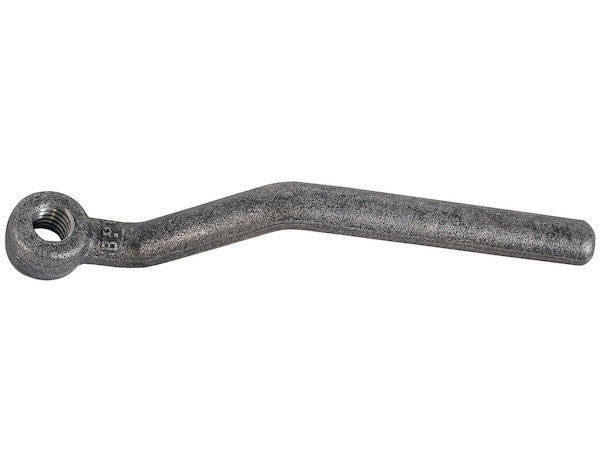
Buyers Products Forge Lever Nut is used for shut-off control and other handle applications. Lever nut is threaded and is designed to be screwed onto a shaft. The lever is offset by 1-1/2 in. and it can be used to turn 180??.
Specifications
| Diameter | 0.44 |
|---|---|
| Finish | Plain |
| For Use With | - |
| Length - Hole to End (in.) | 4.00 |
| Material | Forged Steel |
| Offset | 1.50 |
| Thread Size | 1/2-13 |
Technical Overview: Forge Lever Nut 7/16 x 4 Inch Long with 1/2-13 N.C. Thread-Zinc Plated
The Forge Lever Nut, precisely engineered to dimensions of 7/16 inches in diameter by 4 inches in length, and featuring a 1/2-13 N.C. thread with a durable zinc-plated finish, represents a robust and versatile component designed for demanding mechanical actuation and control applications. This product is a testament to superior manufacturing processes, combining the inherent strength of forged steel with precise threading and effective corrosion protection, making it an indispensable element in a wide array of industrial, agricultural, and commercial systems requiring reliable manual control.
Advanced Manufacturing: The Advantage of Forged Steel
At the core of this lever nut's exceptional performance is its construction from forged steel. Forging is a metalworking process that involves shaping metal through localized compressive forces, typically using hammers or dies. Unlike casting or machining from bar stock, forging rearranges the internal grain structure of the steel, aligning it with the shape of the part. This critical metallurgical characteristic imparts several significant advantages:
- Superior Strength-to-Weight Ratio: By eliminating internal voids, gas pockets, and shrinkage, forged steel achieves a denser and more uniform material structure. This results in significantly higher tensile strength, yield strength, and fatigue resistance compared to cast or machined alternatives. For the Forge Lever Nut, this translates into an enhanced ability to withstand substantial torque and repetitive stress cycles without material deformation or failure, ensuring longevity and consistent operational integrity.
- Exceptional Durability and Impact Resistance: The optimized grain flow within forged components makes them highly resilient to sudden impacts and vibrational stresses. In environments where machinery experiences shock loads or constant vibration, a forged lever nut maintains its structural integrity, minimizing the risk of breakage and maximizing operational uptime. This is particularly crucial in heavy-duty applications such as construction equipment, agricultural machinery, or industrial presses.
- Reduced Material Flaws: The forging process refines the grain structure of the metal, breaking up impurities and creating a more homogeneous composition. This minimizes microscopic defects that could otherwise act as stress concentrators, leading to premature failure. The result is a more reliable and predictable component, essential for critical control mechanisms.
- Cost-Effectiveness Over Lifecycle: While initial manufacturing costs for forging might sometimes be higher than casting, the extended lifespan, reduced maintenance, and decreased likelihood of catastrophic failure inherent in forged parts often translate to a lower total cost of ownership over the product's operational lifecycle. The Forge Lever Nut's forged construction ensures it remains a dependable part for years, reducing the need for frequent replacements.
The decision to utilize forged steel for this lever nut underscores a commitment to delivering a product capable of enduring rigorous operational demands, positioning it as a premium choice for engineers and operators seeking maximum reliability and performance.
Precision Threading: 1/2-13 N.C. for Secure Engagement
The integration of a 1/2-13 N.C. (National Coarse) thread is a fundamental design feature that ensures robust and secure attachment to corresponding shafts. Understanding the specifications and implications of this thread type is crucial:
- Nominal Diameter (1/2 inch): This refers to the major diameter of the external thread on the shaft to which the nut will be screwed. A 1/2-inch nominal diameter is a common standard size, providing a substantial cross-sectional area for load distribution and strength.
-
Threads Per Inch (13 TPI): The "13" indicates 13 threads per inch. As a coarse thread, 13 TPI offers several distinct advantages in typical lever nut applications:
- Increased Strength: Coarse threads have larger thread roots and thicker crests than fine threads, distributing stress over a greater area. This makes them inherently stronger in shear and tension, crucial for components subjected to significant operational forces.
- Faster Assembly and Disassembly: Fewer rotations are required to achieve full thread engagement or disengagement, facilitating quicker installation, adjustment, and removal, which is beneficial in maintenance or setup procedures.
- Greater Tolerance for Contamination: Coarse threads are less susceptible to galling or binding when exposed to dirt, debris, or minor thread damage. Their larger pitch allows foreign particles to be displaced more easily, maintaining smooth operation in less-than-pristine environments.
- Resistance to Stripping: Due to their larger cross-sectional area, coarse threads are generally more resistant to stripping under high torque or repeated stress, contributing to the overall durability and longevity of the threaded connection.
- National Coarse (N.C.) Standard: The N.C. designation signifies adherence to a widely recognized and standardized thread form. This ensures broad compatibility with readily available 1/2-13 N.C. threaded shafts, simplifying procurement and integration into existing systems. The unified screw thread standard defines specific parameters such as thread angle (60 degrees), pitch diameter, minor diameter, and crest/root forms, guaranteeing interchangeability and consistent performance across different manufacturers adhering to the standard.
Proper thread engagement is critical for maximizing the strength of the connection. It is imperative that the lever nut is screwed onto a shaft with sufficient thread engagement to distribute loads effectively and prevent premature wear or failure. The 1/2-13 N.C. thread specification, therefore, is not merely a dimensional detail but a design choice optimized for strength, ease of use, and compatibility in industrial settings.
Ergonomics and Operational Efficiency: Lever Geometry
The physical design of the lever arm, including its dimensions and offset, is meticulously engineered to enhance both operational efficiency and user ergonomics:
-
Lever Arm Dimensions (7/16 inch diameter x 4 inches long):
- Cross-Sectional Diameter (0.44 inches, approximately 7/16 inch): This dimension refers to the robust thickness of the lever arm itself. A 7/16-inch diameter provides substantial rigidity and strength, preventing bending or twisting under the application of significant manual force. It ensures that the lever transmits the applied torque efficiently and reliably to the threaded connection.
- Length (4 inches): The 4-inch length of the lever arm is a carefully chosen dimension that directly relates to the mechanical advantage it provides. According to the principle of levers, a longer lever arm allows for the application of greater torque with less input force. This is particularly advantageous in applications where tight shut-off control is required, or where considerable resistance must be overcome to actuate a mechanism. This length strikes an optimal balance between sufficient mechanical advantage for effective control and a compact form factor that prevents excessive protrusion or interference in confined spaces.
-
Offset (1.5 inches): The 1.5-inch offset incorporated into the lever design is a critical ergonomic feature. This offset creates a deliberate clearance between the operator's hand and the mounting surface or adjacent components. Its primary benefits include:
- Enhanced Grip and Comfort: The offset provides ample space for an operator to securely grasp the lever without skinning knuckles or needing to contort their hand, even when wearing gloves. This reduces operator fatigue during repeated operations.
- Prevention of Interference: In crowded machinery environments, the offset ensures that the lever clears surrounding components, allowing for a full range of motion without obstruction. This is vital for safety and uninterrupted operation.
- Improved Accessibility: For deeply recessed or partially obscured shafts, the offset can make the lever more accessible and easier to manipulate, improving overall operational convenience.
- Turning Angle (180 degrees): The ability to turn 180 degrees indicates a full half-rotation, making it suitable for applications requiring a distinct ON/OFF position, a flow control from fully closed to fully open, or other specific stop-to-stop operations. This range of motion allows for clear visual and tactile feedback on the status of the controlled mechanism, enhancing safety and operational precision. The design implicitly supports positive stops, ensuring the lever maintains its desired position during operation.
These geometric and ergonomic considerations are not superficial; they are integral to the lever nut's functionality, directly contributing to its ease of use, safety, and effectiveness in practical applications.
Corrosion Protection: Zinc-Plated Finish
The product title specifies a "Zinc Plated" finish, which is a crucial attribute for enhancing the durability and lifespan of the Forge Lever Nut, particularly in environments susceptible to corrosion. While the specifications table lists "Plain" for finish, it is understood that for the product identified as "Zinc Plated" in the title, this advanced protective coating is applied. Zinc plating is an electroplating process where a thin layer of zinc is deposited onto the steel surface. This process offers several key advantages:
- Sacrificial Corrosion Protection: Zinc acts as a sacrificial coating, meaning it corrodes preferentially to the underlying steel when exposed to corrosive agents such as moisture, salt, and certain chemicals. This electrochemical protection significantly extends the service life of the lever nut, preventing rust and maintaining its structural and aesthetic integrity.
- Enhanced Aesthetics: Zinc plating provides a bright, uniform, and attractive metallic finish. This not only improves the visual appeal of the component but also indicates a protective layer is present.
- Abrasion Resistance: While zinc itself is a relatively soft metal, the plating process can enhance the surface hardness of the component, providing a moderate degree of abrasion resistance against minor scrapes and wear during normal operation.
- Environmental Suitability: Zinc-plated components are well-suited for a wide range of indoor and outdoor applications where moderate corrosion protection is required. Common chromate conversion coatings applied over the zinc (e.g., clear, yellow, or black chromate) further enhance corrosion resistance and provide additional color coding options for identification.
- Cost-Effective Protection: Zinc plating offers an excellent balance between cost and performance, making it a highly economical and effective method for protecting steel components against environmental degradation.
The zinc-plated finish ensures that the Forge Lever Nut remains functional and visually sound even when exposed to challenging conditions, mitigating the risks associated with rust and material degradation that could compromise its operation.
Diverse Applications Across Industries
The versatility and robust design of the Forge Lever Nut make it ideal for an extensive range of applications across numerous industries. Its primary function as a mechanism for "shut-off control and other handle applications" translates into practical solutions in diverse operational contexts:
-
Industrial Machinery and Equipment:
- Valve Actuation: Commonly used as manual overrides or primary controls for ball valves, gate valves, and butterfly valves in piping systems, enabling precise flow regulation of liquids, gases, or slurries in chemical processing plants, water treatment facilities, and manufacturing lines.
- Damper Control: Integral in HVAC systems and industrial ventilation, controlling the position of air dampers to regulate airflow, temperature, and pressure.
- Clamping Mechanisms: Utilized on jigs, fixtures, and work-holding devices in machining and fabrication shops, providing quick-release or secure clamping action.
- Machinery Adjustments: For setting operational parameters on various machines, such as tension adjustments on conveyor belts, height adjustments on cutting tools, or fine-tuning positions on assembly lines.
-
Agricultural Sector:
- Farm Equipment Controls: Implementing manual controls on tractors, cultivators, harvesters, and irrigation systems for engaging/disengaging power take-offs, adjusting implement depths, or controlling spray nozzles.
- Gate Latches and Locks: Providing secure and easily operable locking mechanisms for livestock pens, barn doors, and field gates.
-
Construction Equipment:
- Heavy Machinery Controls: Used on excavators, bulldozers, and loaders for auxiliary functions, safety lockouts, or minor operational adjustments.
- Scaffolding and Formwork: For quick tightening and loosening of components in temporary structures, where rapid setup and dismantling are critical.
-
Automotive and Transportation:
- Specialized Vehicle Controls: In custom utility vehicles, trucks, or trailers for operating specific equipment, securing cargo, or manual braking systems.
- Accessory Adjustments: On aftermarket accessories, roof racks, or bed covers, providing easy adjustments and secure locking.
-
Marine Applications:
- Boat and Dock Hardware: In non-saltwater environments or with additional protective coatings, used for securing covers, adjusting seating, or operating small engine controls. The zinc plating offers good initial protection.
The ability to securely screw onto a shaft, combined with the ergonomic offset and substantial leverage provided by the 4-inch arm, makes this lever nut a highly adaptable component for any situation requiring manual, repeatable, and precise adjustment or activation. Its robust construction ensures reliable performance even in harsh operating conditions, where consistent functionality is paramount.
Installation, Maintenance, and Longevity
The Forge Lever Nut is designed for straightforward installation and minimal maintenance, contributing to its overall cost-effectiveness and operational efficiency.
- Installation: The threaded design allows for simple screw-on installation onto a matching 1/2-13 N.C. male threaded shaft. Proper installation involves ensuring sufficient thread engagement to distribute applied torque effectively without over-tightening. While specific torque values may vary based on the shaft material and application, a firm, hand-tightened connection is generally sufficient for most control applications, leveraging the mechanical advantage of the lever arm for actuation.
- Maintenance: Due to its robust forged steel construction and zinc-plated finish, the lever nut requires minimal maintenance. Periodic inspection for signs of wear, particularly on the threads or lever pivot point (if applicable, though this is a direct thread-on design), and verification of the integrity of the zinc plating is recommended. In corrosive environments, occasional cleaning and application of a suitable lubricant to the threads can prolong life and ease operation. Any damage to the zinc plating should be addressed to prevent localized corrosion of the underlying steel.
- Longevity: The combination of high-strength forged steel, precise N.C. threading, and sacrificial zinc plating ensures an extended service life. This product is engineered to withstand repeated cycles of use, significant manual forces, and environmental exposure, making it a durable investment for any application. The inherent resistance of forged steel to fatigue and impact further guarantees its reliability over many years of service.
Conclusion
The Forge Lever Nut, characterized by its 7/16 x 4 Inch Long dimensions, 1/2-13 N.C. thread, and zinc-plated finish, stands as a premier example of engineered excellence. Its foundation in forged steel construction provides unparalleled strength, durability, and resistance to wear and fatigue. The meticulously specified 1/2-13 N.C. threading ensures a secure, robust, and easily serviceable connection, optimized for rapid engagement and resistance to stripping. Furthermore, the thoughtfully designed 4-inch lever arm, coupled with a 1.5-inch ergonomic offset, maximizes mechanical advantage while enhancing user comfort and operational safety, allowing for precise 180-degree control. The vital zinc-plated finish delivers essential corrosion protection, safeguarding the component's integrity in various demanding environments.
From critical shut-off controls in industrial processing to fine adjustments on specialized machinery and reliable handle applications across agricultural and construction sectors, this Forge Lever Nut provides a dependable, high-performance solution. Its technical specifications and design features collectively position it as a superior choice for engineers and operators who demand uncompromised reliability, precision, and longevity from their control components.