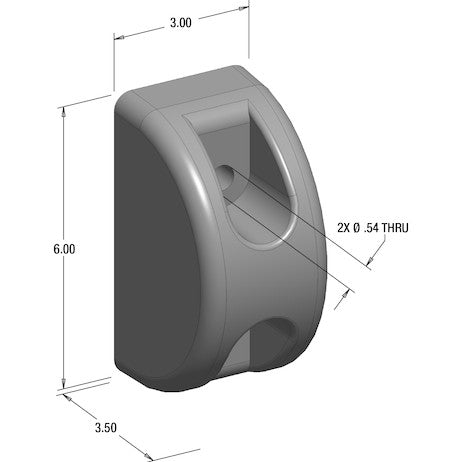
Buyers Products Molded Rubber Bumpers help protect the rear of a truck or trailer when backing to a loading dock or delivery bay. Bumpers are an ideal addition to any piece of equipment that has a high frequency of contact, such as a loading dock or delivery bay. Sold in pairs or as singles, bumpers are constructed from compression-molded rubber for high impact resistance and durability.
Specifications
| Color | Black |
|---|---|
| Depth (in.) | 3-1/2 |
| Finish | Plain |
| Height (in.) | 6.00 |
| Hole Dia. | .54 |
| Material | Rubber |
| Mounting Holes Ctr to Ctr (in.) | 3.00 |
| Number of Mounting holes | 2 |
| Quantity | 2 |
| Width (in.) | 3.00 |
The D-Shaped Molded Rubber Bumper, presented here in a 3 x 3-1/2 x 6 inch tall configuration and supplied as a set of two, represents a crucial component in comprehensive impact protection systems across a multitude of industrial and commercial applications. Engineered by Buyers Products, these bumpers are meticulously designed to mitigate the kinetic energy generated during collisions, thereby safeguarding valuable assets, infrastructure, and personnel. The inherent properties of the compression-molded rubber, coupled with the specific geometric profile of the 'D' shape, contribute to a superior product offering that prioritizes durability, functional efficiency, and long-term cost savings. This technical description will delve into the material science, design principles, performance characteristics, and diverse applications of these robust protective devices.
Central to the efficacy of this product is its material composition: compression-molded industrial-grade rubber. The compression molding process is a manufacturing technique where the rubber compound, typically in a pre-formed slug or sheet, is placed into a heated mold cavity. Pressure is then applied by closing the mold, causing the material to flow and conform to the mold's shape. Concurrently, the heat initiates vulcanization, a chemical process that irreversibly cross-links the polymer chains. This transformation converts the pliable rubber compound into a highly elastic and resilient thermoset elastomer. The advantages of compression molding for bumpers are manifold. It yields a product with consistent density, minimal internal stresses, and excellent dimensional stability, all critical factors for components subjected to repetitive impacts. Furthermore, this method is particularly adept at producing thick-walled parts, allowing for substantial material volume to absorb and distribute impact forces effectively. The specific rubber compound utilized is optimized for a demanding operational environment, exhibiting superior tensile strength to resist tearing under stress, high elongation properties to absorb energy without permanent deformation, and excellent rebound resilience to return to its original shape after impact. Its resistance to abrasion ensures longevity even with frequent frictional contact, while its inherent resistance to ozone, UV radiation, and varying temperatures—from sub-zero to elevated heat—guarantees performance in diverse climatic conditions and outdoor exposures. The plain black finish is not merely aesthetic; it signifies a standard, robust, non-marking material suitable for industrial settings where functional integrity takes precedence.
The distinctive D-shaped profile, measuring 3 inches in width, 3.5 inches in depth, and 6 inches in height, is a deliberate engineering choice that optimizes both protection and mounting flexibility. The flat back of the 'D' allows for flush mounting against planar surfaces, such as the rear frame of a truck or trailer, the edge of a loading dock, or an industrial wall. This flush fit minimizes protrusions, reduces potential snag points, and ensures a secure, stable attachment. The curved front face provides a large radius of contact, effectively distributing impact forces over a wider area. This curvature is critical for deflecting glancing blows and minimizing localized stress concentrations that could lead to premature wear or damage to either the bumper or the impacting object. When a vehicle backs into a loading dock, for example, the D-shape ensures that the initial contact force is spread across the bumper's surface, allowing the rubber's elastic properties to absorb and dissipate the kinetic energy gradually, rather than transmitting a sharp, damaging shock to the vehicle's chassis or the dock structure. The 3.5-inch depth provides ample cushioning material, acting as a substantial buffer zone, while the 6-inch height ensures adequate vertical coverage for various contact points on trucks and trailers, accommodating different vehicle heights and potential misalignments during maneuvering. The 3-inch width complements these dimensions, providing a robust frontal area for direct impact absorption.
Mounting integrity is paramount for any protective device. These D-shaped bumpers feature two precisely positioned mounting holes, with a diameter of 0.54 inches and a center-to-center spacing of 3.00 inches. This standardized hole configuration facilitates straightforward and secure installation using common industrial fasteners. The 0.54-inch diameter is engineered to accommodate robust bolts, typically 1/2-inch or 14mm, ensuring a strong mechanical connection to the mounting surface. The 3.00-inch center-to-center spacing provides optimal stability, preventing rotational movement or undue stress on a single fastener point, especially under dynamic impact loads. For maximum security and longevity, it is recommended to utilize high-grade fasteners, such as Grade 8 bolts, along with appropriate washers and locknuts, particularly when mounting to steel frames or thick concrete structures. In applications involving lighter substrates or where through-bolting is not feasible, specialized anchors or backing plates may be employed to distribute the load and enhance pull-out resistance. Proper installation techniques are critical to realizing the full protective potential of these bumpers, ensuring they remain firmly in place throughout their operational lifespan, even after repeated severe impacts.
The application spectrum for these D-shaped molded rubber bumpers is exceptionally broad, extending beyond the typical truck and trailer docking scenarios initially highlighted. In the realm of transportation, they are indispensable for fleet operations, protecting the rear of commercial trucks, semi-trailers, box trucks, utility vehicles, and municipal vehicles (e.g., sanitation trucks, snow plows). They act as a critical interface during trailer coupling and uncoupling, preventing damage to fifth wheels, kingpins, and landing gear. For loading docks, these bumpers are integral components of fixed installations, permanently affixed to concrete or steel dock edges. They shield the dock structure from spalling, cracking, and structural fatigue, while simultaneously protecting incoming vehicles from costly bodywork damage, bent frames, and compromised lighting systems. This reciprocal protection minimizes repair expenses for both facilities and vehicles, reducing operational downtime and improving safety. Beyond docking, they find utility in various industrial and manufacturing settings, serving as protective barriers on machinery, guard rails, warehouse walls, and material handling equipment like forklifts and industrial carts. In marine environments, smaller versions of D-shaped bumpers are often employed as fenders for boats and smaller docks, providing similar impact absorption capabilities against jetties and other vessels. Their versatility is a testament to the fundamental effectiveness of their design and material properties.
From an operational efficiency and safety perspective, the integration of these bumpers yields substantial dividends. By effectively absorbing impact energy, they significantly reduce the frequency and severity of damage to vehicles, infrastructure, and cargo. This directly translates to lower maintenance and repair costs, decreased vehicle downtime, and improved asset utilization rates. For example, a minor backing accident without adequate bumper protection can result in thousands of dollars in repairs for a truck's rear components and potentially thousands more in lost revenue due to the vehicle being out of service. Proactive installation of robust bumpers represents a cost-effective preventative measure against such economic losses. Furthermore, these bumpers contribute to a safer working environment. They help prevent injuries to personnel who might otherwise be caught between an unprotected vehicle and a solid object. They also minimize the risk of structural compromise to buildings, which could pose a safety hazard. In many industrial contexts, the use of such protective equipment is not merely a best practice but a regulatory requirement to comply with occupational safety standards.
The engineering specifications of these bumpers are not arbitrarily chosen but are the result of extensive research and development to meet the rigorous demands of their intended applications. The chosen durometer hardness of the rubber, while not explicitly listed as a number, is optimized to provide a balance between impact absorption and load-bearing capacity. A rubber that is too soft might compress excessively, leading to insufficient protection, while one that is too hard could transmit too much shock, negating its purpose. The compression-molding process allows for precise control over this critical property, ensuring consistent performance across all units. The finished product, with its plain black appearance, signifies a practical, no-frills design focused entirely on performance. The absence of additional coatings or treatments ensures that the inherent properties of the rubber are fully leveraged for durability and impact resistance without relying on superficial finishes that could degrade over time. Each set, comprising two units, provides adequate coverage for standard vehicle rear profiles or dock sections, allowing for symmetrical installation and balanced protection.
Long-term performance and maintenance considerations are equally important. Due to the inherent resilience and environmental resistance of the compression-molded rubber, these D-shaped bumpers require minimal maintenance. Periodic visual inspections are recommended to check for any signs of extreme wear, deep cuts, or compromised mounting integrity, particularly in high-frequency contact areas. Should minor surface abrasion occur, it typically does not impair the bumper's structural or protective capabilities. Replacement is generally only necessary if the bumper sustains severe, localized damage that compromises its ability to absorb impacts effectively, or if the mounting points become excessively fatigued. The robust construction ensures an extended service life under normal operating conditions, providing reliable protection for many years. Buyers Products stands behind the quality and engineering of these components, ensuring that they meet stringent manufacturing standards for material integrity and dimensional accuracy. This commitment to quality assures end-users of a dependable product that will perform consistently in the demanding environments for which it is designed.
In summary, the D-Shaped Molded Rubber Bumper, with its precise dimensions of 3 x 3-1/2 x 6 inches tall, supplied as a pair, represents a technically advanced solution for impact mitigation. Its construction from high-performance compression-molded rubber, combined with the functionally optimized D-profile, delivers unparalleled impact resistance, superior durability, and extended operational longevity. From safeguarding valuable truck and trailer fleets against the rigors of docking and maneuvering to protecting expensive loading dock infrastructure and diverse industrial equipment, these bumpers are an indispensable asset. Their ease of installation, coupled with minimal maintenance requirements and substantial economic and safety benefits, underscores their value proposition. For any operation where the prevention of collision damage is paramount, these Buyers Products D-Shaped Molded Rubber Bumpers offer a reliable, engineered solution designed for consistent performance in the most demanding environments.