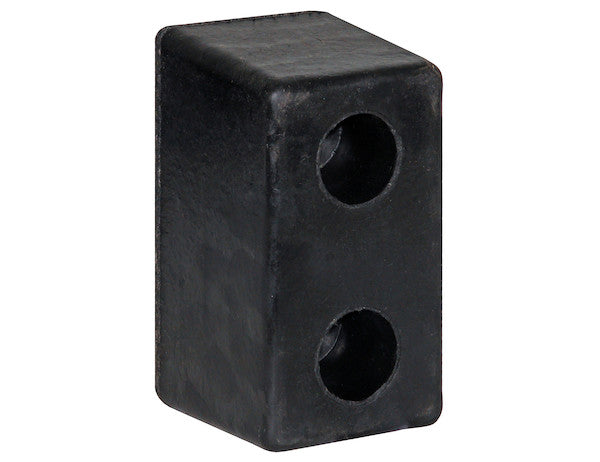
Buyers Products Molded Rectangular Rubber Bumpers help protect the rear of a truck or trailer when backing to a loading dock or delivery bay. Bumpers are an ideal addition to any piece of equipment that has a high frequency of contact, such as a loading dock or delivery bay. Our Rubber Bumpers are constructed from compression-molded rubber for high impact resistance and durability. Sold in pairs and available in various sizes.
Specifications
| Color | Black |
|---|---|
| Depth (in.) | 3-1/2 |
| Height (in.) | 6.00 |
| Hole Dia. | .56 |
| Material | Rubber |
| Mounting Holes Ctr to Ctr (in.) | 3.00 |
| Number of Mounting holes | 2 |
| Sold in Pairs (y/n) | Yes |
| Width (in.) | 3-1/2 |
Advanced Engineering of the Molded Rubber Bumper for Industrial Applications
The Buyers Products Molded Rectangular Rubber Bumper, specifically engineered with dimensions of 3-1/2 inches in width, 3-1/2 inches in depth, and 6 inches in height, represents a critical component in safeguarding valuable assets within the demanding environments of commercial logistics and industrial operations. This meticulously designed set of two bumpers serves as a robust protective interface, strategically mitigating impact forces between heavy-duty vehicles and fixed infrastructure such as loading docks, delivery bays, and other static structures. The professional-grade construction and material science employed in these bumpers ensure superior performance, longevity, and ultimately, a significant reduction in operational downtime and maintenance costs associated with impact-related damage.
Material Science: The Superiority of Compression-Molded Rubber
The foundation of this bumper's exceptional performance lies in its material composition and manufacturing process: high-grade, compression-molded rubber. Unlike extruded or injection-molded alternatives, compression molding imparts specific advantageous characteristics essential for severe-duty applications.
Composition and Polymer Properties
The rubber utilized is typically a durable elastomeric compound, carefully selected for its optimal balance of elasticity, resilience, and resistance to environmental degradation. Key polymer properties include a high tensile strength, indicating its ability to withstand significant pulling forces before tearing, and excellent elongation capabilities, allowing it to stretch considerably and then return to its original shape. This intrinsic elasticity is paramount for absorbing kinetic energy during an impact event, converting it into stored elastic potential energy that is then safely dissipated, rather than transmitting damaging forces to the vehicle or infrastructure.
The Compression Molding Process
Compression molding involves placing a pre-measured amount of raw rubber compound (often in sheet or pre-form form) into a heated mold cavity. The mold is then closed under immense pressure, forcing the rubber to conform to the mold's exact dimensions. The heat initiates a vulcanization (curing) process, where polymer chains cross-link, transforming the rubber from a plastic-like material into a highly elastic and durable thermoset elastomer. This process yields several critical benefits:
- Enhanced Density and Uniformity: Compression molding results in a denser, more homogenous material structure, virtually eliminating voids or weak points that could compromise integrity under stress.
- Superior Physical Properties: The controlled heat and pressure optimize the cross-linking, leading to improved tensile strength, tear resistance, and abrasion resistance compared to other molding methods. This translates directly to a longer service life in abrasive and high-impact environments.
- Dimensional Stability: The cured rubber exhibits excellent dimensional stability, maintaining its precise form even after repeated impacts and exposure to varying temperatures.
- Resistance to Environmental Factors: The robust molecular structure developed through compression molding enhances the rubber's inherent resistance to UV radiation, ozone, moisture, oils, and certain chemicals, which are common corrosive elements in industrial settings.
Precision Engineering and Design: Optimizing Protection and Durability
The specific dimensions and rectangular geometry of these bumpers are not arbitrary; they are the result of careful engineering considerations to maximize protective efficacy and integrate seamlessly into industrial operational contexts.
Dimensional Analysis: 3-1/2 x 3-1/2 x 6 Inches
- Width (3-1/2 inches) and Depth (3-1/2 inches): These dimensions define the primary contact surface area and the volumetric mass of the bumper available for energy absorption. A substantial width and depth ensure that impact forces are distributed over a larger area, reducing localized stress points on both the bumper and the contacting surfaces of the vehicle or dock. This ample cross-section also provides significant material volume to deform and recover, facilitating effective energy dissipation.
- Height (6 inches): The 6-inch height provides a critical vertical buffer, accommodating a range of vehicle heights and ensuring protection across varying trailer bed elevations during dynamic loading and unloading operations. This vertical coverage is crucial for protecting not only the lower chassis but also higher vehicle components such as tailgates, lights, and bodywork from impact damage against dock edges or other vertical obstructions.
Rectangular Geometry for Optimal Load Distribution
The rectangular form factor offers distinct advantages over other shapes. It provides a flat, stable contact surface that efficiently transfers and dissipates force across its entire face. This geometry prevents point loading, which can occur with round or irregularly shaped bumpers, and ensures a consistent protective barrier. The substantial volume of the rectangular block allows for significant elastic deformation upon impact, distributing the kinetic energy throughout the rubber matrix and minimizing the peak force transmitted to the protected structures.
Mounting Integrity: Engineered for Secure Attachment
The bumper design incorporates two precisely located mounting holes with a diameter of 0.56 inches, positioned 3.00 inches center-to-center. This configuration is critical for a secure and durable attachment to vehicle frames or dock structures:
- Hole Diameter (0.56 inches): This size is optimized for common heavy-duty fasteners (e.g., 1/2-inch bolts), ensuring a snug fit that minimizes play and prevents shear forces from prematurely damaging the mounting points or the bumper itself.
- Mounting Holes Center-to-Center (3.00 inches): The precise spacing ensures proper alignment with standard mounting plates or frame members, facilitating straightforward installation and replacement. This spacing also provides a wide enough base for stable attachment, distributing the anchoring forces effectively and preventing the bumper from twisting or detaching under severe impact.
- Number of Mounting Holes (2): Two strategically placed holes provide sufficient anchorage to withstand significant impact and shear forces. This design balances robust attachment with ease of installation and reduced drilling requirements.
Applications and Operational Integration: Essential Protection Across Industries
These molded rubber bumpers are indispensable in a multitude of industrial and commercial settings where vehicle-to-structure contact is a frequent occurrence. Their application extends beyond mere vehicle protection, encompassing asset preservation, safety enhancement, and operational continuity.
Logistics and Warehousing Operations
In high-volume logistics centers, distribution hubs, and warehousing facilities, trucks and trailers are constantly maneuvering into and out of loading docks. The repetitive nature of these operations makes impact damage an inevitable risk. These bumpers act as the primary line of defense, protecting:
- Vehicle Assets: Preventing damage to rear chassis components, taillights, license plates, mud flaps, and overall bodywork of semi-trailers, box trucks, delivery vans, and utility trailers. This extends the operational lifespan of fleets and reduces costly body shop repairs.
- Dock Infrastructure: Shielding concrete dock edges, steel frames, dock levelers, and building walls from abrasive wear, cracks, and structural damage caused by direct vehicle contact. Maintaining dock integrity is crucial for safety and uninterrupted operations.
- Cargo Integrity: By absorbing impact energy, the bumpers indirectly protect sensitive cargo from sudden jolts that could lead to shifting, breakage, or spoilage during docking maneuvers.
Municipal and Utility Fleets
Beyond commercial freight, municipal vehicles such as sanitation trucks, utility service vehicles, and construction equipment often operate in confined spaces or interact with static infrastructure. These bumpers provide essential protection when backing into tight alleys, waste transfer stations, or maintenance bays.
Manufacturing and Industrial Facilities
Within manufacturing plants, heavy machinery and internal transport vehicles often navigate through aisles and around processing equipment. Bumpers offer protection against accidental collisions with sensitive machinery, structural columns, and wall systems, preventing costly damage and production stoppages.
Durability, Performance, and Longevity
The performance profile of the Buyers Products Molded Rectangular Rubber Bumper is characterized by exceptional durability and a long service life, even under extreme operating conditions.
- High Impact Resistance: The robust compression-molded rubber formulation is specifically designed to absorb and dissipate high-energy impacts repeatedly without degradation of its protective capabilities. This means consistent performance over thousands of docking cycles.
- Temperature Extremes: The material retains its elastomeric properties across a broad temperature range, from freezing conditions typical in northern climates or refrigerated environments to the high temperatures encountered in direct sunlight or industrial operations. It resists embrittlement in cold and excessive softening in heat.
- Resistance to Environmental Degradation: The engineered rubber compound is highly resistant to UV radiation, ozone, moisture, and common automotive fluids or cleaning agents. This prevents premature cracking, hardening, or material breakdown, ensuring the bumper maintains its structural integrity and aesthetic appearance over time.
- Abrasion and Tear Resistance: The dense, uniform structure of the compression-molded rubber provides superior resistance to abrasion and tearing, which are common forms of wear and tear encountered during frequent contact with rough concrete or metal surfaces.
Installation Protocol and Maintenance
Proper installation is paramount to maximizing the protective capabilities and longevity of these rubber bumpers. While sold as a set of two, their precise placement and secure fastening are critical.
Recommended Installation Practices
- Surface Preparation: The mounting surface on the truck frame or dock structure should be clean, flat, and free of corrosion or debris to ensure a flush and stable attachment.
- Hardware Selection: Utilizing high-grade, corrosion-resistant fasteners (e.g., Grade 8 bolts, lock washers, and nuts) is essential for a secure, long-lasting installation. The 0.56-inch hole diameter typically accommodates 1/2-inch bolts, providing excellent shear strength.
- Torque Specifications: Fasteners should be torqued to manufacturer-recommended specifications to ensure optimal clamping force without over-stressing the bumper material or the mounting substrate.
- Strategic Placement: Bumpers should be installed symmetrically and at an appropriate height to provide maximum protection for the rear of the vehicle, aligning with the typical impact zones of loading docks or other contact points.
Maintenance and Inspection
Regular inspection is recommended to ensure ongoing efficacy. This involves:
- Visual Check: Inspecting the bumper for signs of significant cracking, tearing, delamination, or excessive wear that might compromise its ability to absorb impact.
- Mounting Integrity: Verifying that all mounting bolts are securely fastened and that the bumper remains tightly affixed to its mounting surface. Loose fasteners can lead to accelerated wear or detachment.
- Environmental Damage: Checking for unusual material degradation due to chemical spills or extreme environmental exposure, although the material is designed to resist such factors.
Despite their robust construction, rubber bumpers are wear items in high-frequency contact applications. Timely replacement of heavily worn or damaged bumpers is crucial to maintain optimal protection levels and prevent damage to both vehicles and infrastructure.
Economic and Safety Benefits: A Prudent Investment
Investing in high-quality molded rubber bumpers offers substantial economic and safety benefits that far outweigh their initial cost.
- Return on Investment (ROI) through Damage Prevention: By preventing costly damage to vehicle chassis, lights, bodywork, and dock structures, these bumpers yield significant savings in repair expenses and insurance claims. A single severe impact can result in repair costs that dwarf the price of multiple bumper sets.
- Reduced Operational Downtime: Vehicle damage or compromised dock infrastructure leads to vehicles being out of service or docks being inaccessible, resulting in lost revenue and operational inefficiencies. Effective bumper protection minimizes these disruptions, ensuring fleets and facilities remain operational.
- Enhanced Workplace Safety: By absorbing and dissipating impact forces, bumpers help prevent structural damage that could lead to unsafe conditions for personnel. They also contribute to a safer environment by providing a clear, resilient contact point, reducing the risk of sudden, jarring impacts that could injure drivers or dock workers.
- Extended Asset Lifespan: Consistent protection from impact extends the service life of both vehicles and permanent infrastructure, postponing capital expenditures for replacement or major repairs.
- Compliance and Best Practices: Utilizing appropriate protective equipment like these bumpers aligns with industry best practices for fleet management and facility safety, potentially aiding in regulatory compliance.
Conclusion
The Buyers Products Molded Rectangular Rubber Bumper (3-1/2 x 3-1/2 x 6 Inch Tall, Set of 2) is a testament to robust engineering and advanced material science applied to a fundamental industrial need. Its design, rooted in the superior properties of compression-molded rubber, provides unparalleled impact resistance, durability, and environmental resilience. From safeguarding intricate vehicle components and preserving critical dock infrastructure to enhancing operational safety and delivering significant economic advantages through damage prevention, these bumpers are an indispensable asset. They represent a prudent, long-term investment for any operation involving heavy vehicle traffic and frequent interactions with static structures, embodying reliability and performance in the most demanding environments.