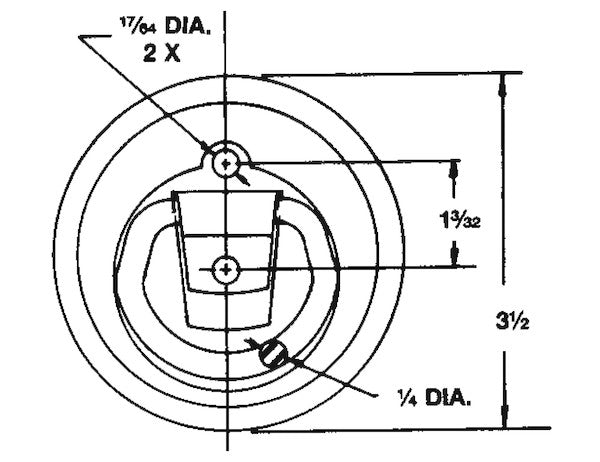
The Surface Mounted or Recessed Rope Ring from Buyers Products can be mounted two ways to meet your needs. Use a plastic bezel with the included recessed pan for surface mounting, or use the pan without the bezel and install the ring anywhere that can accommodate its 3 in. diameter mounting hole. This zinc-plated ring is designed for interior, light capacity use such as inside work vans and enclosed trailers. It has a working load limit of 265 lb. Rope rings are not approved for lifting.
Specifications
| Min. Breaking Strength (lbs) | 795 |
|---|---|
| Mount Type | Either |
| W.L.L. (lbs) | 265 |
Advanced Technical Overview: Surface Mounted or Recessed Rope Ring – Engineering, Application, and Safety
The Surface Mounted or Recessed Rope Ring with a zinc-plated finish and plastic bezel represents a versatile and robust solution for light-capacity cargo securement in a variety of enclosed environments. Engineered by Buyers Products, this component is designed for optimal performance in applications such as work vans, enclosed trailers, and other utility vehicles where reliable tie-down points are paramount for preventing cargo shift during transit. This comprehensive description delves into the intricate design principles, material science, performance specifications, installation methodologies, and safety considerations that underpin the efficacy and reliability of this essential hardware.
Engineering and Design Principles: Adaptable Securement Solutions
The core innovation of this rope ring lies in its dual-mounting capability, offering unparalleled flexibility to adapt to diverse installation requirements and aesthetic preferences. This design addresses the common challenge of integrating securement hardware seamlessly into vehicle interiors while maintaining structural integrity and user convenience.
Dual Mounting Mechanism: Surface vs. Recessed Integration
The product’s versatility is primarily attributed to its intelligent design, which accommodates both surface and recessed mounting configurations. This adaptability is achieved through the inclusion of a specialized recessed pan and a distinct plastic bezel.
- Surface Mounting with Plastic Bezel: When a flush mount is not feasible or desired, the rope ring can be surface mounted. In this configuration, the recessed pan is utilized in conjunction with the included plastic bezel. The bezel serves multiple critical functions: it provides a finished aesthetic, covers the edges of the recessed pan for a cleaner appearance, and mitigates potential snag hazards. Furthermore, the bezel can help distribute the compressive force exerted by fasteners more evenly across the mounting surface, contributing to enhanced stability. This method is particularly beneficial on thin panels or surfaces where cutting a large hole is undesirable or structurally compromising. The surface-mounted design ensures that the functional components of the tie-down are readily accessible and visibly integrated into the interior structure.
- Recessed Mounting without Bezel: For applications demanding a low-profile, flush finish, the recessed pan can be installed directly into a prepared opening without the bezel. This method requires a precisely cut 3-inch diameter mounting hole, allowing the pan to sit flush with the surrounding surface. The primary advantages of recessed mounting include minimizing protrusions into the cargo area, thereby enhancing safety by reducing trip hazards and preventing accidental damage to cargo or personnel. A flush installation also contributes to a cleaner, more professional interior aesthetic, which is often preferred in customized vans or high-end enclosed trailers. The structural integrity of the mounting surface is paramount for recessed installations, as the perimeter of the pan directly transfers load forces to the underlying structure.
In both configurations, the robust design of the pan and the integrated ring ensures efficient transfer of tie-down forces to the vehicle's structural framework, provided appropriate fasteners and reinforcement are used.
Material Science: Zinc Plating for Enhanced Durability
The selection of zinc plating for the rope ring component is a strategic material science decision aimed at optimizing performance within its intended operational environment. Zinc plating is an electrochemical process where a thin layer of zinc is deposited onto a metal substrate, typically steel.
- Corrosion Resistance: The primary benefit of zinc plating is its superior corrosion resistance. Zinc acts as a sacrificial coating, meaning it corrodes preferentially to the underlying steel when exposed to moisture and oxygen. This electrochemical protection significantly extends the lifespan of the rope ring, especially in environments where humidity fluctuations or minor condensation might occur, such as within enclosed trailers or work vans.
- Hardness and Wear Resistance: While not as hard as chrome, zinc plating does offer a degree of surface hardness that contributes to wear resistance, protecting the underlying steel from minor abrasions and scratches that can occur during routine cargo loading and unloading.
- Interior Application Suitability: For interior, light-capacity use, zinc plating strikes an optimal balance between cost-effectiveness and performance. It provides ample protection against common indoor corrosive agents without the need for more expensive, heavy-duty coatings typically required for harsh outdoor or marine environments.
Plastic Bezel Composition: Functionality and Aesthetics
The plastic bezel, integral to the surface mounting option, is typically manufactured from engineering plastics chosen for a specific set of mechanical and aesthetic properties.
- Material Selection: Common plastics for such applications include high-impact ABS (Acrylonitrile Butadiene Styrene) or reinforced polypropylene. These materials are selected for their excellent impact resistance, rigidity, and dimensional stability across a range of operational temperatures.
- Protective and Aesthetic Role: Beyond its structural function in supporting the pan for surface mounting, the bezel serves to finish the installation, providing a clean edge and covering any imperfections in the mounting hole or surrounding surface. Its smooth, non-abrasive surface also minimizes the risk of snagging ropes or straps, enhancing operational safety.
- UV Stability (Interior Context): While primarily for interior use, good quality plastics for the bezel will often possess some inherent UV stability to resist degradation from incidental sunlight exposure through windows or doors, preventing brittleness and discoloration over time.
Performance Specifications and Load Dynamics: Understanding Securement Capabilities
Understanding the specified load limits is paramount for the safe and effective utilization of the rope ring. Buyers Products meticulously defines these parameters to guide users in appropriate application and to ensure operational safety.
Working Load Limit (WLL): 265 lbs
The Working Load Limit (WLL) is the maximum load that can be safely applied to a piece of lifting or securement equipment when the load is uniformly distributed. For this rope ring, the WLL is specified at 265 lbs. This figure represents the practical, safe upper limit for dynamic and static forces encountered during cargo transport.
- Definition: WLL is typically a fraction of the Minimum Breaking Strength (MBS), incorporating a significant safety factor to account for variables such as dynamic loads (shocks, vibrations), material fatigue, environmental conditions, and potential misuse.
- Application Context: A WLL of 265 lbs makes this rope ring ideally suited for securing relatively lightweight items. Examples include toolboxes, small machinery, parts bins, leisure equipment, personal effects, or auxiliary cargo within work vans and enclosed trailers. It is designed to resist forces exerted by shifting cargo under normal driving conditions, including acceleration, deceleration, and cornering.
- Importance: Adhering to the WLL is critical to prevent hardware failure, cargo damage, and potential injury to personnel. Exceeding the WLL significantly compromises the integrity of the securement point and can lead to catastrophic failure during transit.
Minimum Breaking Strength (MBS): 795 lbs
The Minimum Breaking Strength (MBS), also referred to as Ultimate Tensile Strength (UTS), represents the minimum force required to cause permanent deformation or failure of the rope ring under controlled laboratory conditions. For this product, the MBS is 795 lbs.
- Safety Factor Calculation: The relationship between MBS and WLL is critical in determining the inherent safety margin. For this rope ring, the safety factor is calculated as MBS / WLL = 795 lbs / 265 lbs = 3:1. A 3:1 safety factor is a robust industry standard for many tie-down and securement applications, indicating that the component is designed to withstand three times its rated working load before failure. This substantial margin provides a critical safeguard against unforeseen stresses or minor overloads.
- Design for Contingency: The inclusion of a significant safety factor is a testament to the engineering philosophy of anticipating and mitigating potential risks. It ensures that even under conditions exceeding the normal WLL, there is a substantial buffer before structural compromise occurs.
Crucial Limitation: "Rope Rings Are Not Approved For Lifting"
This explicit disclaimer is a vital safety directive and underscores a fundamental distinction in hardware design and application. While the rope ring is engineered for robust cargo securement, it is strictly not intended or approved for lifting operations.
- Tie-Down vs. Lifting: Tie-down points, like this rope ring, are designed to withstand forces primarily exerted at an angle or laterally, keeping cargo pressed against a surface or preventing horizontal movement. These forces are typically static or quasi-static. In contrast, lifting equipment (e.g., lifting eyes, shackles, hoist rings) is designed to bear the full weight of a suspended load, with forces acting predominantly vertically, and often involves dynamic loads during hoisting.
- Stress Vectors and Design Parameters: The geometry and material distribution of tie-down rings are optimized for securement forces. Lifting operations introduce different stress vectors, potentially leading to bending moments, shear stresses, or fatigue loads for which the rope ring has not been designed or tested. Lifting hardware undergoes more rigorous testing and certification processes, often complying with specific industry standards like ASME B30.26 (for detachable lifting devices).
- Consequences of Misuse: Attempting to use this rope ring for lifting purposes could result in catastrophic failure, leading to dropped loads, severe injury, or even fatalities. This warning is not merely a legal disclaimer but a critical safety instruction based on engineering principles.
Installation Guidelines and Best Practices
Proper installation is as crucial as the quality of the hardware itself. Adhering to best practices ensures the rope ring performs to its specifications and provides reliable securement over its lifespan.
Pre-Installation Considerations
- Mounting Surface Assessment: The structural integrity of the mounting surface is paramount. Whether wood, metal, or composite, the surface must be sufficiently robust to support the WLL of the rope ring without deformation or failure. For thinner materials (e.g., sheet metal panels), local reinforcement with backing plates or washers is strongly recommended to distribute fastener loads over a larger area.
- Fastener Selection: While fasteners are typically not included, their selection is critical. For wooden surfaces, appropriately sized wood screws or lag bolts are suitable. For metal, self-tapping screws, machine bolts with nuts and washers, or blind fasteners (rivet nuts) may be used depending on access and desired strength. All fasteners should be of a material compatible with the zinc plating (e.g., galvanized or stainless steel) to prevent galvanic corrosion and ensure long-term durability. The number and size of fasteners must be sufficient to meet or exceed the WLL of the rope ring itself.
- Tooling: Essential tools include a drill, appropriate drill bits, and a 3-inch hole saw for recessed mounting. A tape measure, marker, and safety glasses are also required.
Installation Procedures
- Surface Mounting: Position the pan with the plastic bezel at the desired location. Mark the fastener hole locations. Pre-drill pilot holes if necessary, ensuring they are correctly sized for the chosen fasteners. Secure the pan firmly to the surface, ensuring the fasteners are tightened evenly to prevent distortion.
- Recessed Mounting: Mark the center of the desired installation point. Use a 3-inch hole saw to cut a clean, precise hole. Ensure there is adequate clearance behind the mounting surface for the pan to sit flush. Insert the pan into the hole. Mark the fastener locations and pre-drill pilot holes. Secure the pan with appropriate fasteners, ensuring a flush and stable fit.
Post-Installation Verification
After installation, a thorough inspection is recommended. Verify that all fasteners are securely tightened, the rope ring pivots freely within its pan, and there are no signs of deformation or stress on the mounting surface. Periodically re-check fastener tightness, especially after initial use or exposure to heavy loads and vibrations.
Applications and Target Environments
The Surface Mounted or Recessed Rope Ring is engineered for a diverse range of interior, light-capacity applications where efficient and reliable cargo securement is essential.
- Work Vans: Indispensable for tradespeople, installers, and service technicians. These rings provide secure attachment points for toolboxes, equipment cases, material bins, ladders (when stored horizontally), and other specialized gear, preventing movement during driving and enhancing workplace safety.
- Enclosed Trailers: Ideal for utility, recreational, or small commercial enclosed trailers. They allow users to tie down ATVs, motorcycles, furniture, moving boxes, lawn equipment, or general freight, ensuring items remain stationary and arrive undamaged.
- Utility Vehicles and Truck Beds (Light Duty): For truck beds with caps or covers, or utility vehicles where permanent tie-down points are needed for lighter cargo.
- Workshop and Garage Organization: Can be installed on workbenches, walls (with appropriate backing), or shelves to secure tools, projects, or equipment during work or storage, offering versatile anchoring options.
- Specialty Vehicles: Applicable in emergency response vehicles, mobile labs, or any customized interior requiring modular and adaptable securement solutions.
Maintenance and Longevity
While designed for durability, routine maintenance and adherence to best practices will significantly extend the operational life of the rope ring.
- Regular Inspection: Periodically inspect the rope ring, pan, and mounting surface for any signs of wear, corrosion, deformation, cracking in the plastic bezel, or loose fasteners. Pay close attention to the pivot point of the ring and the areas where it contacts the pan.
- Cleaning: Keep the unit free from dirt, debris, and chemical spills, which can degrade materials or obscure potential damage. A simple wipe-down with a damp cloth is usually sufficient.
- Fastener Integrity: Vibrations and consistent loading can gradually loosen fasteners. Regular checks and re-tightening are crucial to maintain secure attachment.
- Environmental Awareness: Although zinc-plated for corrosion resistance, prolonged exposure to harsh chemicals, excessive moisture, or abrasive conditions beyond its intended interior use should be avoided to prevent premature degradation.
- Replacement Criteria: Any rope ring showing significant signs of wear, deformation, cracking, or corrosion that compromises its structural integrity should be immediately removed from service and replaced.
Conclusion: A Foundation for Secure Transport
The Surface Mounted or Recessed Rope Ring Zinc Plated With Plastic Bezel from Buyers Products stands as a testament to practical engineering and material science, delivering a versatile, durable, and safe solution for interior cargo securement. Its dual-mounting capability, coupled with robust zinc plating and a protective plastic bezel, provides fleet managers, tradespeople, and private users with the flexibility to optimize their cargo spaces. By adhering to the specified Working Load Limit of 265 lbs, respecting the 3:1 safety factor, and strictly observing the "not approved for lifting" directive, users can confidently rely on this component to ensure their valuable cargo remains secure and stable, contributing to safer transit and operational efficiency. This rope ring is more than just a piece of hardware; it is an integral component in the responsible management of mobile assets.