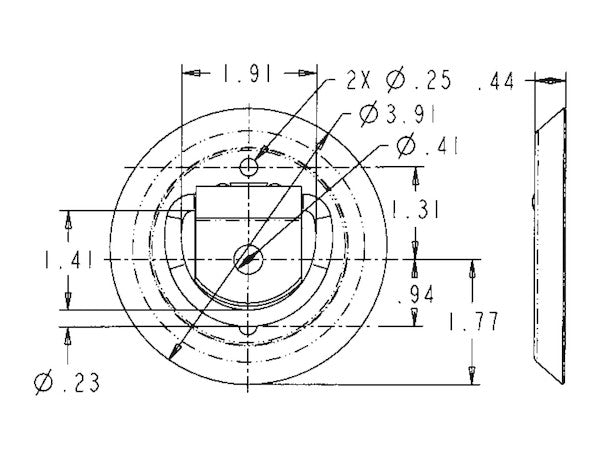
The Rope Ring with Plastic Surface Mount from Buyers Products is zinc-plated and carries a working load limit of 1,000 lb. Rope rings are not approved for lifting.
Specifications
| Min. Breaking Strength (lbs) | 3,000 |
|---|---|
| Mount Type | Surface |
| W.L.L. (lbs) | 1,000 |
Advanced Technical Overview: Surface Mounted Rope Ring with Plastic Pan and 1/4 Inch Steel Ring
This comprehensive technical description details the engineering, material science, performance characteristics, and application considerations of the Surface Mounted Rope Ring featuring a Plastic Pan and a 1/4 Inch Diameter Steel Ring, manufactured by Buyers Products. Designed specifically for robust cargo securement applications, this component provides a reliable anchor point with a rated Working Load Limit (WLL) of 1,000 lb and a Minimum Breaking Strength (MBS) of 3,000 lb. It is critically important to note that, in accordance with industry safety standards and regulatory guidelines, this rope ring assembly is strictly not approved for lifting operations.
I. Engineering and Material Specifications
A. The 1/4 Inch Diameter Steel Ring: Core of Securement
The primary load-bearing element of this assembly is the 1/4 inch diameter steel ring. The selection of steel as the base material is paramount due to its inherently high tensile strength, yield strength, and ductility, properties that are crucial for applications involving dynamic and static load forces in cargo securement. The specific grade of steel utilized, while proprietary, is engineered to meet the demanding mechanical properties required for a 1,000 lb WLL and a 3,000 lb MBS. A 1/4 inch (approximately 6.35 mm) diameter provides an optimal balance between strength and compatibility with various tie-down equipment such as ropes, bungee cords, light-duty chains, and cam buckle straps.
To enhance its durability and operational lifespan, the steel ring undergoes a meticulous zinc-plating process. Zinc plating, typically applied through electrodeposition, creates a thin, sacrificial layer of zinc on the steel surface. This layer serves as an anodic barrier, preferentially corroding before the underlying steel substrate in the presence of moisture and other corrosive agents. The benefits of zinc plating are multi-faceted:
- Corrosion Resistance: Significant protection against rust and oxidation, particularly vital in outdoor or harsh environmental conditions where exposure to rain, road salt, and humidity is common.
- Abrasion Resistance: While not its primary function, the zinc layer provides a degree of protection against minor abrasions, which can compromise the integrity of unprotected steel.
- Aesthetics: The bright, silvery finish imparted by zinc plating contributes to the professional appearance of the hardware.
- Extended Service Life: By mitigating corrosion, zinc plating extends the functional life of the steel ring, reducing the frequency of replacement and maintenance.
The ring's construction, whether seamless or welded, is designed to ensure uniform load distribution and prevent localized stress concentrations under operational loads. Quality control measures during manufacturing ensure the integrity of the steel and the consistency of the zinc plating.
B. The Plastic Pan: Structural Integration and Protection
The steel ring is housed within a robust plastic pan, designed for surface mounting. The choice of polymer for the pan is critical for its performance characteristics. While the specific plastic compound is not detailed, typical materials used for such applications include high-density polyethylene (HDPE), nylon, or impact-modified ABS. These materials are selected for their advantageous properties:
- Impact Resistance: Essential for resisting damage from accidental bumps, drops, or shifting cargo, especially in dynamic environments.
- UV Stability: If exposed to sunlight, the plastic formulation must incorporate UV inhibitors to prevent degradation, embrittlement, and discoloration over time.
- Temperature Range: The pan must maintain its structural integrity and mechanical properties across a wide range of operating temperatures, from extreme cold to high heat, without becoming brittle or deforming.
- Chemical Resistance: Resistance to common chemicals found in transport environments, such as fuels, oils, solvents, and cleaning agents, prevents material degradation.
- Weight Reduction: Compared to an all-metal pan, a plastic pan offers a significant weight advantage, contributing to overall vehicle efficiency without compromising securement capability.
- Non-Corrosive Nature: The plastic pan itself is inherently resistant to rust and most forms of chemical corrosion, complementing the zinc-plated steel ring.
The pan's design incorporates a surface mount configuration, which offers several installation and operational benefits. The low-profile nature of a surface-mounted pan minimizes protrusion, reducing the risk of snags or damage when not in use. The design facilitates straightforward installation onto various flat surfaces, including trailer beds, truck floors, cargo van walls, and workshop benches, requiring only appropriate fasteners to secure it. The pan typically includes pre-drilled or marked mounting holes, ensuring proper alignment and load transfer into the underlying structure. The pan also serves to protect the mounting surface from direct contact with the steel ring, preventing scratches or wear during use, and potentially aiding in dampening noise and vibration.
II. Performance Metrics and Safety Protocols
A. Working Load Limit (WLL) - 1,000 lb
The Working Load Limit (WLL) of 1,000 lb (approximately 453.6 kg) represents the maximum static or dynamic load that the rope ring assembly is designed to safely withstand during normal operational conditions. The WLL is a critical safety parameter derived from the Minimum Breaking Strength (MBS) divided by an appropriate safety factor. For cargo securement hardware, a common safety factor is 3:1, implying that the WLL is one-third of the MBS. This inherent safety margin accounts for various real-world variables, including:
- Dynamic Loading: Forces experienced during sudden stops, acceleration, turns, and road irregularities.
- Shock Loads: Momentary forces significantly higher than the static load.
- Material Fatigue: Degradation of material properties over time due to repeated stress cycles.
- Environmental Factors: Temperature fluctuations, moisture, and chemical exposure that might subtly affect material strength.
- Manufacturing Tolerances: Inherent variations in material properties and dimensions within acceptable manufacturing limits.
- Wear and Tear: Gradual loss of material due to abrasion or minor damage during use.
Adherence to the specified WLL is not merely a recommendation but a regulatory and ethical imperative. Overloading the rope ring beyond its WLL significantly increases the risk of component failure, potentially leading to cargo shifting, damage to property, severe injury, or even fatalities. Users must always ensure that the cumulative WLL of all securement devices used on a particular piece of cargo is sufficient for the cargo's weight and the forces it will encounter.
B. Minimum Breaking Strength (MBS) - 3,000 lb
The Minimum Breaking Strength (MBS) of 3,000 lb (approximately 1360.8 kg) is the minimum force that the rope ring assembly is guaranteed to withstand before experiencing permanent deformation or catastrophic failure under a controlled destructive test. This value is determined through rigorous testing processes, where samples are subjected to incrementally increasing loads until failure occurs. The MBS is a fundamental engineering specification that informs the WLL and underscores the robust design of the product.
The relationship between MBS and WLL for this product demonstrates a safety factor of 3:1 (MBS 3,000 lb / WLL 1,000 lb = 3). This safety factor is consistent with industry best practices for general cargo securement hardware, providing a substantial buffer against unforeseen operational stresses and ensuring a high degree of reliability when the product is used within its specified WLL. Understanding the MBS provides confidence in the product's ultimate strength capability, even as it reinforces the importance of operating strictly within the WLL for safe and compliant operation.
C. Critical Safety Advisory: "Not Approved for Lifting"
The explicit statement "Rope rings are not approved for lifting" is a paramount safety warning that distinguishes cargo securement hardware from overhead lifting apparatus. This distinction is critical and legally enforceable. Lifting operations, which involve vertically suspending and moving loads, are governed by an entirely different set of stringent engineering standards, safety factors, and regulatory bodies (e.g., ASME B30 series for Cranes and Lifting Devices, OSHA 29 CFR 1910.184 for Slings). Lifting hardware typically incorporates higher safety factors (e.g., 5:1 or even 8:1 for personnel lifting) and often features specific design elements (e.g., proof testing, material traceability) that are not present in cargo securement hardware.
The misuse of this rope ring for lifting purposes, even for loads well below its WLL or MBS, could result in catastrophic failure. The forces involved in lifting, particularly dynamic forces during acceleration, deceleration, or swinging of a suspended load, can be far more complex and exert different stress profiles on hardware than those encountered in static or dynamic cargo securement on a flat surface. Such failure could lead to severe injury, fatality, or significant property damage. Users are strictly advised to employ only purpose-built, certified lifting equipment for any overhead lifting application and to adhere meticulously to all relevant lifting standards and regulations.
III. Applications and Installation Considerations
A. Versatile Applications
The Surface Mounted Rope Ring with Plastic Pan is engineered for a broad spectrum of non-lifting cargo securement applications across various industries and personal uses. Its design caters to scenarios where a fixed, robust tie-down point is required. Common applications include:
- Commercial Transportation: Securing cargo within trucks, trailers, flatbeds, cargo vans, and utility vehicles. This includes everything from pallets and equipment to loose items and machinery.
- Recreational Vehicles (RVs) and Powersports: Providing anchor points in toy haulers, enclosed trailers, and truck beds for securing motorcycles, ATVs, UTVs, dirt bikes, and other recreational equipment.
- Marine Environments: While the plastic pan offers inherent corrosion resistance and the steel ring is zinc-plated, suitability for direct salt-water immersion should be evaluated. However, it is ideal for securing gear on boats, kayaks, or pontoons on decks or in storage compartments, or for dockside securement of light craft.
- Industrial and Workshop Settings: Anchoring tools, equipment, or materials within workshops, garages, and storage facilities to prevent movement.
- Agricultural Use: Securing farming equipment, feed sacks, or other items on utility trailers or farm vehicles.
- Home and DIY: Creating tie-down points in garages, sheds, or on utility trailers for everyday securement needs.
It is compatible with a variety of securement devices, including ropes of various diameters, bungee cords, cam buckle straps, and light-duty ratchet straps, provided their end fittings (hooks, loops) can interface with the 1/4 inch steel ring and their WLL aligns with the application.
B. Installation Best Practices
Proper installation is paramount to ensuring the rope ring assembly achieves its full WLL and performs reliably. As a surface-mounted component, its strength is directly dependent on the integrity of the mounting surface and the fasteners used. Key considerations include:
- Surface Selection: Mount the ring on a flat, structurally sound surface capable of supporting the anticipated loads. This typically involves truck beds (metal or reinforced wood), trailer floors, steel frames, or heavy-gauge sheet metal. Avoid mounting on thin, unsupported panels or materials prone to splitting or cracking.
- Fastener Selection: Utilize high-strength fasteners appropriate for the substrate material. For metal, grade 5 or grade 8 bolts, self-tapping screws, or rivets may be suitable, ensuring proper thread engagement. For wood, robust wood screws or through-bolts with washers and nuts are recommended. Fasteners should be corrosion-resistant (e.g., zinc-plated, stainless steel) to match the hardware's longevity.
- Number of Fasteners: The plastic pan design will dictate the number and spacing of mounting holes. Ensure all available mounting points are utilized with appropriate fasteners to distribute the load effectively.
- Reinforcement: For applications approaching the WLL or for softer substrates, consider reinforcing the mounting area with backing plates or additional structural members to spread the load and prevent pull-through.
- Torque Specifications: Fasteners should be tightened to the manufacturer's recommended torque specifications to ensure a secure connection without over-stressing the pan or the mounting surface.
- Clearance: Ensure sufficient clearance around the installed rope ring to allow full articulation of the steel ring and easy attachment/detachment of securement devices.
- Inspection Post-Installation: After installation, visually inspect the assembly to ensure it is firmly seated, and the fasteners are tight. Periodically check fasteners for looseness, especially after initial use.
IV. Maintenance and Longevity
While designed for durability, routine inspection and basic maintenance contribute significantly to the prolonged and safe operation of the rope ring. Users should implement a systematic inspection regimen:
- Visual Inspection: Before each use, inspect the steel ring for signs of deformation, bends, cracks, excessive wear, or severe corrosion (e.g., red rust compromising the base metal). Examine the zinc plating for signs of flaking or significant loss.
- Plastic Pan Integrity: Check the plastic pan for cracks, chips, impact damage, or discoloration that might indicate UV degradation or material fatigue. Ensure the pan is securely fastened to the mounting surface and that no fasteners are loose or missing.
- Fastener Security: Verify that all mounting fasteners remain tight and show no signs of loosening, pull-out, or corrosion.
- Functionality: Ensure the steel ring articulates freely within the plastic pan, allowing for proper attachment of tie-down devices.
- Cleaning: Periodically clean the assembly to remove dirt, mud, salt, or chemical residues that could accelerate wear or corrosion. A mild detergent and water are typically sufficient.
- Replacement Criteria: Any rope ring assembly exhibiting significant damage, permanent deformation (bent ring), severe corrosion, or compromised mounting integrity should be immediately removed from service and replaced to maintain safety standards. Do not attempt to repair damaged load-bearing hardware.
V. Conclusion: A Reliable Solution for Secure Cargo Transport
The Surface Mounted Rope Ring with Plastic Pan and 1/4 Inch Diameter Steel Ring from Buyers Products represents a meticulously engineered solution for a wide array of cargo securement requirements. Its design integrates high-strength, zinc-plated steel with a durable, weather-resistant plastic pan, providing a robust, corrosion-resistant anchor point. With a Working Load Limit of 1,000 lb and a Minimum Breaking Strength of 3,000 lb, it offers a substantial safety margin for non-lifting applications. The surface-mounted configuration ensures ease of installation and versatility across numerous platforms, from commercial transport to recreational vehicles and workshop environments.
Emphasis on its explicit classification as non-lifting hardware is crucial for user safety and regulatory compliance. By understanding its technical specifications, adhering to proper installation procedures, and maintaining a routine inspection schedule, users can leverage this rope ring to ensure the safe, compliant, and efficient transport of goods, protecting both cargo and personnel.