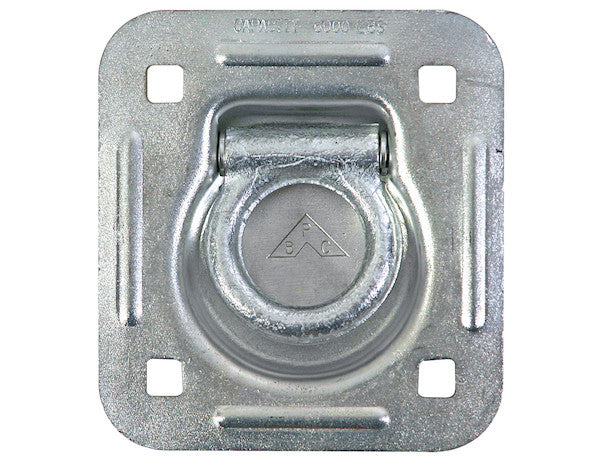
The Heavy Duty Recessed Rope Ring from Buyers Products features high capacity holding power for your service body or other commercial work truck. It carries a working load limit of 2,000 lb. Designed for exterior use, this ductile iron rope ring is available with several mounting/finish options, including an optional back plate. Rope rings are not approved for lifting.
Specifications
| Finish | Zinc Plated |
|---|---|
| Min. Breaking Strength (lbs) | 6,000 |
| Mount Type | Recessed |
| W.L.L. (lbs) | 2,000 |
Optimizing Cargo Securement: An In-Depth Technical Review of the Heavy Duty Recessed Rope Ring
In the demanding world of commercial transportation and fleet operations, the integrity and reliability of cargo securement systems are paramount. The Heavy Duty Recessed Rope Ring, zinc plated, from Buyers Products represents a critical component in ensuring the safe and efficient transport of goods, tools, and equipment on service bodies, commercial work trucks, and various trailer configurations. Engineered for resilience and designed for seamless integration, this product is more than just a tie-down point; it is a meticulously crafted element contributing to overall operational safety and efficiency.
Material Science and Engineering: The Foundation of Durability
At the core of this rope ring's robust performance lies its construction from ductile iron. Ductile iron, also known as spheroidal graphite cast iron, is a specialized ferrous alloy distinguished by its unique microstructure. Unlike traditional grey cast iron, where graphite appears as irregular flakes that can act as stress concentrators and limit tensile strength, ductile iron features graphite in spheroidal or nodular forms. This microscopic difference fundamentally alters its mechanical properties, imparting significantly enhanced ductility, toughness, and impact resistance without compromising its high tensile strength and compressive strength. The result is a material capable of withstanding considerable shock loads and dynamic stresses encountered during vehicle operation, far surpassing the brittle characteristics of conventional cast iron. This makes ductile iron an ideal choice for heavy-duty components that require both strength and the ability to deform plastically under extreme loads before fracturing.
Complementing the inherent strength of ductile iron is the protective layer of zinc plating. Zinc plating is a universally recognized and highly effective method for preventing corrosion on steel and iron components. The process typically involves electroplating, where a thin, uniform layer of zinc is deposited onto the rope ring's surface. Zinc provides cathodic or sacrificial protection; in the presence of an electrolyte (such as moisture, road salt, or environmental pollutants), the zinc coating will preferentially corrode, effectively protecting the underlying ductile iron substrate from oxidation. This sacrificial action extends the service life of the rope ring, preserving its structural integrity and aesthetic appearance even in harsh outdoor environments characterized by varying temperatures, humidity, and exposure to corrosive agents. The zinc plating ensures that the rope ring maintains its operational functionality and cosmetic appeal over an extended period, significantly reducing the need for premature replacement due to rust or material degradation.
Design Principles: Recessed Mounting for Enhanced Functionality and Safety
The "recessed" mount type is a key engineering decision that offers substantial advantages over surface-mounted alternatives. A recessed design allows the rope ring to sit flush with or slightly below the mounting surface of the vehicle or trailer bed. This design minimizes protrusion, thereby significantly reducing the risk of snagging on cargo, clothing, or other equipment. This feature is particularly crucial in high-traffic work environments where personnel and equipment frequently move around the truck bed. Furthermore, a flush mounting profile offers protection to the rope ring itself, shielding it from direct impacts that could occur during loading, unloading, or general operation, which might otherwise deform or damage a surface-mounted component. Beyond functional benefits, the recessed installation contributes to a cleaner, more integrated aesthetic, enhancing the professional appearance of the vehicle.
The geometry of the rope ring itself is optimized for securement applications. Its generous internal diameter and smooth, radiused edges facilitate easy threading of ropes, straps, and various tie-down hooks, minimizing wear and abrasion on the securement devices themselves. This careful consideration of design ensures that the contact points between the rope ring and the tie-down mechanism are distributed effectively, preventing localized stress concentrations that could lead to premature failure of either the ring or the strap. The ductile iron's inherent toughness further contributes to its ability to resist deformation and wear at these critical contact points over repeated use cycles.
Performance Metrics: Working Load Limit (WLL) and Minimum Breaking Strength (MBS)
The operational capabilities of the Heavy Duty Recessed Rope Ring are quantitatively defined by its Working Load Limit (WLL) and Minimum Breaking Strength (MBS). These specifications are fundamental to understanding the product's capacity and safe application parameters. The rope ring boasts a WLL of 2,000 lbs (approximately 907 kg) and an MBS of 6,000 lbs (approximately 2,721 kg).
The Minimum Breaking Strength (MBS) represents the absolute minimum force required to cause a component to fail when subjected to a static, steadily increasing load. It is a critical metric for material and design validation, ensuring the component possesses a baseline of extreme resilience. The 6,000 lb MBS indicates a robust engineering margin.
The Working Load Limit (WLL), on the other hand, is the maximum load that a component, system, or piece of equipment is designed to safely support under normal operating conditions. The WLL is derived from the MBS by applying a safety factor. For this rope ring, with an MBS of 6,000 lbs and a WLL of 2,000 lbs, the implicit safety factor is 3:1 (MBS / WLL = 6000 lbs / 2000 lbs = 3). This 3:1 safety factor is a standard and robust ratio for non-lifting tie-down components in the commercial transportation industry, providing a substantial buffer against unforeseen dynamic loads, shock forces, and potential minor overloads that can occur during transit. It is crucial for fleet operators and drivers to adhere strictly to the WLL to ensure the continued safety and longevity of the securement system and, most importantly, the cargo itself.
It is imperative to reiterate the explicit directive that "Rope rings are not approved for lifting." While the WLL and MBS values are substantial, lifting applications impose unique and significantly more stringent design requirements, safety factors (often 4:1 or 5:1 for lifting devices), dynamic load considerations, and regulatory certifications (e.g., ASME B30 standards for rigging hardware). The design, testing, and material properties required for lifting points are distinct from those for cargo securement, where loads are primarily static or quasi-static with dynamic excursions. Using these rope rings for overhead lifting could lead to catastrophic failure, severe injury, or property damage, and is strictly prohibited.
Installation Protocols and Structural Integration
Proper installation is paramount to achieving the specified WLL and ensuring the overall integrity of the cargo securement system. The availability of "several mounting/finish options, including an optional back plate," highlights the product's adaptability to diverse vehicle structures. When installing, it is critical to select a mounting location on the vehicle's body or trailer bed that possesses sufficient structural rigidity. This often necessitates reinforcing the mounting surface, particularly if it is constructed from thin-gauge sheet metal or composite materials.
The "optional back plate" is a crucial accessory for optimal installation, especially on surfaces that may not inherently possess the necessary strength to withstand the concentrated forces of a loaded tie-down. A back plate, typically a robust steel or iron component, is installed on the underside of the mounting surface. Its primary function is to distribute the compressive and tensile forces generated by the rope ring over a much larger area of the vehicle's structure. This effectively prevents localized deformation, tearing, or pull-through of the mounting material, thereby maximizing the effective WLL of the entire securement point. When utilizing a back plate, it is essential to use high-grade fasteners (e.g., Grade 8 bolts or metric equivalent 10.9) that pass through both the rope ring, the mounting surface, and the back plate, secured with appropriate locking nuts and washers, torqued to manufacturer specifications.
Furthermore, given that these rope rings are "Designed for exterior use," attention to environmental sealing during installation is vital. Employing industrial-grade sealants (e.g., polyurethane or silicone-based sealants) around the perimeter of the recessed opening and fastener penetrations will prevent water ingress into the vehicle's structural cavities. This critical step protects against internal corrosion, preserves the integrity of the vehicle's body, and prevents potential issues such as electrical shorts or premature degradation of interior components due to moisture.
Application Versatility Across Commercial Fleets
The Heavy Duty Recessed Rope Ring is an indispensable asset across a broad spectrum of commercial vehicle applications:
- Service Bodies: Essential for securing a wide array of tools, spare parts, generators, compressors, and diagnostic equipment. Their recessed design prevents snags in cramped compartments and maintains clear pathways.
- Utility Trucks: Ideal for tying down ladders, piping, spools of cable, and various construction materials, ensuring they remain stable during transport to job sites.
- Flatbed Trucks and Trailers: Critical for securing heavy machinery, construction materials, agricultural equipment, and palletized loads, providing reliable anchor points for straps and chains.
- Enclosed Trailers: Used to prevent shifting of sensitive equipment, furniture, consumer goods, or recreational vehicles (e.g., motorcycles, ATVs) within the enclosed space, protecting both the cargo and the trailer's interior.
- Marine and Agricultural Settings: While not for direct marine immersion, their corrosion resistance makes them suitable for securing gear on trailers transporting boats or equipment in coastal regions. In agriculture, they can secure tools and implements on utility vehicles.
Maintenance and Longevity
Despite their robust construction, routine inspection and basic maintenance are advisable to ensure the long-term performance and safety of these rope rings. Periodic visual inspections should check for any signs of wear, deformation, cracking, or severe corrosion that might compromise structural integrity. While zinc plating offers excellent protection, prolonged exposure to abrasive forces or extreme corrosive environments can eventually lead to localized wear or breakdown of the coating. In such instances, minor surface rust can often be remediated with appropriate rust converters and touch-up coatings designed for metal surfaces. Ensuring the mounting fasteners remain adequately torqued is also a good practice. By adhering to a simple inspection regimen, fleet operators can maximize the lifespan of these components and proactively address potential issues before they escalate.
Conclusion: A Strategic Investment in Safety and Efficiency
The Heavy Duty Recessed Rope Ring, zinc plated, from Buyers Products represents a significant investment in operational safety, efficiency, and longevity for any commercial fleet or heavy-duty application. Its superior material composition (ductile iron), advanced corrosion protection (zinc plating), intelligent recessed design, and independently validated load capacities (2,000 lb WLL, 6,000 lb MBS) collectively position it as a premium cargo securement component. While its design strictly precludes lifting applications, its performance as a tie-down anchor is unassailable. By integrating such meticulously engineered components, businesses can ensure compliance with safety regulations, protect valuable cargo, minimize damage, and ultimately enhance the overall professionalism and reliability of their operations. The choice of this rope ring is a testament to prioritizing durability, safety, and functional design in the demanding environment of commercial transportation.