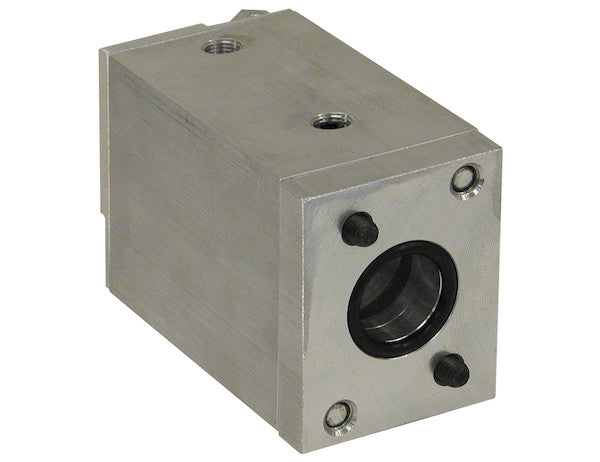
Buyers Products Air Shift Cylinder converts a manually controlled pump to pneumatic control. It comes complete with a pump activator cylinder and mounting hardware. This hydraulic pump air shift cylinder works on Buyers Products H101 and H102 series pumps as well as Permco?? DM300/DM400 units.
Specifications
| For Use With | H101/102 pumps only |
|---|
The Buyers Products Air Shift Cylinder represents a pivotal component in the optimization and automation of hydraulic pump systems, particularly those categorized as smaller hydraulic pumps. Engineered for precision and durability, this device facilitates the seamless transition from manual to pneumatic control, offering significant operational advantages in terms of efficiency, safety, and remote accessibility. Its primary function is to actuate the shift mechanism of a hydraulic pump, enabling system operators to engage or disengage the pump's power take-off (PTO) or control its flow direction using compressed air.
At its core, the Air Shift Cylinder operates on fundamental principles of pneumatics, converting the energy of compressed air into linear mechanical motion. The unit comprises a robust cylinder housing, a piston, a rod, and a series of seals designed to withstand the rigors of demanding industrial and mobile applications. When compressed air is directed into one side of the cylinder, it exerts pressure on the piston, causing it to move along the cylinder bore. This linear motion is then transmitted via the piston rod to the pump's control linkage, effectively shifting its operational state. The reverse action occurs when air is vented or directed to the opposite side of the piston, retracting the rod and returning the pump to its initial state.
The design philosophy behind the Buyers Products Air Shift Cylinder emphasizes both reliability and ease of integration. The complete kit includes the pump activator cylinder itself, along with all necessary mounting hardware. This comprehensive approach ensures that system integrators and maintenance professionals have everything required for a straightforward installation, minimizing downtime and simplifying the conversion process. The mounting hardware is meticulously designed to provide a secure and stable attachment to various pump configurations, guaranteeing consistent and accurate actuation over extended operational cycles. Material selection for the cylinder and its components prioritates longevity and resistance to environmental factors common in hydraulic systems, such as vibration, temperature fluctuations, and exposure to hydraulic fluids.
A critical aspect of this Air Shift Cylinder's versatility lies in its specified compatibility. It is engineered to function seamlessly with Buyers Products H101 and H102 series pumps. These series are recognized within the industry for their compact design and suitability for a wide range of smaller-scale hydraulic applications, often found in vocational trucks, municipal equipment, and agricultural machinery. Furthermore, the cylinder extends its compatibility to Permco DM300 and DM400 units. Permco pumps, particularly these series, are widely adopted for their robust performance and adaptability in diverse hydraulic circuits. This broad compatibility underscores the Buyers Products Air Shift Cylinder's utility as a standardized solution for enhancing the control capabilities of several prevalent hydraulic pump models, providing a cost-effective upgrade path for operators seeking improved system management.
The technical advantages of implementing pneumatic control via an air shift cylinder are manifold. Firstly, it facilitates remote operation. Unlike manual levers which require direct physical interaction, a pneumatic system can be actuated from a distance using simple electrical switches or pneumatic control valves. This is particularly beneficial in applications where the pump is located in an inaccessible or hazardous area, or where centralized control from a vehicle cab or control panel is desired. Remote control enhances operator safety by removing them from potentially dangerous moving parts or high-pressure environments.
Secondly, pneumatic control offers superior precision and repeatability. The consistent pressure of compressed air ensures that the shift mechanism engages fully and accurately every time, reducing the risk of partial engagement or misalignment that can occur with manual operations. This precision contributes to extended pump life by minimizing wear and tear associated with imprecise shifting. The rapid response time of pneumatic systems also allows for quicker engagement and disengagement of the pump, improving overall operational efficiency, especially in applications requiring frequent cycling.
Thirdly, pneumatic systems generally involve fewer moving parts than complex mechanical linkages, leading to reduced maintenance requirements and increased reliability. The air shift cylinder itself is a sealed unit, protecting internal components from contaminants. Routine maintenance primarily involves ensuring a clean, dry air supply and periodic inspection of air lines and connections. The simplicity of pneumatic logic circuits also contributes to easier troubleshooting and diagnosis should an issue arise.
From a technical specification standpoint, while the primary focus is on its application, it is essential to consider the underlying engineering principles. The cylinder bore diameter, piston rod diameter, and stroke length are critical dimensions that determine the force output and travel distance. These parameters are carefully selected to provide sufficient force to overcome the internal resistance of the pump's shift mechanism while ensuring adequate stroke to fully engage or disengage the control. The operating pressure range of the cylinder is also a key factor, dictating the required air supply pressure. Modern air shift cylinders are designed to operate efficiently within standard industrial air pressure ranges, typically 80-120 psi (5.5-8.3 bar).
Materials science plays a crucial role in the durability and performance of the Air Shift Cylinder. The cylinder barrel is often constructed from high-strength aluminum alloys or honed steel, offering excellent corrosion resistance and dimensional stability. The piston rod is typically hard chrome-plated steel, providing a smooth, wear-resistant surface that minimizes friction and enhances seal life. Seals, often made from advanced elastomers like nitrile rubber (Buna-N) or polyurethane, are chosen for their excellent sealing properties, resistance to hydraulic fluids and lubricants, and ability to perform across a wide temperature range. These material choices collectively contribute to the cylinder's robust performance in demanding operational environments.
The integration process typically involves connecting the air shift cylinder to the hydraulic pump's shift lever or mechanism using the provided mounting hardware. An air line, typically a reinforced pneumatic hose, is then connected from the cylinder's port to a pneumatic control valve. This control valve, which can be manually operated, electrically actuated (solenoid valve), or pilot-operated, allows the operator to direct compressed air to the cylinder. The pneumatic control system also requires a filtered and regulated air supply to ensure optimal cylinder performance and longevity. An air dryer is often recommended in humid environments to prevent moisture ingress into the pneumatic system, which can lead to corrosion and premature component failure.
Considering the specific applications of the H101/H102 and DM300/DM400 pumps, these are often found in environments where reliability is paramount. For example, in refuse trucks, snowplows, or utility vehicles, the ability to quickly and reliably engage the hydraulic system for lifting, plowing, or operating auxiliary equipment is critical for operational efficiency and safety. The Air Shift Cylinder provides this critical interface, transforming a manual operation into a streamlined, repeatable, and often automated process.
For fleet managers and equipment operators, the investment in an Air Shift Cylinder translates into several long-term benefits. Reduced operator fatigue is a direct outcome of eliminating strenuous manual shifting. Enhanced equipment uptime is achieved through increased reliability and simplified maintenance. The potential for integrating the hydraulic system into a broader vehicle control network through electrical signaling to a solenoid valve further elevates the level of automation and control, potentially enabling advanced telematics or diagnostic capabilities. This modern approach to hydraulic pump control is not merely an upgrade; it is a step towards more intelligent, efficient, and safer equipment operation.
In conclusion, the Buyers Products Air Shift Cylinder for smaller hydraulic pumps is more than just an accessory; it is an essential component for modernizing and optimizing hydraulic systems. By converting manual control to pneumatic control, it delivers significant improvements in operator safety, system efficiency, precision, and remote accessibility. Its robust construction, thoughtful design, and specified compatibility with popular pump series like Buyers Products H101/H102 and Permco DM300/DM400 ensure a reliable and effective solution for a diverse range of vocational and industrial applications. This product embodies a commitment to engineering excellence, providing a durable and high-performing interface that extends the capabilities and service life of critical hydraulic equipment.