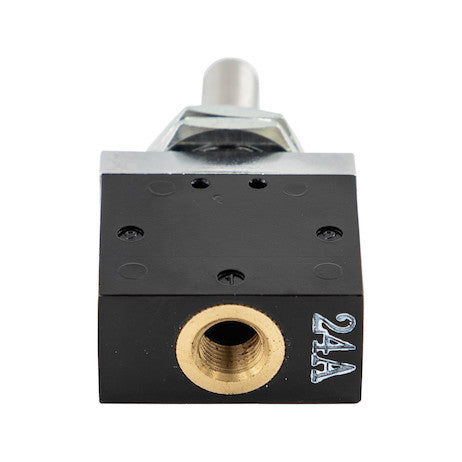
Buyers Products Neutral Lockout Toggle with 3 Position Detents can control pumps, valves, or tailgate cylinders. It is also available in a momentary switch style.
Specifications
| Feathering | No |
|---|---|
| Neutral Lock Out (y/n) | Yes |
| Number of Detents | 3 |
| Number of Ports | 2 |
| Port Size | 0.250 |
| Port Type | NPT |
| Rated Pressure | 125 |
| Spring to Neutral / Deadman Control (y/n) | N |
| Valve Action | Neutral Lockout |
| Valve Actuation | Manual Toggle |
| Valve Primary Application | Toggle 3 Position Detented Valve Only |
The Neutral Lockout Toggle 3-Position Detented Valve Only represents a precision-engineered control solution designed for a multitude of demanding hydraulic and pneumatic applications. As a standalone valve component, it offers unparalleled flexibility for integration into existing systems or for the design of new fluid power circuits where robust, reliable, and safe manual control is paramount. This detailed technical description will elaborate on its features, operational principles, application versatility, and the critical benefits it provides in industrial and mobile equipment environments.
At its core, this valve is characterized by its "Neutral Lockout" capability. This feature is not merely a convenience but a crucial safety mechanism. In complex machinery, inadvertent actuation of hydraulic functions can lead to severe safety hazards, operational errors, and potential equipment damage. The neutral lockout mechanism ensures that the valve remains securely in its central, inactive position until deliberately disengaged by the operator. This provides a tangible barrier against accidental engagement of pumps, movement of cylinders, or activation of other hydraulic components. For applications such as operating tailgate cylinders on dump trucks, utility vehicles, or snowplow blades, where unexpected movement could cause injury or property damage, the neutral lockout offers an essential layer of protection, requiring a conscious, intentional action from the operator to initiate movement.
Complementing the neutral lockout is the "3-Position Detented" design. A detent system provides distinct, tactile feedback for each operational position, ensuring that the operator can confidently feel and confirm the valve's state without needing visual confirmation. In the context of a 3-position valve, these detents typically correspond to "Extend," "Neutral/Hold," and "Retract" for double-acting cylinders, or "On," "Off," and "Standby" for pump control applications. Unlike momentary switches, which return to a neutral position upon release, detented valves maintain their selected position without continuous operator input. This characteristic is invaluable in scenarios where a function needs to be sustained for an extended period, such as holding a tailgate open, maintaining a lift arm at a certain height, or keeping a pump engaged. The detents provide a positive 'click' or 'snap' into place, giving the operator assurance that the valve is locked into the desired state, thereby enhancing operational precision and reducing operator fatigue.
The "Valve Action" is specifically designated as "Neutral Lockout," directly referring to the integrated safety feature discussed. The "Valve Actuation" is a "Manual Toggle," underscoring its straightforward and intuitive mechanical interface. Toggle valves are renowned for their simplicity, durability, and reliability, especially in environments where electronic controls might be susceptible to moisture, dust, vibration, or extreme temperatures. The physical manipulation of the toggle provides direct mechanical control over the valve's internal spool, translating operator input into fluid path changes with minimal latency and high fidelity. This manual control, combined with the detents, offers a direct and robust user experience, essential for heavy equipment operators who often wear gloves or operate in challenging conditions.
Delving into the hydraulic specifications, the valve features "2 Ports." This configuration makes it suitable for various control tasks, including simple on/off control for a pump, or directional control for a single-acting cylinder (e.g., extend and retract via gravity or spring return, with the valve controlling the extend or retract line). The "Port Size" is 0.250 inches, commonly expressed as 1/4 inch, a standard dimension for auxiliary lines, pilot circuits, or systems requiring relatively lower flow rates. This size ensures broad compatibility with standard hydraulic fittings and hoses prevalent in light to medium-duty mobile and industrial applications. The "Port Type" is NPT (National Pipe Taper), a widely adopted standard for threading in North America for joining pipes and fittings. NPT threads are tapered, which allows them to form a fluid-tight seal when tightened, without the need for additional sealants in many applications, although pipe dope or PTFE tape is often recommended for optimal sealing and ease of disassembly. This standardized port type facilitates easy integration and field maintenance, reducing complexity and potential for leaks when correctly installed.
The "Rated Pressure" of 125 PSI indicates the maximum operating pressure the valve is designed to withstand safely and perform reliably within. While many primary hydraulic circuits operate at significantly higher pressures, a 125 PSI rating is ideal for pneumatic control systems, lower-pressure hydraulic auxiliary functions, or as a pilot control valve for larger, higher-pressure main valves. In systems where this valve directly controls fluid flow, this pressure rating must be carefully considered against the maximum system pressure to ensure operational integrity and safety. It implies the valve is constructed to handle moderate pressure loads with a robust design that prevents leaks and premature failure under specified conditions.
It is important to note the characteristics of "Feathering (No)" and "Spring to Neutral / Deadman Control (No)." "Feathering" refers to the ability to precisely modulate fluid flow, allowing for very gradual and finely controlled movements of an actuator. The "No" specification for feathering indicates that this detented valve is designed for discrete, fully open or fully closed positions rather than proportional control. This reinforces its utility in applications requiring clear-cut actions rather than nuanced speed control, aligning perfectly with the detented mechanism which fixes positions. Similarly, "Spring to Neutral / Deadman Control (No)" signifies that the valve does not automatically return to a neutral position when the toggle is released. Instead, it remains in the last selected detented position until manually actuated again. This design choice is fundamental to the detented nature, allowing operators to set a function and walk away, confident that the valve will hold its position. While deadman controls are crucial for certain safety applications where continuous operator presence is required, for this detented valve, the integrated neutral lockout serves as the primary safety mechanism against unintentional activation when the system is supposed to be inactive.
The "Valve Primary Application" is explicitly stated as "Toggle 3 Position Detented Valve Only." This emphasizes its role as a fundamental control element in systems requiring robust, manually operated, position-holding functionality. It is designed to be a durable workhorse, managing the flow of hydraulic or pneumatic fluid to initiate, sustain, or terminate mechanical actions. The 'Valve Only' designation signifies that it is a core component, ready for integration with existing plumbing, actuators, and power sources, without being part of a larger pre-assembled control panel or manifold.
Consider the expansive range of applications where this valve excels. For mobile hydraulic systems, such as those found on municipal vehicles, construction equipment, agricultural machinery, and commercial trucks, its robust construction and intuitive operation are invaluable. In snow removal equipment, it can reliably control the angling of a plow blade or the discharge of a salt spreader. On utility and service trucks, it can manage the extension and retraction of outriggers, the operation of small cranes, or the deployment of utility bodies and access platforms. The neutral lockout is particularly critical in these scenarios, preventing accidental deployment or retraction of equipment during transit or when personnel are working in proximity to the machinery.
For stationary industrial applications, the valve can serve as a primary control for manufacturing processes, material handling equipment, or various pneumatic circuits. Its detented positions allow for precise control of tooling, clamping mechanisms, or conveyor systems, ensuring that operations can be initiated and maintained with certainty. The manual toggle interface is often preferred in environments where operators need direct, non-electronic control, or where the simplicity of a mechanical system offers greater reliability and less susceptibility to electrical interference or component failure.
The construction of such a valve typically involves high-quality materials to ensure longevity and performance in harsh operating conditions. This includes precision-machined valve bodies (often from durable metals like brass or aluminum), hardened steel spools for smooth operation and wear resistance, and resilient seals (suchs as Buna-N or Viton, depending on fluid compatibility and temperature ranges) to prevent leaks and maintain pressure integrity. The toggle lever itself is designed for ergonomic use, often with a robust handle that can withstand repeated actuation cycles. These material choices contribute to the valve's ability to resist corrosion, abrasion, and the stresses of continuous operation in environments subject to vibration, temperature fluctuations, and exposure to dirt and debris.
Proper integration of the Neutral Lockout Toggle 3-Position Detented Valve into a hydraulic system involves careful consideration of the overall circuit design. This includes appropriate sizing of connecting hoses and fittings, ensuring compatibility with the hydraulic fluid being used, and positioning the valve in an accessible yet protected location for operator safety and ease of maintenance. When installing NPT fittings, it is critical to use appropriate thread sealant to achieve a leak-free connection, tightening to the manufacturer's recommended torque specifications to prevent over-tightening damage or under-tightening leaks.
In summary, the Neutral Lockout Toggle 3-Position Detented Valve Only from Buyers Products is a highly specialized and essential component for applications demanding precise, reliable, and safe manual fluid power control. Its combination of a secure neutral lockout mechanism, positive 3-position detents, and robust manual toggle actuation offers distinct advantages in terms of operator safety, control accuracy, and operational efficiency. Designed for integration and built to last, this valve provides a dependable solution for controlling pumps, valves, and cylinders across a broad spectrum of industrial and mobile hydraulic systems where mechanical robustness and operator confidence are paramount. Its adherence to standard port sizes and types further simplifies its incorporation into diverse hydraulic architectures, making it a valuable asset for engineers and operators alike.