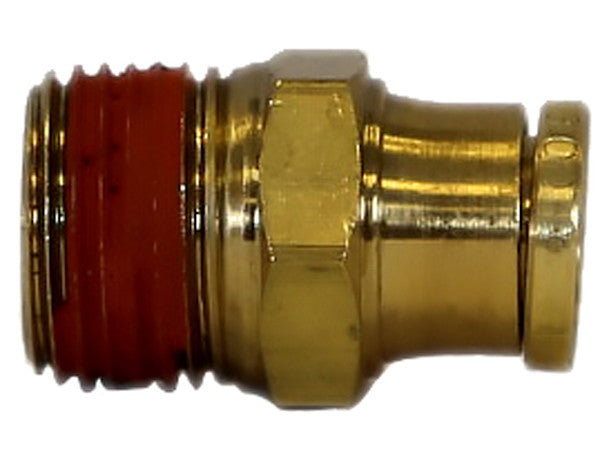
Buyers Products Male Connectors are made of long lasting and corrosion-resistant brass. They are designed to meet DOT FMVSS 571.106 air brake performance specifications.
Specifications
| Color | Natural |
|---|---|
| Finish | Plain |
| Fitting Shape | Straight |
| Male/Female/Union | Male |
| Material | Brass |
| Meets D.O.T. FMVSS 571.106 Air Brake Performance Regulations (y/n) | Yes |
| Pipe Thread Size | 3/8 NPT |
| Swivel (y/n) | No |
| Works with Tube Outer Diameter | 3/8 |
Advanced Technical Overview: Brass DOT Push-In Male Connector
The Brass DOT Push-In Male Connector, featuring a 3/8 Inch Tube O.D. and a 3/8 Inch Pipe Thread (NPT), represents a critical component in modern air brake and pneumatic control systems. Engineered for precision and reliability, this connector is specifically designed to meet the rigorous demands of vehicle safety standards, particularly the U.S. Department of Transportation’s Federal Motor Vehicle Safety Standard (FMVSS) 571.106. Its construction from high-grade brass ensures exceptional durability and resistance to environmental degradation, making it an indispensable element for heavy-duty commercial vehicles and various industrial applications where robust and secure pneumatic connections are paramount.
Material Science: The Superiority of Brass in Pneumatic Systems
The selection of brass as the primary material for this connector is not arbitrary; it is a deliberate choice rooted in material science principles that prioritize long-term performance and system integrity. Brass, an alloy primarily composed of copper and zinc, offers a unique combination of mechanical and chemical properties highly suited for fluid power applications. Specifically, the brass utilized in these DOT-compliant connectors is typically a high-quality alloy formulated for strength, machinability, and superior corrosion resistance.
One of the foremost advantages of brass is its inherent resistance to corrosion. Unlike steel or other ferrous alloys which are susceptible to rust and oxidation, brass forms a passive oxide layer that protects the underlying metal from corrosive agents, including moisture, road salts, and various industrial chemicals. This characteristic is particularly vital in air brake systems, where components are often exposed to harsh external environments and fluctuating temperatures, which can accelerate degradation in lesser materials. The specific grade of brass used in these fittings is often selected for its dezincification resistance, a critical factor in preventing a specific type of corrosion where zinc is selectively leached from the alloy, leading to weakening and potential failure.
Beyond corrosion resistance, brass exhibits excellent mechanical properties. It possesses a favorable strength-to-weight ratio and is highly ductile, meaning it can withstand significant stress and deformation without fracturing. This ductility is crucial for fittings that may experience vibration, pressure fluctuations, and minor misalignments in dynamic vehicle environments. Furthermore, brass maintains its structural integrity across a wide range of operating temperatures, ensuring consistent performance from extreme cold to elevated heat, which is a common scenario in vehicle operation.
The thermal conductivity of brass is another beneficial attribute, allowing for efficient heat dissipation, which can contribute to the longevity of adjacent components. Its non-sparking properties also make it a safer choice in environments where flammable gases or dust might be present, although this is less critical for external air brake lines. From a manufacturing perspective, brass is highly machinable, allowing for the precise fabrication of intricate designs necessary for push-in mechanisms and pipe threads, ensuring tight tolerances and consistent product quality. The natural, plain finish of the brass material not only provides an aesthetically clean appearance but also indicates the unadulterated quality of the alloy, free from external coatings that could chip or degrade over time.
Compliance and Safety: Adherence to DOT FMVSS 571.106
The commitment to meeting DOT FMVSS 571.106 air brake performance specifications is a cornerstone of this connector's design and manufacturing. FMVSS 571.106, officially known as "Brake Hoses," establishes stringent safety standards for brake hoses and hydraulic, air, and vacuum brake hose assemblies and their end fittings, which are used in hydraulic and air brake systems of motor vehicles. While the regulation primarily focuses on hoses, its scope inherently covers the performance of fittings that connect these hoses, ensuring the entire system functions as a cohesive, safe unit.
Compliance with FMVSS 571.106 mandates that the connector withstands a series of rigorous tests designed to simulate real-world operational stresses and extreme conditions. These tests typically include:
- Proof Pressure Test: The fitting must endure a specified internal pressure without bursting or exhibiting any signs of leakage or permanent deformation. This ensures its capability to handle the maximum operational pressures of an air brake system.
- Burst Pressure Test: This test determines the ultimate pressure the fitting can withstand before failure, establishing a safety margin beyond normal operating pressures.
- Tensile Test (Pull-Out Force): For push-in fittings, this is critical. The connection must withstand a minimum axial pull-out force without separating from the tubing, ensuring the tubing remains securely seated even under significant mechanical stress or vibration. This directly addresses the safety implications of a hose detaching during vehicle operation.
- Leakage Test: The fitting, when connected to a compatible tube, must exhibit zero leakage under specified pressures and temperatures, verifying the integrity of the O-ring seal and the mechanical grip.
- Vibration Test: Simulating dynamic vehicle movement, this test subjects the assembled fitting and tube to prolonged periods of vibration while under pressure. The fitting must maintain its connection integrity and remain leak-free.
- High and Low Temperature Performance: The material and design must ensure consistent performance and sealing capabilities across the full operational temperature range, which can vary significantly depending on climate and vehicle duty cycle. This confirms that the brass material and internal elastomers do not become brittle in cold or degrade in heat.
- Corrosion Resistance Test: Although brass is inherently corrosion-resistant, additional tests (e.g., salt spray) may be applied to confirm the material's and assembly's resilience in corrosive environments over time, aligning with the long-lasting characteristic mentioned in the product description.
By meeting these demanding specifications, manufacturers provide an assurance of safety and reliability, critical for components integrated into commercial vehicle braking systems where failure can have catastrophic consequences. The "Yes" affirmation for meeting D.O.T. FMVSS 571.106 in the specifications table is a testament to the rigorous design, material selection, and quality control processes applied to this product, offering peace of mind to engineers, mechanics, and fleet operators.
Push-In Technology: Efficiency and Reliability
The push-in connection technology, also known as push-to-connect or quick-connect, has revolutionized pneumatic system assembly by offering significant advantages in installation speed, ease, and reliability compared to traditional compression or threaded fittings. For this Brass DOT Push-In Male Connector, the mechanism is engineered for robust performance in demanding air brake environments.
The core of the push-in mechanism typically comprises three key components: a collet (or grab ring), an O-ring seal, and a fitting body. When a properly prepared tube (in this case, 3/8 inch O.D.) is inserted into the connector:
- The tube passes through the collet, which features angled teeth or grippers, usually made of stainless steel or a hardened polymer. These teeth automatically grip the outer diameter of the tube, providing a secure mechanical lock against pull-out forces. The design of these teeth ensures a firm grip without excessively scoring or damaging the tube surface, which could compromise its integrity.
- Further insertion brings the tube into contact with an internal O-ring seal, typically made of an elastomeric material such as NBR (Nitrile Butadiene Rubber). This O-ring compresses around the tube's exterior, creating an airtight, leak-proof seal. The elasticity and material properties of the O-ring are critical for maintaining the seal under varying pressures and temperatures, and for accommodating minor tube ovality.
- The fitting body itself guides the tube, ensuring proper alignment and engagement of both the grab ring and the O-ring. The precision machining of the brass body ensures that all components fit snugly and function effectively.
The primary advantage of push-in technology in DOT applications is the swift, tool-less installation and removal process, which significantly reduces maintenance time and labor costs. Technicians can quickly connect and disconnect air lines, facilitating faster repairs and system modifications. Despite the ease of connection, the design ensures a remarkably secure joint that resists vibration and pressure surges inherent in air brake systems, directly contributing to vehicle safety and operational uptime. Disconnection is typically achieved by pressing the release collar (often integrated into the collet design) against the fitting body, which expands the collet teeth, allowing the tube to be withdrawn.
This technology is designed to work optimally with specific types of tubing commonly found in air brake systems, such as nylon (polyamide) or other plastic tubing, which are characterized by their smooth, consistent outer diameters. Proper tube preparation, including a square, burr-free cut, is essential to ensure maximum sealing efficiency and retention force.
Technical Specifications: Precision in Dimensions and Form
This Brass DOT Push-In Male Connector is characterized by specific dimensions and a straightforward form factor, which are crucial for its functional integration into pneumatic systems.
3/8 Inch Tube O.D.
The "3/8 Inch Tube O.D." specification refers to the outer diameter of the pneumatic tubing that this connector is designed to accept. This is a standard size for air brake lines in many commercial vehicles and industrial applications. The precision of this measurement is critical for ensuring a proper fit with the push-in mechanism. A tubing with an outer diameter that is too large will not insert, while one that is too small will result in an insecure connection and potential leaks. The internal components of the push-in fitting – the collet and O-ring – are precisely sized to engage with 3/8 inch O.D. tubing, providing optimal grip and seal.
3/8 Inch Pipe Thread (NPT)
The "3/8 Inch Pipe Thread" refers to the male threaded end of the connector, which is designed to screw into a female port on a manifold, valve, air tank, or other system component. Specifically, this is a 3/8 NPT (National Pipe Taper) thread. NPT threads are characterized by their tapered profile, meaning the diameter of the thread gradually decreases along its length. When a male NPT thread is tightened into a female NPT port, the tapering causes the threads to wedge together, creating a mechanical seal. However, to ensure a truly leak-proof connection, especially in high-pressure air systems, the use of a suitable thread sealant (such as PTFE tape or liquid pipe sealant) is always recommended. The 3/8 NPT size is a common standard in pneumatic and hydraulic applications, providing compatibility with a vast array of industry-standard components.
Straight Fitting Shape
The "Straight" fitting shape indicates that the connector provides a linear path for fluid flow. It does not introduce any directional changes, unlike elbows or tees. This configuration is ideal for direct connections where the tube needs to extend straight out from a port. Straight fittings are often preferred for their minimal flow restriction and simpler installation in applications where alignment is already linear, reducing turbulence and pressure drop in the air line. The non-swivel design implies a fixed orientation once the pipe thread is tightened, contributing to system rigidity and stability.
Pressure and Temperature Ratings
While not explicitly detailed beyond DOT compliance, such fittings are typically rated for operating pressures common in heavy-duty air brake systems, often up to 150 psi (approximately 10 bar) or higher, with burst pressures significantly exceeding this. The temperature range typically spans from approximately -40°F to 200°F (-40°C to 93°C), ensuring functionality across diverse environmental conditions. These parameters are fundamental to the safety and operational envelope of the air brake system.
Installation and Best Practices for System Integrity
Proper installation is paramount to leveraging the full safety and performance benefits of the Brass DOT Push-In Male Connector. Adherence to best practices ensures a leak-free, durable connection that meets and maintains DOT compliance throughout its service life.
- Tube Preparation: Begin by cutting the 3/8 inch O.D. tubing squarely and cleanly. A specialized tube cutter designed for plastic tubing is recommended to prevent tube deformation or jagged edges. Deburr both the inside and outside of the cut end to remove any sharp edges or debris that could damage the internal O-ring seal or impede insertion. Ensure the tubing is free of scratches, scores, or kinks, particularly near the insertion point.
- Thread Sealant Application: For the 3/8 NPT male thread, apply a high-quality thread sealant. PTFE (Teflon) tape is a common choice; apply two to three wraps clockwise around the threads, leaving the first thread exposed to prevent sealant from entering the air system. Alternatively, a liquid pipe sealant suitable for pneumatic systems can be used, applied according to the manufacturer's instructions. Avoid over-application, as excess sealant can contaminate the air system.
- Threaded Connection: Hand-tighten the male NPT thread into the female port until snug. Then, use an appropriate wrench to tighten an additional 1 to 2 turns, or to the torque specified by the system or component manufacturer. Avoid over-tightening, which can damage the threads or the receiving port.
- Tube Insertion: With the male connector securely in place, firmly push the prepared 3/8 inch O.D. tube straight into the push-in port until it bottoms out. A slight resistance will be felt as the O-ring engages, followed by a definite "click" or tactile sensation as the grab ring locks onto the tube. Give the tube a gentle pull to confirm it is securely seated and cannot be easily dislodged.
- System Testing: After all connections are made, pressurize the air brake system and conduct a thorough leak test. Apply a soapy water solution to all connections. Any bubbles indicate a leak that requires immediate attention. Rectify leaks by re-seating the tube, reapplying thread sealant, or replacing the fitting if damaged.
- Maintenance and Inspection: Regularly inspect all air brake connections during routine vehicle maintenance. Check for signs of wear, corrosion, tube abrasion, or physical damage. Ensure tubing is properly routed and secured to prevent rubbing, chafing, or excessive vibration that could compromise fitting integrity or tube longevity.
These practices are not merely suggestions; they are integral to ensuring the longevity, safety, and regulatory compliance of the entire air brake system. The natural color and plain finish of the brass fitting facilitate easy visual inspection for potential issues.
Versatile Applications Across Industries
The robust design and DOT compliance of this Brass Push-In Male Connector extend its utility across a broad spectrum of applications, primarily focused on transportation and industrial pneumatic systems:
- Heavy-Duty Commercial Vehicles: This is the primary application. The connector is integral to the air brake systems of Class 8 trucks, semi-trailers, buses, and other heavy-duty vehicles. It forms critical connections between air tanks, brake valves, actuators, air dryers, and other pneumatic components.
- Off-Highway and Construction Equipment: Equipment such as excavators, bulldozers, and agricultural machinery often utilize pneumatic systems for auxiliary functions, where reliable and durable connections, especially in harsh environments, are essential.
- Specialty Vehicles: Fire trucks, ambulances, refuse vehicles, and utility trucks frequently incorporate complex pneumatic systems for various operational features, where DOT-compliant fittings ensure safety and performance.
- Industrial Pneumatics: While primarily designed for vehicle air brakes, the high standards of performance and reliability (especially FMVSS 571.106 compliance) make this connector suitable for stationary industrial pneumatic applications requiring robust, long-lasting, and easily maintainable connections. This includes automated manufacturing lines, material handling equipment, and compressed air distribution systems where system integrity is paramount.
- Fleet Maintenance and Repair: As a replacement part, this connector is vital for maintenance operations, offering a reliable, direct-fit solution that restores system integrity to DOT standards following repairs or component replacements.
Its straight fitting shape makes it ideal for direct connections in linear runs, simplifying system design and assembly in numerous contexts.
Conclusion: An Uncompromising Standard for Air Brake Connectivity
The Brass DOT Push-In Male Connector (3/8 Inch Tube O.D. x 3/8 Inch Pipe Thread) embodies a blend of advanced material engineering, innovative connection technology, and stringent adherence to safety regulations. Its construction from long-lasting, corrosion-resistant brass ensures unparalleled durability and performance even in the most challenging operational environments. The integration of efficient push-in technology provides for quick, tool-less, yet remarkably secure connections, significantly streamlining installation and maintenance procedures without compromising integrity.
Crucially, its full compliance with DOT FMVSS 571.106 air brake performance specifications underscores a commitment to safety and reliability that is non-negotiable in commercial vehicle applications. This compliance is backed by rigorous testing, assuring users that this connector will perform consistently under the stresses of vibration, pressure fluctuations, and temperature extremes. From heavy-duty trucks and trailers to a variety of industrial pneumatic setups, this male connector stands as a testament to engineering excellence, offering a dependable, efficient, and regulatory-compliant solution for critical air brake and pneumatic circuits. Choosing this connector means investing in the safety, efficiency, and longevity of your pneumatic systems, ensuring operational continuity and peace of mind.