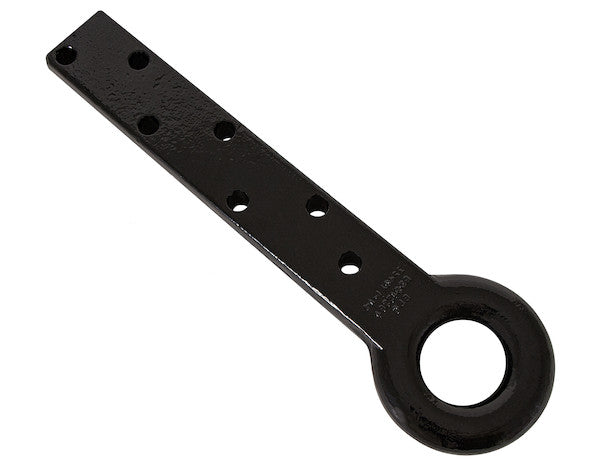
The Bolt-On Forged Steel Drawbar from Buyers Products is a tough, durable product ideal for towing a variety of specialty equipment. It can be removed and adjusted into position on the trailer tongue to give you the flexibility you need when working with on- and off-road trailers. The drawbar is available in two forged steel models for maximum towing weights from 20,000 to 22,000 lb.
Specifications
| Color | Black |
|---|---|
| Drawbar Section (in.) | 1.625 |
| Eye Inner Diameter (in.) | 3.0 |
| Eye Outer Diameter (in.) | 6.25 |
| Finish | Powder-Coat |
| M.G.T.W. (lbs.) | 22,000 |
| M.V.L. (lbs.) | 4,500 |
| Material | Forged Steel |
Advanced Technical Overview: 3 Inch I.D. Bolt-On Forged Steel Alloy Drawbar
The 3 Inch I.D. Bolt-On Forged Steel Alloy Drawbar from Buyers Products represents a critical component in heavy-duty towing operations, engineered for superior strength, durability, and operational flexibility. Designed to interface seamlessly with a range of specialty equipment and commercial vehicles, this drawbar is a testament to precision manufacturing and materials science, ensuring reliable performance across diverse and demanding applications, from arduous construction sites to extensive agricultural landscapes and rigorous utility operations.
Material Science and Forging Process: The Foundation of Strength
At the core of this drawbar's exceptional performance is its construction from forged steel alloy. Forging is a manufacturing process that involves shaping metal using localized compressive forces. Unlike casting, which involves pouring molten metal into a mold, or fabrication, which welds together various components, forging mechanically works the material, resulting in a number of distinct metallurgical advantages crucial for high-stress applications.
The steel alloy chosen for this drawbar is specifically formulated to withstand the immense static and dynamic loads inherent in heavy-duty towing. Typical alloying elements, while not explicitly detailed, would include precise percentages of carbon for hardness and tensile strength, manganese for strength and toughness, silicon as a deoxidizer and strengthener, and potentially chromium, molybdenum, or nickel to further enhance properties such as hardenability, corrosion resistance, and high-temperature strength. This precise metallurgical composition is critical to achieve the specified Maximum Gross Trailer Weight (M.G.T.W.) of 22,000 lbs and Maximum Vertical Load (M.V.L.) of 4,500 lbs.
The forging process refines the grain structure of the steel, aligning it with the shape of the component. This creates a continuous grain flow that follows the contours of the drawbar, particularly around critical stress points such as the eye and the mounting flange. This optimized grain flow significantly improves the material's resistance to fatigue, impact, and shear stresses, which are paramount in towing applications where sudden jerks, vibrations, and uneven terrain can induce extreme forces. Forged components typically exhibit superior tensile strength, yield strength, and ductility compared to their cast or machined counterparts, reducing the likelihood of catastrophic failure under extreme conditions. The inherent density of forged steel also minimizes internal defects such as porosity or shrinkage, ensuring a more consistent and predictable material performance throughout the component's service life.
Precision Engineering: Design and Dimensional Integrity
The drawbar’s design incorporates precise dimensional specifications that are critical for its function and compatibility:
- Eye Inner Diameter (I.D.): 3.0 inches: This critical dimension directly relates to the drawbar's interface with the towing vehicle's coupling mechanism, typically a pintle hook. A 3.0-inch I.D. (Inner Diameter) lunette ring is a standard size for heavy-duty commercial and military applications, ensuring broad compatibility with a wide array of towing vehicles equipped with corresponding pintle hooks. This standardization is vital for fleet operations and ensures secure, compliant connections that minimize slack and wear between the coupling components. The precise tolerance control of this dimension is essential to prevent excessive play, which can lead to accelerated wear, increased noise, and compromised towing stability.
- Eye Outer Diameter (O.D.): 6.25 inches: The substantial outer diameter of 6.25 inches provides the necessary material thickness and structural integrity around the 3.0-inch inner diameter. This robust design is crucial for distributing the immense forces exerted during towing, particularly the tensile and compressive stresses during acceleration and braking, and the shear forces introduced by vertical and lateral movements. The generous O.D. ensures that the forged steel has ample cross-sectional area to withstand these forces without deformation or material fatigue, contributing directly to the drawbar's overall load capacity and longevity.
- Drawbar Section: 1.625 inches: This dimension refers to the cross-sectional thickness of the main body of the drawbar, which extends from the eye to the mounting flange. The 1.625-inch section is engineered to provide substantial bending strength and torsional rigidity. During towing, the drawbar acts as a lever, transmitting both horizontal (pulling/pushing) and vertical (tongue weight) forces. A robust drawbar section is paramount for resisting bending moments that occur when the trailer pivots relative to the tow vehicle or when encountering uneven terrain. The uniformity and integrity of this section, enhanced by the forging process, are key to preventing localized stress concentrations and ensuring the structural soundness of the entire assembly.
The Bolt-On Advantage: Flexibility and Maintainability
The "Bolt-On" designation signifies a design philosophy centered on adaptability, ease of installation, and simplified maintenance. Unlike welded or permanently integrated drawbars, the bolt-on mechanism offers several operational benefits:
- Adjustability and Versatility: The ability to remove and adjust the drawbar's position on the trailer tongue provides unparalleled flexibility. This is particularly valuable for applications involving a variety of towing vehicles or trailers with different hitch height requirements. Optimizing hitch height is critical for maintaining proper trailer leveling, which in turn ensures balanced weight distribution, optimal braking performance, and enhanced stability, especially for on- and off-road trailers. Correct leveling prevents undue stress on the trailer frame, tires, and suspension components, extending their operational life.
- Ease of Installation and Replacement: Should the drawbar ever be damaged due to extreme impact or prolonged wear, its bolt-on nature allows for straightforward replacement. This minimizes downtime and associated costs, as it eliminates the need for specialized welding equipment or extensive fabrication work. Installation typically involves standard hand tools and adherence to specified torque values for the securing bolts. The use of high-grade fasteners (e.g., SAE Grade 8 or equivalent metric fasteners) is imperative to match the structural integrity of the drawbar itself, ensuring a secure and durable attachment to the trailer tongue.
- Reduced Stress on Trailer Structure: A properly bolted connection distributes stress more evenly across the mounting points compared to some welded designs, which can introduce localized heat-affected zones that alter the metallurgical properties of the parent material. The design ensures that the forces are transmitted efficiently through robust mechanical joints.
Performance Metrics: Ensuring Safety and Reliability
The specified performance metrics underscore the drawbar's capacity for heavy-duty operations:
- Maximum Gross Trailer Weight (M.G.T.W.): 22,000 lbs: This rating represents the maximum permissible weight of the fully loaded trailer that the drawbar is engineered to safely tow. It encompasses the weight of the trailer itself plus all cargo, fuel, and other contents. Exceeding this limit compromises structural integrity, increases braking distances, and can lead to catastrophic failure. The 22,000 lbs M.G.T.W. positions this drawbar firmly within the heavy-duty segment, suitable for large construction trailers, multi-axle agricultural implements, and substantial utility equipment. This rating is determined through rigorous engineering calculations, material stress analysis, and extensive physical testing, incorporating appropriate safety factors as per industry standards (e.g., SAE J684 for trailer hitches, where applicable, or more specific commercial towing standards).
- Maximum Vertical Load (M.V.L.): 4,500 lbs: Also known as tongue weight, the M.V.L. represents the maximum static downward force exerted by the trailer tongue on the drawbar when the trailer is level and loaded. This parameter is crucial for towing stability. Insufficient tongue weight can lead to trailer sway, reduced steering control, and unstable towing dynamics, while excessive tongue weight can overload the tow vehicle's rear axle and suspension, affecting handling and braking. The 4,500 lbs M.V.L. rating indicates that the drawbar is designed to withstand significant compressive forces, which is particularly relevant for trailers with heavy front-end loads or specialized equipment that distributes weight forward. Proper M.V.L. management is essential for safe and efficient towing, and this drawbar is robustly designed to accommodate substantial vertical loads.
Protective Coating: Durability in Harsh Environments
The drawbar features a black powder-coat finish, a critical element in its long-term durability and resistance to environmental degradation. Powder coating is a dry finishing process where finely ground particles of pigment and resin are electrostatically charged and sprayed onto the electrically grounded drawbar. The charged powder particles adhere to the drawbar's surface and are then melted and fused into a smooth, uniform coating in a curing oven.
This advanced finishing technique offers several advantages over conventional liquid paints, especially for components exposed to the rigorous conditions of on- and off-road use:
- Superior Corrosion Resistance: The powder-coat forms a thick, uniform barrier that effectively seals the forged steel from moisture, road salts, chemicals, and other corrosive agents. This is vital for preventing rust and preserving the structural integrity of the drawbar over its operational lifespan, particularly in regions with harsh winter conditions or coastal environments.
- Enhanced Abrasion and Impact Resistance: The cured powder-coat is significantly more durable and resistant to chipping, scratching, and abrasion than liquid paint. This resilience is crucial for a component that will inevitably encounter flying debris, gravel, and potential impacts during its service life, especially in off-road environments.
- UV Stability and Aesthetic Retention: The finish maintains its color and integrity even when exposed to prolonged ultraviolet (UV) radiation from sunlight, preventing fading and chalking. This ensures the drawbar retains its professional appearance throughout its service life.
- Environmental Benefits: From a manufacturing perspective, powder coating is an environmentally friendly process, as it contains no volatile organic compounds (VOCs) and produces minimal waste.
Versatility in Application: On- and Off-Road Capability
This drawbar is engineered to excel in a diverse range of applications, demonstrating its adaptability to both on-highway and challenging off-highway conditions:
- On-Road Performance: For highway use, the drawbar provides a stable and secure connection, ensuring predictable handling and compliance with road safety regulations. Its robust design minimizes flex and vibration, contributing to a smoother towing experience and reduced wear on both the tow vehicle and the trailer over long distances.
- Off-Road Resilience: The "on- and off-road trailers" mention highlights the drawbar's ability to withstand the extreme shock loads, uneven terrain, and dynamic forces encountered in off-road environments. The forged steel alloy, combined with the continuous grain flow, provides exceptional impact resistance. The secure bolt-on connection and the resilient powder-coat finish ensure that the drawbar can endure rough conditions, mud, water, and debris without compromising performance or integrity. This makes it ideal for construction trailers traversing unpaved job sites, agricultural equipment in fields, or utility trailers operating in remote, challenging locations.
The capacity to tow a "variety of specialty equipment" further underscores its broad utility. This can include, but is not limited to: heavy construction equipment trailers (e.g., excavators, skid steers), agricultural implements (e.g., large planters, sprayers, tillage equipment), utility trailers (e.g., cable reel trailers, portable generators, air compressors), and other industrial trailers requiring robust and reliable towing solutions.
Compliance, Inspection, and Maintenance
While specific certifications are not listed, components of this caliber are typically designed to meet or exceed relevant industry standards for towing equipment, such as those established by the Society of Automotive Engineers (SAE), the American Society for Testing and Materials (ASTM), and applicable Department of Transportation (DOT) regulations. Adherence to such standards is fundamental to ensuring safety, interoperability, and product reliability.
Regular inspection and maintenance are crucial for maximizing the service life and ensuring the safe operation of the drawbar. This includes:
- Fastener Integrity: Periodically checking and re-torquing all mounting bolts to their specified values to prevent loosening, which can lead to excessive wear and potential failure.
- Visual Inspection: Examining the drawbar for signs of wear, cracks, deformation, or damage to the forged steel and the powder-coat finish. Particular attention should be paid to the eye, the mounting flange, and the main drawbar section.
- Corrosion Management: Addressing any chips or breaches in the powder-coat finish promptly to prevent localized corrosion, especially in aggressive environments.
Conclusion
The 3 Inch I.D. Bolt-On Forged Steel Alloy Drawbar is more than just a towing accessory; it is a precisely engineered, heavy-duty component designed for the most demanding professional applications. Its foundation in advanced forged steel alloy, coupled with meticulous design, critical performance ratings, and a durable protective finish, ensures exceptional strength, resilience, and operational flexibility. By combining high load capacity with the practical advantages of a bolt-on, adjustable design, this drawbar provides operators with a reliable, safe, and efficient solution for towing a wide spectrum of specialty equipment, capable of performing flawlessly across both rigorous on-road and challenging off-road terrains. It represents an investment in safety, efficiency, and longevity for any heavy-duty towing fleet.