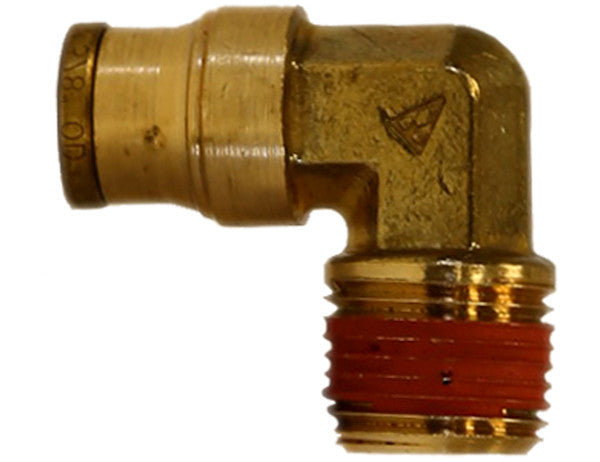
Buyers Products Male Elbows are made of long lasting corrosion-resistant brass. They are designed to meet DOT FMVSS 571.106 air brake performance specifications.
Specifications
| Color | Natural |
|---|---|
| Finish | Plain |
| Fitting Shape | 90?? Elbow |
| Male/Female/Union | Male |
| Material | Brass |
| Meets D.O.T. FMVSS 571.106 Air Brake Performance Regulations (y/n) | Yes |
| Pipe Thread Size | 1/4 NPT |
| Swivel (y/n) | No |
| Works with Tube Outer Diameter | 1/4 |
Advanced Technical Overview: Brass DOT Push-In Male Elbow for Critical Air Brake Systems
The Brass DOT Push-In Male Elbow, specified with a 1/4 Inch Tube O.D. and a 1/4 Inch Pipe Thread, represents a critical component in the intricate architecture of modern commercial vehicle air brake systems. Engineered for precision, durability, and unwavering compliance with stringent safety regulations, this fitting is an indispensable asset for maintaining optimal performance and safety in heavy-duty applications. Its design embodies a synthesis of superior material science, advanced connection technology, and meticulous adherence to industry standards, ensuring reliable pneumatic connections under the most demanding operational conditions.
Material Excellence: The Inherent Advantages of High-Grade Brass
The selection of brass as the primary material for this DOT-compliant elbow is a deliberate engineering choice, predicated on its exceptional metallurgical properties. Brass, an alloy primarily composed of copper and zinc, offers a unique combination of characteristics ideally suited for pneumatic fittings. Its inherent resistance to corrosion is paramount, particularly in environments where exposure to moisture, road salts, hydraulic fluids, and various atmospheric pollutants is commonplace. Unlike other metals that might succumb to rust or galvanic corrosion, brass maintains its structural integrity and aesthetic over extended periods, minimizing the risk of leaks and system failures due to material degradation.
Beyond corrosion resistance, brass provides excellent mechanical strength and ductility. This allows for precise machining and fabrication of complex shapes, such as the 90-degree elbow, while retaining sufficient robustness to withstand the internal pressures and external stresses typical of air brake systems. The ductility of brass also contributes to its resistance to vibrational fatigue, a critical factor in vehicle applications where constant motion and engine vibrations can compromise lesser materials. Furthermore, brass is inherently resistant to high temperatures, making it suitable for locations in commercial vehicles where ambient temperatures can fluctuate significantly or where proximity to heat-generating components is unavoidable. Its non-sparking properties are also a safety advantage in certain industrial environments.
The specific brass alloys utilized in DOT-approved fittings are chosen for their optimal balance of machinability, strength, and corrosion resistance, ensuring that each fitting conforms to the exact dimensional and performance specifications required for air brake applications. The natural, plain finish of the brass is not merely aesthetic; it signifies a lack of additional coatings that could potentially chip, flake, or degrade over time, leaving the underlying material vulnerable. This unadorned surface allows the natural protective patina of brass to form, further enhancing its long-term durability and reliability.
Advanced Push-In Technology for Rapid and Secure Connections
The integration of push-in technology into this male elbow design signifies a commitment to efficiency, reliability, and ease of installation. Unlike traditional compression fittings that require tools for assembly and disassembly, push-in fittings allow for quick and secure connections by simply inserting the appropriate tubing (in this case, 1/4 inch O.D.) into the fitting. This mechanism is especially beneficial in applications where space is confined, and time is of the essence, reducing installation labor and potential for human error.
The internal architecture of a high-quality push-in fitting is sophisticated. It typically comprises several key components working in concert:
- Gripping Collet: This component, often made of a durable polymer or brass, features angled teeth or claws designed to firmly grip the outer diameter of the inserted tubing. Once the tube is pushed past a certain point, the collet springs inward, creating a secure mechanical lock that prevents the tube from pulling out under pressure or vibration.
- Sealing O-Ring: Positioned behind the gripping collet, a robust O-ring, usually made of an elastomeric material like NBR (nitrile butadiene rubber) or EPDM (ethylene propylene diene monomer), forms a hermetic seal around the tube. This seal is crucial for maintaining the integrity of the pneumatic system, preventing air leaks that could compromise brake performance and necessitate frequent compressor cycling.
- Retaining Washer/Body Design: The overall body design and internal retaining features ensure that the collet and O-ring remain properly seated and perform their functions reliably throughout the fitting's operational life.
Precision Engineering: The 90-Degree Male Elbow Configuration
The 90-degree elbow shape of this fitting is a fundamental design choice driven by practical considerations in fluid power routing. In the often-cramped chassis of commercial vehicles, space is a premium, and air lines must navigate around numerous structural components, engine parts, and auxiliary systems. A 90-degree elbow provides an efficient and compact solution for changing the direction of pneumatic tubing by ninety degrees without kinking the line or creating undue stress on the tubing material.
The male pipe thread (1/4 NPT) on one end allows the elbow to be securely fastened into a female threaded port, commonly found on manifolds, valves, reservoirs, or other system components. The fixed, non-swiveling nature of this particular elbow (as indicated by "Swivel (y/n): No") ensures a stable and robust connection once installed. While swivel fittings offer positional flexibility, a fixed elbow often implies a direct, unyielding connection preferred in applications where movement of the fitting itself could introduce points of wear or potential failure, thus prioritizing static strength and long-term stability.
From a fluid dynamics perspective, the internal bore of the elbow is carefully designed to minimize pressure drop and turbulence, ensuring smooth and efficient airflow. Any significant restriction or sharp internal angle could impede air flow, leading to slower brake response times or increased energy consumption by the air compressor. The smooth internal geometry of quality brass elbows helps maintain the desired pneumatic performance.
Critical Sizing Specifications: 1/4 Inch Tube O.D. x 1/4 Inch Pipe Thread
The precise dimensional specifications of this fitting—1/4 Inch Tube Outer Diameter (O.D.) x 1/4 Inch National Pipe Taper (NPT) Thread—are crucial for system compatibility and performance.
- 1/4 Inch Tube O.D.: This refers to the external diameter of the pneumatic tubing with which the push-in end of the fitting is designed to interface. 1/4 inch O.D. tubing is a common standard size in air brake and various pneumatic control systems, offering a good balance between flow capacity and flexibility for routing. The push-in mechanism is engineered to grip and seal this specific tube dimension precisely, ensuring a leak-proof connection without requiring specialized tools for calibration or adjustment.
- 1/4 Inch Pipe Thread (NPT): The NPT designation signifies a National Pipe Taper thread, which is a widely adopted standard for joining pipes and fittings in North America. The tapered profile of NPT threads allows for a mechanical interference fit, where the flanks of the male and female threads physically deform against each other, creating a seal. While NPT connections are designed for a mechanical seal, the use of an appropriate thread sealant (e.g., PTFE tape or pipe dope) is highly recommended and often required for pneumatic systems to ensure a bubble-tight, leak-free connection, especially under dynamic pressures and vibrations. The 1/4 NPT size corresponds to the nominal diameter of the pipe connection, aligning with common port sizes on air valves, tanks, and other components in air brake systems.
Adherence to DOT FMVSS 571.106 Air Brake Performance Regulations
The declaration that this Brass DOT Push-In Male Elbow "Meets D.O.T. FMVSS 571.106 Air Brake Performance Regulations" is arguably its most critical attribute. FMVSS (Federal Motor Vehicle Safety Standard) 571.106, specifically "Brake Hoses," establishes stringent performance and design requirements for hydraulic, air, and vacuum brake hoses and their end fittings, which includes components like this elbow when used in air brake systems of commercial vehicles. The overarching goal of this standard is to ensure the integrity and reliability of vehicle braking systems, thereby enhancing public safety.
Compliance with FMVSS 571.106 necessitates rigorous testing protocols, which fittings must successfully pass to be certified for use in air brake applications. These tests typically include, but are not limited to:
- Pressure Retention Test: Verifies the fitting's ability to maintain system pressure without leakage over extended periods and under various thermal conditions.
- Vibration Test: Simulates the constant mechanical stresses and oscillations experienced by components in a moving vehicle. The fitting must maintain its seal and structural integrity under prolonged vibration.
- Pull-Out Test: Measures the force required to pull the tubing out of the push-in fitting. This ensures the mechanical grip is sufficiently strong to withstand operational forces, including those caused by pressure fluctuations and vehicle dynamics.
- Thermal Cycling Test: Exposes the fitting to extreme temperature variations to assess its performance and resistance to degradation in hot and cold environments. This is crucial given the wide range of climates vehicles operate in.
- Burst Pressure Test: Determines the maximum pressure the fitting can withstand before catastrophic failure, providing a critical safety margin above normal operating pressures.
Durability and Longevity in Demanding Environments
The inherent qualities of brass, combined with the robust design of the push-in mechanism and 90-degree elbow configuration, contribute significantly to the fitting's exceptional durability and longevity. Commercial vehicles operate in some of the harshest environments imaginable, facing continuous exposure to:
- Environmental Extremes: Wide temperature fluctuations, high humidity, rain, snow, and UV radiation.
- Chemical Exposure: Road salts, anti-icing agents, petroleum products, engine fluids, and cleaning solvents.
- Mechanical Stresses: Constant vibration from engine and road, pressure surges, minor impacts, and abrasive debris.
Installation and Operational Integrity
Proper installation is crucial for maximizing the performance and longevity of the Brass DOT Push-In Male Elbow. While the push-in design simplifies the process, adherence to best practices is essential:
- Tubing Preparation: The pneumatic tubing must be cut squarely and cleanly, free of burrs or deformations, to ensure a perfect seal with the O-ring and an effective grip by the collet. Calibration and deburring tools are recommended.
- Full Insertion: The tubing must be pushed firmly and completely into the fitting until it bottoms out. This ensures that the collet fully engages and the O-ring creates its intended seal. A light tug back on the tube after insertion can confirm a secure connection.
- Thread Sealant for NPT: As mentioned, for the 1/4 NPT connection, an appropriate thread sealant (e.g., PTFE tape or liquid pipe sealant rated for pneumatic applications) must be applied to the male threads to ensure a leak-free seal and facilitate future disassembly if required.
- Avoid Over-tightening: While the male NPT connection requires firm tightening, excessive torque can damage the threads or deform the fitting body. Torque specifications, if provided by the manufacturer, should be followed.
Applications in Commercial and Heavy-Duty Vehicles
The Brass DOT Push-In Male Elbow is engineered specifically for the demanding environment of commercial and heavy-duty vehicles. Its primary applications include:
- Trucks and Tractors: Connecting air lines for air brake systems, suspension controls, and auxiliary pneumatic functions.
- Trailers: Routing air lines for trailer brake systems, often exposed to harsh external conditions.
- Buses: Critical for air brake systems, door operation, and kneeling functions.
- Off-Highway Equipment: Construction vehicles, agricultural machinery, and mining equipment where robust pneumatic connections are essential for brake and accessory systems.
Manufacturing Excellence and Quality Assurance
The production of such critical components involves sophisticated manufacturing processes and stringent quality control. Precision machining of the brass ensures exact dimensional tolerances, critical for both the push-in tube connection and the NPT thread. Automated inspection systems and manual checks are employed at various stages of production to verify material integrity, surface finish, thread quality, and the proper functioning of the internal push-in components. Batch testing, including destructive testing, is often performed to ensure ongoing compliance with DOT FMVSS 571.106, reinforcing the commitment to safety and performance that customers expect from a reputable manufacturer.
Comprehensive Technical Specifications: An Elaboration
To further contextualize the provided specifications, each attribute plays a vital role in the overall design and functionality of this critical component:
- Color: Natural - Signifies the inherent hue of unplated brass. This choice ensures no external coatings are present that could flake or wear off, potentially contaminating the air system or compromising the material's integrity over time.
- Finish: Plain - Similar to the color, a plain finish implies the natural surface texture of machined brass, free from additional treatments like lacquering or polishing, which might be aesthetically pleasing but less functional for long-term industrial use. The plain finish allows the natural protective oxide layer of brass to form and regenerate.
- Fitting Shape: 90° Elbow - This geometric configuration is optimized for directional changes in pneumatic lines within confined spaces, providing a smooth bend radius that minimizes flow restriction and tube kinking. Its fixed angle offers predictable and stable routing.
- Male/Female/Union: Male - Indicates the presence of a male pipe thread on one end, designed to screw into a corresponding female threaded port on a valve, manifold, or another system component. This standard configuration ensures broad compatibility within pneumatic systems.
- Material: Brass - As extensively discussed, brass is chosen for its superior corrosion resistance, mechanical strength, machinability, and ductility, making it ideal for high-performance, long-lasting pneumatic fittings.
- Meets D.O.T. FMVSS 571.106 Air Brake Performance Regulations (y/n): Yes - This is the cornerstone of the fitting's reliability and suitability for air brake systems. It confirms that the product has undergone and passed rigorous federal safety and performance tests for brake hoses and fittings, ensuring its dependability in critical vehicle safety applications.
- Pipe Thread Size: 1/4 NPT - Specifies the standardized tapered pipe thread dimension for connection to female ports. The 1/4 NPT size is a common standard, ensuring compatibility with a wide range of air system components.
- Swivel (y/n): No - This indicates that the elbow maintains a fixed orientation relative to its threaded connection once tightened. While swivel fittings offer installation flexibility, a non-swivel design often contributes to greater stability and robust, unyielding connections, preferred in applications where movement could lead to stress or leakage.
- Works with Tube Outer Diameter: 1/4 - Defines the specific external diameter of the tubing that the push-in mechanism is designed to securely grip and seal. Precision in this dimension is critical for establishing a leak-proof and pull-out resistant connection.
Conclusion
The Brass DOT Push-In Male Elbow with 1/4 Inch Tube O.D. x 1/4 Inch Pipe Thread stands as a testament to engineering excellence in pneumatic fluid power components. Its meticulously selected brass construction, advanced push-in connection technology, space-saving 90-degree elbow design, and uncompromising adherence to DOT FMVSS 571.106 air brake performance regulations coalesce to form a product of unparalleled reliability and safety. For commercial vehicle operators and industrial entities prioritizing system integrity, operational efficiency, and long-term durability, this fitting offers a robust solution, ensuring critical pneumatic systems perform flawlessly under the most challenging conditions. It is not merely a component; it is an assurance of consistent performance and unwavering safety.