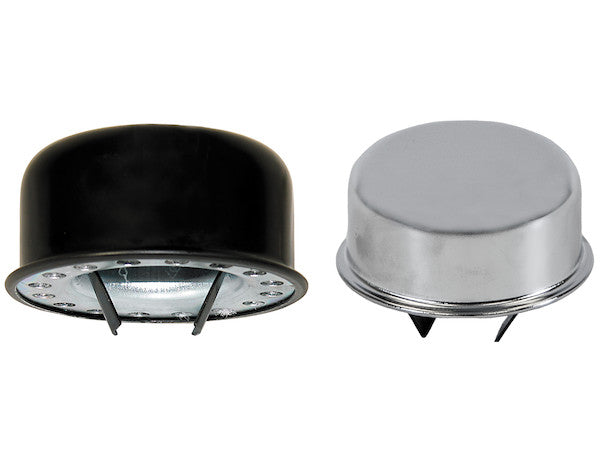
The Push-In Breather Cap from Buyers Products acts as a ventilator to provide a free flow of clean air into your reservoir. It features oil-resistant filter elements that keep out dirt and dust particles as small as 40 microns. Choose either a chrome or heavy duty black cap. To install, just push in to the 1-1/2 in. OD tube on top of your reservoir.
Specifications
| Cap Type | Push-On |
|---|---|
| Material | Carbon Steel |
| Thread Size | - |
Advanced Technical Overview: The Black Heavy Duty Push-In Breather Cap for 1-1/2 Inch O.D. Tube
In the realm of hydraulic and fluid power systems, the integrity and operational efficiency of the reservoir are paramount. A seemingly minor component, the breather cap, plays a critically significant role in maintaining optimal system performance, extending component lifespan, and ensuring the cleanliness of the hydraulic fluid. This detailed technical description focuses on the Black Heavy Duty Push-In Breather Cap, engineered by Buyers Products, designed specifically for integration with 1-1/2 inch O.D. tubes on fluid reservoirs.
The Essential Function of a Breather Cap in Fluid Systems
A fluid reservoir in a hydraulic or lubrication system is not a sealed, static container. It is a dynamic component that interfaces with the surrounding atmosphere. As hydraulic cylinders extend and retract, or as fluid levels fluctuate due to thermal expansion and contraction, air must either enter or exit the reservoir to equalize pressure. Without a properly functioning breather, the reservoir would experience significant pressure differentials:
- Vacuum Formation: When hydraulic fluid is drawn from the reservoir into the system (e.g., during cylinder extension or pump suction), a vacuum can form within the reservoir. This negative pressure can lead to cavitation in pumps, which severely damages pump components, reduces efficiency, and generates excessive noise. Furthermore, persistent vacuum conditions can cause the reservoir walls to deform or even collapse, especially in lighter gauge constructions.
- Over-pressurization: Conversely, when fluid returns to the reservoir from the system (e.g., during cylinder retraction or system bypass), or when the fluid temperature increases, the air volume inside the reservoir decreases and expands, respectively, leading to an increase in internal pressure. Excessive positive pressure can stress reservoir seals, potentially leading to leaks and compromising the system's integrity.
The Black Heavy Duty Push-In Breather Cap addresses these challenges by acting as a ventilator, facilitating a bidirectional flow of air while simultaneously performing a critical filtration function. This continuous, controlled exchange of air is fundamental to maintaining atmospheric pressure within the reservoir, thus preventing the detrimental effects of both vacuum and over-pressurization.
Advanced Contamination Control: The 40-Micron Filtration Standard
One of the most critical aspects of hydraulic system longevity and reliability is fluid cleanliness. Airborne particulate matter, moisture, and other contaminants are pervasive in most operating environments and, if allowed to enter the reservoir, can severely degrade the hydraulic fluid and damage expensive system components. The Push-In Breather Cap features oil-resistant filter elements engineered to capture particles as small as 40 microns.
Understanding Micron Rating and Its Importance:
- Micron Definition: A micron (micrometer) is one-millionth of a meter. To put 40 microns into perspective, the smallest particle visible to the naked human eye is typically around 40 microns. However, even particles of this size, and certainly smaller, are highly destructive within hydraulic systems.
-
Harmful Effects of Particulate Contamination:
- Abrasive Wear: Hard particles, even those larger than 40 microns, act as abrasive agents, causing wear to precision-machined surfaces within pumps, valves, and cylinders. This leads to increased clearances, internal leakage, reduced efficiency, and ultimately, component failure.
- Silting and Sticking: Finer particles can accumulate in critical clearances, leading to valve sticking, sluggish operation, and reduced control precision.
- Fluid Degradation: Contaminants can accelerate the oxidation and degradation of hydraulic fluid, diminishing its lubricating properties and requiring more frequent fluid changes.
- Oil-Resistant Filter Elements: The filter media employed in this breather cap is specifically designed to be oil-resistant. This is crucial as the breather is exposed to oil mist and vapors from within the reservoir. Non-oil-resistant materials would degrade over time, compromising filtration efficiency and potentially shedding their own fibers into the fluid. The robust construction ensures long-term integrity and consistent performance in demanding environments.
- Strategic 40-Micron Rating: While finer filtration (e.g., 10 or 3 microns) is often desirable for system return line filters, a 40-micron rating for a breather cap strikes an optimal balance. It provides effective protection against most airborne dust and larger particulates that could rapidly degrade fluid quality, while simultaneously allowing for sufficient airflow to prevent pressure imbalances without excessive restriction. For many heavy-duty applications in environments where very fine airborne particles are less prevalent or where a balance between robust airflow and essential protection is prioritized, 40-micron filtration is a widely accepted and effective standard.
Material Science: Carbon Steel with Heavy Duty Black Finish
The choice of construction material and finish is critical for components subjected to industrial and outdoor environments. This breather cap is constructed from carbon steel and features a heavy-duty black finish, providing a distinct set of advantages:
- Carbon Steel Durability: Carbon steel is renowned for its exceptional strength, rigidity, and resistance to impact. In heavy-duty applications, where components may be exposed to physical abuse, vibrations, or harsh environmental conditions, the inherent robustness of carbon steel ensures the structural integrity and longevity of the breather cap. It withstands mechanical stresses far better than lighter materials, preventing deformation or cracking that could compromise its sealing and filtration capabilities.
-
Heavy Duty Black Finish: The "heavy duty black finish" typically implies a robust coating, often a powder coat or similar industrial-grade paint system. This finish provides several key benefits:
- Superior Corrosion Resistance: The primary function of such a finish is to create a protective barrier against environmental corrosion. Carbon steel, left unprotected, is susceptible to rust when exposed to moisture and oxygen. The black finish acts as an effective shield against water, humidity, road salts, chemicals, and industrial pollutants, making the cap suitable for outdoor, mobile, and corrosive industrial settings.
- Abrasion Resistance: Powder coatings are generally tougher and more resistant to scratching, chipping, and abrasion than conventional paints. This is particularly important for components on heavy equipment or in industrial settings where incidental contact or exposure to abrasive dust is common.
- UV Stability: For outdoor applications, the finish must resist degradation from ultraviolet (UV) radiation. A high-quality heavy-duty black finish is formulated to maintain its color and protective properties even under prolonged sunlight exposure, preventing chalking, fading, or cracking.
- Chemical Resistance: The finish offers enhanced resistance to various chemicals, including hydraulic fluids, fuels, degreasers, and cleaning agents commonly encountered in maintenance operations, preventing degradation of the aesthetic and protective layer.
- Aesthetic and Functional Integration: The black finish provides a discreet, professional appearance that blends well with many industrial and mobile equipment designs, where black components are often standard.
Precision Engineering: Push-In Installation for 1-1/2 Inch O.D. Tube
The installation method of the breather cap is a critical design consideration, balancing ease of integration with secure retention and effective sealing. This breather cap employs a push-in design specifically dimensioned for a 1-1/2 inch O.D. (Outer Diameter) tube. This design choice offers several advantages:
- Simplicity and Speed of Installation: The push-in mechanism eliminates the need for threading, specialized tools, or complex fasteners. Installation is achieved by simply applying pressure to seat the cap securely onto the designated tube. This simplifies assembly procedures, reduces installation time, and minimizes potential for error.
- Secure and Reliable Fit: Despite its simplicity, a properly engineered push-in connection provides a surprisingly robust and reliable fit. The cap's internal diameter is precisely matched to the 1-1/2 inch O.D. of the reservoir tube, often incorporating an internal sealing feature (such as an elastomeric O-ring or a precisely tapered fit) to create a tight seal. This seal prevents bypass contamination and ensures that all incoming air passes through the filter element.
- Vibration Resistance: For mobile hydraulic applications, components must withstand continuous vibration. A well-designed push-in connection, especially when combined with a resilient sealing element, can effectively dampen vibrations and maintain its secure attachment over extended operating periods.
- Ease of Maintenance and Replacement: The push-in design also facilitates straightforward removal for inspection, cleaning, or replacement of the filter element or the entire cap. This is essential for routine maintenance to ensure that the breather's filtration capabilities are not compromised by a saturated or clogged filter.
- Standardization: The 1-1/2 inch O.D. tube size is a common dimension in many industrial and mobile hydraulic reservoir designs, ensuring broad compatibility with existing equipment and new builds.
Applications and Industries
Given its heavy-duty construction, effective 40-micron filtration, and robust black finish, this Push-In Breather Cap is ideally suited for a wide array of demanding applications and industries:
- Mobile Hydraulics: Construction equipment (excavators, bulldozers, loaders), agricultural machinery (tractors, harvesters), material handling equipment (forklifts, telehandlers), refuse vehicles, snowplows, and utility trucks. These environments often expose components to severe dust, dirt, moisture, and temperature fluctuations.
- Industrial Hydraulic Power Units: Manufacturing plants, steel mills, plastics injection molding, presses, and other stationary industrial machinery where fluid cleanliness and robust components are essential for uninterrupted operation.
- Marine Applications: While direct saltwater immersion is not intended, its corrosion-resistant finish makes it suitable for decks of vessels or portside equipment where salt spray and high humidity are prevalent.
- Mining and Quarrying: Environments characterized by extreme particulate levels, heavy vibrations, and abrasive materials, where the heavy-duty carbon steel construction and effective filtration are critical.
- Forestry Equipment: Logging machinery operating in rugged, dirty, and often wet conditions.
The "heavy duty black cap" specifically appeals to applications where resilience and a non-reflective, rugged appearance are desired, contrasting with chrome options often chosen for more aesthetic or less aggressive environments.
Elaborated Technical Specifications
Building upon the foundational specifications, a more in-depth technical understanding reveals the product's engineering merits:
- Cap Type: Push-On: This designation signifies a non-threaded, friction or interference fit installation. The primary advantages include rapid assembly, cost-effectiveness in manufacturing, and suitability for applications where tank access or periodic removal is a design consideration. It implies a precise dimensional tolerance between the cap's inner bore and the specified 1-1/2 inch O.D. tube.
- Material: Carbon Steel: This refers to a family of steel alloys with carbon as the main alloying element. While specific grades vary, in this application, it denotes a material chosen for its high tensile strength, yield strength, and impact resistance. These properties ensure the cap resists mechanical deformation under normal operating stresses, impacts, or vibrations, maintaining the integrity of the filtration and sealing mechanisms. The carbon steel provides a robust housing for the filter element.
- Filtration Rating: 40 Micron: This is a critical performance parameter. It specifies that the filter element is designed to prevent the passage of solid particles larger than 40 micrometers (µm) into the reservoir. As discussed, this rating effectively screens out common airborne dust, sand, and larger industrial particulates, safeguarding the hydraulic fluid and internal components from abrasive wear and contamination-induced failures. The filter element material is oil-resistant, typically a synthetic media or treated paper, chosen for its filtration efficiency, durability, and compatibility with various hydraulic fluids.
- Compatibility: 1-1/2 Inch O.D. Tube: This precise dimension is crucial. The cap is engineered to seat snugly and securely onto a standpipe or port with an outer diameter of exactly 1.5 inches. This ensures a proper seal, preventing unfiltered air or contaminants from bypassing the filter element. Incorrect tube dimensions would lead to a loose fit (allowing contaminant ingress) or an inability to install.
- Operating Temperature Range (Implied): While not explicitly stated, such industrial components are typically designed to operate reliably across a broad temperature range, often from -40°F (-40°C) to +200°F (+93°C) or higher. This accounts for diverse climate conditions and temperature fluctuations inherent in hydraulic systems.
- Airflow Capacity (Implied): For effective pressure equalization, a breather cap must have sufficient airflow capacity. While not specified in CFM or LPM, the design, including the filter media porosity and surface area, is optimized to allow adequate air exchange for typical reservoir volumes associated with heavy-duty mobile and industrial hydraulic systems, preventing vacuum or pressure buildup under normal operating fluid transfer rates.
Installation and Maintenance Protocols
Proper installation and regular maintenance are pivotal to maximizing the effectiveness and lifespan of the breather cap and, by extension, the entire hydraulic system.
Installation Procedure:
- Verification: Before installation, confirm that the standpipe or port on the reservoir has an outer diameter of 1-1/2 inches. Ensure the tube is clean, free of burrs, and any residual debris that could compromise the seal or be introduced into the fluid.
- Seating: Position the breather cap over the tube. Apply firm, steady downward pressure to push the cap onto the tube. The push-in design relies on an interference fit or internal seal (e.g., O-ring) to create a secure, airtight connection. Ensure the cap is fully seated and level on the tube.
- Inspection: After installation, visually inspect the base of the cap to ensure there are no gaps or irregularities that could indicate an improper seal. The connection should appear robust and stable.
Maintenance Requirements:
- Regular Inspection: Periodically inspect the breather cap for physical damage (cracks, dents), signs of wear, or any indications that it is loose on the tube. The heavy-duty black finish should be checked for signs of significant chipping or corrosion that could compromise its protective qualities.
- Filter Element Condition: The most critical maintenance aspect is the inspection and potential replacement of the filter element. Over time, the 40-micron filter element will accumulate particulate matter from the air. A visibly dirty or clogged filter element will restrict airflow, leading to the very pressure imbalances and pump cavitation it is designed to prevent.
- Replacement Schedule: The replacement interval for the breather cap or its filter element depends heavily on the operating environment. In highly dusty or contaminated environments (e.g., mining, construction), replacement may be required more frequently (e.g., every few months). In cleaner environments, it might be annually or based on hours of operation. Consult equipment manufacturer recommendations or establish a predictive maintenance schedule based on system performance monitoring (e.g., observing pressure differentials or vacuum levels in the reservoir).
- Cleaning: While some filter elements might be gently cleaned with compressed air, it is generally recommended to replace the entire cap or filter element when significantly clogged to ensure optimal filtration efficiency and avoid damage to the media.
Neglecting breather cap maintenance can lead to a cascade of expensive problems, including pump damage, seal failures, accelerated fluid degradation, and ultimately, system downtime.
Overall Benefits and Value Proposition
The Black Heavy Duty Push-In Breather Cap for 1-1/2 Inch O.D. Tube from Buyers Products offers a compelling value proposition by delivering a synergistic combination of engineering excellence and practical utility:
- Enhanced System Longevity: By diligently filtering incoming air to 40 microns, it significantly reduces the ingress of abrasive particles, thereby extending the operational life of pumps, valves, cylinders, and other critical hydraulic components.
- Optimized System Efficiency: Maintaining atmospheric pressure within the reservoir prevents pump cavitation, ensuring pumps operate at peak efficiency and avoiding energy losses associated with aeration.
- Reduced Operating Costs: Protection against contamination translates directly into lower maintenance costs, fewer component replacements, and reduced downtime, leading to a lower total cost of ownership.
- Robustness and Reliability: The carbon steel construction and heavy-duty black finish ensure the cap withstands harsh operating conditions, offering exceptional durability and consistent performance over its service life.
- Ease of Integration and Maintenance: The push-in design simplifies initial installation and subsequent maintenance procedures, minimizing labor and complexity.
- Fluid Cleanliness Compliance: Contributes significantly to maintaining ISO cleanliness codes for hydraulic fluids, which is increasingly important for modern, high-precision hydraulic systems.
In conclusion, the Black Heavy Duty Push-In Breather Cap is far more than a simple cover for a reservoir opening. It is a precision-engineered component that serves as a critical first line of defense against environmental contamination and the damaging effects of pressure imbalances. Its robust construction, effective 40-micron filtration, and practical design make it an indispensable asset for ensuring the long-term reliability, efficiency, and cleanliness of hydraulic and fluid power systems in the most demanding heavy-duty applications.