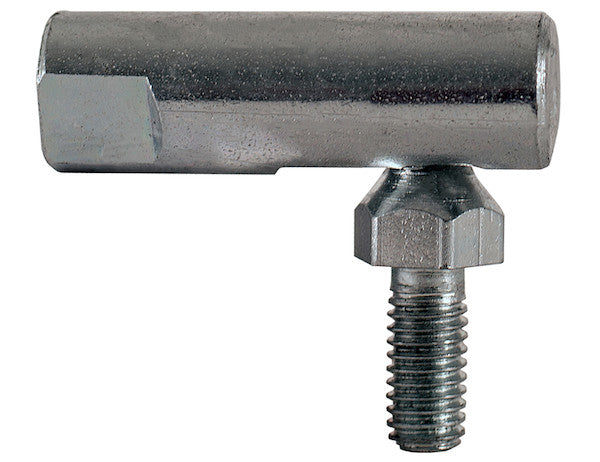
The Buyers Products Ball Joint is constructed from steel and available in five sizes.
Specifications
| Center to Stud Shoulder | 0.438 " |
| Movement Cone | 35 |
| Thread | #10-32 |
| Center to Socket Face | 0.875 " |
| Thread Depth | 0.438 " |
| Overall Length | 1.063 " |
| Stud Length from Shoulder | 0.438 |
| Ball Diameter | 0.172 " |
| Socket Diameter | 0.375 " |
The Buyers Products #10-32 Ball Joint represents a critical component within a vast array of mechanical and electromechanical systems, designed for precision articulation and reliable performance. This expanded technical description aims to delve into the intricate details, material science, engineering principles, application contexts, and operational advantages of this specific ball joint, positioning it as an indispensable element for engineers, designers, and procurement specialists.
At its core, a ball joint is a spherical bearing that enables rotational movement in multiple planes, providing a flexible connection between two components while maintaining structural integrity. The #10-32 Ball Joint, as specified, is engineered from high-grade steel, a material selection driven by its superior mechanical properties, including tensile strength, yield strength, hardness, and fatigue resistance. The decision to utilize steel underscores a commitment to durability and longevity, particularly in applications where dynamic loads, vibrations, and environmental stressors are prevalent. The precise steel alloy chosen, while not explicitly stated, is typically selected from grades known for good machinability and the ability to withstand specific operational conditions, often involving surface treatments like zinc plating for enhanced corrosion resistance, or phosphating for improved wear resistance and paint adhesion.
The nomenclature "#10-32" refers to the thread specification, a critical parameter for mechanical fastening. "#10" indicates the nominal diameter of the screw, which in the Unified Thread Standard (UTS) system corresponds to approximately 0.190 inches (or 4.826 mm). The "32" signifies 32 threads per inch (TPI), indicating a fine thread pitch. Fine threads offer several advantages: they provide a larger stress area due to more threads engaging within a given length, leading to higher shear strength and greater resistance to loosening under vibration compared to coarse threads. This makes the #10-32 thread ideal for applications requiring secure, stable connections, especially in compact assemblies where space is at a premium and precise adjustment might be necessary.
Let us examine the detailed specifications provided, as they offer crucial insights into the geometric and kinematic characteristics of this ball joint:
- Center to Stud Shoulder: 0.438 inches (11.125 mm). This dimension specifies the distance from the rotational center of the ball to the shoulder of the stud. The shoulder serves as a bearing surface or a stop, providing a defined mounting point and preventing over-insertion or misalignment. This dimension is critical for determining the effective length of the stud and its interaction with mating components, ensuring proper spacing and load distribution.
- Movement Cone: 35 degrees. The movement cone, often referred to as the angular range of motion, indicates the maximum angle through which the stud can articulate relative to the socket's longitudinal axis. A 35-degree cone signifies a total angular deflection of 35 degrees from the central axis in any direction. This parameter is vital for designers to ensure that the ball joint provides adequate flexibility for the intended application without binding or exceeding its mechanical limits. This range allows for significant angular misalignment accommodation and facilitates complex kinematic linkages.
- Thread: #10-32. As previously discussed, this specifies the threading for attachment, ensuring compatibility with standard #10-32 nuts or threaded holes. The precision of this thread is paramount for a secure and reliable mechanical connection.
- Center to Socket Face: 0.875 inches (22.225 mm). This measurement represents the distance from the ball's center to the outer face of the socket housing. This dimension is crucial for understanding the overall installed height and standoff created by the ball joint. It influences the lever arm length and potential bending moments experienced by the joint in an assembly.
- Thread Depth: 0.438 inches (11.125 mm). This refers to the length of the threaded portion of the stud. A sufficient thread depth is essential to ensure maximum thread engagement with the mating nut or threaded bore, thereby maximizing the strength of the threaded connection and preventing stripping under load. This depth is typically designed to allow for full engagement with standard nut thicknesses.
- Overall Length: 1.063 inches (27.000 mm). This is the total longitudinal extent of the ball joint from the tip of the stud to the furthest end of the socket. This dimension is fundamental for space planning and integration into tight enclosures, providing an accurate representation of its physical footprint.
- Stud Length from Shoulder: 0.438 inches (11.125 mm). This specification clarifies the exposed length of the stud beyond its shoulder. This length is critical for fastening applications, determining how much of the stud is available to pass through an attachment point and receive a nut. In conjunction with the "Center to Stud Shoulder" dimension, it helps define the full stud geometry.
- Ball Diameter: 0.172 inches (4.369 mm). The diameter of the spherical ball element. This dimension is intrinsically linked to the load-bearing capacity and wear characteristics of the joint. A larger ball diameter generally allows for higher contact stress distribution, potentially increasing load capacity and reducing wear, though it also increases the overall size of the joint. The precision of this spherical surface is critical for smooth, low-friction articulation.
- Socket Diameter: 0.375 inches (9.525 mm). This refers to the internal diameter of the socket housing that encapsulates the ball. The fit between the ball and socket is engineered for a precise clearance, allowing for smooth rotational movement while minimizing undesirable play or looseness. The internal surface of the socket is often polished or treated to reduce friction and wear.
The construction material, steel, is a deliberate choice for its balance of strength, machinability, and cost-effectiveness. Depending on the specific application requirements, the steel may undergo various post-manufacturing processes. Heat treatment, such as hardening and tempering, can significantly enhance the wear resistance of the ball and socket surfaces, and increase the overall strength of the stud. Surface coatings, such as zinc plating (clear chromate, yellow chromate), nickel plating, or black oxide, are commonly applied to steel components to provide corrosion resistance, reduce friction, and improve aesthetic appeal. For applications in corrosive environments, stainless steel variants might be employed, though they typically come with a higher material cost.
The engineering of the ball-and-socket mechanism is paramount to the ball joint's functionality. The ball, a precision-machined sphere, nests within a conforming socket. The contact surfaces are designed to minimize friction and wear during articulation. In many high-performance ball joints, a self-lubricating liner (e.g., PTFE, nylon, acetal) may be integrated into the socket to provide permanent lubrication, reduce stick-slip phenomena, and extend service life, particularly in applications where external lubrication is impractical or undesirable. While not explicitly mentioned for this specific product, the choice of mating materials for the ball and socket, or the inclusion of such liners, significantly impacts the coefficient of friction, operating temperature range, and maintenance requirements.
Applications for the Buyers Products #10-32 Ball Joint are diverse and span across numerous industries. In the automotive sector, smaller ball joints are often found in throttle linkages, gear selector mechanisms, and sensor mounts, where precise and backlash-free motion transfer is critical. In industrial machinery, they are employed in control linkages, robotic end effectors, jig and fixture components, and instrumentation mounts, enabling fine adjustments and accommodating minor misalignments. Aerospace applications, while often requiring more stringent material certifications, might utilize similar small ball joint designs for non-critical flight control indicators, interior mechanism linkages, or auxiliary system controls. They are also prevalent in consumer electronics, medical devices, and scientific instruments where compact, durable, and articulating connections are needed for displays, probes, or positioning systems.
Key advantages of utilizing this specific ball joint include its compact size, robust steel construction, and precise angular movement capability. The #10-32 thread ensures compatibility with standard fastening hardware, simplifying integration into existing designs. The 35-degree movement cone offers a substantial range of articulation, allowing for dynamic adjustments and absorption of minor misalignments without inducing undue stress on connected components. The combination of its precise dimensions and durable materials ensures a long operational lifespan, even under demanding conditions. Furthermore, the availability in five sizes, as mentioned in the initial description, suggests a design family that offers scalability and interchangeability, allowing engineers to select the optimal size for specific load and space constraints within a cohesive product line.
When selecting and integrating the #10-32 Ball Joint, several engineering considerations are critical. Designers must evaluate the maximum anticipated static and dynamic loads to ensure the joint's capacity is not exceeded. Factors such as tensile load, compressive load, and shear load on the stud, as well as the contact pressure within the ball-and-socket interface, must be within the material's elastic limits. Fatigue life under cyclic loading is another crucial aspect, especially in applications subject to continuous vibration or repetitive motion. Environmental factors, including operating temperature range, exposure to moisture, chemicals, dust, or abrasive particles, will influence material selection, lubrication strategy, and protective coatings. The rotational torque required for articulation and any potential for fretting corrosion at the ball-socket interface should also be considered. Proper installation practices, including correct torque application for the #10-32 fastener, are essential to achieve the advertised performance and prevent premature failure.
In summary, the Buyers Products #10-32 Ball Joint is a meticulously engineered component, designed for reliable performance in applications requiring flexible, articulate connections. Its steel construction provides a foundation of strength and durability, while the precise dimensional specifications ensure accurate fitment and controlled movement. The fine #10-32 thread pitch guarantees a secure fastening, critical for maintaining positional stability. With its specified movement cone and compact form factor, it stands as an exemplary solution for demanding mechanical linkages across a spectrum of industrial, commercial, and specialized applications where precise motion, accommodation of misalignment, and long-term reliability are paramount. Engineers and designers choosing this ball joint can expect a high-quality component that integrates seamlessly into complex systems, contributing to overall system integrity and operational efficiency.