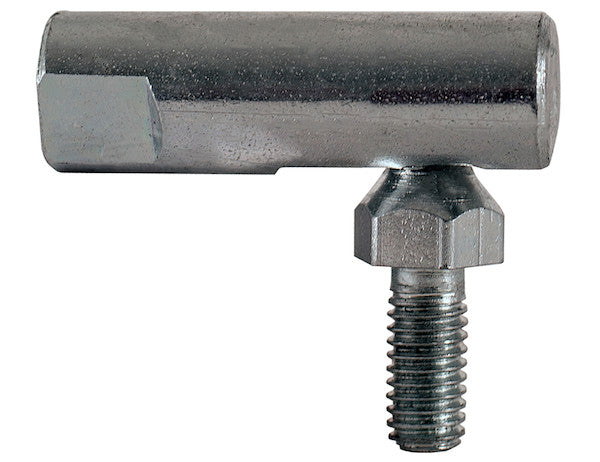
The Buyers Products Ball Joint is constructed from steel and available in five sizes.
Specifications
| Center to Socket Face | 1.125 " |
| Stud Length from Shoulder | 0.688 |
| Overall Length | 1.406 " |
| Thread | 5/16-24 |
| Ball Diameter | 0.232 " |
| Socket Diameter | 0.500 " |
| Movement Cone | 35 |
| Center to Stud Shoulder | 0.531 " |
| Thread Depth | 0.563 " |
The Buyers Products 5/16 Inch Ball Joint represents a pinnacle of precision engineering, meticulously designed to facilitate accurate angular movement and robust force transmission in critical mechanical linkages. Constructed entirely from high-grade steel, this component is engineered for exceptional durability, structural integrity, and prolonged service life across a diverse range of demanding applications. Its standardized 5/16-24 thread, coupled with precise dimensional control, positions it as an indispensable solution for systems requiring compact, strong, and highly articulate connections. This detailed technical overview focuses on the 5/16 inch variant, elucidating its design principles, material science, operational characteristics, and broad industrial applicability.
Material Science and Engineering: Steel Construction for Enhanced Durability
The foundation of the Buyers Products Ball Joint's superior performance lies in its high-grade steel construction. Steel, an alloy renowned for its outstanding mechanical properties, is strategically chosen for its optimal balance of high tensile strength, significant yield strength, and excellent resistance to wear and fatigue. Typically, low-carbon alloy steels are employed, often case-hardened, particularly for the spherical stud. Case hardening is a metallurgical process where the surface of the steel is enriched with carbon, followed by specific heat treatments (quenching and tempering). This creates an extremely hard, wear-resistant outer layer (the "case") capable of enduring abrasive forces and galling, while retaining a tougher, more ductile core. This dual-property structure is crucial for components like ball joints that experience both surface friction and dynamic shock loads, ensuring the stud resists both surface degradation and catastrophic fracture. Furthermore, the steel components are often treated with protective coatings, such as zinc plating or black oxide finishes, to significantly enhance corrosion resistance, extending the joint's operational life in various environmental conditions from dry industrial settings to more corrosive outdoor or marine applications. This meticulous material selection and treatment process guarantees that the ball joint maintains its dimensional stability and functional integrity under continuous operational stresses.
Detailed Analysis of Engineering Specifications
Each specification of the Buyers Products 5/16 Inch Ball Joint is a testament to precision engineering, critical for its functional integration and long-term reliability:
- Thread (5/16-24): This designates a 5/16-inch diameter thread with 24 threads per inch, identifying it as a Unified National Fine (UNF) thread. UNF threads offer superior resistance to loosening under vibration compared to coarse threads due to their smaller helix angle and larger shear area per unit length of engagement. This characteristic makes the 5/16-24 thread ideal for dynamic applications where secure fastening is paramount, enabling finer adjustments and enhancing the connection's tensile strength when properly torqued.
- Center to Socket Face (1.125"): This dimension measures the perpendicular distance from the center of the ball's articulation to the outermost face of the socket housing. It is a critical parameter for defining the kinematic geometry of a linkage system, enabling engineers to precisely calculate lever arm lengths, establish clearance requirements, and ensure the ball joint operates within its intended angular range without mechanical interference.
- Stud Length from Shoulder (0.688"): This measurement denotes the length of the threaded stud from its load-bearing shoulder to its end. A precise stud length ensures optimal thread engagement with the mating component, maximizing the connection's strength and minimizing the risk of stripping or pull-out under operational loads. It also influences the stand-off distance from the mounting surface, crucial for overall assembly dimensions.
- Overall Length (1.406"): The total length of the ball joint, measured at 1.406 inches, is a vital consideration for spatial planning within compact mechanical designs. This dimension allows for accurate integration into confined enclosures or intricate mechanisms, ensuring proper fitment and preventing physical interference with surrounding components. It contributes to the overall compact footprint of the linkage.
- Ball Diameter (0.232"): The spherical ball, measuring 0.232 inches in diameter, is the articulating element of the joint. Its precise dimension directly impacts load distribution, wear characteristics, and the smoothness of angular movement. A finely machined and hardened ball surface ensures consistent contact with the socket, evenly distributing forces and minimizing localized stress concentrations to enhance the joint's endurance.
- Socket Diameter (0.500"): Encapsulating the ball, the socket has an internal diameter of 0.500 inches. The precise tolerance between the ball and socket diameters is fundamental for controlling the joint's play and achieving the desired articulation quality. A well-controlled fit facilitates smooth rotation while providing stability, often augmented by internal low-friction surfaces or liners in specific designs to reduce wear and minimize operational friction.
- Movement Cone (35 degrees): This specification defines the maximum angular articulation from the axial centerline in any direction, providing a total range of 70 degrees (35 degrees pivot from center). This generous movement cone is essential for applications requiring substantial angular adjustment or compensation for dynamic misalignment. It allows connected components to move through a wide arc without inducing damaging bending stresses on the stud or causing the linkage to bind.
- Center to Stud Shoulder (0.531"): This dimension measures the distance from the center of the ball to the shoulder of the threaded stud. It is another critical kinematic parameter, essential for accurately establishing the pivot point relative to the mounting interface. Precision in this measurement ensures correct alignment of the linkage, efficient force transmission, and predictable behavior within the assembled mechanical system.
- Thread Depth (0.563"): This refers to the effective length of the threaded portion of the stud. A thread depth of 0.563 inches ensures sufficient thread engagement, distributing loads across multiple threads. This prevents shear failure of the threads and significantly contributes to the overall pull-out strength and structural integrity of the connection, vital for maintaining reliability under tensile loads.
Mechanical Principles and Operational Characteristics
The Buyers Products 5/16 Inch Ball Joint operates on fundamental mechanical principles, enabling versatile motion transfer. It functions as a spherical bearing, allowing multi-directional angular movement (roll, pitch, yaw) within its specified 35-degree cone, effectively accommodating misalignment and dynamic changes in angle between two connected components. This intrinsic ability prevents binding and reduces stress on adjacent elements, ensuring continuous force transmission. The steel construction is specifically engineered to manage both axial (tension/compression) and radial (bending) loads, distributing stresses efficiently across the hardened ball and socket interface. This design contributes to an extended fatigue life, allowing the joint to endure numerous load cycles without premature material degradation. While not explicitly detailed as a sealed unit, the design minimizes friction through precision machining and material hardening, contributing to smooth operation, reduced wear, and efficient energy transfer.
Manufacturing Excellence and Quality Assurance
The production of the Buyers Products 5/16 Inch Ball Joint involves rigorous manufacturing processes and stringent quality control protocols. High-grade steel is precisely forged or CNC machined to achieve the intricate geometries and tight tolerances required for the ball stud and socket. Subsequent heat treatment processes, including hardening and tempering (and often case hardening for the stud), are meticulously controlled to impart optimal mechanical properties such as enhanced hardness, strength, and toughness. Surface finishing techniques, such as protective platings, further improve corrosion resistance and surface integrity. Throughout production, comprehensive quality assurance measures are implemented. These include multi-stage dimensional verification using advanced metrology equipment (e.g., CMMs, precision gauges), material spectrographic analysis to confirm chemical composition, and hardness testing to validate heat treatment efficacy. Destructive testing, such as tensile and fatigue analysis, along with non-destructive inspections, ensures that every ball joint meets or exceeds specified performance benchmarks for load bearing capacity, endurance, and operational reliability.
Versatile Applications Across Industries
The robust design and precise articulation of the Buyers Products 5/16 Inch Ball Joint make it exceptionally versatile across numerous industrial and mechanical sectors:
- Industrial Automation & Machinery: Critical in robotic end-effectors, packaging equipment linkages, sensor mounts, and various control rod assemblies requiring flexible, precise movement.
- Agricultural Equipment: Utilized in throttle controls, gear shift mechanisms, and small implement linkages on tractors and other farm machinery, tolerating vibration and rugged environments.
- Marine Applications: Found in throttle and shift control systems, trim tab actuators, and other non-critical linkages on boats and watercraft, requiring durability against corrosive elements.
- Specialty Vehicles: Integrated into non-suspension steering linkages, shifter mechanisms, and accessory controls for ATVs, UTVs, golf carts, and custom off-road vehicles.
- Custom Fabrication & Prototyping: A preferred component for engineers and fabricators creating bespoke mechanical systems, test rigs, and prototypes due to its standardized dimensions and reliable performance.
Installation and Maintenance Best Practices
To ensure optimal performance and longevity of the 5/16 Inch Ball Joint, proper installation and routine maintenance are essential. Critically, the 5/16-24 thread must be torqued to the manufacturer's specified value using a calibrated torque wrench. This prevents loosening under vibration (under-torquing) and avoids material fatigue or thread damage (over-torquing). Ensure adequate clearance for the full 35-degree movement cone to prevent binding or undue stress on the joint. Regular inspections should be conducted to check for signs of wear, such as excessive play or "slop," corrosion, or damage to the stud or housing. Timely replacement of worn components is crucial to maintain system integrity, precision, and safety, preventing potential cascading failures in the mechanical linkage.
Advantages of Buyers Products Ball Joint: A Standard of Excellence
The Buyers Products 5/16 Inch Ball Joint offers distinct advantages through its thoughtful engineering: its robust steel construction ensures unparalleled durability and strength for load-bearing applications; precision manufacturing guarantees accurate fitment and predictable kinematic behavior, minimizing backlash; the generous 35-degree movement cone provides extensive angular flexibility, preventing binding and accommodating dynamic misalignments; and its standardized 5/16-24 UNF thread simplifies integration and ensures compatibility. These attributes collectively deliver a high-performance, long-lasting component that significantly enhances the reliability and efficiency of the mechanical systems it serves, providing excellent long-term value.
Conclusion
The Buyers Products 5/16 Inch Ball Joint stands as an exemplar of robust, precision-engineered mechanical components. Its high-grade steel construction, meticulously engineered dimensions including the 5/16-24 UNF thread and 35-degree movement cone, and adherence to stringent quality standards ensure exceptional durability, precise articulation, and reliable force transmission. Designed for demanding applications across diverse industries, this ball joint offers an optimal balance of strength, flexibility, and longevity. It is a critical enabler for sophisticated mechanical systems, providing the reliable, maintenance-friendly interface necessary for consistent performance and operational integrity. For engineers and designers prioritizing resilience and precision, the Buyers Products 5/16 Inch Ball Joint delivers a superior solution.