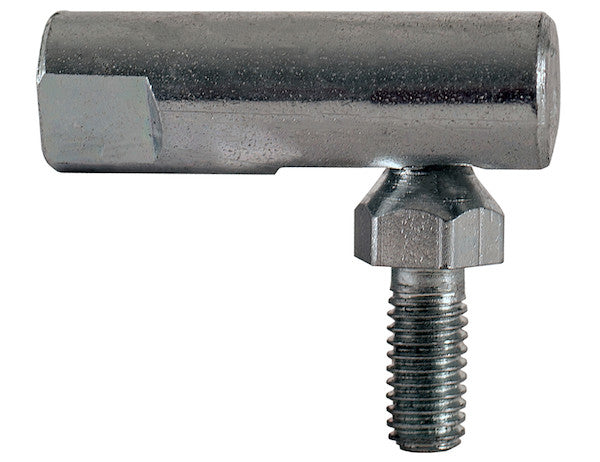
The Buyers Products Ball Joint is constructed from steel and available in five sizes.
Specifications
| Stud Length from Shoulder | 0.875 |
| Center to Socket Face | 1.375 " |
| Movement Cone | 35 |
| Ball Diameter | 0.297 " |
| Overall Length | 1.688 " |
| Center to Stud Shoulder | 0.688 " |
| Thread | 3/8-24 |
| Socket Diameter | 0.625 " |
| Thread Depth | 0.750 " |
Technical Overview: Buyers Products 3/8 Inch Ball Joint
The Buyers Products 3/8 Inch Ball Joint represents a critical component in various mechanical linkages, offering unparalleled flexibility and robust performance in demanding applications. Engineered from high-grade steel, this ball joint is designed for durability and precision, ensuring reliable operation across a wide spectrum of industrial, automotive, and heavy-duty equipment sectors. This comprehensive technical description will delve into the material science, design principles, dimensional specifications, performance characteristics, and application considerations of this essential mechanical component.
Material Science and Construction
The foundation of the Buyers Products Ball Joint's exceptional performance lies in its material composition. Constructed entirely from steel, it benefits from the inherent strength, rigidity, and wear resistance associated with ferrous alloys. The specific grade of steel used is selected to balance attributes such as tensile strength, yield strength, hardness, and ductility, critical for components subjected to complex loading conditions including tension, compression, shear, and bending moments. Surface treatments, such as phosphating or galvanizing, may be applied to enhance corrosion resistance and reduce friction, although the primary material strength is derived from the bulk steel properties.
The manufacturing process typically involves precision machining, forging, or stamping, followed by heat treatment processes such as hardening and tempering. These processes are meticulously controlled to achieve the desired microstructural properties, thereby optimizing the mechanical performance of the ball joint. The spherical ball, the articulating stud, and the socket housing are designed to withstand significant operational stresses without succumbing to deformation or premature wear. The robust steel construction ensures a long service life, even in environments characterized by vibration, shock loads, and exposure to contaminants.
Design Principles and Articulation Mechanics
A ball joint's primary function is to permit angular movement in multiple planes while simultaneously transmitting force. This is achieved through a spherical bearing mechanism where a ball-shaped stud articulates within a mating spherical socket. The Buyers Products 3/8 Inch Ball Joint embodies this principle with a design optimized for both freedom of movement and structural integrity.
The 'Movement Cone' specification of 35 degrees is a critical design parameter. This value defines the maximum angular displacement the stud can achieve relative to the socket's longitudinal axis before mechanical interference or binding occurs. A 35-degree movement cone indicates substantial flexibility, allowing for significant angular misalignment or dynamic changes in linkage geometry. This angular freedom is essential in applications where components are subject to dynamic movement or where precise alignment cannot be guaranteed during installation or operation. The design ensures smooth, friction-minimized articulation within this specified range, preventing premature wear on the internal surfaces of the socket and the ball.
The spherical contact area between the ball and the socket is engineered to distribute loads evenly, reducing localized stress concentrations. This design minimizes wear and tear on the articulating surfaces, contributing to the component's extended operational life. The internal geometry of the socket is precisely matched to the Ball Diameter of 0.297 inches, ensuring a snug yet freely moving fit. This precision fit is paramount for maintaining system rigidity and preventing undesirable play or backlash in the linkage.
Dimensional Specifications and Their Significance
The provided specifications are crucial for proper integration and performance analysis of the ball joint within an assembly. Each dimension plays a vital role:
- Stud Length from Shoulder (0.875"): This dimension measures the length of the threaded stud portion extending from the shoulder of the ball joint. It is critical for determining the engagement depth with mating components and ensuring adequate thread engagement for secure fastening.
- Center to Socket Face (1.375"): This measurement represents the distance from the center of the spherical articulation point to the outer face of the socket housing. It is essential for calculating overall linkage length and clearance requirements within an assembly.
- Movement Cone (35 degrees): As previously discussed, this specifies the maximum angular range of motion for the stud within the socket. It is a key indicator of the joint's flexibility and suitability for applications requiring significant angular displacement.
- Ball Diameter (0.297"): This is the diameter of the spherical ball on the stud, which articulates within the socket. It is a critical dimension for manufacturing tolerances and ensuring the correct fit and smooth movement within the socket.
- Overall Length (1.688"): This provides the total length of the ball joint from the tip of the stud to the opposite end of the socket housing. It is a fundamental dimension for space claim and overall design layout considerations.
- Center to Stud Shoulder (0.688"): This dimension indicates the distance from the center of articulation to the shoulder of the stud. Together with "Stud Length from Shoulder," it defines the stud's overall geometry and its contribution to the linkage length.
- Thread (3/8-24): This specifies the thread type and size of the stud. "3/8" refers to the nominal major diameter of the thread in inches, and "24" indicates 24 threads per inch (TPI). This imperial fine thread (UNF) is chosen for its higher tensile strength and resistance to loosening under vibration compared to coarse threads, making it suitable for secure mechanical fastening.
- Socket Diameter (0.625"): This is the external diameter of the main socket housing. It is important for determining clearance and potential interference with surrounding components in an assembly.
- Thread Depth (0.750"): This dimension specifies the length of the usable threaded portion on the stud. It ensures adequate thread engagement with a mating nut or threaded hole, providing sufficient clamping force and preventing stripping under load.
These precise dimensions allow engineers to integrate the ball joint seamlessly into existing designs or to develop new systems with confidence in the component's fit and function.
Performance Characteristics and Reliability
The performance of the Buyers Products 3/8 Inch Ball Joint is characterized by several key attributes:
- Load Bearing Capacity: While specific load ratings are not provided, the steel construction and robust dimensional specifications indicate a substantial capacity for handling both static and dynamic loads. The precise machining of the ball and socket ensures an even distribution of forces, minimizing stress concentrations that could lead to premature failure.
- Wear Resistance: The use of steel, potentially with surface hardening treatments, provides excellent resistance to abrasive wear, especially in the articulating surfaces. This is crucial for maintaining tight tolerances and preventing the development of excessive play over time, which can compromise linkage precision and system stability.
- Fatigue Life: Components subjected to repetitive loading and unloading cycles must exhibit high fatigue resistance. The careful selection of steel grade and manufacturing processes, including stress relief treatments, contributes to a long fatigue life, making the ball joint suitable for continuously operating machinery.
- Corrosion Resistance: While primary construction is steel, consideration for operating environments is critical. For applications exposed to moisture, chemicals, or salt, supplementary corrosion protection (e.g., plating, coating, or specific stainless steel variants if offered) would be necessary to maintain structural integrity and functional performance.
- Temperature Range: Steel components typically perform well across a broad range of temperatures, from sub-zero conditions to elevated temperatures. The operational temperature limits would primarily be dictated by any lubricants or protective coatings used, rather than the steel itself.
- Maintenance Requirements: Depending on the specific design variant (e.g., sealed or unsealed), the ball joint may be designed as a low-maintenance or maintenance-free component. Sealed versions typically incorporate internal lubrication and protective boots to keep contaminants out and grease in, extending service intervals.
Applications and Industry Relevance
The versatility and robustness of the Buyers Products 3/8 Inch Ball Joint make it indispensable across a multitude of industries and applications:
- Automotive and Heavy Equipment: Widely used in steering linkages, suspension systems, throttle controls, and shift mechanisms. The ability to accommodate angular movement while transmitting force is critical for responsive and reliable vehicle operation. In heavy equipment, they are found in control arms for excavators, loaders, and other machinery where precise articulation and high load capacity are essential.
- Agricultural Machinery: Employed in various implements and equipment, such as tractor linkages, mower deck adjustments, and spray boom articulation. Their ruggedness is well-suited to the harsh operating conditions encountered in farming.
- Industrial Robotics and Automation: Integral to robotic arms, end-effectors, and automated assembly lines where precise and flexible movement is required. The high degree of accuracy and minimal backlash are critical for maintaining robotic precision.
- Material Handling Systems: Found in conveyor systems, sorters, and positioning equipment where components need to pivot or accommodate changes in alignment.
- Specialty Vehicles: Utilized in off-road vehicles, recreational vehicles (RVs), and utility vehicles for various control and linkage applications.
- Marine Applications: In marine steering and control systems, requiring robust construction and corrosion resistance (often with specialized coatings or stainless steel variants).
- Aerospace (Non-Flight Critical): For ground support equipment, test fixtures, and non-flight critical control linkages, where high reliability is still paramount.
- General Mechanical Linkages: Any application requiring the connection of two components that need to pivot freely relative to each other while transmitting push/pull forces. This includes everything from prototyping to custom machinery.
Installation and Integration Considerations
Proper installation is paramount to ensuring the optimal performance and longevity of the Buyers Products 3/8 Inch Ball Joint. Key considerations include:
- Thread Engagement: The 3/8-24 thread and 0.750-inch thread depth necessitate adequate thread engagement with the mating component (e.g., a nut or threaded hole). Insufficient engagement can lead to thread stripping, loss of clamping force, and premature failure. Manufacturers typically recommend at least 1.5 times the nominal diameter for thread engagement in steel.
- Torque Specifications: Fastening the ball joint stud requires adhering to specified torque values to achieve proper clamping force without over-stressing the threads or the stud itself. Over-tightening can lead to thread damage or material yielding, while under-tightening can result in loosening under vibration.
- Alignment: While ball joints accommodate angular misalignment, minimizing initial misalignment during installation can reduce stress on the joint and surrounding components, promoting smoother operation and extended life.
- Clearance: Ensure sufficient clearance around the socket and stud to allow for the full 35-degree movement cone without interference with other components.
- Environmental Protection: For applications in corrosive or abrasive environments, ensure that the ball joint is adequately protected. This may involve using protective boots, specific coatings, or selecting an appropriate variant designed for such conditions.
- Lubrication: If the ball joint is not sealed and factory-lubricated, regular lubrication (with an appropriate grease or lubricant) according to manufacturer recommendations is crucial to minimize friction and wear on the articulating surfaces.
Conclusion
The Buyers Products 3/8 Inch Ball Joint is a meticulously engineered component, designed to meet the rigorous demands of modern mechanical systems. Its steel construction, precise dimensional specifications, and generous 35-degree movement cone ensure exceptional durability, reliability, and versatility. By understanding the underlying material science, design principles, and application considerations, engineers and designers can confidently select and integrate this ball joint into a wide array of industrial, automotive, and heavy-duty applications, ensuring optimal performance and longevity of their systems. The availability in five sizes further enhances its adaptability, allowing for precise selection based on specific load, space, and motion requirements.