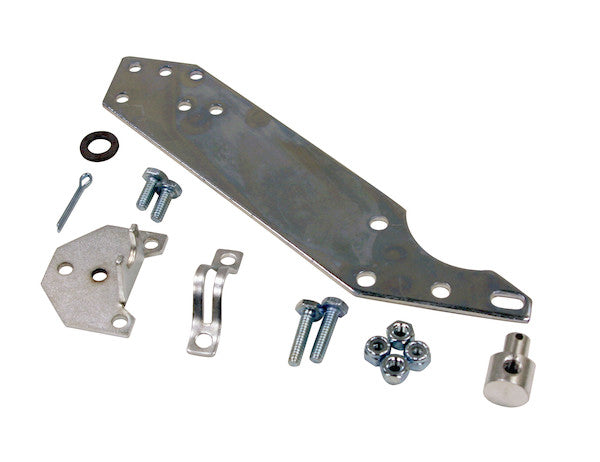
The BPT PTO Connection Kit from Buyers Products contains all fasteners and hardware required to connect a clamp style push-pull cable to a double gear Chelsea?? or similar PTO.
Specifications
| Rotation | - |
| Connects To | Double Gear Chelsea & Similar P.T.O.s |
| Works with Cable Type | 5200 Series & 6200 Series |
| Works w/Cable Travel (in.) | 3 |
| Compatible Cable Thread Size (in.) | 1/4-28 & 5/16-24 |
The Dual Gear PTO Connection Kit, specifically the BPT PTO Connection Kit from Buyers Products, represents a critical component in the mechanical linkage system for vocational trucks and industrial equipment. This kit is meticulously engineered to facilitate the precise and secure connection of a clamp-style push-pull cable to a double gear Chelsea or functionally analogous Power Take-Off (PTO) unit. Understanding the technical intricacies and operational significance of this kit requires a comprehensive examination of its design, application, and the broader context of PTO systems.
A Power Take-Off (PTO) is a mechanical gearbox that attaches to a transmission and is used to transfer the engine’s power to auxiliary components, such as hydraulic pumps, air compressors, or various other equipment. In applications demanding high torque or specific operational characteristics, double gear PTOs are often employed. These units offer enhanced durability and power transfer capabilities compared to single gear counterparts, making them suitable for heavy-duty applications like refuse trucks, dump trucks, snowplows, and various utility vehicles. The effectiveness and longevity of such a system are heavily reliant on the integrity and precision of its control mechanism.
The BPT PTO Connection Kit is designed to bridge the gap between the operator's control input (via a push-pull cable) and the PTO engagement mechanism. Push-pull cables, often referred to as control cables, are an essential element in mechanical control systems due to their ability to transmit both tensile and compressive forces over varying distances with minimal backlash. The kit's compatibility with 5200 Series and 6200 Series cables underscores its versatility and adherence to industry standards for robust and reliable cable types. These series typically denote specific construction methods and load ratings, ensuring that the connected cable can withstand the operational stresses inherent in engaging and disengaging a PTO.
Central to the kit's functionality is its ability to accommodate a cable travel of 3 inches. This specification is crucial as it dictates the range of motion required at the PTO engagement lever for full and proper engagement or disengagement. Insufficient travel could lead to partial engagement, resulting in premature wear of gears and clutches, reduced power transfer efficiency, and potential system failure. Conversely, excessive travel might indicate an incorrect setup or incompatible components. The 3-inch travel is a carefully selected parameter designed to optimize the mechanical advantage and operational feel for the user, ensuring a definitive and smooth transition between engaged and disengaged states.
Furthermore, the kit’s compatibility with common cable thread sizes, specifically 1/4-28 and 5/16-24, highlights its adaptability across a wide array of existing cable systems. These thread specifications are standard in the industrial control cable sector, ensuring that maintenance and replacement parts are readily available. The inclusion of both sizes within the kit implies a universal design approach, allowing technicians to utilize the kit with various manufacturers' cables without requiring additional adapters or modifications. This not only streamlines installation but also reduces inventory requirements for fleet operators and service centers.
The "clamp style" designation for the push-pull cable refers to the method by which the cable's inner wire is secured at the connection point. This typically involves a robust clamping mechanism that provides a firm, non-slip grip on the cable's inner wire, ensuring that the force transmitted from the control lever to the PTO engagement mechanism is precise and consistent. The integrity of this clamp is paramount, as any slippage would directly translate to a loss of control or an imprecise engagement, potentially leading to operational hazards or component damage.
The hardware and fasteners included in the BPT PTO Connection Kit are specifically chosen for their durability, corrosion resistance, and ability to withstand the vibrational and dynamic stresses inherent in commercial vehicle operation. These often include high-grade steel components, potentially with protective coatings such as zinc plating or passivation, to resist environmental degradation and extend service life. The precise assortment of nuts, bolts, washers, and specialized brackets ensures that the connection is not only secure but also properly aligned, minimizing wear on the PTO's internal linkages and the control cable itself.
When considering the installation of the Dual Gear PTO Connection Kit, several technical aspects must be addressed to ensure optimal performance and safety. Proper alignment of the cable with the PTO lever arm is critical. Misalignment can introduce side loading on the cable and its conduit, leading to increased friction, premature wear, and potential cable binding. The kit components are designed to facilitate this alignment, often incorporating adjustable elements or specific mounting orientations to achieve the ideal geometry. The securing of the cable conduit also plays a vital role; improper routing or loose mounting can cause kinks or excessive bending, impairing cable movement and reducing operational efficiency.
Maintenance considerations for systems utilizing the BPT PTO Connection Kit are straightforward but essential. Regular inspection of the cable for signs of fraying, corrosion, or kinks is recommended. The connection points, particularly the clamp mechanism and all fasteners, should be checked for tightness and signs of wear. Lubrication of the cable's inner wire, where applicable and recommended by cable manufacturers, can significantly extend its lifespan and maintain smooth operation. The robust design of the BPT kit components, however, aims to minimize the frequency of such interventions, providing a reliable "fit and forget" solution under normal operating conditions.
In summary, the Dual Gear PTO Connection Kit (BPT PTO Connection Kit) from Buyers Products is more than just an assortment of hardware; it is a precisely engineered interface designed to ensure reliable and efficient control of double gear PTO systems. Its compatibility with standard push-pull cable series (5200 and 6200), its specified cable travel of 3 inches, and its accommodation of common cable thread sizes (1/4-28 and 5/16-24) collectively make it a versatile and indispensable component for a wide range of heavy-duty vocational applications. By facilitating a secure, precise, and durable connection, this kit plays a fundamental role in maximizing the operational efficiency and extending the service life of critical auxiliary equipment powered by the vehicle's engine. Its technical specifications reflect a thoughtful design approach aimed at meeting the rigorous demands of industrial and commercial environments, making it a professional-grade solution for mechanical control systems.
Further delving into the technical aspects, the choice of materials for the BPT PTO Connection Kit components is critical. Given the harsh operating environments often encountered by vocational vehicles—exposure to road salt, moisture, dirt, and extreme temperatures—each part must exhibit superior material properties. Typically, fasteners and brackets are manufactured from high-strength steel alloys, often heat-treated to achieve specific mechanical properties such as tensile strength and hardness. Surface treatments are equally important; common choices include zinc plating (for corrosion resistance), black oxide finishes (for minimal light reflection and some corrosion protection), or even specialized e-coatings or powder coatings for enhanced durability and aesthetic appeal. These material choices are not merely incidental but are fundamental to the kit's long-term reliability and performance, ensuring that the connection remains robust under continuous cyclic loading and environmental stress.
The "double gear" aspect of the compatible Chelsea PTOs is also significant. Double gear PTOs utilize two sets of gears to achieve different speed ratios or to provide enhanced torque output. This design complexity means that the engagement mechanism within the PTO itself might require a more precise and definitive throw to ensure full gear mesh, thus underscoring the importance of the specified 3-inch cable travel. The BPT kit is engineered to provide this exact throw, preventing partial engagement which can lead to rapid wear of gear teeth, increased noise, and ultimately, premature failure of the PTO unit. The mechanical advantage provided by the kit’s lever arm configuration, if applicable, would also be optimized to ensure that the force required by the operator to engage the PTO is within ergonomic limits while still providing sufficient force at the PTO end to overcome any resistance from the internal shifting mechanism.
Regarding the compatibility with 5200 and 6200 Series cables, these classifications often refer to heavy-duty industrial control cables designed for demanding applications. Key characteristics of such cables include:
- Robust Conduit Construction: Often featuring multiple layers of steel wires or flat steel strips, sometimes helically wound, for crush resistance and flexibility, encased in a durable polymer jacket (e.g., HDPE, PVC, or PTFE-lined for reduced friction).
- High-Strength Inner Wire: Typically made from stranded stainless steel or high-carbon steel, providing high tensile and compressive strength, crucial for transmitting forces over distance.
- Low Friction Liner: Many quality cables include an internal liner (e.g., Teflon® or similar polymer) to minimize friction between the inner wire and the conduit, ensuring smooth operation and extending cable life.
- Sealed Ends: Often feature sealed end fittings to prevent ingress of moisture and contaminants into the conduit, which can cause corrosion and increase friction.
The concept of "clamp style" for the push-pull cable connection signifies a robust and adjustable fastening method. Unlike crimped connections, a clamp style allows for fine-tuning of the cable's effective length after initial installation. This adjustability is crucial for setting the exact engagement point of the PTO and ensuring that there is no slack or undue tension in the cable system when the PTO is in its fully disengaged or engaged state. A typical clamp assembly might involve a set screw, a U-bolt, or a wedge-type mechanism that physically grips the inner wire of the cable, securing it firmly within a receiver block or lever arm. The design must ensure that this clamping force is sufficient to prevent slippage even under maximum operational loads and vibrations, thus maintaining the integrity of the control input.
From an installation perspective, the BPT PTO Connection Kit aims to simplify the process while ensuring reliability. Detailed instructions would typically accompany the kit, outlining specific steps for mounting the bracketry to the PTO and connecting the cable. Consideration must be given to torque specifications for all fasteners to prevent over-tightening (which can strip threads or deform components) or under-tightening (which can lead to loose connections and system failure). The kit's design likely incorporates features that facilitate a straightforward installation, such as pre-drilled holes that align with standard PTO mounting patterns, and components that can be easily manipulated within the often-confines space around a vehicle's transmission. The overall goal is to provide a 'bolt-on' solution that minimizes custom fabrication and maximizes compatibility.
Furthermore, the absence of a "Rotation" specification in the provided table is noteworthy. This implies that the BPT PTO Connection Kit is designed for a linear push-pull action and does not introduce or compensate for any rotational motion directly. The PTO itself will have a specified rotation (e.g., clockwise or counter-clockwise) for its output shaft, but the connection kit merely translates the linear motion of the control cable into the necessary linear or limited rotational movement of the PTO engagement lever. This simplifies the kit's design, focusing purely on the mechanical linkage rather than complex rotational couplings.
The professional implications of choosing a high-quality connection kit like the BPT are significant for fleet managers and equipment operators. A poorly designed or inferior kit can lead to frequent breakdowns, unscheduled downtime, and costly repairs, not just of the connection kit itself but potentially of the PTO unit or even the transmission due to improper engagement. By providing a kit with clearly defined technical specifications and robust components, Buyers Products ensures that the interface between the control system and the PTO is as reliable as the PTO itself. This contributes to increased operational uptime, reduced maintenance costs, and enhanced safety for personnel operating the equipment. The investment in a quality connection kit is an investment in the overall reliability and longevity of the entire vocational vehicle system.
In conclusion, the Dual Gear PTO Connection Kit, embodied by the BPT PTO Connection Kit from Buyers Products, represents an expertly crafted solution for a critical interface in heavy-duty mechanical control systems. Its precise engineering, comprehensive compatibility with industry-standard cables, and robust construction are tailored to the demanding environments of vocational applications. The kit’s specifications for cable travel and thread sizes are not arbitrary but are carefully chosen to ensure optimal performance, definitive PTO engagement, and longevity. By focusing on durability, ease of installation, and seamless integration, this connection kit provides a foundational element for reliable power transfer, directly contributing to the efficiency, safety, and operational success of industrial and commercial machinery equipped with double gear Chelsea or similar PTO units. It stands as a testament to specialized engineering in the automotive and heavy equipment accessory sector.