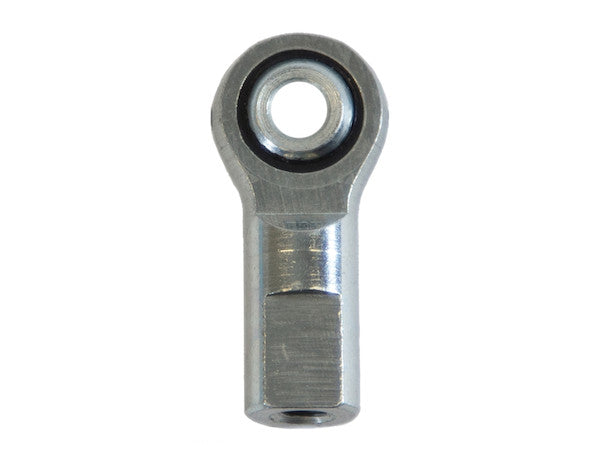
The Buyers Products Rod End Bearing is constructed from steel and available in five sizes.
Specifications
| Socket Diameter | 0.406 " |
| Thread Depth | 0.562 " |
| Thread | #10-32 |
| Ball Diameter | 0.437 " |
| Socket Flats | 0.310 " |
| Overall Length | 1.375 " |
| Movement Cone | 50 |
| Center to Socket Face | 1.062 " |
Advanced Technical Overview: Buyers Products 10-32 Rod End Bearing
The Buyers Products Rod End Bearing, specifically the 10-32 variant, represents a critical component in mechanical linkage systems, designed for the efficient transmission of static and dynamic loads while accommodating angular misalignment. This highly engineered component facilitates movement in multiple planes, making it indispensable in applications requiring precise motion control and robust connectivity. Fabricated from high-grade steel, this rod end bearing is engineered for durability, extended service life, and consistent performance across a broad spectrum of industrial and commercial environments.
Fundamental Principles of Rod End Bearings
A rod end bearing, often referred to as a spherical plain bearing rod end, is a self-aligning mechanical articulation point consisting of a spherical inner ring (the "ball") housed within an outer ring (the "socket" or "housing") that incorporates a male or female threaded shank. The ball, with its precisely ground spherical outer surface, allows for angular movement relative to the housing, accommodating misalignment between connected components without inducing bending stresses or binding. The threaded shank provides a secure and adjustable attachment point to connecting rods or other linkage elements. This design effectively translates push-pull movements while mitigating the effects of inevitable misalignments that arise from manufacturing tolerances, structural deflections, or dynamic operational conditions.
Detailed Analysis of the 10-32 Thread Specification
The designation "#10-32" is a standard unified national fine (UNF) thread specification, critical for understanding the mechanical interface of this rod end bearing. In the Unified Thread Standard (UTS) system, the "#10" refers to the nominal major diameter of the thread. For a #10 screw thread, the major diameter is approximately 0.190 inches (or 4.826 mm). The "32" signifies the thread pitch, indicating 32 threads per inch (TPI). This fine pitch thread offers several distinct advantages over coarser threads, particularly in applications demanding precise adjustment, enhanced resistance to loosening under vibration, and increased tensile strength due to a larger minor diameter for a given major diameter. The finer pitch distributes the load over a greater number of engaged threads, thereby increasing the shear area and reducing localized stress concentrations, which is beneficial for maintaining connection integrity under cyclical loading. The use of a UNF thread ensures interchangeability and adherence to globally recognized standards, simplifying design and procurement processes. Engineers must ensure mating components possess corresponding #10-32 internal threads to achieve a robust, interference-free connection with optimal thread engagement depth.
Material Science: Steel Construction and Surface Engineering
The selection of steel as the primary construction material for the Buyers Products Rod End Bearing is a testament to its inherent mechanical properties, offering a balance of strength, hardness, toughness, and fatigue resistance essential for demanding applications. While the specific alloy may vary (e.g., low carbon steel for cost-effectiveness, medium carbon steel for higher strength, or alloy steel for specialized properties like improved wear resistance or heat treat response), the fundamental advantages of steel remain consistent. Steel provides excellent load-bearing capabilities, resisting deformation under high compressive and tensile stresses. Furthermore, steel components can be subjected to various heat treatment processes, such as hardening, tempering, and case hardening (carburizing or nitriding), to optimize specific properties. For instance, the spherical ball might be through-hardened for superior wear resistance, while the housing maintains a degree of toughness to prevent brittle fracture. Surface treatments are equally crucial. Common enhancements include zinc plating for corrosion resistance, black oxide finishes for mild corrosion protection and aesthetic appeal, or specialized coatings for reduced friction and extended life. These surface engineering strategies are vital in preventing rust, mitigating wear between the ball and socket, and ensuring consistent performance in diverse environmental conditions, including exposure to moisture, chemicals, or abrasive contaminants. The choice of steel also impacts the bearing's operating temperature range and its susceptibility to creep, properties that are meticulously considered during the design phase to meet application-specific requirements.
Precision Engineering: Dissecting the Key Specifications
Each dimension and specification provided for the Buyers Products 10-32 Rod End Bearing is a critical parameter influencing its functionality, integration, and performance:
- Socket Diameter (0.406"): This dimension refers to the internal diameter of the outer race or housing that encapsulates the spherical ball. A precisely machined socket diameter is crucial for achieving the correct fit with the ball. An overly loose fit can lead to excessive play, premature wear, and reduced load capacity, while an overly tight fit can restrict angular movement and increase friction. The 0.406" dimension is meticulously controlled to ensure smooth articulation and stable retention of the ball under operational loads, contributing directly to the bearing's dynamic performance and longevity.
- Thread Depth (0.562"): The thread depth, or the length of the threaded portion on the shank, is a critical factor determining the strength and integrity of the connection to the mating component. A depth of 0.562" provides ample thread engagement for the #10-32 UNF thread, ensuring that the full load-bearing capacity of the thread is utilized. Insufficient thread depth can lead to premature stripping under high tensile loads or dynamic forces, compromising the structural integrity of the linkage. This specific depth is engineered to provide robust engagement without adding unnecessary overall length or material cost, balancing strength with design efficiency.
- Ball Diameter (0.437"): The ball diameter, measured at 0.437", represents the critical dimension of the spherical inner race. This element is typically manufactured with extremely tight tolerances and a high degree of surface finish (often polished or ground) to minimize friction and wear against the socket. The material of the ball is often hardened steel, sometimes with a chromium plating or other specialized coating to enhance its wear characteristics and corrosion resistance. The precise relationship between the ball diameter and the socket diameter is fundamental to the bearing's smooth angular movement and its ability to withstand radial and axial loads effectively.
- Socket Flats (0.310"): The presence of socket flats, measuring 0.310" across, provides a crucial feature for installation and adjustment. These flats typically allow for the engagement of a standard wrench, enabling technicians to securely tighten the rod end onto a threaded rod or fixture, or to make precise rotational adjustments to the linkage length. Without these flats, installation would be significantly more challenging, often requiring specialized tools or risking damage to the bearing body during tightening. Their inclusion underscores the practical engineering considerations for maintainability and ease of assembly.
- Overall Length (1.375"): The total length of the rod end bearing, from the end of the threaded shank to the opposite face of the socket, is 1.375". This dimension is vital for system designers who must account for spatial constraints and ensure proper clearance within their assemblies. The overall length directly influences the design of connecting rods, the total length of a linkage mechanism, and the available envelope for mounting. It represents a balance between maximizing thread engagement for strength and minimizing the physical footprint of the component.
- Movement Cone (50 Degrees): The movement cone specification, indicating 50 degrees, defines the maximum angular displacement the spherical ball can achieve relative to the central axis of the housing without binding. This large angularity is a key advantage of rod end bearings, allowing for significant misalignment compensation in dynamic systems. A 50-degree movement cone means the bearing can accommodate an angular deviation of ±25 degrees from its neutral axis. This capability is essential in applications where precise alignment is difficult to maintain due to structural flex, vibration, or manufacturing tolerances, preventing stress concentrations that could lead to premature failure in rigid connections.
- Center to Socket Face (1.062"): This dimension, measured from the theoretical center of the spherical ball to the face of the socket (the end opposite the threaded shank), is crucial for geometric layout and linkage design. It allows engineers to accurately calculate the effective length of a linkage assembly when incorporating the rod end bearing. This measurement works in conjunction with the overall length and thread depth to define the precise kinematic geometry of the system, ensuring that desired travel ranges and lever ratios are achieved. It is a fundamental input for CAD modeling and assembly planning.
Performance Characteristics and Operational Considerations
The performance of the Buyers Products 10-32 Rod End Bearing is governed by several critical characteristics:
- Load Capacity: Rod end bearings are typically rated for both static and dynamic load capacities. Static load capacity (C0) refers to the maximum load a non-moving bearing can withstand without permanent deformation of the raceway surfaces. Dynamic load capacity (C) relates to the load a bearing can endure for a specified number of oscillations (e.g., 1 million cycles) without fatigue failure. Given its steel construction and precise manufacturing, this bearing is designed to handle significant radial and axial loads, making it suitable for demanding applications.
- Friction and Wear: The interface between the spherical ball and the socket is a primary determinant of friction and wear. In non-lubricated (maintenance-free) designs, low-friction liners (e.g., PTFE-based composites) are often used. For steel-on-steel designs, a thin film of lubricant (grease or oil) is usually required to minimize friction, dissipate heat, and prevent galling. The smooth finish of the ball and the internal surface of the socket are critical in mitigating wear, ensuring consistent operational torque and prolonged service life.
- Operating Temperature Range: Steel rod end bearings generally perform well across a wide temperature range, typically from -40°F to 250°F (-40°C to 120°C), though specific lubricants or coatings might alter these limits. Extreme temperatures can affect material properties, lubricant viscosity, and dimensional stability, which must be considered during application design.
- Fatigue Life: The fatigue life of a rod end bearing is influenced by the magnitude and frequency of applied loads, the lubrication regime, and environmental factors. Proper selection, installation, and maintenance are paramount to achieving the expected design life. Engineers often utilize L10 life calculations (the life at which 90% of a group of identical bearings will still be operating) to predict durability.
Applications Across Industries
The versatility and robustness of the Buyers Products 10-32 Rod End Bearing make it suitable for a vast array of applications across numerous industries:
- Automotive and Transportation: Steering linkages, throttle controls, shift mechanisms, suspension components in specialty vehicles, utility trailers, and off-road equipment.
- Agricultural Machinery: Control linkages for implements, PTO (Power Take-Off) systems, hydraulic cylinder connections, and steering components in tractors and harvesters.
- Construction Equipment: Linkages in excavators, loaders, bulldozers, and cranes, particularly in hydraulic cylinder connections where angular movement is required.
- Industrial Automation and Robotics: Actuator connections, linear slide mechanisms, robotic arm joints, and sensor mounting points requiring precise articulation.
- Packaging and Material Handling: Conveyor systems, indexing mechanisms, and other automated systems where components need to accommodate dynamic movement.
- Marine Applications: Rudder controls, engine linkages, and throttle systems in boats and marine vessels (often requiring corrosion-resistant variants or coatings).
- Aerospace (Non-Flight Critical): Ground support equipment, cockpit control linkages, and experimental aircraft components where precise, angular motion is vital.
- Specialty Machinery: Textile machinery, printing presses, woodworking equipment, and any custom-built machinery requiring reliable pivoting connections.
Installation, Maintenance, and Selection Guidelines
Correct installation is paramount to the optimal performance and longevity of any rod end bearing. The threaded shank should be engaged into a mating thread with sufficient depth to ensure full load distribution. Torque specifications, if provided, must be strictly adhered to to prevent over-tightening (which can deform the bearing or strip threads) or under-tightening (which can lead to loosening under vibration). Adequate clearance must be maintained around the socket to allow for the full movement cone without interference. For steel-on-steel designs, periodic lubrication (greasing) may be necessary, and access points (e.g., grease fittings) should be considered during design. Maintenance-free bearings often feature self-lubricating liners, eliminating the need for external lubrication, though periodic inspection for wear or damage is always recommended.
When selecting a rod end bearing, engineers must consider:
- Load Type and Magnitude: Static vs. dynamic, radial vs. axial, tensile vs. compressive.
- Operating Environment: Temperature, moisture, contaminants, corrosive agents.
- Required Misalignment Capacity: The movement cone must accommodate the maximum expected angular deviation.
- Life Expectancy: Based on application requirements and duty cycle.
- Mounting Configuration: Male or female thread, left-hand or right-hand thread.
- Cost-Performance Balance: Balancing material, construction, and special features against budget constraints.
Quality and Manufacturing Standards
Buyers Products is committed to delivering components that adhere to stringent quality and manufacturing standards. This 10-32 Rod End Bearing is produced using precision machining techniques, ensuring tight tolerances for all specified dimensions. Materials are sourced to meet specific metallurgical compositions and mechanical properties. Quality control processes typically include dimensional inspection, material certification, and performance testing to ensure each bearing meets design specifications and operational expectations. Compliance with relevant industry standards (e.g., SAE, ISO for threads and dimensions) ensures compatibility and reliability within broader mechanical systems.
Conclusion
The Buyers Products 10-32 Rod End Bearing stands as a robust and precisely engineered solution for mechanical linkages requiring reliable load transmission and angular misalignment compensation. Its steel construction, coupled with meticulous adherence to unified thread standards and critical dimensional specifications, ensures durability and performance in demanding applications. Understanding the technical nuances of its design, from the specific #10-32 thread configuration to the generous 50-degree movement cone, allows engineers to integrate this component effectively, optimizing system reliability and operational efficiency across a diverse range of industrial and commercial sectors. This component is not merely an assembly of parts, but a precisely crafted mechanism designed to extend the lifespan and enhance the functionality of the larger systems it serves.