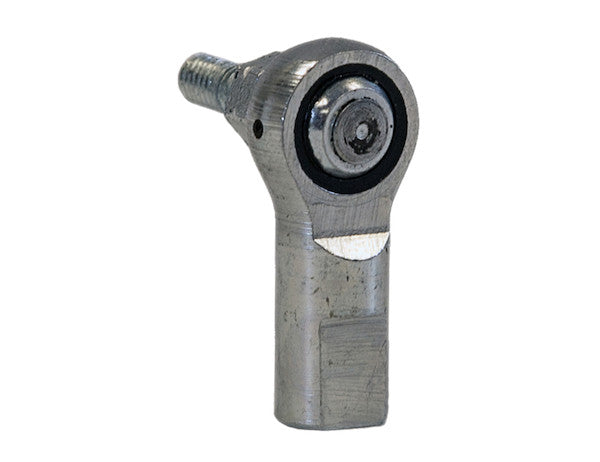
The Buyers Products Rod End Bearing with Stud is constructed from steel and available in five sizes.
Specifications
| Stud Length from Shoulder | 0.500 |
| Center to Stud Shoulder | 0.485 " |
| Ball Diameter | 0.437 " |
| Center to Socket Face | 1.062 " |
| Movement Cone | 50 |
| Thread | #10-32 |
| Socket Diameter | 0.406 " |
| Thread Depth | 0.562 " |
| Socket Flats | 0.310 " |
| Overall Length | 1.375 " |
Technical Overview: The Buyers Products 10-32 Rod End Bearing with Stud
This document provides an in-depth technical analysis of the Buyers Products 10-32 Rod End Bearing with Stud, designed for precision mechanical linkage applications. This component is engineered from high-grade steel, ensuring robust performance and longevity in demanding operational environments. The design integrates a swivel ball with a threaded stud, facilitating articulation and force transmission in mechanisms requiring angular misalignment accommodation.
Product Description and Core Functionality
The Buyers Products Rod End Bearing with Stud is a critical mechanical component utilized across various industries for connecting control linkages, steering mechanisms, and other articulating systems. Its primary function is to permit relative angular movement between two connected parts, thereby compensating for misalignment and reducing stress on other system components. The integrated stud simplifies attachment to mating components, offering a compact and secure connection point. The steel construction underscores its suitability for applications where durability and resistance to operational stresses are paramount. While available in five sizes, this particular variant focuses on the 10-32 thread specification, indicating a standardized, fine-threaded design.
Material Science: Steel Construction
The choice of steel as the primary construction material for this rod end bearing is a deliberate engineering decision based on its superior mechanical properties. Steel, an alloy primarily composed of iron and carbon, offers an exceptional balance of strength, hardness, ductility, and fatigue resistance. Depending on the specific steel alloy utilized (e.g., low-carbon steel, alloy steel, stainless steel), the bearing can exhibit varying levels of tensile strength, yield strength, impact resistance, and corrosion resistance. For typical rod end bearings, a case-hardened low-carbon steel or a medium-carbon alloy steel is often employed for the housing, while the ball stud may utilize a harder, wear-resistant alloy. The specific grade of steel would dictate the ultimate load-carrying capacity and expected service life under dynamic loading conditions. The manufacturing process for such steel components typically involves precision machining, followed by heat treatment processes like carburizing or through-hardening, to optimize surface hardness for wear resistance while maintaining a tough core to resist fracture.
Detailed Dimensional Analysis and Specifications
The provided specifications are crucial for proper integration and performance evaluation of the 10-32 Rod End Bearing with Stud. Each dimension plays a vital role in its functional characteristics and compatibility:
-
Stud Length from Shoulder: 0.500"
This dimension specifies the effective length of the threaded stud portion available for engagement with a mating component, measured from the base of the stud's shoulder. A precise stud length ensures adequate thread engagement and prevents bottoming out prematurely, critical for maintaining connection integrity and load distribution. -
Center to Stud Shoulder: 0.485"
This measurement defines the distance from the spherical center of the bearing ball to the shoulder of the stud. This is a critical dimension for calculating the overall effective length of a linkage assembly and for ensuring proper clearance and alignment within a system. It directly influences the geometry and kinematics of the connected mechanism. -
Ball Diameter: 0.437"
The diameter of the spherical ball within the rod end housing. This dimension is paramount as it dictates the contact area with the inner race of the housing and significantly influences the bearing's load capacity, wear characteristics, and the extent of angular movement it can accommodate. A precisely machined ball diameter ensures smooth articulation and minimal play. -
Center to Socket Face: 1.062"
This dimension represents the distance from the spherical center of the ball to the outer face of the rod end's socket (the opening where the stud emerges). Similar to "Center to Stud Shoulder," this dimension is vital for linkage length calculations and ensuring correct geometric placement within an assembly. -
Movement Cone: 50 degrees
The "Movement Cone" specification, often referred to as angular misalignment capability, indicates the maximum angular deviation (in degrees) that the stud can articulate relative to the housing's longitudinal axis without binding or exceeding the bearing's design limits. A 50-degree movement cone suggests substantial flexibility, allowing for significant angular misalignment compensation in dynamic systems. This is a critical parameter for applications where components may experience considerable relative angular motion or manufacturing tolerances lead to slight misalignments. -
Thread: #10-32
This is a standard Unified National Fine (UNF) thread designation. "#10" refers to the nominal diameter of the stud (approximately 0.190 inches or 4.826 mm), and "32" indicates 32 threads per inch (TPI). This fine thread pitch provides greater resistance to loosening under vibration compared to coarse threads and allows for finer adjustment. The precise thread form (e.g., class 2A or 3A) would further define its fit and strength characteristics, ensuring compatibility with standard #10-32 nuts or threaded holes. -
Socket Diameter: 0.406"
This is the internal diameter of the socket housing that encapsulates the spherical ball. The clearance between the ball diameter and the socket diameter is carefully controlled during manufacturing to allow for smooth rotation and angular movement while minimizing excessive play or backlash. This dimension also affects the overall strength of the housing. -
Thread Depth: 0.562"
This specification denotes the minimum effective thread engagement depth within the stud. It ensures that the stud has sufficient threaded length to provide a robust connection with mating components, even when considering typical fastening depths. This dimension is critical for preventing thread stripping and maintaining the integrity of the bolted joint under tensile and shear loads. -
Socket Flats: 0.310"
This refers to the width across the flats on the rod end's housing, typically provided for wrenching purposes during installation or adjustment. The presence of flats allows for the application of torque to secure or adjust the bearing without damaging its articulating components. The dimension 0.310" suggests a specific wrench size requirement, often a standard fractional or metric size. -
Overall Length: 1.375"
This is the total length of the rod end bearing assembly from the end of the stud to the opposite end of the socket housing. This overarching dimension is essential for space claim analysis and for accurately determining the total length of the linkage system into which the bearing is integrated.
Design Principles and Engineering Considerations
The design of this rod end bearing embodies several fundamental engineering principles aimed at optimizing performance, durability, and ease of integration:
- Spherical Bearing Principle: At its core, the rod end utilizes a spherical plain bearing design. This allows the inner member (the ball stud) to pivot and rotate within the outer member (the housing socket), accommodating angular misalignment and rotational movement simultaneously. This capability is crucial in applications where perfect alignment cannot be guaranteed or where dynamic angular changes are inherent.
- Load Distribution: The spherical contact surface distributes radial and axial loads over a larger area compared to simple pin joints, reducing stress concentrations and enhancing the bearing's lifespan. The specific contact geometry between the ball and socket is optimized to handle combined radial and thrust loads effectively.
- Threaded Connection: The integrated #10-32 threaded stud provides a standardized, robust, and adjustable connection point. Fine threads (32 TPI) offer superior resistance to loosening under vibration and allow for precise length adjustments in linkage systems. The stud is typically machined with a rolled thread to enhance its fatigue strength compared to cut threads.
- Material Selection for Wear and Strength: The use of steel is critical for both the housing and the stud. The housing needs to withstand the compressive and tensile stresses induced by the linkage, while the ball and socket surfaces require high hardness and wear resistance to ensure smooth, low-friction operation over extended periods. Surface treatments or coatings (e.g., chrome plating, PTFE liners) might be applied in higher-performance variants to further reduce friction and enhance wear resistance, though not specified for this basic steel model.
- Lubrication (Implied): While not explicitly stated, general rod end bearings can be self-lubricating (e.g., with PTFE liners) or require external lubrication (e.g., with grease zerks). For an all-steel construction, external lubrication would typically be recommended, especially in applications involving high loads, speeds, or frequent articulation, to minimize friction and prevent galling. The absence of a grease fitting suggests this variant may be designed for lighter duty, intermittent movement, or applications where external lubrication is impractical.
Applications and Use Cases
The 10-32 Rod End Bearing with Stud finds extensive application across a multitude of industries due to its versatility and robust design. Typical use cases include:
- Automotive and Motorsports: Linkages for shifters, throttle controls, suspension components, steering systems (e.g., tie rod ends), and brake bias adjusters. Its ability to handle angular motion is crucial for these dynamic systems.
- Industrial Machinery: Control rods in packaging machines, textile machinery, automation equipment, and agricultural machinery. These bearings facilitate the precise movement and connection of various machine parts.
- Marine Applications: Control linkages for throttles, gear shifts, and steering systems in boats and marine vessels, where resistance to corrosion (if stainless steel variants are used) and reliable operation in demanding environments are essential.
- Aerospace (Non-Flight Critical): Ground support equipment, cockpit controls, and non-primary flight controls where high precision and reliability are required but without the stringent weight and material requirements of primary flight components.
- Robotics: Articulating joints and end effector linkages where smooth, precise, and flexible connections are needed to allow for complex movements.
- HVAC Systems: Dampers and valve control linkages where accurate positioning and compensation for minor misalignments are necessary for efficient operation.
- Recreational Vehicles (RVs) and Utility Vehicles (UTVs): Steering, suspension, and accessory linkages where ruggedness and articulation are vital for off-road or demanding conditions.
Installation and Maintenance Considerations
Proper installation is paramount to ensuring the optimal performance and longevity of the rod end bearing. The #10-32 thread requires a matching female thread with appropriate depth and strength. Torque specifications for tightening the stud should always be adhered to, preventing over-tightening which can damage threads or distort components, or under-tightening which can lead to loosening and premature wear. The presence of socket flats (0.310") facilitates the application of precise torque during installation. For all-steel bearings, consideration for external lubrication should be made based on application severity (load, speed, frequency of movement, environmental factors). Regular inspection for wear, corrosion, and proper articulation is recommended as part of a routine maintenance schedule. Signs of excessive play, binding, or noise indicate the need for replacement.
Advantages and Limitations
Advantages:
- Angular Misalignment Compensation: The primary advantage, allowing for flexible connections and reducing stress on connected components.
- High Load Capacity: Steel construction provides excellent strength for carrying significant radial and axial loads.
- Compact Design: Integrates bearing and attachment point into a single, space-efficient unit.
- Adjustability: The threaded stud allows for precise length adjustment within linkage systems.
- Versatility: Suitable for a wide range of industrial, automotive, and mechanical applications.
- Durability: Engineered for long service life in challenging environments due to robust material.
Limitations:
- Lubrication Requirements: All-steel designs typically require external lubrication, which may not be feasible or desirable in certain environments (e.g., dusty, dirty, or hard-to-reach areas) unless a self-lubricating variant is used.
- Potential for Corrosion: Standard steel can be susceptible to corrosion if exposed to moisture, chemicals, or harsh environments without proper protective coatings or if stainless steel is not specified.
- Weight: Steel components are inherently heavier than alternatives like aluminum or certain composite materials, which might be a consideration in weight-sensitive applications.
- Limited Speed: While offering excellent angular movement, spherical bearings in general have speed limitations compared to rolling element bearings, particularly under heavy loads, due to potential for heat generation from sliding friction.
- Friction: Sliding contact between the ball and socket will inherently generate more friction than rolling element bearings, potentially leading to higher operating temperatures and energy losses in high-frequency articulation applications without proper lubrication.
Conclusion
The Buyers Products 10-32 Rod End Bearing with Stud is a meticulously engineered component designed to deliver reliable and precise articulation in mechanical linkage systems. Its steel construction, detailed dimensional specifications, and ability to accommodate substantial angular misalignment make it an indispensable element in a broad spectrum of industrial and mechanical applications. Understanding its technical specifications, design principles, and operational characteristics is crucial for engineers and designers to ensure its correct selection, integration, and long-term performance within their respective systems. This product exemplifies a balance of strength, flexibility, and precision, making it a foundational component for robust and effective mechanical control and motion transfer.