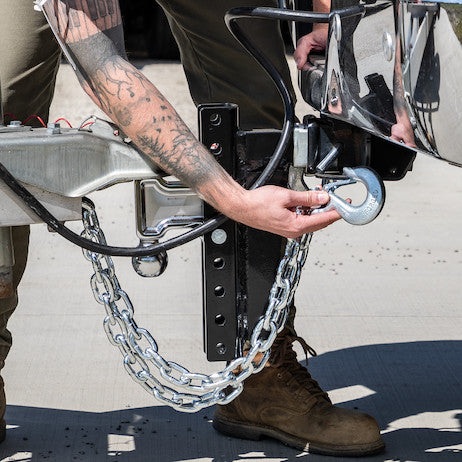
The Class 4 Safety Chain from Buyers Products is rated to 10,000 or 15,000 lb depending on the model. The chain is zinc-plated to withstand corrosion. Available in a range of sizes and lengths, the chains feature forged slip hook connectors. Use two safety chains with a total holding capacity of at least the total weight of the trailer and its contents. The chains are designed for towing only, not for lifting.
Specifications
| Chain Diameter (in.) | 3/8 |
|---|---|
| Chain Length (in.) | 35.00 |
| Coil | 40 Proof |
| Color | Silver |
| Finish | Zinc Plated |
| M.G.T.W. (lbs) | 15,000 |
| Material | Carbon Steel |
Product Overview: 3/8x35 Inch Class 4 Trailer Safety Chain with 1-Clevis Style Slip Hook - 43 Proof
The 3/8x35 Inch Class 4 Trailer Safety Chain from Buyers Products, engineered to the robust 43 Proof standard with a single clevis-style slip hook, is a critical component for secure and compliant towing operations. Boasting a formidable 15,000 lb Maximum Gross Trailer Weight (MGTW) rating, its zinc-plated carbon steel construction ensures superior resistance to environmental degradation, providing a reliable safeguard against catastrophic trailer detachment. This detailed technical overview will delve into the product's precise specifications, advanced material science, operational requirements, and critical safety considerations, underscoring its unparalleled value and high performance for demanding towing applications.
The Indispensable Role of Trailer Safety Chains
Safety chains are not merely an accessory; they are a legally mandated and critically important safety device in nearly all jurisdictions governing trailer operation. Their primary function is to serve as a redundant connection between the tow vehicle and the trailer, providing a failsafe mechanism should the primary hitch connection fail due to mechanical fatigue, improper coupling, or sudden impact. In such an event, safety chains prevent the trailer from detaching completely and becoming a runaway hazard, which could lead to severe accidents, injuries, or fatalities. Beyond preventing full detachment, properly installed safety chains help maintain a degree of control over the trailer during a partial disconnection event, allowing the driver a critical window to safely bring the entire rig to a controlled stop. This essential function is underpinned by federal regulations, such as those promulgated by the Department of Transportation (DOT), and industry standards like SAE J684, which specify the performance criteria for these components. Adherence to these standards is vital not just for legal compliance, but for safeguarding lives and property on public roadways, as the absence or inadequacy of safety chains renders any towing setup inherently unsafe and illegal.
Understanding "Class 4" in Towing Systems
The classification of towing components, such as hitches and safety chains, is fundamentally linked to their load-bearing capabilities. A "Class 4" rating signifies a component designed for heavy-duty towing applications, typically accommodating Gross Trailer Weights (GTW) ranging from 10,001 to 16,000 pounds. This specific 3/8x35 Inch Safety Chain is explicitly designated for use with trailers having an MGTW of up to 15,000 lbs, aligning it firmly within the performance envelope of Class 4 towing systems. This classification ensures that the chain's structural integrity, material composition, and overall design are commensurate with the stresses and forces encountered when towing substantial loads, such as large utility trailers, car haulers, heavy-duty boat trailers, or medium-sized construction equipment. Its robust design integrates seamlessly into a comprehensive Class 4 towing setup, providing the necessary safety margin for demanding tasks and offering peace of mind to operators.
Detailed Material Science and Construction: Carbon Steel and Grade 43 Proof Chain
The foundation of this safety chain's exceptional strength and durability lies in its material composition and manufacturing grade. Constructed from high-quality **carbon steel**, this material choice is deliberate, balancing superior tensile strength with essential ductility. Carbon steel offers excellent resistance to impact and abrasion, crucial properties for components subjected to dynamic loads and environmental exposure. The chain links are typically formed through a rigorous process of drawing, shaping, and welding, ensuring each link achieves uniform strength and structural integrity.
Crucially, this safety chain adheres to the **Grade 43 Proof Chain** standard, often referred to as "High Test" chain. The term "proof" in chain terminology refers to the proof test load, which is a manufacturing quality control step where each chain is subjected to a predetermined tensile force—typically twice its Working Load Limit (WLL)—to ensure it meets its minimum performance requirements without permanent deformation. Grade 43 chains are characterized by a higher strength-to-weight ratio compared to lower grades, such as Grade 30 (Proof Coil). For instance, a typical 3/8-inch Grade 43 chain boasts a Working Load Limit significantly higher than its Grade 30 counterpart, often exceeding 5,400 lbs WLL, which translates to a formidable Minimum Breaking Strength (MBS) of over 19,000 lbs. This elevated strength provides a substantial safety margin for trailer applications, allowing the chain to withstand unexpected shock loads and peak stresses far beyond typical operating conditions. The rigorous testing and certification processes associated with Grade 43 ensure that each link and weld joint meets stringent quality control measures, guaranteeing reliability in critical safety applications. This superior grading ensures that the chain not only meets but often exceeds the demanding safety requirements for trailers up to 15,000 lbs MGTW, offering an enhanced level of security.
Advanced Corrosion Protection: Zinc Plating
To preserve the inherent strength of its carbon steel core and extend its operational lifespan, the 3/8x35 Inch Class 4 Trailer Safety Chain undergoes a meticulous **zinc plating** process. This surface treatment is not merely cosmetic; it provides a highly effective barrier against the pervasive threat of corrosion, which can severely compromise the structural integrity of steel over time. Zinc plating acts as a sacrificial coating: when exposed to corrosive elements like moisture, road salts, or chemicals, the zinc preferentially oxidizes before the underlying steel, thereby protecting the chain. This galvanic protection is superior to simple paint coatings which only offer a physical barrier. The uniform silver finish is indicative of this high-quality plating, which also contributes to a cleaner appearance and reduces the likelihood of rust staining adjacent components. This enhanced corrosion resistance is particularly vital for towing equipment, which frequently operates in harsh outdoor environments, from wet roads to dusty trails. The zinc plating minimizes the need for extensive maintenance, ensuring that the chain retains its critical strength and visual integrity throughout its service life, contributing significantly to long-term safety and reliability.
Precision Engineering: Chain Dimensions and Components
Every dimension and component of this safety chain is meticulously engineered to optimize performance and safety. The **3/8-inch chain diameter** is a critical specification, directly correlating to the chain's tensile strength and overall robustness. In the context of Grade 43 steel, this diameter provides an exceptional balance of strength and flexibility, allowing the chain to endure substantial pulling forces without excessive bulk or rigidity. This specific diameter is carefully selected to meet the rigorous demands of Class 4 towing, ensuring that the individual links can collectively support the forces generated by a heavy trailer under emergency conditions.
The **35-inch chain length** is equally significant. An optimal length is crucial for proper safety chain function. Chains that are too short restrict the trailer's turning radius, potentially causing them to bind or even snap during tight maneuvers. Conversely, chains that are excessively long can drag on the ground, leading to premature wear, entanglement with road debris, or even snagging on obstacles, which could prematurely damage the chain or cause a dangerous situation. The 35-inch length is typically engineered to provide sufficient slack for full articulation of the trailer through turns, while simultaneously being short enough to prevent dragging and to maintain a minimal drop height should the primary hitch connection fail. This measured length ensures that in the event of a hitch failure, the trailer's tongue remains elevated off the ground, preventing it from digging into the pavement and allowing for greater control during an emergency stop.
The integration of a **single clevis-style slip hook** further enhances the chain's functional superiority. Unlike simpler S-hooks, which can inadvertently detach under certain conditions, the clevis hook design incorporates a robust, spring-loaded safety latch or a securing pin (depending on specific clevis design) that positively locks the hook onto the tow vehicle's attachment point. This secure locking mechanism prevents accidental disengagement during transit, especially over uneven terrain or during sudden stops and starts. The "forged" construction of the slip hook is a testament to its exceptional strength. Forging is a manufacturing process that involves shaping metal through localized compressive forces, which refines the metal's grain structure, eliminating porosity and voids. This results in a hook with superior impact resistance, fatigue strength, and overall durability compared to cast or fabricated alternatives. The integration of this high-strength, secure hook design ensures a reliable connection point, which is paramount for the overall integrity of the safety chain system.
Load Capacity and Safety Margins: The 15,000 lb M.G.T.W. Rating
The designation of a **15,000 lb M.G.T.W. (Maximum Gross Trailer Weight)** for this safety chain is a critical indicator of its intended application and inherent strength. It signifies that this chain is engineered to provide the necessary safety redundancy for trailers with a total weight (including cargo) up to 15,000 pounds. While a single chain possesses significant strength, towing regulations universally require the use of two safety chains, each attached independently from the trailer tongue to the tow vehicle's frame or hitch receiver. The combined Working Load Limit (WLL) of these two chains must meet or exceed the Gross Trailer Weight (GTW). A typical 3/8-inch Grade 43 chain has a WLL in the range of 5,400 to 6,600 lbs, meaning two such chains offer a combined WLL of 10,800 to 13,200 lbs. The product's MGTW rating of 15,000 lbs implies that this specific chain model may feature an enhanced design or material specification resulting in an individual WLL sufficient to meet the 15,000 lb requirement (e.g., at least 7,500 lbs). This significant capacity ensures that, even if one chain were to fail, the remaining chain would possess a substantial portion of the necessary strength to control the trailer, offering an exceptional margin of safety. This redundancy is paramount in preventing runaway trailers and mitigating potential hazards, underscoring the product's commitment to uncompromising safety standards for heavy-duty towing.
Installation, Usage, and Regulatory Compliance
Proper installation and usage are paramount to harness the full safety potential of the 3/8x35 Inch Class 4 Trailer Safety Chain. The chains should always be connected in a criss-cross pattern beneath the trailer tongue. This method achieves two critical safety objectives: first, it prevents the trailer tongue from dropping to the ground if the hitch fails, instead cradling it; second, it helps maintain directional stability by applying opposing forces to the tow vehicle. Ensure the chains are securely attached to designated, structural points on the tow vehicle's frame or hitch receiver, not to easily bendable components.
The length of the chain, though optimized at 35 inches, must still allow for full turning radius without becoming taut, yet be short enough to prevent dragging on the ground. A common guideline is that the chains should have enough slack to allow a 90-degree turn, but not so much that the trailer tongue could hit the pavement if the hitch disconnects. Regular inspection for proper slack is essential before each tow. It is critically important to reiterate that these chains are explicitly **designed for towing only, not for lifting**. Lifting applications introduce entirely different types of stress, dynamic loading, and safety factors that exceed the design parameters of a trailer safety chain. Lifting chains are typically subjected to different grading standards (e.g., Grade 80, Grade 100) and require specific end fittings and inspection criteria. Attempting to use a trailer safety chain for lifting can lead to catastrophic failure, resulting in severe injury, property damage, or fatality. Adhering to these fundamental principles of installation and usage is not just a recommendation; it is often a legal requirement governed by federal and state Department of Transportation regulations and industry standards like SAE J684, ensuring the highest level of road safety for all users.
Maintenance and Longevity
To ensure the continued peak performance and reliability of the Class 4 Trailer Safety Chain, a diligent regimen of regular inspection and minimal maintenance is strongly recommended. Prior to each towing operation, and certainly after any prolonged storage or particularly demanding use, the entire length of the chain, including all links and the clevis-style slip hook, should be thoroughly inspected. Look for any signs of wear, such as stretched or distorted links, nicks, gouges, cracks, or excessive abrasion. Pay close attention to the weld points on each link and the structural integrity of the hook, particularly the pin or latch mechanism. While the zinc plating offers excellent corrosion resistance, any areas where the plating may have been compromised, exposing the underlying carbon steel, should be noted. Rust formation, even superficial, can indicate a weakening of the material. Any chain showing significant damage, deformation, or severe corrosion should be immediately taken out of service and replaced to prevent potential failure and ensure maximum safety on the road.
Conclusion
The 3/8x35 Inch Class 4 Trailer Safety Chain, with its 1-Clevis Style Slip Hook and 43 Proof rating, stands as an exemplar of robust engineering and unwavering commitment to towing safety. Its high-quality carbon steel construction, advanced zinc plating, precise dimensions, and formidable 15,000 lb MGTW rating make it an indispensable asset for heavy-duty towing applications. By integrating this high-performance safety chain into your towing setup, you ensure compliance with critical safety regulations while significantly enhancing the security and control of your trailer. This product is more than just a component; it is a vital investment in the safety of your cargo, your vehicle, and everyone on the road. Choose reliability, choose compliance, choose the Buyers Products Class 4 Safety Chain.