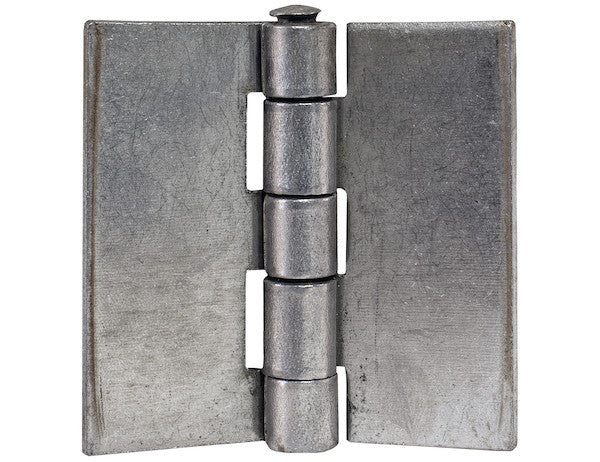
Buyers Products Steel Butt Hinges have a plain finish and can be either welded-on or drilled for bolt-on installation. No holes provide a clean look and the plain finish can be painted or powder-coated if desired. The steel butt hinges feature a tight pin, spun on both ends for secure installation. The hinges are available in multiple sizes to fit a variety of applications. Please contact Customer Service for further information.
Specifications
| Finish | Plain |
|---|---|
| Hinge Length (in.) | 3.00 |
| Material | Carbon Steel |
| Open Width (in.) | 3.00 |
| Pin Diameter (in.) | .25 |
| Pin Retention | Spun Ends |
| Thickness (in.) | .120 |
Technical Overview: Heavy-Duty Steel Butt Hinge – Optimized for Industrial and Commercial Applications
This technical description provides an in-depth analysis of the Steel Butt Hinge, specifically the .120 inch thickness, 3-inch length, 1/4-inch pin diameter, and 3-inch open width variant. Designed for the most demanding environments, this hinge represents a synthesis of robust material science, precision engineering, and adaptable installation methodology. It is engineered to provide superior structural support, reliable articulation, and extended operational longevity across a spectrum of industrial, commercial, and heavy-duty applications where lesser hinges would fail prematurely.
Material Science: The Indispensable Strength of Carbon Steel
The foundation of this hinge's exceptional performance lies in its material composition: high-grade carbon steel. Carbon steel is an iron alloy with carbon content ranging from 0.05% to 2.0% by weight. The specific grade utilized in this hinge is selected to optimize a balance of strength, ductility, and weldability, making it ideal for structural components subjected to significant mechanical stresses. The inherent metallurgical properties of carbon steel provide several critical advantages:
- High Tensile Strength: Carbon steel exhibits a high resistance to being pulled apart, making it suitable for applications involving substantial tensile loads. This characteristic is crucial for hinge leaves that must withstand the weight and dynamic forces of the attached panel or door.
- Excellent Yield Strength: The yield strength of carbon steel defines the point at which the material begins to deform permanently. This hinge's steel possesses a high yield strength, ensuring that it can sustain heavy static and dynamic loads without permanent bending or deformation, maintaining its structural integrity and operational precision over time.
- Impact Resistance: In environments where components may be subjected to sudden impacts or shock loads, carbon steel offers superior resilience compared to many other metals. This ensures the hinge can withstand accidental collisions or rapid closures without fracturing or compromising its mechanical function.
- Weldability: The specific carbon content in the chosen steel grade facilitates excellent weldability. This is a critical factor given the "no holes" design and the provision for weld-on installation, allowing for strong, metallurgical bonds that integrate the hinge seamlessly and permanently with the supporting structure.
- Cost-Effectiveness: While offering premium performance characteristics, carbon steel remains a cost-effective material, providing an optimal balance between initial investment and long-term durability, thereby delivering superior value over the product's lifecycle.
It is important to note that while carbon steel provides exceptional mechanical properties, its inherent susceptibility to oxidation (rust) in the absence of protective coatings necessitates the "plain finish" approach, which allows for custom post-treatment tailored to specific environmental requirements.
Precision Engineering: Optimized Dimensions for Uncompromised Performance
Every dimension of this steel butt hinge has been meticulously engineered to contribute to its overall strength, stability, and functional efficiency. Understanding these specifications is paramount to appreciating the hinge's suitability for heavy-duty applications:
-
Thickness (.120 Inch / Approximately 11 Gauge): The .120-inch (or approximately 11-gauge) material thickness is a defining characteristic of this hinge, distinguishing it from lighter-duty alternatives. This substantial thickness:
- Enhances Load-Bearing Capacity: Directly increases the cross-sectional area of the hinge leaves, significantly augmenting their resistance to bending moments and shear forces. This allows the hinge to support substantially heavier doors, gates, or panels without material fatigue or deformation.
- Improves Rigidity: Provides superior rigidity to the entire hinge assembly, minimizing flex and ensuring stable, precise articulation even under dynamic loads or lateral stresses. This is crucial for maintaining proper alignment and preventing sag over time.
- Extends Service Life: A thicker material wears down slower and resists localized stress concentrations more effectively, contributing directly to a longer operational lifespan in demanding environments.
-
Hinge Length (3.00 Inches): The 3.00-inch overall length of the hinge leaves serves several critical functions:
- Stress Distribution: A longer hinge distributes the load over a greater surface area along the edge of the door and frame, reducing localized stress points and preventing material fatigue in both the hinge and the mounting surface.
- Enhanced Alignment: The extended length provides a more stable and accurate pivot axis, helping to maintain proper alignment of the attached component and ensuring smooth, consistent operation without binding or excessive play.
- Increased Mounting Area: For bolt-on applications, the 3-inch length offers ample surface area for drilling multiple fasteners, allowing for a robust and secure attachment pattern that can be customized to the specific application's load requirements.
-
Open Width (3.00 Inches): The 3.00-inch open width refers to the total dimension from the outer edge of one leaf to the outer edge of the other leaf when the hinge is fully open (flat). This dimension is crucial for:
- Clearance Management: Dictates the spatial relationship between the rotating components and the surrounding structure, ensuring adequate clearance for the door or panel to swing freely without impingement.
- Moment Arm and Stability: A wider open width often indicates a larger distance between the mounting points and the pivot axis. This can influence the leverage exerted on the hinge and the stability of the mounted object. For a butt hinge, the open width, combined with the thickness, defines the strength of the hinge's "knuckle" or barrel assembly, where the pin resides.
- Structural Integration: A 3-inch open width provides a substantial footprint for attachment, contributing to the hinge's ability to integrate strongly with the frame and panel, mitigating the risk of tear-out.
-
Pin Diameter (1/4 Inch / .25 Inch): The 0.25-inch (1/4-inch) pin diameter is a critical specification, as the pin is the primary load-bearing element during articulation. A robust pin diameter ensures:
- High Shear Strength: The 1/4-inch diameter pin possesses significant shear strength, enabling it to withstand the direct forces exerted as the hinge supports and moves the attached object. This prevents the pin from bending or fracturing under heavy loads.
- Reduced Wear and Deflection: A larger diameter pin distributes wear over a greater surface area within the hinge knuckles, prolonging its life. It also minimizes deflection or bending of the pin, maintaining smooth operation and preventing binding or premature failure.
- Enhanced Security: A thicker pin is inherently more resistant to tampering or forced removal, contributing to the overall security of the hinged assembly.
Advanced Pin Retention: The "Tight Pin, Spun on Both Ends" Mechanism
A distinctive and crucial feature of this hinge is its "tight pin, spun on both ends" design. This advanced retention mechanism is engineered for maximum security, rigidity, and longevity, particularly in applications where reliable, non-removable articulation is paramount.
-
Tight Pin Construction: A "tight pin" implies that the hinge pin is precisely fitted into the knuckles with minimal clearance. This design:
- Eliminates Play: Minimizes lateral and axial movement of the pin within the knuckles, which translates to reduced slop or wobble in the hinged assembly. This ensures a more stable and precise pivot, crucial for heavy doors or panels where excessive play could lead to misalignment or accelerated wear.
- Enhances Rigidity: The tight fit contributes significantly to the overall structural rigidity of the hinge. By making the pin an integral, non-moving component of the knuckle assembly, it acts as a robust fulcrum, distributing stress more effectively.
- Increases Security: A tight, non-removable pin vastly improves the security profile of the hinged system. It prevents casual tampering, vandalism, or unauthorized removal of the pin to bypass the door or panel, making it an ideal choice for secure enclosures or access points.
-
Spun Ends Retention: The "spun on both ends" method is a superior mechanical retention technique for hinge pins. During manufacturing, the ends of the pin are plastically deformed (spun or riveted) after insertion, creating a permanent, flared head on both sides of the hinge knuckles. This process:
- Permanent Mechanical Lock: Creates an extremely durable and permanent mechanical lock that prevents the pin from migrating axially, vibrating loose, or being deliberately driven out. Unlike crimped or peened pins, spun ends offer a more robust and symmetrical retention force.
- Resistance to Vibration and Impact: Ensures the pin remains securely in place even under extreme vibration, frequent cycling, or direct impact, which are common occurrences in industrial and mobile applications.
- Long-Term Assembly Integrity: Guarantees that the hinge assembly maintains its original integrity throughout its operational lifespan, preventing disassembly or failure due to pin withdrawal. This is particularly vital in safety-critical applications.
Installation Versatility: Weld-On or Drill for Bolt-On
The "no holes" design of this butt hinge is a strategic feature that offers unparalleled installation flexibility, allowing for optimal customization and structural integration for diverse application requirements.
-
The "No Holes" Advantage for Customization: The absence of pre-drilled holes provides the installer with complete control over the mounting method. This allows for:
- Precision Drilling: For bolt-on installations, holes can be drilled precisely where needed to match existing bolt patterns, accommodate specific fastener types, or optimize load distribution on the mounting surface. This eliminates the compromises often associated with pre-drilled hinges that may not align perfectly with the application.
- Optimized Fastener Selection: The installer can choose the exact size, type, and quantity of fasteners (e.g., machine screws, self-tapping screws, rivets, carriage bolts) best suited for the material thickness and strength requirements of the frame and door.
- Clean Aesthetic: For applications where welding is chosen, the absence of holes provides a seamless, clean appearance, allowing for an uninterrupted finish after painting or powder-coating.
-
Weld-On Installation: This method is highly recommended for applications requiring maximum strength, permanence, and structural integration. Benefits include:
- Superior Strength: A properly executed weld creates a metallurgical bond between the hinge and the mating surface, resulting in a joint that is often stronger than the parent materials themselves. This is ideal for heavy gates, machinery enclosures, and trailer doors where dynamic loads and high stresses are encountered.
- Permanent Attachment: Welding provides a tamper-proof and incredibly durable attachment, resistant to vibration, impact, and forced removal, enhancing security and operational reliability.
- Seamless Integration: For custom fabrication, welding allows the hinge to become an integral part of the structure, contributing to overall rigidity and structural integrity.
- Material Compatibility: The carbon steel material of the hinge is highly compatible with common welding processes (e.g., MIG, TIG, Stick) when joining with other steel components.
-
Drilled for Bolt-On Installation: While welding offers permanence, drilling for bolt-on installation provides advantages in different scenarios:
- Serviceability and Replaceability: Bolt-on hinges can be more easily replaced or serviced if damaged, without requiring cutting and re-welding. This is beneficial for components that may need periodic maintenance or are subject to wear.
- Non-Permanent Applications: Ideal for applications where the hinge may need to be removed in the future, or where welding is not feasible due to material incompatibility (e.g., attaching to wood or certain plastics, though this steel hinge is primarily for metal-to-metal applications) or access limitations.
- Ease of Installation: For many users, drilling and bolting may be simpler or more accessible than welding, requiring standard tools.
- Adjustability: In some cases, slight adjustments can be made to bolt-on hinges after initial installation by loosening and retightening fasteners.
The Plain Finish: A Strategic Foundation for Custom Protection
The "plain finish" on this steel butt hinge is a deliberate design choice, offering maximum flexibility for post-treatment rather than representing a final, finished state. A plain finish signifies that the hinge is supplied as bare, uncoated carbon steel. This approach provides distinct advantages:
- Optimal for Welding: For weld-on applications, a bare steel surface is crucial. The absence of paint, powder-coat, or other protective layers eliminates the need for grinding or chemical stripping, which can save significant preparation time and ensure a cleaner, stronger weld free from contamination or gaseous inclusions.
-
Customizable Corrosion Protection: Carbon steel, by nature, will corrode (rust) when exposed to moisture and oxygen. The plain finish allows the end-user to apply a protective coating specifically tailored to their operating environment:
- Painting: A wide array of industrial-grade paints can be applied for aesthetics and corrosion resistance. Proper surface preparation (e.g., degreasing, priming) is essential for optimal adhesion and longevity.
- Powder-Coating: For superior durability, chip resistance, and a wide range of aesthetic options, powder-coating is an excellent choice. The plain steel surface provides an ideal substrate for electrostatic application and subsequent curing.
- Galvanizing: For extreme corrosion resistance, particularly in outdoor or marine environments, hot-dip galvanizing can be applied. This process creates a metallurgically bonded zinc coating that provides both barrier and cathodic protection.
- Oiling/Greasing: For applications in controlled environments where minimal aesthetic impact is desired, a simple oil or grease coating can provide temporary corrosion protection.
- Economic Efficiency: By supplying the hinge in a plain finish, manufacturers can avoid the costs associated with a universal factory coating, passing on savings to the customer who can then invest in a custom finish that precisely meets their needs without paying for an unwanted or redundant coating.
Diverse Industrial and Commercial Applications
The robust specifications and versatile installation options of this steel butt hinge make it suitable for a wide array of demanding applications across various sectors:
- Commercial Vehicles and Trailers: Ideal for heavy-duty truck doors, trailer ramps, cargo doors, utility vehicle compartments, and agricultural equipment access panels where durability and security are paramount.
- Industrial Machinery and Enclosures: Suitable for access doors on manufacturing equipment, control panel enclosures, machine guards, and inspection hatches that require reliable articulation under continuous operation or harsh conditions.
- Agricultural Equipment: Used on heavy farm machinery, gates for livestock enclosures, and storage facility doors where exposure to weather and heavy use is common.
- Security and Storage Units: Employed in the construction of secure storage containers, vaults, heavy-duty security gates, and toolboxes where resistance to forced entry is critical.
- Construction and Off-Road Equipment: Applicable for access panels or doors on excavators, bulldozers, loaders, and other heavy construction vehicles that operate in rugged environments.
- Marine Applications: With appropriate post-galvanization or specialized marine coatings, these hinges can be adapted for use on boat hatches, access doors for marine equipment, and dock hardware requiring exceptional strength.
- Custom Fabrication: An invaluable component for custom metalworkers and fabricators who require a strong, adaptable hinge for bespoke projects, allowing them to integrate it seamlessly into their designs.
Conclusion: Durability, Reliability, and Adaptability
In summary, the Steel Butt Hinge, with its .120-inch thickness, 3-inch length, 1/4-inch pin, and 3-inch open width, is an engineered solution for critical applications requiring unwavering strength and operational integrity. Its carbon steel construction provides superior mechanical properties, while the precise dimensions are optimized for heavy loads and stable articulation. The innovative "tight pin, spun on both ends" design ensures permanent retention and enhanced security, and the "no holes" plain finish offers unparalleled flexibility for custom installation (weld-on or bolt-on) and tailored corrosion protection. This hinge is not merely a component; it is a fundamental element designed to ensure the reliable, long-term performance of industrial and commercial systems, providing exceptional value through its durability and adaptability.
For further technical consultation, detailed load calculations, or specific application guidance, please contact our Customer Service department. Our team of experts is prepared to assist in selecting the optimal hinge solution for your project requirements.