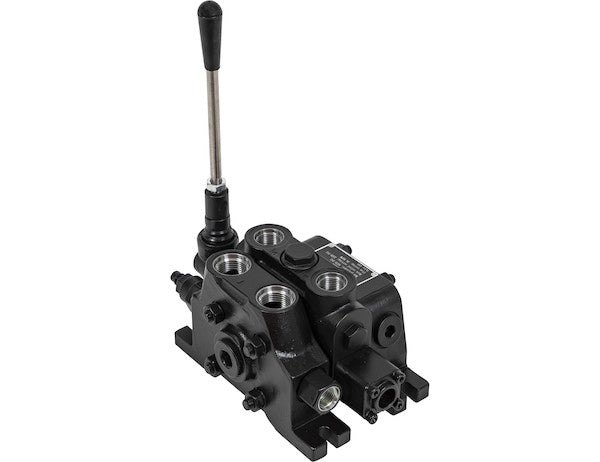
The 21 GPM Valve from Buyers Products is a tough, cast-iron sectional valve you can accommodate handle or cable controls to meet your hydraulic needs. The valve can handle the most demanding jobs, with a maximum rating of 4300 PSI when the main relief is set at a higher pressure. The main relief is adjustable from 1300 to 3000 PSI (factory preset at 2150 PSI). Two additional adjustable port reliefs -- angle and dump -- are available to provide protection for the specific job. This sectional valve offers a lot of versatility in spool action and Power Beyond options to configure to your work needs. It can accommodate either handle or cable controls. All valves have cylinder spools. Additional functions and configurations are available. Please contact Customer Service for further information or Hydraulics Technical Support for assistance.
Specifications
| Electrically Operated (y/n) | N |
|---|---|
| Inlet Port Size | 3/4 SAE ORB (-12) |
| Main Relief Setting | 2250 |
| Maximum Flow Rate | 25 |
| Maximum Pressure | 4500 |
| Outlet Port Size | 3/4 SAE ORB (-12) |
| Port Relief (y/n) | N |
| Port Relief Angle | N |
| Port Relief Dump | N |
| Port Type | SAE |
| Power Beyond (y/n) | N |
| Spool Action 1 | Power Up/Power Down |
| Work Port Size | 5/8 SAE ORB (-10) |
Advanced Technical Overview: The Buyers Products 21 GPM 4-Way Directional Control Valve with No Power Beyond
The Buyers Products 21 GPM 4-Way Directional Control Valve represents a robust and precisely engineered solution for demanding hydraulic applications. Designed as a sectional valve, this unit integrates superior material science with intelligent hydraulic design to deliver reliable performance in challenging operational environments. This detailed technical exposition will delve into the core attributes, operational mechanics, system integration considerations, and application suitability of this particular valve configuration, emphasizing its 4-way functionality and the absence of Power Beyond.
1. Structural Integrity and Material Science: The Cast-Iron Advantage
At the foundation of this valve's exceptional durability is its heavy-duty cast-iron construction. Cast iron, specifically grey cast iron, is chosen for its unique combination of mechanical properties, which are critically advantageous in high-pressure hydraulic systems. Key characteristics include:
- High Compressive Strength: Cast iron exhibits excellent resistance to compressive forces, a prevalent stressor within hydraulic circuits operating at high pressures. This property ensures the valve body can withstand internal fluid pressures without deformation or structural fatigue.
- Vibration Damping: The inherent microstructure of cast iron, characterized by graphite flakes, provides superior vibration damping capabilities compared to other metals like steel. This is crucial in hydraulic systems where pulsating flows and rapid pressure changes can induce significant vibrations, potentially leading to noise, component wear, and system instability.
- Wear Resistance: Cast iron offers good wear resistance, particularly beneficial for the internal bores and sealing surfaces where spools constantly move. This contributes to the valve's long service life and sustained performance accuracy.
- Thermal Stability: In applications where hydraulic fluid temperature can fluctuate, cast iron maintains its dimensional stability, minimizing the risk of internal clearances changing and affecting valve performance or sealing integrity.
- Corrosion Resistance (Relative): While not impervious, cast iron provides a reasonable level of corrosion resistance, especially when combined with appropriate surface treatments or when operating with standard hydraulic fluids that offer some lubricity and rust inhibition.
The sectional design further enhances robustness and modularity. Unlike monoblock valves, sectional valves allow for individual sections to be added, removed, or serviced, providing greater flexibility in system design and maintenance. This design inherently contributes to the valve's "toughness" by enabling specialized material and manufacturing processes for each section, optimizing overall performance and longevity.
2. Hydraulic Performance Parameters: Flow, Pressure, and Relief Mechanisms
Understanding the hydraulic specifications is paramount for proper system design and operation. This valve is engineered with precise flow and pressure characteristics:
- Nominal Flow Rate (21 GPM): The designation "21 GPM Valve" signifies its optimal operational flow rate. At this flow, the valve is designed to operate with minimal pressure drop and maximum efficiency, ensuring responsive and controlled actuation of hydraulic cylinders or motors.
- Maximum Flow Rate (25 GPM): While nominally rated for 21 GPM, the valve can accommodate a maximum transient flow of up to 25 GPM. This capacity is critical for applications experiencing intermittent flow spikes or where slightly higher flow might be temporarily required without compromising valve integrity. Designing a system slightly below the maximum flow rate ensures a margin of safety and extends component life.
- Maximum System Pressure (4500 PSI): This specification refers to the ultimate structural integrity of the valve body and its components. The valve is engineered to safely withstand internal pressures up to 4500 PSI, representing its bursting pressure or absolute structural limit. It is important to distinguish this from the operational working pressure, which is governed by the system's relief valve settings.
- Operational Pressure Rating (4300 PSI): The description notes a "maximum rating of 4300 PSI when the main relief is set at a higher pressure." This indicates the upper limit of the *operational* pressure the valve is designed to handle continuously and reliably, given that the main relief valve is appropriately configured. This distinction highlights the difference between instantaneous structural capacity and sustained working capability under typical hydraulic cycling.
-
Main Relief Valve (MRV) & Adjustability: The integrated main relief valve is a critical safety and control component. It protects the hydraulic pump and system components from over-pressurization by diverting excess fluid back to the tank once a preset pressure is reached.
- Adjustable Range: The MRV is adjustable from 1300 PSI to 3000 PSI, offering significant flexibility to tailor system pressure to specific application requirements. This broad range allows for fine-tuning performance based on the load characteristics and desired actuator force.
- Factory Preset: The valve comes factory preset at 2250 PSI (as per specifications, noting a slight difference from the descriptive text's 2150 PSI, the table's specific value takes precedence for technical accuracy). This common setting is suitable for a wide array of applications, reducing initial setup time. However, it must be verified and adjusted as necessary to match the specific demands of the installed hydraulic system.
- Absence of Port Reliefs (This Configuration): The specifications clearly indicate "Port Relief (y/n): N," "Port Relief Angle: N," and "Port Relief Dump: N." While the sectional valve *series* offers the option for adjustable port reliefs (angle and dump), this specific model is configured without them. Port reliefs are typically used to protect individual actuators or parts of the circuit from pressure spikes generated by external forces (e.g., impact loads on a cylinder) or over-running loads. In systems utilizing this valve, over-pressure protection for the work ports would typically be managed by the main system relief valve, or external port relief valves would be plumbed into the work lines if specific actuator protection is required. This configuration simplifies the valve design, potentially reducing cost and complexity for applications where such localized protection is not deemed necessary or is handled elsewhere in the system.
3. 4-Way Functionality and Spool Design: Precision Control for Actuators
The designation "4-Way" is fundamental to the valve's functionality as a directional control valve. A 4-way valve typically refers to a valve with four working ports: one pressure port (P), one tank port (T), and two work ports (A and B). This configuration is standard for controlling double-acting hydraulic cylinders or bi-directional hydraulic motors.
- Operational Principle: In its neutral position, the spool within the valve blocks or directs flow in a specific manner. When actuated (moved to one of its working positions), the spool shifts, connecting the pressure port to one work port (e.g., A) and simultaneously connecting the other work port (B) to the tank port. Shifting the spool in the opposite direction reverses these connections (P to B, A to T), enabling the retraction or reverse rotation of the actuator.
- Spool Action 1: "Power Up/Power Down": This specific spool action indicates a direct control over the extension and retraction phases of a double-acting cylinder. When the spool is shifted to the "Power Up" position, hydraulic fluid is directed to the cap end of the cylinder, extending the rod and performing work. Simultaneously, fluid from the rod end is returned to the tank. When shifted to the "Power Down" position, pressure fluid is directed to the rod end, retracting the cylinder, and fluid from the cap end returns to the tank. This action ensures controlled, powered movement in both directions, which is critical for lifting, lowering, pushing, and pulling applications.
- Cylinder Spools: The use of "cylinder spools" implies a design optimized for controlling hydraulic cylinders. These spools are typically configured to provide smooth, stable movement and hold a load in the neutral position (closed center) or allow for precise feathering (metering flow) depending on the specific spool cut and application requirements. For this specific valve, the "Power Up/Power Down" action further confirms its dedication to robust cylinder control.
4. Porting Standards and Connectivity: SAE ORB Reliability
The valve utilizes SAE O-Ring Boss (ORB) ports, a superior connection standard in hydraulic systems known for its exceptional leak-free performance and ease of assembly. Key details include:
- Inlet Port Size: 3/4 SAE ORB (-12): The inlet port is where pressurized fluid from the pump enters the valve. The 3/4 inch size and -12 dash number indicate a robust connection capable of handling the specified flow rate with minimal pressure drop and ensuring efficient delivery of hydraulic power to the valve.
- Outlet Port Size: 3/4 SAE ORB (-12): The outlet port, or tank port, facilitates the return of fluid from the valve to the hydraulic reservoir. A matching 3/4 inch size ensures unrestricted flow back to the tank, minimizing back pressure and preventing heat buildup in the system.
- Work Port Size: 5/8 SAE ORB (-10): The work ports, which connect to the hydraulic actuator (e.g., cylinder), are sized at 5/8 inch SAE ORB (-10). This sizing is carefully chosen to balance flow capacity to the actuator with the physical dimensions of the valve body, optimizing performance for a 21 GPM system.
-
Benefits of SAE ORB:
- Superior Leak Resistance: The O-ring provides a metal-to-metal seal with an elastomeric O-ring backup, forming a highly effective, robust, and reliable seal against fluid leakage, even under high pressures and system vibrations.
- Ease of Assembly: ORB fittings are relatively easy to install and tighten, reducing the likelihood of overtightening or damage compared to pipe threads.
- Reduced Contamination Risk: The design minimizes thread exposure to the fluid path, reducing the risk of thread sealant or debris entering the hydraulic system.
5. The Significance of "No Power Beyond"
The most defining characteristic of this specific valve configuration, as highlighted in the product title and specifications, is the explicit absence of "Power Beyond" functionality. Understanding what Power Beyond is, and why its omission is significant, is crucial for system architects.
- What is Power Beyond? In a sectional directional control valve, a "Power Beyond" port allows the pressurized fluid (after passing through the current valve section but before returning to the tank) to be routed to the inlet of a subsequent directional control valve in series. This enables multiple valves to be supplied by a single pump, allowing for independent operation of multiple hydraulic functions (e.g., operating a loader arm and a bucket simultaneously, or sequentially with proper valving). When a valve has Power Beyond, its tank port typically returns *only* the fluid used by its own work ports, while the main system pressure line continues through the Power Beyond port to the next valve.
-
Implications of "No Power Beyond":
- Return to Tank (Open Center or Closed Center): For an open-center system (common with gear pumps), a valve without Power Beyond implies that when the spool is in the neutral position, the fluid flows directly from the pressure port (P) through the valve and out the tank port (T) back to the reservoir. There is no provision to carry the pressurized flow to another valve. For a closed-center system (common with piston pumps), a valve without Power Beyond means that when the spool is in neutral, the pressure port is blocked, and the pump would typically go to standby pressure (compensating pump) or require a separate unloader valve.
- Single Function Operation: This valve is primarily intended for systems where only one hydraulic function is operated at a time by this valve. If multiple functions are needed, they would either need to be parallel-connected (requiring a pump with sufficient flow for all simultaneous operations, or flow dividers) or utilize a different valve series with Power Beyond capabilities.
- Simplified Circuit Design for Dedicated Tasks: The "No Power Beyond" configuration simplifies the hydraulic circuit for applications requiring a single, dedicated control function or for systems where this valve is the terminal control unit. It eliminates the need for complex internal passages or external plumbing required for serial connections to downstream valves.
- Cost-Effectiveness: Removing the Power Beyond feature can reduce the manufacturing complexity and, consequently, the cost of the valve, making it a more economical choice for specific applications.
-
Alternative System Architectures: If multiple hydraulic functions are required with a valve lacking Power Beyond, system designers would typically employ:
- Parallel Circuits: Each valve is supplied directly from the pump, often requiring a larger pump or flow priority arrangements.
- Load Sensing Systems: More advanced systems that can efficiently manage flow and pressure to multiple functions, but typically require specific pump and valve designs.
- Separate Pumps: Utilizing a dedicated pump for each independent function.
Therefore, the "No Power Beyond" characteristic means this valve is perfectly suited for standalone hydraulic applications or as the final stage in a hydraulic circuit, optimizing performance and simplicity for its intended single-function purpose.
6. Control Mechanisms: Handle or Cable Controls
The valve's design accommodates both handle and cable control mechanisms, offering flexibility in operator interface and installation:
- Handle Controls: Direct mechanical linkage, offering tactile feedback and robust manual operation. Ideal for applications where the operator is in close proximity to the valve, such as on mobile equipment control panels or industrial workstations. Handles provide immediate, intuitive control.
- Cable Controls: Allow for remote operation, providing ergonomic benefits and enabling the valve to be mounted in locations that are physically distant or difficult to access. Push-pull cables transmit force over distances, making them suitable for vehicles where the control lever in the cab needs to operate a valve mounted on the chassis or implement. This greatly enhances installation flexibility and operator comfort.
The ability to integrate either control type underscores the valve's adaptability to diverse mounting and operational requirements.
7. Applications and Industry Suitability
Given its robust construction, precise 4-way control with Power Up/Power Down action, and specific "No Power Beyond" configuration, this valve is highly suitable for a range of demanding applications across various industries:
- Mobile Hydraulics: Ideal for single-function controls on utility vehicles, snowplows (for blade lift/angle where Power Beyond is not needed for additional functions), dump trailers, small agricultural implements, and other mobile equipment where a dedicated, robust hydraulic function is required.
- Material Handling: Control of lifting tables, small conveyors, or specialized attachments on forklifts and industrial trucks that utilize a single cylinder for primary action.
- Construction Equipment: Auxiliary hydraulic functions on compact construction machinery, such as small excavators, skid steers, or backhoes, for specific attachments that don't require simultaneous multi-function control.
- Agricultural Machinery: Operating single-acting or double-acting cylinders on various farm implements, such as tillers, cultivators, or spray booms, where a single valve performs a dedicated task.
- Industrial Machinery: In stationary industrial settings, it can be used for presses, clamping devices, gate actuators, or other systems requiring reliable 4-way hydraulic control for a single process.
- Waste Management: On refuse trucks or compactors for specific compaction or lifting mechanisms.
Its non-electrically operated nature further simplifies the system by eliminating the need for complex wiring and electronic controls, favoring straightforward mechanical actuation, which can be advantageous in harsh or electrically sensitive environments.
8. Maintenance and Longevity
The design principles behind the Buyers Products 21 GPM sectional valve contribute significantly to its longevity and ease of maintenance:
- Material Durability: As previously discussed, cast iron ensures the valve body can withstand operational stresses and resist wear over extended periods.
- Precision Machining: The internal components, particularly the spool and bore, are precision-machined to tight tolerances. This minimizes internal leakage (slip flow), maintains efficiency, and ensures smooth spool action, reducing wear on seals and surfaces.
- Replaceable Seals: High-quality seals, typically made from materials like Nitrile (Buna-N) or Viton, are used to prevent external leakage and maintain internal pressure integrity. These are often standard components, making replacement straightforward during routine maintenance.
- Sectional Design Advantage: Should a specific section or spool experience an issue, the sectional nature of the valve allows for individual section replacement or repair without having to replace the entire valve bank, significantly reducing downtime and maintenance costs.
Regular maintenance, including monitoring hydraulic fluid cleanliness, temperature, and ensuring proper relief valve settings, will maximize the operational lifespan of this valve.
9. Conclusion
The Buyers Products 21 GPM 4-Way Directional Control Valve with No Power Beyond stands as a testament to robust engineering and functional precision. Its cast-iron construction, high-pressure and flow ratings, precise "Power Up/Power Down" cylinder spool action, and reliable SAE ORB porting make it an ideal choice for single-function hydraulic applications demanding durability and straightforward control. The intentional omission of Power Beyond simplifies its integration into dedicated hydraulic circuits, offering an optimized solution for a broad spectrum of mobile and industrial equipment. For specific configurations, custom requirements, or technical guidance on integrating this valve into complex hydraulic systems, Buyers Products' Customer Service and Hydraulics Technical Support remain invaluable resources, ensuring that every application benefits from the optimal hydraulic solution.