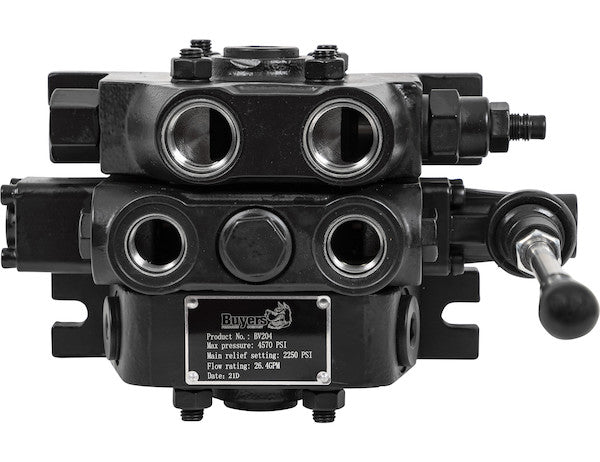
The 21 GPM Valve from Buyers Products is a tough, cast-iron sectional valve you can accommodate handle or cable controls to meet your hydraulic needs. The valve can handle the most demanding jobs, with a maximum rating of 4300 PSI when the main relief is set at a higher pressure. The main relief is adjustable from 1300 to 3000 PSI (factory preset at 2150 PSI). Two additional adjustable port reliefs -- angle and dump -- are available to provide protection for the specific job. This sectional valve offers a lot of versatility in spool action and Power Beyond options to configure to your work needs. It can accommodate either handle or cable controls. All valves have cylinder spools. Additional functions and configurations are available. Please contact Customer Service for further information or Hydraulics Technical Support for assistance.
Specifications
| Electrically Operated (y/n) | No |
|---|---|
| Inlet Port Size | 3/4 SAE ORB (-12) |
| Main Relief Setting | 2250 |
| Maximum Flow Rate | 25 |
| Maximum Pressure | 4500 |
| Outlet Port Size | 3/4 SAE ORB (-12) |
| Port Relief (y/n) | No |
| Port Relief Angle | N |
| Port Relief Dump | N |
| Port Type | SAE |
| Power Beyond (y/n) | Yes |
| Spool Action 1 | Power Up/Power Down |
| Work Port Size | 5/8 SAE ORB (-10) |
Elevating Hydraulic Control: An In-Depth Analysis of the 21 GPM 4-Way/Power Beyond Sectional Valve
The hydraulic system is the backbone of countless industrial and mobile machinery, providing the brute force and precision necessary for demanding operations. At the heart of such systems lies the directional control valve, a critical component that orchestrates fluid flow to actuators. The 21 GPM 4-Way/Power Beyond Sectional Valve from Buyers Products represents a pinnacle of robust design and versatile functionality, engineered to meet the rigorous demands of heavy-duty applications. This comprehensive technical overview delves into the intricate features, performance characteristics, and operational advantages of this essential hydraulic component.
Core Functionality: Directional Control and Spool Configuration
The designation "4-Way" is fundamental to understanding this valve's primary function. A 4-way directional control valve is designed to manage the flow of hydraulic fluid to and from a double-acting hydraulic cylinder or a reversible hydraulic motor. It achieves this by providing four distinct port connections: an inlet port (P) from the pump, a tank port (T) for return fluid, and two work ports (A and B) connected to the actuator. The spool within the valve can be shifted to different positions to direct pressurized fluid to either port A or port B, while simultaneously allowing fluid from the opposite side of the actuator to return to the tank. This capability enables precise control over the extension and retraction of cylinders or the clockwise and counter-clockwise rotation of motors.
This particular valve is configured with "cylinder spools," which are ideally suited for controlling linear actuators. The specified "Power Up/Power Down" spool action indicates a common and highly effective control scheme for applications such as lift gates, dump beds, or snowplows. In a typical Power Up/Power Down configuration, one position of the spool directs pressurized fluid to extend the cylinder (e.g., lift an object), while another position directs fluid to retract the cylinder (e.g., lower an object), often under controlled resistance. A neutral position typically locks the cylinder in place by blocking flow, allowing the load to be held steady. The manual control interface, accommodating either handle or cable controls, further reinforces its suitability for environments where operator directness and mechanical reliability are prioritized over electronic complexity. Being non-electrically operated, this valve offers inherent immunity to electrical interference, moisture, and vibration, making it a reliable choice for harsh operating conditions.
Uncompromising Performance: Flow Rate and Pressure Management
The valve's performance is defined by its ability to manage fluid flow and pressure effectively. While the product title highlights "21 GPM," the technical specifications reveal a "Maximum Flow Rate" of 25 GPM. This distinction is crucial: 21 GPM typically represents the nominal or recommended operating flow for optimal efficiency and minimal pressure drop in most applications, ensuring smooth and responsive actuator movement. The 25 GPM maximum flow rate signifies the absolute capacity the valve can safely handle without experiencing excessive internal wear, heat generation, or undue pressure drops, providing a substantial margin for peak demands or specific system designs.
Pressure management is equally critical for both system performance and safety. The valve boasts an impressive "Maximum Pressure" rating of 4500 PSI. This figure represents the absolute structural integrity limit of the valve body and internal components, indicating the maximum static or transient pressure it can withstand without material failure. For practical operation, the valve incorporates a sophisticated main relief valve system. The main relief valve is adjustable across a broad range, from 1300 PSI to 3000 PSI, with a "Main Relief Setting" of 2250 PSI for this specific configuration. This valve's function is paramount: it acts as a safety device, diverting excess system pressure back to the tank once the preset limit is reached. This protects the pump, other hydraulic components, and the overall system from damage due to over-pressurization. The factory preset of 2250 PSI is a carefully chosen operating point for a wide array of demanding applications, balancing power delivery with component protection. The earlier description's mention of a "maximum rating of 4300 PSI when the main relief is set at a higher pressure" indicates that while the valve can structurally withstand up to 4500 PSI, the practical upper limit for system operation, especially when actively managing relief, is closer to 4300 PSI. This difference highlights the importance of understanding design limits versus practical operating envelopes.
Beyond the main system relief, the availability of "two additional adjustable port reliefs — angle and dump" speaks to the valve's advanced protective capabilities, even if not included in the standard configuration. While the specifications for this particular product indicate "Port Relief (y/n): No," it is important to understand the role these optional modules play in a sectional valve system. Port relief valves are mounted directly onto the work ports (A and B) and are designed to protect specific actuators from shock loads or overloads. For instance, in an application involving a snowplow blade, an "angle" port relief would protect the angling cylinder if the blade were to strike an immovable object. Similarly, a "dump" port relief could be critical for a dump bed cylinder to prevent damage if an unexpected load surge occurs during lowering. These optional features provide an enhanced layer of localized protection, ensuring actuator longevity and system integrity under dynamic and unpredictable operating conditions. Their availability underscores the modularity and customization potential of this sectional valve platform.
Robust Construction and Modularity: The Sectional Design Advantage
The foundation of this valve's durability is its "tough, cast-iron" construction. Cast iron is a material renowned for its high compressive strength, excellent vibration damping properties, and superior wear resistance, making it an ideal choice for hydraulic components operating under high pressures and in harsh environments. Its inherent density also contributes to noise reduction and improved thermal stability, which is vital for maintaining hydraulic fluid properties during extended operation. The precision casting process ensures a robust housing capable of withstanding the substantial internal forces generated by a 4500 PSI hydraulic system.
Crucially, this is a "sectional valve." This design methodology offers significant advantages over monoblock valves. A sectional valve is composed of individual work sections, an inlet section, and an outlet section, bolted together to form a single manifold. This modularity provides unparalleled flexibility:
- Customization: Each work section can be configured with different spool types, control options (e.g., Power Up/Power Down, motor spools, float positions), and pressure relief mechanisms (including optional port reliefs). This allows manufacturers and end-users to tailor the valve precisely to their specific application requirements.
- Serviceability: If a single section malfunctions or wears out, it can be individually replaced or repaired without needing to replace the entire valve block, significantly reducing maintenance costs and downtime.
- Scalability: Additional work sections can be added or removed as application needs evolve, providing a future-proof solution for system expansion or modification.
- Manufacturing Efficiency: Manufacturers can produce standardized sections, streamlining production and inventory management.
Seamless Integration: Porting and Connectivity
Proper porting is essential for efficient fluid transmission and leak-free operation. This valve utilizes "SAE ORB (O-Ring Boss)" port types, which are an industry standard for high-pressure hydraulic connections. SAE ORB ports are recognized for their excellent sealing integrity, achieved by an O-ring compressed within a machined groove. This design effectively prevents leaks, even under high pressure and vibration, and facilitates easier assembly and disassembly compared to pipe threads. The specified port sizes are critical for system design:
- Inlet Port Size: 3/4 SAE ORB (-12): This large inlet ensures adequate fluid supply from the pump to support the valve's maximum flow rate of 25 GPM with minimal pressure drop at the valve entrance.
- Outlet Port Size: 3/4 SAE ORB (-12): Similarly, a robust outlet port size is necessary to efficiently return fluid to the tank, preventing back pressure build-up that could impede system performance and generate heat.
- Work Port Size: 5/8 SAE ORB (-10): The work ports, connected to the actuators, are sized to balance flow delivery with the physical constraints of actuator connections, offering a strong connection point for hydraulic lines leading to cylinders or motors.
Advanced System Integration: The Power Beyond Feature
One of the most significant features of this valve, as highlighted in its title and specifications, is "Power Beyond." This capability is crucial for hydraulic systems that require multiple control valves to operate in series, allowing for continuous pressurized flow to downstream components even when the primary valve is in its neutral position. In a conventional open-center hydraulic system without Power Beyond, when a control valve is in neutral, all pump flow typically returns directly to the tank, effectively dead-ending the pressure line for any subsequent valves.
The Power Beyond feature addresses this limitation. Instead of directly routing return flow to the tank from the outlet of the first valve, a Power Beyond port (often labeled as "P.B." or "CF" for continuous flow) diverts the pressurized fluid to the inlet of the next valve in the series. This ensures that a constant supply of pressurized fluid is available to all subsequent valves, enabling more complex hydraulic circuits and the potential for simultaneous or sequential operation of multiple functions. Key advantages of Power Beyond include:
- System Expansion: Easily add more hydraulic functions without needing a separate pump or a more complex parallel circuit.
- Efficiency: Maintains system pressure for downstream components, potentially reducing the need for constant pump cycling or complex flow division.
- Simplified Plumbing: Reduces the complexity of hydraulic lines by allowing a cleaner, in-series connection of control valves.
- Versatility: Indispensable for applications on mobile equipment such as tow trucks, dump trucks with auxiliary functions, snowplows with spreader controls, or agricultural machinery that may require power for multiple implements.
User Interface and Control Mechanisms
The option to accommodate "handle or cable controls" underscores the valve's adaptability to various operator interface preferences and installation constraints.
- Handle Controls: Direct mechanical linkage provides immediate tactile feedback to the operator, allowing for precise, intuitive control. Handles are typically robust, easy to maintain, and reliable in environments where electronic components might be susceptible to damage.
- Cable Controls: Offer greater flexibility in mounting the operator's lever away from the valve body, which is particularly beneficial in tight spaces or for remote operation within the vehicle cabin. Mechanical cables transmit the operator's input to the spool, providing a durable and straightforward connection without the need for complex electrical wiring or hydraulic pilot lines.
Applications and Industry Suitability
Given its robust construction, pressure and flow capabilities, 4-way control, and Power Beyond functionality, this 21 GPM sectional valve is ideally suited for a broad spectrum of demanding applications across various industries:
- Municipal and Utility Equipment: Essential for snowplows, salt spreaders, refuse compactors, and utility bucket trucks where multiple hydraulic functions (lifting, angling, spreading, dumping) are required.
- Construction Machinery: Used in mini excavators, skid-steer loaders, and other compact equipment for controlling attachments, booms, and buckets.
- Agricultural Equipment: Powering various implements such as cultivators, loaders, and bale handlers, often requiring sequential or simultaneous operations.
- Transportation and Logistics: Critical for dump trucks, car carriers, and tow trucks, managing tilt beds, winches, and auxiliary hydraulic functions.
- Industrial Hydraulics: Applicable in stationary machinery requiring robust, manually controlled hydraulic power for tasks like clamping, pressing, or material handling.
Longevity, Maintenance, and Technical Support
The longevity of any hydraulic component is directly linked to proper system design, installation, and maintenance. Utilizing clean, high-quality hydraulic fluid, adhering to recommended filtration practices, and performing routine inspections are crucial for maximizing the lifespan of this cast-iron sectional valve. The sectional design itself contributes to ease of maintenance and repair; individual sections can be inspected, cleaned, or replaced if necessary, minimizing downtime and extending the overall service life of the valve.
Buyers Products emphasizes customer support for advanced configurations. This indicates that while the listed specifications define a robust standard product, the modular nature of the sectional valve allows for extensive customization. Customers seeking specific spool actions, additional work sections, integrated port relief valves (such as "angle" or "dump" functions), or other specialized features are encouraged to contact Customer Service or Hydraulics Technical Support. This commitment to technical assistance ensures that users can optimize the valve's configuration to achieve peak performance and safety in their unique applications.
Conclusion
The 21 GPM 4-Way/Power Beyond Sectional Valve from Buyers Products stands as a testament to engineering excellence in hydraulic control. Its combination of a durable cast-iron sectional body, precise 4-way control with Power Up/Power Down spool action, formidable pressure handling capabilities (up to 4500 PSI maximum, with a main relief adjustable to 3000 PSI), and the invaluable Power Beyond feature, positions it as a premier choice for demanding hydraulic applications. Whether it's the reliability of manual handle/cable controls, the efficiency of SAE ORB porting, or the inherent flexibility of modular construction, every aspect of this valve is designed for unwavering performance and long-term durability. It is not merely a component but a foundational element upon which high-performance hydraulic systems can be built, adapted, and sustained for years of rigorous service. For those requiring a resilient, versatile, and high-capacity hydraulic control solution, this valve represents a sound and strategic investment.