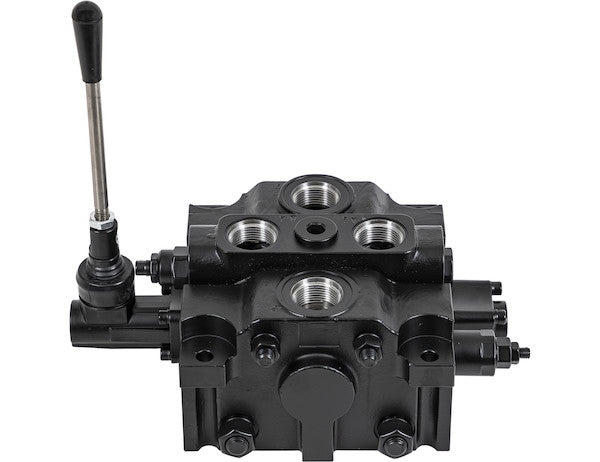
The 40 GPM Valve from Buyers Products is a tough, cast-iron sectional valve that can accommodate handle or cable controls to meet your hydraulic needs. It's designed for high-flow, high-pressure work requirements. The valve can handle the most demanding jobs, with a maximum rating of 4300 PSI when the main relief is set at a higher pressure. The main relief is adjustable from 1300 to 3000 PSI (factory preset at 2150 PSI ). Two additional adjustable port reliefs -- angle and dump -- are available to provide protection for the specific job. This sectional valve offers a lot of versatility in spool action and Power Beyond options to configure to your work needs. It can accommodate cable or handle controls. All valves have cylinder spools unless specified as motor. Additional configurations are available. Please contact Customer Service for further information.
Specifications
| Electrically Operated (y/n) | No |
|---|---|
| Inlet Port Size | 1 SAE ORB (-16) |
| Main Relief Setting | 2500 |
| Maximum Flow Rate | 40 |
| Maximum Pressure | 4500 |
| Outlet Port Size | 1 SAE ORB (-16) |
| Port Relief (y/n) | Yes |
| Port Relief Angle | Y |
| Port Relief Dump | Y 800 PSI |
| Port Type | SAE |
| Power Beyond (y/n) | No |
| Spool Action 1 | Power Up/Power Down - 1 Port Relief |
| Work Port Size | 1 SAE ORB (-16) |
Advanced Technical Overview: 40 GPM 4-Way Sectional Hydraulic Valve with Integrated Port Relief
The 40 GPM 4-Way Sectional Hydraulic Valve from Buyers Products represents a pinnacle of robust engineering and precision control for demanding hydraulic applications. Designed to meet the stringent requirements of heavy-duty mobile and industrial equipment, this valve combines high flow capabilities, impressive pressure ratings, and advanced safety features within a durable, modular framework. This comprehensive technical description delves into the construction, operational principles, performance metrics, and application versatility of this critical hydraulic component.
Core Design and Construction: Cast-Iron Sectional Modularity
At the heart of this valve's exceptional durability and adaptability lies its cast-iron sectional design. Cast iron is meticulously chosen for its inherent strength, excellent vibration damping characteristics, and superior resistance to wear and tear, even under prolonged exposure to high pressures and abrasive hydraulic fluids. This robust material ensures longevity and reliable performance in the harshest operational environments, making it ideal for machinery subjected to rigorous daily use.
The sectional architecture is a cornerstone of its versatility. Unlike monolithic (monoblock) valves, a sectional valve comprises individual work sections, an inlet section, and an outlet section, all bolted together. This modularity offers significant advantages:
- Customization: Users can specify the exact number of work sections required, each potentially housing a different spool type or control mechanism, optimizing the valve for a precise set of functions.
- Serviceability: Should an individual section or spool require maintenance or replacement, it can often be serviced independently without necessitating the replacement of the entire valve assembly, thereby reducing downtime and operational costs.
- Scalability: The ability to add or remove sections means the hydraulic system can evolve with changing application requirements, extending the lifecycle and utility of the initial investment.
The precise machining of each cast-iron section ensures tight tolerances, minimizing internal leakage and maximizing volumetric efficiency. This design philosophy underpins the valve's ability to consistently deliver high performance over its operational lifespan.
Hydraulic Performance Parameters: Flow Rate and Pressure Dynamics
This valve is engineered for high-performance hydraulic systems, evidenced by its impressive specifications:
- Maximum Flow Rate: 40 GPM (Gallons Per Minute): A 40 GPM rating signifies the valve's capacity to efficiently manage substantial fluid volumes. This high flow rate is crucial for applications requiring rapid actuation of large cylinders or high-speed operation of hydraulic motors. It ensures that heavy loads can be moved quickly and efficiently, enhancing productivity in construction, refuse collection, agriculture, and material handling sectors. The design of the internal fluid passages and spool geometry is optimized to minimize pressure drop at this flow rate, contributing to overall system energy efficiency.
- Maximum System Pressure: 4500 PSI (Pounds Per Square Inch): The capability to withstand a maximum system pressure of 4500 PSI positions this valve at the upper echelon of its class. This high-pressure rating is critical for applications demanding significant force generation, such as heavy lifting, crushing, or compacting. The structural integrity of the cast-iron housing and the robust design of the spools and seals are specifically engineered to endure these extreme pressures without compromise, ensuring operational safety and long-term reliability. The initial product description mentions a maximum rating of 4300 PSI when the main relief is set higher, while the specifications table lists 4500 PSI. For design integrity and maximum operational limit, 4500 PSI is the absolute structural capacity under ideal conditions, with the relief valve setting typically configured below this to prevent system over-pressurization.
The combination of high flow and high pressure makes this valve exceptionally suitable for heavy-duty machinery where both speed and force are paramount.
Advanced Pressure Management: Main and Port Relief Valve Systems
Integral to the safe and reliable operation of any high-performance hydraulic system are effective pressure relief mechanisms. This 40 GPM valve incorporates sophisticated main and port relief valves to protect the entire hydraulic circuit and specific actuators from over-pressurization.
Main Relief Valve
The main relief valve is a critical safety component, acting as the primary guardian against excessive pressure within the entire hydraulic system. Its function is to divert hydraulic fluid back to the reservoir when system pressure exceeds a predetermined setting, thereby preventing damage to the pump, control valve, hoses, and other components. For this valve:
- Adjustable Range: 1300 to 3000 PSI: This wide adjustment range allows system designers and operators to precisely tailor the main relief setting to the specific requirements and safety limits of their hydraulic circuit. This flexibility is crucial for optimizing performance while ensuring robust protection.
- Factory Preset: 2500 PSI (as per specifications): The valve typically ships with a factory preset of 2500 PSI. This common setting is suitable for a broad spectrum of applications, providing a balance of power and protection. However, the adjustability ensures it can be fine-tuned for specialized tasks.
The main relief valve is strategically located, typically in the inlet section, to protect the pump and the entire downstream system from potential overloads during peak demand or unexpected blockages.
Integrated Port Relief Valves
Beyond the main system relief, this valve features integrated port relief functionality, crucial for protecting individual actuators (cylinders or motors) from pressure spikes that may occur due to external forces or shock loads. The specific configuration highlighted includes "1 Port Relief" in its spool action, and the availability of "Angle" and "Dump" port reliefs underscores its advanced protection capabilities.
- Functionality: Port relief valves are cartridge-style valves threaded into the work ports of a valve section. They protect a specific cylinder or motor from impact loads or sudden external forces that could generate pressures higher than the main system relief setting. For instance, if a cylinder extending a plow hits an immovable object, the pressure in that specific cylinder line can surge dangerously. A port relief valve will open to divert fluid and dissipate this localized pressure, preventing damage to the cylinder or attached equipment.
-
Types Available (Angle and Dump): The mention of "Angle" and "Dump" port reliefs indicates specialized protection:
- Angle Relief: Typically used in applications where a specific load or torque needs to be maintained, or where one side of a double-acting cylinder requires protection from overload in one direction of travel (e.g., holding a blade at an angle against a load).
- Dump Relief (800 PSI preset): A dump relief, with a factory preset of 800 PSI, is designed to relieve pressure at a lower threshold, often to protect against impact loads or to allow controlled movement under certain conditions. The specific 800 PSI setting indicates it's designed for rapid response to lighter shock loads or for particular operational sequences where a lower relief threshold is beneficial.
While the product title specifies "1 Port Relief," the modular design and description imply that the sectional valve platform supports the integration of multiple such reliefs, as indicated by "two additional adjustable port reliefs -- angle and dump -- are available." This highlights the customizable nature of the valve, where specific sections can be configured with the necessary port relief functionality based on the demands of the attached actuator.
Control Mechanisms: Manual Operation for Reliability
This 4-way valve is designed for manual operation, accommodating either handle or cable controls. This non-electrically operated design offers distinct advantages in certain applications:
- Simplicity and Reliability: Manual controls eliminate the complexities and potential failure points associated with electrical solenoids, wiring harnesses, and control modules. This leads to higher intrinsic reliability, particularly in environments prone to moisture, dust, extreme temperatures, or vibrations.
- Cost-Effectiveness: Manual control systems typically have lower initial costs and simpler maintenance requirements compared to their electro-hydraulic counterparts.
- Direct Feedback: Operators often appreciate the direct tactile feedback provided by handle controls, allowing for precise metering and fine control of hydraulic functions. Cable controls offer flexibility in mounting the control lever remotely from the valve, which is common in mobile equipment cabins.
The "Electrically Operated (y/n): No" specification confirms its design for robust, dependable mechanical control, favored in many heavy-duty industrial and mobile hydraulic systems.
Porting and Connectivity: SAE ORB Standard
All hydraulic connections—Inlet, Outlet, and Work Ports—utilize the 1 SAE ORB (-16) standard. This choice reflects a commitment to modern, leak-free hydraulic system design:
- SAE ORB (O-Ring Boss): SAE ORB ports are recognized for their superior sealing capabilities compared to older pipe thread designs. The O-ring provides a positive seal that resists leakage even under high pressure and vibration, significantly reducing the potential for hydraulic fluid loss and system contamination.
- Size 1 (-16): The "-16" designation refers to a 1-inch nominal size, indicating large porting suitable for the valve's 40 GPM flow rate. This ensures minimal flow restriction and pressure drop through the connections, optimizing system efficiency.
The consistent use of SAE ORB across all ports simplifies plumbing, reduces the likelihood of incorrect connections, and enhances overall system integrity and cleanliness.
Spool Action and Versatility: 4-Way & Power Up/Power Down
The term "4-Way" defines the valve's ability to direct fluid flow in four paths: pressure input, tank return, and two work ports (A and B). This configuration is fundamental for controlling double-acting cylinders or bi-directional hydraulic motors.
The primary spool action specified is "Power Up/Power Down - 1 Port Relief." This indicates a specific control function commonly found in applications requiring precise, controlled movement in both directions, often under load:
- Power Up/Power Down: In this configuration, hydraulic power is actively used to both extend (power up) and retract (power down) an actuator. This is distinct from a "power up/gravity down" setup, where retraction relies on gravity or an external force. Power Up/Power Down ensures positive control and force generation in both directions of movement, essential for applications like dump body actuation, snowplow lift/angle, or scissor lifts.
- Cylinder Spools (Standard): The valve sections are typically configured with cylinder spools by default. Cylinder spools are designed for open-center systems, where fluid flows directly back to the tank in the neutral position. They offer three positions: neutral (blocked work ports, open to tank), extend (pressure to one work port, return from the other), and retract (pressure to the other work port, return from the first).
- Motor Spools (Optional): The availability of motor spools, upon specification, caters to applications requiring bi-directional hydraulic motor control. Motor spools typically have a "closed center" neutral position or a regenerating function, providing different flow characteristics tailored to rotary actuators.
This inherent versatility in spool types and actions underscores the valve's adaptability to a broad spectrum of hydraulic circuits.
Modular Design and Configurability: Addressing Power Beyond
While the specifications for this particular valve configuration indicate "Power Beyond (y/n): No," the initial description clearly states that the valve "offers a lot of versatility in spool action and Power Beyond options." This apparent discrepancy is resolved by understanding the modular nature of sectional valves. The "No" in the specifications refers to this specific ordered configuration, not the inherent capability of the valve series.
- Power Beyond Functionality: A Power Beyond sleeve or section allows a portion of the pressurized hydraulic fluid to be directed to another downstream hydraulic component (e.g., another valve, a hydraulic motor, or an auxiliary circuit) *after* passing through the control valve but *before* returning to the tank. This is crucial for operating multiple hydraulic functions in series without requiring a separate pump for each circuit.
- Customization Potential: The sectional design means that a Power Beyond port can be integrated into the outlet section of the valve when required for complex hydraulic systems. For simpler, standalone applications, such as a dedicated circuit for a single implement, a Power Beyond option may not be necessary, hence its exclusion in a base configuration. The ability to add or omit this feature during configuration exemplifies the valve's adaptability to diverse system architectures.
Customers requiring Power Beyond functionality for their multi-component hydraulic systems should consult Customer Service for configurations that include this essential feature.
Application Spectrum and Industry Relevance
The robust construction, high flow and pressure capabilities, and versatile control options of the 40 GPM 4-Way Sectional Hydraulic Valve make it indispensable across a multitude of heavy-duty applications:
- Snow & Ice Management: Ideal for controlling snowplow lift, angle, and dump body functions on municipal and commercial vehicles, providing reliable operation in harsh winter conditions.
- Refuse & Waste Management: Powering compaction cylinders, lift mechanisms, and tailgate operations on refuse trucks, where high forces and continuous duty cycles are the norm.
- Construction Equipment: Suitable for auxiliary functions on excavators, loaders, and backhoes, controlling attachments like grapples, hammers, or specialized tools.
- Agricultural Machinery: Operating implements such as front-end loaders, tillage equipment, and various auxiliary functions on tractors and harvesters.
- Material Handling: Providing precise control for lift, tilt, and clamp functions on forklifts, telehandlers, and other industrial material handling equipment.
- Utility Vehicles: Actuating boom lifts, winches, and auxiliary tools on service trucks and utility vehicles.
Its non-electrical nature further enhances its suitability for outdoor, mobile, and potentially hazardous environments where electrical components might be vulnerable.
Operational Considerations, Maintenance, and Longevity
To ensure optimal performance and extend the lifespan of the 40 GPM sectional valve, several operational and maintenance considerations are paramount:
- Hydraulic Fluid Quality: Using high-quality hydraulic fluid that meets OEM specifications is crucial. Proper viscosity, anti-wear additives, and thermal stability are essential for smooth operation, preventing premature wear, and maintaining sealing integrity.
- Filtration: A clean hydraulic system is a healthy system. Implementing appropriate filtration levels upstream of the valve protects the precision-machined spools and valve seats from abrasive contaminants, which can cause internal leakage and reduce efficiency.
- Seal Integrity: While cast iron provides structural strength, the integrity of seals (O-rings, backup rings) is critical for leak-free operation. Regular inspection and timely replacement of worn seals, particularly during scheduled maintenance, will prevent external leakage and pressure loss.
- Periodic Adjustment: The adjustability of the main and port relief valves allows for fine-tuning. Periodic verification and, if necessary, adjustment to specified pressure settings ensure continued system protection in line with operational requirements.
- Environmental Protection: Although robust, protecting the valve from excessive external impact, corrosive chemicals, and extreme temperatures beyond its design limits will contribute to its longevity.
The sectional design simplifies maintenance, as individual sections can often be isolated and serviced, minimizing the time and effort required to keep the hydraulic system fully operational.
Conclusion
The 40 GPM 4-Way Sectional Hydraulic Valve with Integrated Port Relief from Buyers Products stands as a testament to engineering excellence in hydraulic control. Its heavy-duty cast-iron construction, high flow and pressure capabilities, advanced main and port relief systems, and versatile manual control options combine to deliver a reliable, high-performance solution for the most challenging applications. Designed for maximum configurability and ease of maintenance, this valve is an intelligent investment for systems requiring precise, powerful, and protected hydraulic actuation. For specific configurations, including Power Beyond options or alternative spool types, contact Customer Service to ensure the valve perfectly aligns with your hydraulic system's unique demands.