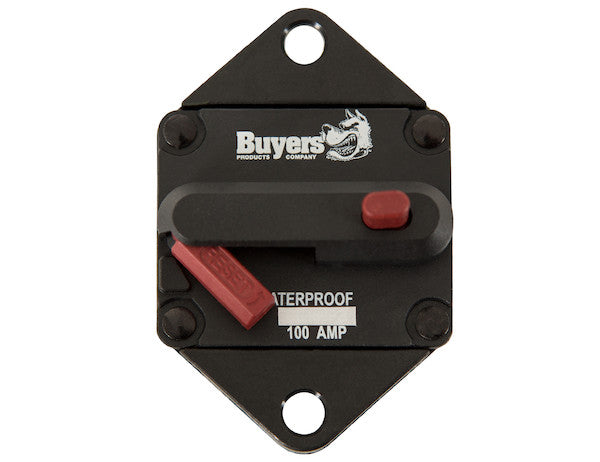
Buyers Products Hi-Amp Panel Mount Circuit Breaker is ideal for switch and power distribution panels. It can be switched with a manual push-button trip. The unit is waterproof to protect against shorts and IP67 rated for dust resistance.
Specifications
| Depth | 2.090 |
|---|---|
| Length | 1.91 |
| Material | Plastic |
| Max Volts | 42.0 |
| Reset | Manual |
| Studs Material | Brass |
| Trip Current | 100 |
| Waterproof (y/n) | Y |
| Width | 2.92 |
Advanced Technical Overview: 100 Amp Push-to-Trip Circuit Breaker for Demanding Applications
The Buyers Products Hi-Amp Panel Mount Circuit Breaker represents a robust and essential component for safeguarding electrical systems operating under challenging conditions. Engineered to provide superior overcurrent protection in high-amperage, direct current (DC) circuits, this device combines critical safety features with exceptional environmental durability. Its design emphasizes reliability, precision, and user control, making it an indispensable asset in a broad spectrum of professional and industrial applications.
Core Functionality: Overcurrent Protection Principles
At its heart, this unit functions as a sophisticated circuit breaker, a safety device designed to protect an electrical circuit from damage caused by overcurrent, short circuit, or overload. Unlike a fuse, which operates once and must be replaced, a circuit breaker can be reset (manually, in this case) to resume normal operation, offering significant advantages in terms of cost-efficiency, operational convenience, and diagnostic capabilities. When an overcurrent condition occurs, the internal mechanism of the breaker detects the anomaly and rapidly interrupts the flow of electricity, thereby preventing potential damage to wiring, connected equipment, and mitigating fire hazards.
The 100 Amp rating signifies its trip threshold. This breaker is specifically calibrated to interrupt the circuit when the current continuously exceeds 100 Amperes. This precise rating is crucial for ensuring that the breaker trips before the wiring or connected components are subjected to destructive current levels, while simultaneously preventing nuisance tripping during normal operational current surges. Its maximum voltage rating of 42.0V clearly positions it for DC applications, commonly found in automotive, marine, heavy equipment, and renewable energy systems where high currents are prevalent.
The Significance of "Push-to-Trip" and Manual Reset
A distinctive feature of this circuit breaker is its "Push-to-Trip" capability, coupled with a manual reset mechanism. The push-to-trip function allows an operator to intentionally trip the breaker by pressing a button, even when no overcurrent fault exists. This provides a critical safety and operational advantage:
- Planned Circuit Isolation: For maintenance, installation of new components, or during diagnostic procedures, the ability to manually de-energize a specific circuit without disturbing the entire power system is invaluable. It ensures that personnel can safely work on downstream equipment.
- Emergency Disconnection: In certain scenarios, an immediate and deliberate power cut may be required, for instance, to prevent further damage during an unforeseen system malfunction or to isolate a hazardous condition. The push-to-trip mechanism provides this instantaneous control.
- System Diagnostics: Technicians can use the push-to-trip function to test the responsiveness of the breaker itself or to systematically isolate parts of a complex electrical network for fault identification.
The manual reset feature further complements its operational utility. Once tripped, either automatically by an overcurrent or manually by the push-button, the breaker remains in the open (tripped) position until it is physically reset by the user. This is a critical safety measure, ensuring that the underlying fault, which caused the overcurrent, has been investigated and rectified before power is restored. Automatic reset breakers, while convenient in some specific applications, can cycle on and off during a persistent fault, potentially causing intermittent damage to components or creating a fire risk. The manual reset demands human intervention, thereby promoting safer troubleshooting practices and preventing repetitive fault exposure.
Unparalleled Environmental Durability: IP67 Rating and Waterproof Construction
One of the most compelling attributes of this 100 Amp circuit breaker is its exceptional environmental resilience, explicitly highlighted by its IP67 rating and waterproof design. The Ingress Protection (IP) rating system, defined by international standard IEC 60529, classifies and rates the degree of protection provided by mechanical casings and electrical enclosures against intrusion from foreign bodies and moisture. The "IP67" designation conveys a superior level of protection:
- "6" for Solids Protection: This indicates that the enclosure is completely dust-tight. No ingress of dust is permitted under test conditions. This is vital in environments where particulate matter, such as dirt, sand, road salt, or fine industrial dust, could compromise internal components, leading to corrosion, short circuits, or mechanical interference with the tripping mechanism.
- "7" for Liquids Protection: This signifies that the device is protected against the effects of temporary immersion in water. Specifically, it can withstand immersion in water up to 1 meter (3.3 feet) for 30 minutes without harmful ingress of water. This level of waterproofing is crucial for applications in marine vessels (boats, yachts), off-road vehicles (ATVs, UTVs, construction equipment), agricultural machinery, and outdoor power distribution panels where exposure to rain, splashes, washdowns, or even temporary submersion is a real possibility.
The combination of dust-tightness and water immersion protection ensures that the internal electrical contacts and sensitive tripping mechanisms remain clean, dry, and fully functional, even in the most aggressive operational environments. This directly translates to enhanced reliability, extended product lifespan, and consistent performance under adverse conditions, minimizing maintenance requirements and reducing downtime.
Robust Material Selection and Construction
The choice of materials in the construction of this circuit breaker is deliberate, optimized for performance, durability, and electrical safety. The primary housing is constructed from a high-quality plastic. This material offers several key advantages:
- Excellent Dielectric Properties: Plastic is an electrical insulator, preventing current leakage and ensuring that the outer casing remains safe to touch, even when the internal circuitry is live.
- Corrosion Resistance: Unlike metal enclosures, plastic is inherently resistant to rust and corrosion caused by moisture, salt spray, chemicals, and many industrial solvents. This is particularly important for marine and outdoor applications.
- Lightweight: Plastic contributes to a lighter overall product weight, which can be a factor in weight-sensitive applications or for ease of installation.
- Impact Resistance: Modern engineering plastics are designed to be durable and resistant to mechanical impact, protecting the internal components from physical damage.
The studs, which serve as the connection points for the electrical wiring, are made from brass. Brass is an alloy primarily composed of copper and zinc, chosen for its:
- Superior Electrical Conductivity: Brass offers excellent conductivity, ensuring minimal resistance at the connection points and efficient current transfer.
- Corrosion Resistance: While not as robust as certain specialized stainless steels, brass offers good corrosion resistance, particularly against oxidation, making it suitable for electrical terminals in damp or mildly corrosive environments.
- Mechanical Strength: Brass provides sufficient mechanical strength to withstand the torque applied during terminal tightening, ensuring secure and stable electrical connections without stripping threads or deforming.
This judicious selection of materials underscores a commitment to longevity and performance, especially in the demanding environments for which this breaker is intended.
Dimensions and Panel Mount Integration
The physical dimensions of the breaker – Length: 1.91 inches, Width: 2.92 inches, Depth: 2.090 inches – are indicative of a compact yet robust form factor, designed for efficient panel mounting. Panel mount designs are highly favored in professional installations for several reasons:
- Integrated Aesthetics: The breaker sits flush or nearly flush with the panel surface, providing a clean, professional, and organized appearance to switchgear or distribution boards.
- Secure Installation: Panel mounting ensures the breaker is securely fixed, resistant to vibrations and accidental dislodgement, which is critical in mobile applications like vehicles and boats.
- Accessibility and Usability: Positioning the breaker on a control panel makes the manual trip button and reset mechanism easily accessible to operators for monitoring, control, and troubleshooting.
- Space Optimization: The specific dimensions guide installers in planning panel layouts, ensuring adequate spacing for wiring, ventilation, and operator access within often constrained enclosures.
Diverse Applications Across Industries
The technical specifications and robust design of this 100 Amp Push-to-Trip Circuit Breaker make it exceptionally well-suited for a wide array of high-current DC applications:
- Automotive and Heavy Equipment: Ideal for protecting critical circuits in heavy-duty trucks, construction equipment, agricultural machinery, buses, emergency vehicles, and commercial fleets. This includes power feeds for auxiliary lighting, winches, inverters, power take-offs (PTOs), and complex control systems where significant currents are drawn.
- Marine Systems: Indispensable for boat and yacht electrical panels, protecting battery banks, main DC distribution lines, high-power navigation electronics, anchor windlasses, thrusters, and other marine accessories against the harsh saltwater and humid environment.
- Recreational Vehicles (RVs) and Campers: Used as a primary overcurrent protection device for main DC distribution panels, battery chargers, inverters, and high-draw appliances within RVs, ensuring safety and compliance with RV electrical standards.
- Renewable Energy Systems: Essential in off-grid solar power systems, battery storage banks, and small wind turbine setups to protect charge controllers, inverters, and main DC distribution from overcurrents originating from either the generation source or load side.
- Industrial DC Control Systems: Applicable in industrial settings for protecting DC power supplies, motor control circuits, solenoids, and other high-current DC loads within control cabinets, particularly in environments exposed to dust or moisture.
- Telecommunications Infrastructure: Can be deployed in remote telecommunications sites for protecting DC power feeds to critical network equipment, where reliability and environmental resistance are paramount.
Installation and Safety Considerations
Proper installation is paramount to leveraging the full safety and performance benefits of this circuit breaker. Users and installers should adhere to industry best practices and relevant electrical codes:
- Wire Gauge Selection: Always select wire gauges appropriate for the 100 Amp current rating, considering circuit length and expected load, to prevent overheating and voltage drop.
- Connection Integrity: Ensure all terminal connections are clean, secure, and torqued to manufacturer specifications (if provided) to prevent loose connections, which can lead to localized heating, increased resistance, and potential fire hazards. The brass studs facilitate reliable connections.
- Mounting Location: Mount the breaker in an accessible location on a sturdy panel, allowing for easy visual inspection, manual tripping, and resetting. Ensure adequate clearance for wiring and heat dissipation.
- Environmental Shielding: While the breaker is IP67 rated, additional shielding or strategic placement within an enclosure can further extend its lifespan in extremely harsh or corrosive environments.
- System Design: Integrate the circuit breaker into a comprehensively designed electrical system that accounts for total load, fault current levels, and coordination with other protective devices.
- Safety Protocols: Always disconnect the power source before installing or servicing the circuit breaker. Use appropriate personal protective equipment (PPE) and follow lockout/tagout procedures as necessary.
Conclusion
The 100 Amp Push-to-Trip Circuit Breaker from Buyers Products stands as a testament to engineering excellence in circuit protection. Its robust 100 Amp trip current, specific 42V DC rating, and the tactical advantage of a manual push-to-trip and reset mechanism provide exceptional control and safety. Furthermore, its IP67 rated, waterproof, and dust-resistant construction, combined with durable plastic and brass materials, ensures reliable operation and longevity in the most demanding environmental conditions. Whether for automotive, marine, RV, or industrial DC power distribution panels, this breaker offers an optimal blend of performance, safety, and durability, protecting valuable equipment and ensuring operational continuity in critical high-current applications.