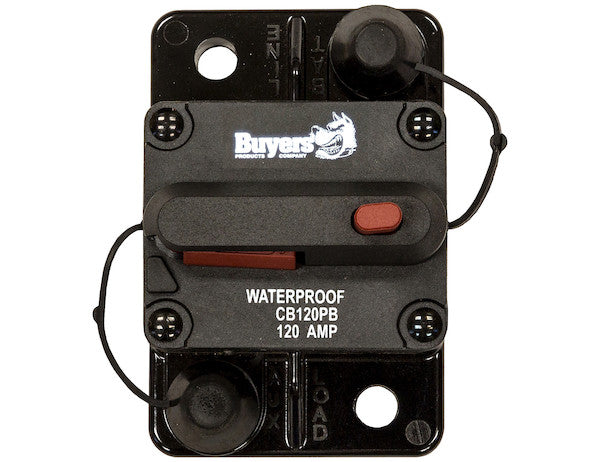
High-Amp Circuit Breakers with Manual Reset from Buyers Products helps protect auxiliary and accessory circuits on dump hoists, plows, spreaders, lift gates, and cranes. The manual reset, push-to-trip circuit breakers are water resistant and feature silver-plated studs, stainless steel nuts, and rubber boots. They are available in amperages ranging from 30A to 250A.
Specifications
| Box Material | Plastic |
|---|---|
| Color | Black |
| Connection | Stud |
| Connection Material | Brass |
| Finish | Plain |
| Length | 2.875 |
| Material | Plastic |
| Max Volts | 42.0 |
| Reset | Manual |
| Studs Material | Brass |
| Trip Current | 120 |
| Waterproof (y/n) | Yes |
| Width | 1.875 |
Advanced Technical Overview: 120 Amp High-Capacity Manual Push-to-Trip Reset Circuit Breaker
The 120 Amp Circuit Breaker with Manual Push-to-Trip Reset represents a critical component in the electrical architecture of heavy-duty vehicular and industrial equipment. Engineered for robust performance in challenging environments, this high-amp circuit breaker from Buyers Products is specifically designed to provide superior overcurrent protection for auxiliary and accessory circuits. Its technical specifications and operational design underscore a commitment to reliability, safety, and operational continuity for applications such as dump hoists, plows, spreaders, lift gates, and cranes.
Fundamentals of Overcurrent Protection in Mobile Applications
In mobile and off-highway equipment, electrical systems are subject to a multitude of stressors, including transient voltage spikes, sustained overloads, and direct short circuits. These conditions can arise from motor inrush currents, mechanical binding, wiring insulation degradation, or environmental factors. Without adequate protection, such events can lead to severe damage to wiring harnesses, electronic control units, motors, and other expensive components, potentially resulting in equipment downtime, fire hazards, or operator injury. Circuit breakers, unlike single-use fuses, offer a resettable solution, allowing for restoration of power after a fault condition has been cleared, significantly reducing maintenance costs and operational interruptions.
The 120 Amp rating of this circuit breaker is precisely selected for circuits demanding substantial current delivery. This rating signifies the maximum continuous current the device is designed to carry without tripping. When the current flow exceeds this threshold due to an overload or short circuit, the internal mechanism of the breaker rapidly interrupts the circuit, isolating the faulty section and preventing further damage. The trip curve characteristics, inherent to thermal or thermal-magnetic circuit breakers, dictate the time-current relationship, ensuring a fast response to high-magnitude short circuits while allowing for momentary inrush currents that are typical of motor starting or capacitive loads without nuisance tripping.
Operational Principle: Manual Reset with Push-to-Trip Functionality
This circuit breaker features a manual reset mechanism, a design choice specifically advantageous for heavy-duty applications. In contrast to automatic reset breakers which cycle power back on after a cooling period (potentially re-energizing a persistent fault), a manual reset requires deliberate human intervention. This ensures that the root cause of the overcurrent event can be investigated and rectified before power is restored, enhancing safety and preventing repetitive system stresses. The manual reset action typically involves a lever or button that must be physically actuated to close the internal contacts and re-establish the circuit.
A distinctive and highly valuable feature of this particular model is its "push-to-trip" functionality. This allows for manual tripping of the circuit breaker for diagnostic purposes, system testing, or during maintenance procedures. By intentionally activating the trip mechanism, technicians can safely de-energize a circuit without disconnecting wiring or relying on external tools. This capability streamlines troubleshooting processes, verifies proper breaker operation, and facilitates safe work practices on live equipment by allowing for a controlled power shutdown to specific auxiliary systems.
Robust Construction and Material Science for Demanding Environments
The integrity and longevity of circuit breakers in heavy-duty applications are profoundly influenced by their material composition and construction. This 120 Amp circuit breaker exemplifies engineered durability through its judicious selection of materials and protective features:
- Enclosure (Plastic, Black): The housing is constructed from high-grade plastic, chosen for its excellent dielectric properties, robust impact resistance, and inherent corrosion resistance. The black coloration offers UV stability, preventing material degradation and discoloration when exposed to sunlight, a common factor for externally mounted components on vehicles. Industrial-grade plastics are formulated to withstand extreme temperature fluctuations, chemical exposure (e.g., fuels, lubricants, cleaning agents), and mechanical vibration, all prevalent in agricultural, construction, and municipal vehicle operations. The compact dimensions (Length: 2.875 inches, Width: 1.875 inches) facilitate versatile mounting in constrained spaces.
- Water Resistance (Yes) and Rubber Boots: The designation of "Waterproof (y/n): Yes" is critical for components exposed to the elements. This implies a design that prevents the ingress of water, dust, and other contaminants, maintaining electrical integrity and preventing short circuits or corrosion of internal components. This level of protection is often associated with specific IP (Ingress Protection) ratings. Complementing this, the inclusion of rubber boots over the terminal studs provides an additional layer of environmental sealing, protecting the electrical connections from moisture, road salt, and abrasive debris, which can otherwise lead to premature failure or intermittent connectivity issues.
- Connection Type (Stud, Brass with Silver Plating): The use of stud connections is paramount for high-amp circuits. Unlike screw terminals or blade connectors, studs provide a larger surface area for current transfer and are less prone to loosening under vibration or thermal cycling. The primary connection material is brass, an alloy known for its excellent electrical conductivity and corrosion resistance. Furthermore, the studs are silver-plated. Silver plating significantly enhances conductivity by reducing contact resistance, minimizes heat generation at the terminals, and provides superior resistance to oxidation and tarnish compared to bare brass, ensuring long-term, stable electrical connections under high current loads.
- Stainless Steel Nuts: Securing the electrical connections are stainless steel nuts. Stainless steel is selected for its exceptional corrosion resistance, superior mechanical strength, and resistance to galling, ensuring that the connections remain tight and secure over the operational lifespan of the equipment, even when subjected to harsh weather and corrosive environments. This material choice is crucial for preventing loosening due to vibration, which could otherwise lead to resistive heating and potential failure.
Electrical Performance Characteristics and System Integration
The specified electrical parameters are vital for proper system integration and safe operation:
- Trip Current (120 Amps): As the central protective rating, the 120 Amp trip current ensures that the circuit breaker will reliably interrupt current flow when it exceeds this threshold. This rating is carefully matched to the maximum continuous operating current of the protected circuit, with a sufficient margin to accommodate normal operational surges while tripping rapidly under fault conditions. The precise calibration of the thermal tripping element ensures consistency in performance across its operational temperature range.
- Maximum Voltage (42.0 Volts): With a maximum voltage rating of 42.0 volts, this breaker is ideally suited for common automotive and heavy-duty vehicle electrical systems, which typically operate at 12V, 24V, or increasingly, 48V DC. The voltage rating is a critical safety parameter, indicating the maximum potential difference the breaker can safely interrupt without arcing or insulation breakdown within its contacts. This ensures robust performance and safety margins even under system voltage fluctuations.
- Amperage Range (30A to 250A): While this specific product is rated for 120 amps, its availability within a broader range (30A to 250A) highlights the versatility of Buyers Products' circuit breaker line. This allows for precise matching of protection devices to the specific current demands of various auxiliary systems on heavy-duty equipment, optimizing both safety and performance across a fleet or diverse range of accessories.
Applications in Heavy-Duty Industries
The applications listed for this circuit breaker underscore its critical role in industries where reliable electrical power and robust protection are non-negotiable:
- Dump Hoists: These systems involve powerful electric motors to actuate hydraulic pumps, which can draw significant inrush currents during startup and sustained high currents under heavy loads. A 120A breaker provides essential protection against overloads caused by mechanical resistance or hydraulic system faults.
- Plows and Spreaders: Electrically powered components on snow plows (e.g., angling, lifting mechanisms) and salt/sand spreaders (e.g., auger motors, spinner motors) operate in extreme weather, often with intermittent heavy loads. Protection against moisture-induced shorts and motor overloads is crucial for continuous operation.
- Lift Gates: Hydraulic lift gates on commercial vehicles utilize powerful electric motors to operate the lifting mechanism. These motors are subject to high current draws, especially when lifting maximum loads or encountering mechanical impediments. The 120A breaker ensures that the motor and associated wiring are protected from thermal damage.
- Cranes: Mobile crane auxiliary functions, such as outriggers, rotating mechanisms, and auxiliary lighting, depend on stable electrical power. Given the safety-critical nature of crane operations, reliable overcurrent protection is paramount to prevent electrical failures that could compromise stability or control.
- Other Auxiliary and Accessory Circuits: This general category encompasses a wide array of electrically powered devices common on utility vehicles, construction equipment, and service trucks, including winches, air compressors, auxiliary lighting, inverters, and climate control systems. For any circuit drawing substantial current and operating in harsh conditions, a high-amp manual reset circuit breaker is an indispensable safety and reliability feature.
Installation and Maintenance Considerations
Proper installation is crucial to realizing the full protective capabilities of this 120 Amp circuit breaker. It should be mounted securely in an accessible location, considering ambient temperature and proximity to potential heat sources, as excessive heat can affect its tripping characteristics. Wiring should adhere to industry standards for high-current applications, using appropriately sized conductors and crimped terminals to ensure low-resistance connections. The rubber boots should be correctly positioned over the terminals to maximize environmental protection.
The manual push-to-trip function facilitates routine maintenance checks. Periodically, technicians can utilize this feature to confirm the breaker's operational integrity, verifying that it can indeed interrupt the circuit. This proactive testing, coupled with visual inspections for signs of physical damage or corrosion, contributes significantly to the long-term reliability of the electrical system.
Conclusion
The 120 Amp Circuit Breaker with Manual Push-to-Trip Reset from Buyers Products is an expertly engineered solution for the demanding electrical protection requirements of heavy-duty auxiliary and accessory circuits. Its precise 120A tripping capability, coupled with a robust, water-resistant design featuring silver-plated brass studs and stainless steel hardware, ensures superior performance and longevity in harsh operational environments. The critical manual reset and proactive push-to-trip functions empower operators and technicians with enhanced safety control and diagnostic capabilities, minimizing downtime and maximizing equipment reliability. By integrating this advanced circuit protection device, industries can safeguard their valuable assets, ensure operational continuity, and uphold the highest standards of electrical safety across their mobile fleets and machinery.