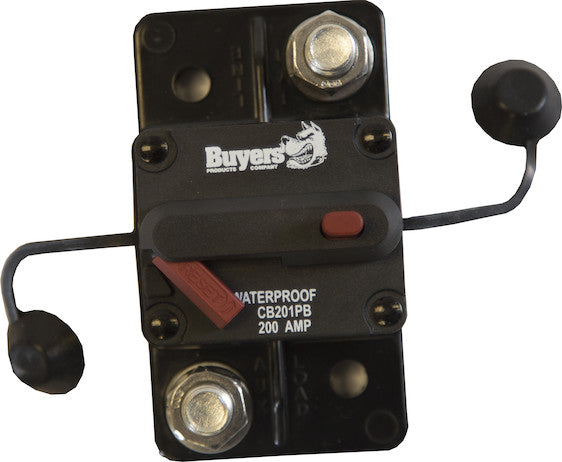
High-Amp Circuit Breakers with Manual Reset from Buyers Products helps protect auxiliary and accessory circuits on dump hoists, plows, spreaders, lift gates, and cranes. The manual reset, push-to-trip circuit breakers are water resistant and feature silver-plated studs, stainless steel nuts, and rubber boots. They are available in amperages ranging from 30A to 250A.
Specifications
| Box Material | Plastic |
|---|---|
| Color | Black |
| Connection | Stud |
| Connection Material | Brass |
| Finish | Plain |
| Length | 3.325 |
| Material | Plastic |
| Max Volts | 42.0 |
| Reset | Manual |
| Studs Material | Brass |
| Trip Current | 200 |
| Waterproof (y/n) | Yes |
| Width | 1.875 |
Advanced Overcurrent Protection: The 200 Amp Manual Reset Circuit Breaker for Demanding Applications
In the realm of high-current DC electrical systems, robust and reliable overcurrent protection is not merely a feature, but an absolute necessity for operational safety, equipment longevity, and uninterrupted productivity. The 200 Amp Circuit Breaker with Manual Push-to-Trip Reset and Large Frame from Buyers Products represents a pinnacle of engineering excellence, specifically designed to meet the rigorous demands of auxiliary and accessory circuits on heavy-duty vehicles and industrial machinery. This technical description delves into the intricate features, operational principles, critical applications, and inherent advantages that make this circuit breaker an indispensable component in high-amperage electrical architectures. Engineered for superior performance in challenging environments, this breaker ensures that critical systems such as dump hoists, plows, spreaders, lift gates, and cranes are protected from the potentially catastrophic consequences of overcurrent conditions.
Core Functionality: Precision 200 Amp Overcurrent Protection
At the heart of this device is its formidable 200 Amp trip current rating. This substantial amperage capacity is tailored for electrical systems that draw significant power, necessitating a protection mechanism capable of handling sustained high loads while offering swift intervention during fault conditions. The precise calibration to 200 amps ensures that the circuit breaker will effectively interrupt the circuit when current exceeds this threshold, safeguarding connected components, wiring, and power sources from thermal damage and electrical stresses. This makes it ideal for primary power feeds to high-draw subsystems or as a master circuit protector for complex auxiliary setups. The ability to precisely manage 200 amps of current is crucial for maintaining the operational integrity of power-intensive equipment that operates under demanding duty cycles, where transient surges and prolonged heavy loads are commonplace. The design accounts for both momentary overloads and sustained fault conditions, providing a comprehensive protective envelope.
Manual Reset Mechanism: Enhanced Control and Diagnostic Capability
A defining characteristic of this circuit breaker is its manual reset, push-to-trip mechanism. Unlike automatic reset breakers, which can repeatedly attempt to re-establish a circuit after a fault clears, a manual reset breaker remains tripped until an operator physically intervenes. This feature offers several distinct advantages in industrial and heavy-duty vehicle applications. Firstly, it prevents cycling on and off during intermittent fault conditions, which can lead to rapid wear on contacts, generate excessive heat, and potentially damage sensitive electronic components downstream. Secondly, the manual reset forces an operator to acknowledge a tripped condition, providing a critical opportunity for fault diagnosis and resolution before re-energizing the circuit. The push-to-trip functionality further enhances safety and control, allowing for manual circuit isolation for maintenance or emergency situations without disconnecting power cables. This deliberate control over the circuit's state is invaluable in ensuring that any underlying issues causing the overcurrent are identified and corrected, thereby preventing recurring problems and enhancing overall system reliability and safety. The robust button mechanism is designed for reliable operation even with gloved hands or in adverse conditions.
Robust Engineering: The Large Frame Advantage
The "Large Frame" designation is not merely a descriptor of physical size but signifies a design philosophy centered on durability, enhanced thermal management, and mechanical robustness. A larger frame allows for more substantial internal components, including larger bimetallic strips or electromagnetic coils (depending on the trip mechanism type, likely thermal for DC high amp), which contribute to more stable and accurate tripping characteristics under varying environmental temperatures. Crucially, the increased surface area of a large frame facilitates superior heat dissipation, mitigating the risk of nuisance trips caused by ambient heat buildup or prolonged high-current flow slightly below the trip point. This is particularly important for applications where the breaker may be enclosed or exposed to high operating temperatures. Furthermore, the large frame provides a more rigid and stable housing for the internal components, making the breaker more resistant to vibration, shock, and physical impact – common challenges in mobile and industrial settings. This robust construction ensures consistent performance and extended service life even when subjected to the harsh dynamic forces associated with heavy machinery operation.
Material Science: Durability and Conductivity for Extreme Environments
The selection of materials for this circuit breaker is a testament to its engineering for resilience. The housing, referred to as the "Box Material" and "Material" in the specifications, is constructed from high-grade plastic. This choice provides excellent electrical insulation, inherent corrosion resistance, and a lightweight profile. The black color is often indicative of UV-stabilized plastics, enhancing resistance to degradation from prolonged sun exposure in outdoor applications. Internally, the "Connection Material" and base "Studs Material" are brass. Brass is chosen for its excellent electrical conductivity, superior mechanical strength, and good resistance to corrosion, particularly in marine or damp environments. Crucially, the specification notes "silver-plated studs." Silver plating on brass studs significantly enhances electrical conductivity, minimizing voltage drop and heat generation at connection points, which is paramount for high-current applications. Silver also offers exceptional corrosion resistance, ensuring a reliable, low-resistance connection over the long term. Complementing these are stainless steel nuts, providing robust, corrosion-resistant fastening that withstands vibration and environmental exposure, and protective rubber boots. These boots act as a barrier against moisture, dust, and debris, preserving the integrity of the electrical connections and enhancing the breaker's overall water resistance. The synergy of these carefully selected materials ensures both optimal electrical performance and mechanical integrity in the most demanding operational scenarios.
Water Resistance: Unyielding Performance in Harsh Conditions
The designation "Waterproof (y/n): Yes" is a critical feature, underscoring this breaker's suitability for environments where exposure to moisture, spray, or even temporary immersion is a distinct possibility. This level of water resistance, often achieved through sealed enclosures, gasketed interfaces, and protective boots over exposed terminals, ensures reliable operation in applications such as marine vessels, agricultural equipment, snowplows, road salt spreaders, and other outdoor or wash-down scenarios. Protection against water ingress prevents short circuits, corrosion of internal components, and insulation breakdown, all of which can lead to circuit failure, safety hazards, and costly downtime. The robustness of this water resistance contributes significantly to the breaker's overall reliability and extends its operational life, making it a dependable choice for any application exposed to the elements or high-humidity environments.
Critical Applications: Safeguarding Heavy-Duty Equipment
The specific mention of dump hoists, plows, spreaders, lift gates, and cranes highlights the intended operational theater for this 200 Amp circuit breaker. Each of these applications involves heavy mechanical loads, often driven by powerful hydraulic or electric motors that draw significant current, sometimes exhibiting high inrush currents upon startup or transient overloads during operation.
- Dump Hoists and Lift Gates: These systems rely on powerful motors to lift and lower heavy loads. An overcurrent condition could arise from motor stalls, hydraulic system blockages, or electrical faults, leading to motor burnout or wiring fires. The 200A breaker provides essential protection, ensuring the motor and associated wiring are safeguarded.
- Plows and Spreaders: Operating in harsh winter conditions, these systems are exposed to extreme cold, moisture, and corrosive salts. Motors driving plow hydraulics or spreader mechanisms can experience increased current draw due to ice, jammed material, or mechanical strain. The water-resistant, high-amp breaker is critical here for preventing failures in adverse conditions.
- Cranes: Both mobile and stationary cranes utilize powerful electric motors for lifting, traversing, and rotating heavy loads. The dynamic nature of crane operation, coupled with the potential for sudden load changes or mechanical binding, necessitates a robust overcurrent device. A 200A breaker offers reliable protection against overloads that could jeopardize structural integrity or operator safety.
- Marine: Protecting winches, anchor windlasses, high-output stereo systems, inverters, and main distribution panels on large boats and yachts.
- Recreational Vehicles (RVs): Safeguarding inverter systems, battery chargers, and high-draw appliance circuits.
- Agricultural Equipment: Protecting pumps, motors, and electronic control systems on tractors, harvesters, and irrigation systems.
- Emergency Vehicles: Ensuring the reliability of lighting systems, communication equipment, and specialty tools in ambulances, fire trucks, and police vehicles.
- Industrial Machinery: Providing overcurrent protection for motors, solenoids, and control circuits in factory automation and material handling equipment.
Technical Specifications: Detailing Performance Parameters
A detailed examination of the provided specifications reveals the precise operational envelope and physical attributes of this 200 Amp circuit breaker:
- Max Volts: 42.0V DC: This voltage rating unequivocally establishes the breaker's suitability for 12V, 24V, and 36V DC electrical systems, which are standard across heavy-duty automotive, marine, and industrial applications. While many systems are 12V or 24V, the 42V rating provides a comfortable safety margin for transient voltage spikes and ensures compatibility with potentially higher voltage auxiliary systems.
- Trip Current: 200 Amps: As highlighted, this is the precise threshold at which the breaker is designed to interrupt the circuit, ensuring protection against excessive current draw.
- Connection Type: Stud: The use of stud connections is a standard practice for high-current applications. Studs provide a secure, low-resistance connection point for heavy gauge wiring, capable of transmitting significant current without overheating. This method also facilitates robust mechanical clamping, reducing the risk of loosening due to vibration.
- Length: 3.325 inches, Width: 1.875 inches: These dimensions provide critical information for installation planning, ensuring adequate space is allocated for mounting the large-frame unit. The footprint suggests a compact yet substantial build, optimizing space utilization while maintaining internal component integrity.
- Finish: Plain: A plain finish indicates a functional, unadorned exterior, focusing on performance and durability rather than aesthetics. This is typical for components designed for demanding industrial and commercial applications where appearance is secondary to reliability.
Mechanism of Operation: Thermal Overcurrent Detection
High-amperage DC circuit breakers, especially those with thermal characteristics, typically operate on the principle of a bimetallic strip. When an overcurrent condition occurs, the excessive current flowing through the circuit heats this bimetallic strip. The strip is composed of two different metals bonded together, each with a different coefficient of thermal expansion. As the strip heats up, the metal with the higher coefficient of expansion expands more rapidly, causing the strip to bend. At a predetermined temperature, corresponding to the 200 Amp trip current, the bending of the bimetallic strip causes a mechanical latch to release. This latch is connected to the breaker's internal contacts, which then spring open, physically interrupting the electrical circuit. The "push-to-trip" function often mechanically mimics this action, allowing an operator to manually actuate the latch and open the contacts, providing a means for manual circuit isolation. The manual reset mechanism then requires a deliberate physical action to re-engage the latch and close the contacts, restoring power to the circuit. This ensures that any fault condition that caused the initial trip is investigated and resolved before power is reapplied, preventing potential damage or safety hazards from an unresolved issue. This thermal-mechanical operation provides a reliable and time-tested method for overcurrent protection in DC systems, offering a predictable trip curve that is responsive to sustained overloads.
Installation and Integration Best Practices
Proper installation is paramount to leveraging the full protective capabilities of this 200 Amp circuit breaker. Given its high amperage rating and critical function, several best practices should be observed:
- Mounting: The large frame design typically implies robust mounting requirements. Securely mount the breaker in an accessible location, away from direct engine heat sources, but within the protected area, using appropriate fasteners. The location should allow for easy visual inspection and manual resetting.
- Wiring: Use appropriately sized, high-quality copper wiring (e.g., AWG 00 or larger, depending on cable length and specific application standards) to handle 200 Amps continuously, minimizing voltage drop and heat generation. Terminate wires with high-quality ring terminals, ensuring proper crimping for maximum conductivity and mechanical integrity.
- Torque Specifications: Adhere strictly to manufacturer-recommended torque specifications when tightening the stainless steel nuts on the silver-plated brass studs. Overtightening can damage the studs or the breaker housing, while undertightening can lead to loose connections, increased resistance, and heat buildup, potentially causing nuisance trips or connection failure.
- Environmental Considerations: While water-resistant, ensure the installation minimizes prolonged exposure to direct water jets or submersion unless the product is specifically rated for such conditions. Utilize the rubber boots to protect exposed terminals from moisture and corrosion. Consider ambient temperature; operating close to the breaker's thermal limits in high ambient temperatures may affect trip characteristics.
- Proximity to Battery: For primary circuit protection, the breaker should be installed as close as practically possible to the power source (e.g., the battery bank) to protect the maximum length of the primary cable run.
Advantages Over Conventional Fuses
While fuses offer reliable one-time overcurrent protection, the 200 Amp manual reset circuit breaker presents distinct advantages, especially in heavy-duty and frequently used applications:
- Resettability: The most obvious advantage is the ability to reset the circuit after a trip without needing to replace a component. This significantly reduces downtime, simplifies troubleshooting, and eliminates the need to carry spare fuses, a practical benefit in remote work environments.
- Cost-Effectiveness: Over its lifetime, a resettable circuit breaker can be more cost-effective than repeatedly replacing high-amperage fuses, particularly if nuisance trips or transient overloads are common.
- Diagnostic Aid: A tripped manual reset breaker provides a clear visual indication of a fault and forces an operator to investigate the cause before resuming operation, thereby improving diagnostic processes and preventing recurrent issues.
- Safety and Convenience: Manually resetting a breaker is generally safer and more convenient than manipulating high-current fuse holders, especially in confined or poorly lit spaces. The push-to-trip function also offers an immediate manual disconnect.
- Thermal Stability: High-quality circuit breakers, particularly those with a large frame, are often designed to have more stable trip characteristics across a range of ambient temperatures compared to some fuse types, which can be sensitive to temperature fluctuations.
Reliability, Durability, and Longevity
The entire design philosophy of this 200 Amp circuit breaker converges on maximizing reliability, durability, and operational longevity. From its robust plastic housing and large frame construction to the selection of corrosion-resistant materials like silver-plated brass and stainless steel, every aspect is engineered to withstand the rigors of heavy-duty use. The "plain" finish signifies a focus on function over superficial aesthetics, indicating that the breaker is built to perform in conditions where other components might fail. The water-resistant design ensures that environmental factors such as rain, snow, and washdowns do not compromise its internal mechanisms or electrical integrity. By protecting critical auxiliary and accessory circuits, this breaker not only safeguards expensive equipment from electrical damage but also contributes significantly to reducing unscheduled downtime and maintenance costs. Its ability to repeatedly protect circuits from overcurrent events, combined with its resistance to environmental degradation and mechanical stress, ensures a long service life, making it a valuable and enduring investment for any high-current DC application.
Conclusion: The Indispensable Component for High-Amp Circuits
The 200 Amp Circuit Breaker with Manual Push-to-Trip Reset and Large Frame from Buyers Products stands as an exemplary solution for advanced overcurrent protection in demanding high-amperage DC systems. Its combination of a precise 200-amp trip rating, intuitive manual reset mechanism, robust large-frame construction, and meticulous material selection—including silver-plated brass studs, stainless steel nuts, and protective rubber boots—ensures unparalleled reliability and safety. Engineered for water resistance and specified for challenging applications such as dump hoists, plows, spreaders, lift gates, and cranes, it provides a critical layer of defense against electrical faults. By offering superior diagnostic capabilities, reduced downtime compared to traditional fuses, and a design built to endure harsh environments, this circuit breaker is not merely a protective device; it is an indispensable component that underpins the operational integrity and longevity of heavy-duty equipment. For engineers, fleet managers, and operators seeking uncompromising performance and reliability in their high-current auxiliary and accessory circuits, this 200 Amp circuit breaker is the definitive choice.