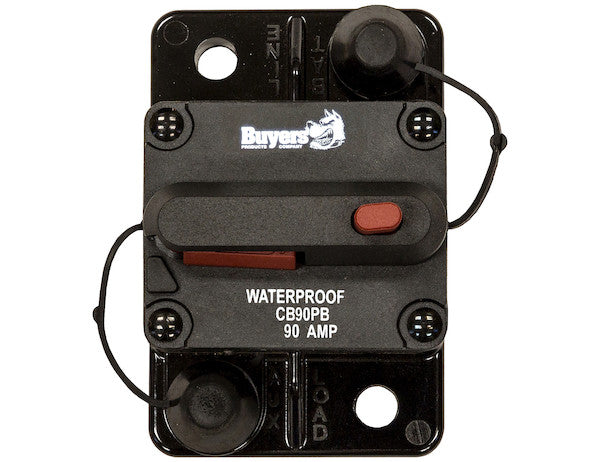
High-Amp Circuit Breakers with Manual Reset from Buyers Products helps protect auxiliary and accessory circuits on dump hoists, plows, spreaders, lift gates, and cranes. The manual reset, push-to-trip circuit breakers are water resistant and feature silver-plated studs, stainless steel nuts, and rubber boots. They are available in amperages ranging from 30A to 250A.
Specifications
| Box Material | Plastic |
|---|---|
| Color | Black |
| Connection | Stud |
| Connection Material | Brass |
| Finish | Plain |
| Length | 2.875 |
| Material | Plastic |
| Max Volts | 42.0 |
| Reset | Manual |
| Studs Material | Brass |
| Trip Current | 90 |
| Waterproof (y/n) | Yes |
| Width | 1.875 |
Technical Overview: 90 Amp Circuit Breaker with Manual Push-to-Trip Reset
The 90 Amp Circuit Breaker with Manual Push-to-Trip Reset from Buyers Products represents a critical component in ensuring the electrical integrity and operational safety of diverse heavy-duty vehicle and equipment applications. Engineered for robust performance in challenging environmental conditions, this high-amp circuit breaker is meticulously designed to provide reliable overcurrent protection for auxiliary and accessory circuits. Its technical specifications and design features underscore its suitability for demanding applications such as dump hoists, plows, spreaders, lift gates, and cranes, where electrical systems are frequently subjected to significant loads and potential fault conditions.
Core Functionality and Overcurrent Protection Principles
At its fundamental level, a circuit breaker serves as an automatic electrical switch designed to protect an electrical circuit from damage caused by overcurrent, typically resulting from an overload or short circuit. Unlike fuses, which are single-use devices, circuit breakers can be reset (either manually or automatically) to resume normal operation after a fault has been cleared. This 90 Amp model is specifically designed for DC (Direct Current) electrical systems, indicated by its 42.0 Max Volts rating, making it ideal for vehicular and heavy equipment applications where 12V, 24V, or 36V systems are prevalent.
The "Trip Current" of 90 Amps signifies the nominal current threshold at which the device is engineered to interrupt the circuit. When the current flowing through the circuit exceeds this 90A rating for a specified duration, the circuit breaker mechanism is activated. This typically involves a thermal tripping mechanism, where an internal bimetallic strip heats up due to the increased current. As the bimetallic strip heats, the two metals with different thermal expansion coefficients bend, physically actuating a latch that opens the electrical contacts and breaks the circuit. This prevents excessive current from damaging wiring, sensitive electronic components, and the power source itself, mitigating risks of overheating, fire, and equipment failure. In the context of "short circuit" protection, while primarily thermal, these breakers often possess an inherent capability to react quickly to extreme current spikes that characterize short circuits, rapidly opening the circuit before significant damage occurs.
Detailed Design and Material Specifications
Robust Enclosure and Dielectric Strength
The circuit breaker's housing is constructed from a high-quality, durable "Plastic" material, as indicated by both "Box Material" and "Material" specifications. This choice of material is critical for several reasons. Firstly, plastics offer excellent dielectric properties, meaning they are effective electrical insulators, preventing unintended current paths and ensuring the safety of personnel and adjacent components. Secondly, engineered plastics are inherently resistant to corrosion, a significant advantage over metallic enclosures, especially in outdoor or marine environments where exposure to moisture, road salt, and various chemicals is common. The "Black" color typically indicates the use of UV-stabilized polymers, enhancing resistance to degradation from prolonged exposure to sunlight, thereby extending the service life of the device.
Optimized Connection Interface
The "Connection" type is specified as "Stud," with the "Connection Material" and "Studs Material" both being "Brass." This selection is based on brass's excellent electrical conductivity and corrosion resistance. Furthermore, the initial description highlights "silver-plated studs." Silver plating over brass significantly enhances conductivity, reduces contact resistance, and provides an additional layer of corrosion protection. Low contact resistance is crucial for minimizing heat generation at the connection points, which can otherwise lead to premature failure or reduced efficiency. The inclusion of "stainless steel nuts" ensures secure, durable connections that are resistant to seizing and corrosion, providing consistent clamping force over time. "Rubber boots" further encapsulate and protect the stud connections, offering superior environmental sealing against moisture, dust, and contaminants, thereby preventing short circuits and galvanic corrosion at the terminals.
Environmental Durability: Waterproofing
The explicit "Waterproof (y/n): Yes" specification is a testament to the circuit breaker's suitability for harsh operating environments. This level of environmental ingress protection typically implies design features such as internal O-rings, sealed seams, and encapsulated components. For applications on dump hoists, plows, and other heavy equipment, exposure to rain, snow, road spray, and wash-down procedures is inevitable. A waterproof design ensures the internal electrical and mechanical mechanisms remain dry and functional, preventing corrosion of sensitive components, maintaining consistent electrical performance, and enhancing overall reliability and safety.
Manual Reset and Push-to-Trip Mechanism
A key operational feature of this circuit breaker is its "Manual Reset" capability, coupled with a "Push-to-Trip" function.
The "Manual Reset" mechanism requires human intervention to restore power after an overcurrent event. This design choice is deliberate and offers significant advantages over automatic reset breakers in many heavy-duty applications. With a manual reset, the operator is forced to investigate the cause of the trip before re-energizing the circuit. This critical diagnostic step prevents repeated tripping, which could exacerbate an underlying fault, cause further damage to the electrical system, or pose safety risks. For instance, if an accessory circuit is continuously drawing excessive current due to a short circuit in the load device, an automatic reset breaker would cycle on and off, potentially overheating wires or damaging the load, whereas a manual reset breaker would remain open until the fault is identified and rectified.
The "Push-to-Trip" feature provides an additional layer of functionality. This allows technicians or operators to intentionally trip the circuit breaker by physically pressing a button. This is invaluable for troubleshooting, maintenance, and system testing. For example, before performing maintenance on an auxiliary hydraulic pump circuit, a technician can use the push-to-trip button to safely de-energize that specific circuit without needing to disconnect power from the entire vehicle or system. This feature confirms the operational integrity of the tripping mechanism and isolates specific circuits for diagnostics or service, enhancing both safety and efficiency in maintenance procedures.
Voltage and Amperage Capacity: 90A, 42V Max
The "Trip Current" of 90 Amps indicates its robust capacity to protect circuits with high power demands. This amperage is significantly higher than typical automotive circuit protection and is tailored for heavy-duty accessory circuits that power large motors, hydraulic pumps, winches, and powerful lighting arrays. The selection of a 90A breaker requires careful consideration of the connected load's continuous operating current and its transient start-up currents to ensure it trips only under true fault conditions, not during normal, albeit high-current, operation.
The "Max Volts" rating of 42.0V clearly positions this breaker for DC applications, encompassing 12V, 24V, and 36V nominal systems. Many heavy-duty trucks, construction equipment, and specialized machinery operate on 24V DC systems, with some higher-end or hybrid systems occasionally employing 36V or 48V. The 42V rating provides a sufficient margin for typical system voltage fluctuations, ensuring reliable operation without being overstressed by transient voltage spikes that can occur in DC electrical environments, particularly during load switching or alternator operation. This DC voltage specification is critical, as AC circuit breakers are not suitable for DC applications due to fundamental differences in arc suppression requirements.
Applications in Heavy-Duty Environments
The specified applications—dump hoists, plows, spreaders, lift gates, and cranes—represent environments where electrical systems are subjected to extreme conditions and variable loads.
- Dump Hoists: These systems utilize powerful hydraulic pumps, often driven by high-current electric motors. A 90A breaker protects the motor circuit from overloads during heavy lifting, or from short circuits that could arise from hydraulic fluid leaks impacting electrical components.
- Plows and Spreaders: Electrical systems for snowplows and salt/sand spreaders power motors for blade articulation, material dispersal, and auxiliary lighting. These components can draw significant current, especially when operating under resistance (e.g., plowing heavy snow or spreading dense material). The breaker ensures continuous operation while safeguarding against motor stalls or wiring damage.
- Lift Gates: Electric motors for lift gates experience high inrush currents upon startup and sustained high currents during lifting operations. The 90A breaker provides critical protection for the motor, relays, and wiring harness, preventing thermal damage from sustained overloads or sudden jams.
- Cranes: Mobile and truck-mounted cranes feature complex electrical systems controlling hydraulic pumps, winches, control systems, and safety interlocks. Protecting these circuits with high-amp breakers like the 90A unit is vital for operational safety and equipment longevity, particularly given the high stresses and dynamic loads inherent in crane operation.
In all these applications, the combination of high amperage, manual reset, and water resistance ensures that the critical auxiliary and accessory circuits are reliably protected against fault conditions while maintaining operational continuity and facilitating safe troubleshooting.
Installation and Maintenance Considerations
Proper installation is paramount for the optimal performance and longevity of the 90 Amp Circuit Breaker. Given its "Stud" connection type, the following considerations are essential:
- Wire Sizing: Conductors connected to a 90A circuit breaker must be appropriately sized (AWG gauge) to safely carry 90 Amps continuously, plus a safety margin, according to applicable electrical codes (e.g., SAE J1127 or NFPA 79). Undersized wires will overheat and create a fire hazard even before the breaker trips.
- Torque Specifications: The stainless steel nuts on the silver-plated brass studs must be tightened to the manufacturer's recommended torque specifications. Overtightening can damage the studs or internal connections, while undertightening can lead to high resistance connections, causing localized heating and potential failure.
- Mounting: The circuit breaker should be securely mounted in a location that is accessible for manual resetting and inspection, yet protected from direct mechanical impact. Its waterproof design allows for exterior mounting, but strategic placement can further enhance its service life.
- Polarity: While many thermal circuit breakers are not inherently polarity sensitive, it is best practice to follow consistent wiring conventions (e.g., positive in, protected load out) for ease of troubleshooting and system integrity.
Routine maintenance should include periodic visual inspections for signs of physical damage, corrosion, or degradation of the rubber boots. The push-to-trip function can be periodically tested to confirm its operability, especially in critical safety systems.
Benefits and System Integration
The integration of the 90 Amp Circuit Breaker into an electrical system provides several key benefits:
- Enhanced Safety: By promptly interrupting overcurrents, the breaker prevents wiring from overheating, reduces the risk of electrical fires, and protects operators from potential electrical hazards.
- Equipment Protection: Safeguards expensive motors, pumps, and control modules from damage caused by electrical faults, extending the service life of critical components.
- Diagnostic Capability: The manual reset and push-to-trip features aid in troubleshooting by allowing controlled isolation of circuits and requiring human intervention to address underlying issues.
- Durability and Reliability: Constructed with robust materials (plastic housing, brass/silver-plated studs, stainless steel nuts) and designed for waterproofing, it offers high reliability and extended service life in harsh operational environments.
- Operational Efficiency: Unlike fuses that require replacement, this resettable breaker minimizes downtime. After a fault is cleared, the circuit can be quickly re-energized by a simple manual reset, allowing equipment to return to service promptly.
This circuit breaker is not merely a component; it is an integral part of a comprehensive electrical safety and management system for heavy-duty equipment. Its design reflects a thorough understanding of the challenges faced in these applications, prioritizing both protection and operational continuity.
Conclusion
The 90 Amp Circuit Breaker With Manual Push-to-Trip Reset from Buyers Products stands as a testament to engineering excellence in overcurrent protection for demanding DC electrical systems. Its precise amperage rating, robust 42V max voltage capacity, and specialized manual reset with push-to-trip functionality provide superior protection and diagnostic utility. Crafted with high-quality plastic housing, silver-plated brass studs secured by stainless steel nuts, and enhanced with protective rubber boots and comprehensive waterproofing, this device is built for maximum resilience against environmental ingress and mechanical stress. Designed to meet the rigorous demands of applications such as dump hoists, plows, spreaders, lift gates, and cranes, it offers unparalleled reliability, safety, and operational efficiency, thereby minimizing downtime and extending the service life of critical auxiliary and accessory circuits. Investing in such a high-caliber circuit breaker is not just about compliance, but about ensuring the enduring performance and safety of heavy-duty vehicular and industrial equipment.