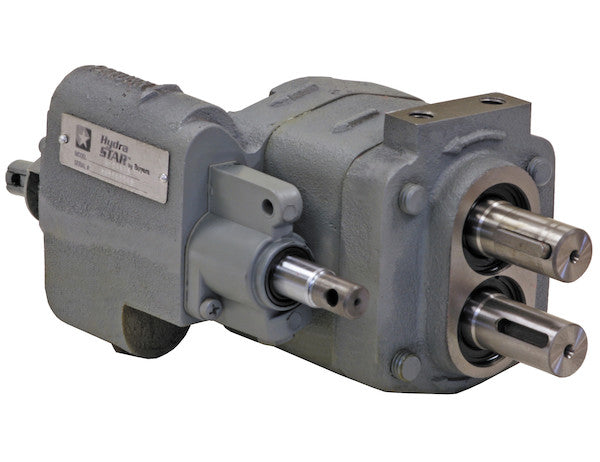
The Remote Mount Small Dump Pump - Air Controlled from Buyers Products is a compact source of hydraulic power ideal for smaller dump applications. Choose from two models for the GPM flow that meets your needs. The pump includes a 4 bolt SAE mounting flange and 7/8 in. by 13 spline shaft, and third line sleeve. Air controls sold separately.
Specifications
| Direct Mount/Remote Mount | Remote |
|---|---|
| Direct or Remote Mount | Remote Mount |
| Displacement | 2 |
| Flow | 11 |
| Flow at 1000 RPM | 11.7 |
| Flow at 1200 RPM | 14.04 |
| Flow at 1500 RPM | 16.76 |
| Flow at 1800 RPM | 21 |
| Flow at 2100 RPM | 24.57 |
| Flow at 600 RPM | 7.00 |
| Flow at 900 RPM | 10.44 |
| Gear Size | 1.50 |
| Gear Width | 1.500 |
| Inlet Port Size | 1 1/4 NPT |
| Input Mount Type | Frame Mount |
| Material | Cast Iron |
| Maximum Pressure | 2500 |
| Maximum Rotations Per Minute (RPM) | 2000 |
| Mount Type | Frame Mount |
| Outlet Port Size | 3/4 NPT |
| Pilot Diameter | - |
| Ports (rear/side) | Rear |
| Rear Port Size | 3/4 NPT |
| Rotation | Clockwise or Counterclockwise |
| Shaft Size | 1 |
| Shaft Type | Round/Keyed |
| Suction Port Size | 1 1/4 NPT |
The Remote Mount Hydraulic Pump with Manual Valve and 1-1/2 Inch Diameter Gear represents a robust and versatile solution for various mobile hydraulic applications, particularly excelling in small to medium-duty dump systems. This meticulously engineered pump is designed to deliver consistent, reliable hydraulic power, offering operators precise control through an integrated manual valve. Its remote mount configuration provides significant installation flexibility, allowing for optimal placement within the vehicle chassis, separated from the power take-off (PTO) or direct drive, thereby mitigating heat and vibration concerns and enhancing accessibility for maintenance. The core of its performance lies in its durable construction and the efficient design of its 1-1/2 inch diameter gear set, ensuring efficient fluid displacement and pressure generation for demanding tasks.
Fundamental Principles of Hydraulic Power and Gear Pump Mechanics
Hydraulic systems are foundational to modern mobile equipment, enabling the transmission of substantial power through incompressible fluids. This Remote Mount Hydraulic Pump operates on the principle of an external gear pump, a positive displacement design renowned for its simplicity, efficiency, and reliability. At its heart, two precisely machined gears—a drive gear and an idler gear—mesh within a closely fitted housing. As these gears rotate, they create expanding cavities on the suction side, drawing hydraulic fluid from the reservoir into the pump. The fluid is then trapped between the gear teeth and the pump casing, carried around the periphery of the gears, and forced out through the discharge port as the gear teeth re-mesh on the outlet side. This continuous action creates a steady flow of high-pressure fluid, capable of actuating hydraulic cylinders or motors.
The inherent advantages of an external gear pump, such as its robust construction, tolerance to fluid contamination compared to more complex pump types, and its consistent flow rate independent of system pressure, make it an ideal choice for the rugged environments encountered in dump applications. The specific 1-1/2 inch diameter (and width) gear featured in this unit is optimized for balancing volumetric efficiency with pressure capability, ensuring that a significant volume of fluid is displaced per revolution while maintaining the structural integrity required to withstand pressures up to 2500 PSI. The design minimizes internal leakage, known as "slip," thereby maximizing the pump's overall efficiency and translating more input power into useful hydraulic work.
Detailed Analysis of Key Technical Specifications and Design Elements
Remote Mounting Architecture: Enhanced Flexibility and Durability
The "Remote Mount" designation is a critical feature offering distinct advantages over direct-mount pump configurations. Unlike pumps that attach directly to a PTO or engine, a remote mount pump can be positioned elsewhere on the vehicle's frame or chassis (specified as "Frame Mount" Input Type), connected to the power source via a drive shaft. This design affords significant flexibility in system layout, enabling engineers to optimize weight distribution, simplify plumbing runs, and improve accessibility for routine inspections and maintenance. Furthermore, remote mounting isolates the pump from direct engine vibrations and heat, extending its operational life and reducing wear on critical components. This isolation also contributes to a quieter system operation by dampening noise transmission. The robust "Cast Iron" material further enhances its suitability for remote, frame-mounted applications where exposure to environmental elements and mechanical stresses is common.
Precise Displacement and Volumetric Efficiency
With a nominal displacement of 2 cubic inches per revolution, this hydraulic pump is engineered to deliver a substantial volume of fluid with each rotation of its gears. Displacement is a fundamental metric, defining the theoretical volume of fluid moved by the pump in a single cycle. In practical terms, this displacement, coupled with the input RPM, directly determines the pump's flow rate. While theoretical flow is a simple calculation (displacement x RPM), actual flow is influenced by volumetric efficiency, which accounts for internal leakage or "slip." The design of this pump aims to minimize slip, ensuring that a high percentage of the theoretically displaced fluid is delivered to the hydraulic system. This efficiency is crucial for rapid response and optimal performance in applications requiring quick and powerful movements, such as raising and lowering a dump bed.
Optimized Flow Rate Characteristics Across Operating RPMs
The provided flow rate specifications illustrate the pump's performance across a broad operational range, crucial for matching the pump to diverse application requirements.
- Flow at 600 RPM: 7.00 GPM - Ideal for precise, slower movements or when lower power demand is present.
- Flow at 900 RPM: 10.44 GPM - A moderate flow rate suitable for many light to medium-duty tasks.
- Flow at 1000 RPM: 11.7 GPM - Approaching the average operating speed for many truck-mounted applications.
- Flow at 1200 RPM: 14.04 GPM - Offers a good balance of speed and power for general dump operations.
- Flow at 1500 RPM: 16.76 GPM - Provides robust flow for faster cycle times in more demanding tasks.
- Flow at 1800 RPM: 21 GPM - Nearing peak performance, suitable for applications requiring rapid movement.
- Flow at 2100 RPM: 24.57 GPM - Demonstrates the pump's capacity for high-speed operation, though it's important to note the maximum recommended RPM is 2000. Operating consistently at 2100 RPM might exceed the continuous duty rating.
This range of flow rates allows for careful selection based on the required speed of hydraulic actuators (e.g., dump cylinder extension/retraction time). The linear relationship between RPM and flow is characteristic of a positive displacement pump, enabling predictable system response. The "Flow" specification of 11 GPM typically refers to a nominal or rated flow at a standard operating RPM, likely around 1000 RPM based on the detailed table, providing a quick reference point for comparison.
Precision-Engineered Gear Set: 1-1/2 Inch Diameter and Width
The heart of this hydraulic pump is its 1-1/2 inch diameter and width gear set. These dimensions are not arbitrary; they are meticulously chosen to optimize the pump's performance envelope. The size of the gears directly correlates to the pump's displacement per revolution. Larger gears (in terms of diameter and width) generally allow for greater fluid displacement, which translates to higher flow rates at a given RPM, assuming all other factors are constant. However, larger gears also require more robust housings and can increase the overall footprint of the pump. The 1-1/2 inch sizing represents a carefully balanced design, providing efficient volumetric flow suitable for small dump applications without making the pump overly large or heavy.
Furthermore, the precision manufacturing of these gears is paramount. The tight tolerances between the gear teeth and the pump housing are critical for maintaining high volumetric efficiency and preventing internal leakage. High-precision gears also contribute to reduced noise levels and extended operational life by minimizing wear and friction. The material selection for the gears themselves (typically hardened steel) ensures resilience against the high-pressure forces and continuous meshing action.
Robust Pressure Capability: 2500 PSI Maximum Operating Pressure
The capability to generate and sustain a maximum pressure of 2500 PSI (Pounds per Square Inch) is a significant technical attribute of this hydraulic pump. This pressure rating dictates the maximum force that can be exerted by the hydraulic system, directly influencing the lifting capacity of a dump cylinder or the torque output of a hydraulic motor. For small dump applications, 2500 PSI is ample to handle a wide range of loads, ensuring that dump beds can be raised and lowered efficiently even when fully loaded.
System design must account for this maximum pressure, typically incorporating a pressure relief valve to prevent over-pressurization and protect the pump and other system components from damage. The structural integrity of the cast iron housing and the precise design of the gear set are fundamental to safely achieving and maintaining this pressure rating over the pump's lifespan. This robust pressure capability underlines the pump's suitability for demanding continuous-duty cycles in commercial and industrial settings.
Optimized Porting for Seamless System Integration
Proper port sizing and configuration are essential for the efficient operation of any hydraulic system. This pump features a 1-1/4 NPT (National Pipe Taper) inlet/suction port and a 3/4 NPT outlet/rear port.
- Inlet Port (1-1/4 NPT): A larger inlet port is crucial for minimizing pressure drop on the suction side, which helps prevent cavitation. Cavitation occurs when insufficient fluid supply pressure causes vapor bubbles to form and then collapse, leading to pump damage and reduced efficiency. The 1-1/4 NPT size ensures adequate fluid flow from the reservoir to the pump, particularly important given the potential flow rates this pump can achieve.
- Outlet Port (3/4 NPT): The smaller outlet port creates the necessary restriction to build pressure in the system, while still being sized appropriately for the pump's maximum flow rate without creating excessive backpressure. The "Rear" porting configuration is often preferred for compact installations, allowing hoses to be routed neatly along the vehicle's chassis, reducing the overall footprint and protecting connections from external damage.
NPT threads are a common standard in North American hydraulic applications, providing a reliable, leak-free connection when properly sealed.
Robust Drive Shaft and Mounting Standard: SAE 4-Bolt Flange & 7/8 in. by 13 Spline Shaft
The drive interface of this pump adheres to industry-standard specifications, ensuring broad compatibility and robust power transmission.
- SAE 4-Bolt Mounting Flange: This is a widely recognized and utilized standard for hydraulic pump mounting (likely an SAE A or B pad, given the typical size of dump pumps). The 4-bolt pattern provides a secure and stable connection to the power take-off (PTO) shaft or a compatible gearbox, ensuring precise alignment and minimizing stress on the drive shaft.
- 7/8 in. by 13 Spline Shaft: A spline shaft is superior to a keyed shaft for transmitting high torque loads, as it distributes the load more evenly across multiple contact points, reducing stress concentrations and wear. The 7/8 inch diameter and 13-spline configuration provide a strong, reliable connection from the power source to the pump's internal gears.
- Third Line Sleeve: This feature is often indicative of a shaft seal drain line. Its purpose is to capture any minor internal leakage past the main shaft seal and direct it back to the reservoir, preventing external oil leaks and protecting the shaft seal by relieving pressure on it. This enhances the longevity and cleanliness of the pump's operation.
The "Shaft Type" being "Round/Keyed" in the specifications might be a generic descriptor, but the specific "7/8 in. by 13 spline shaft" is the more precise and beneficial detail, implying a more robust connection than a simple keyed round shaft for this duty cycle. The "Shaft Size" of 1" likely refers to the overall shaft diameter *at the mounting point* for certain compatibility, while the spline diameter is 7/8".
Construction Material: Durable Cast Iron Housing
The choice of "Cast Iron" as the primary material for the pump's housing is a deliberate engineering decision based on its superior material properties. Cast iron offers an exceptional combination of strength, rigidity, and vibration damping characteristics.
- Strength and Rigidity: It provides a robust enclosure that can withstand the high internal pressures (2500 PSI) and external mechanical stresses inherent in mobile applications. Its inherent stiffness minimizes distortion under load, ensuring the precise alignment of internal components.
- Vibration Damping: Cast iron has excellent natural vibration damping properties, which helps to reduce noise levels during operation and minimize the transmission of harmful vibrations to other vehicle components.
- Heat Dissipation: The material's thermal conductivity aids in dissipating heat generated during operation, contributing to cooler running temperatures and extending the life of hydraulic fluid and internal seals.
- Durability: Cast iron is highly resistant to wear and corrosion, ensuring long-term reliability even in harsh operating environments where exposure to dirt, moisture, and temperature fluctuations is common.
This material selection ensures the pump's longevity and consistent performance under demanding conditions.
Bi-directional Rotation for Enhanced Versatility
The pump's capacity for "Clockwise or Counterclockwise" rotation is a critical feature that significantly enhances its versatility. This means the pump can be driven by a power source rotating in either direction, simplifying installation and reducing the need for specific drive configurations. In systems where the PTO or drive shaft's direction of rotation might vary or where a single pump needs to be compatible with multiple vehicle platforms, this bi-directional capability offers considerable flexibility. It also simplifies inventory management for distributors and service centers, as a single pump model can serve a wider range of applications.
Integrated Manual Control Valve for Direct and Precise Operation
While the pump itself offers robust hydraulic power, the "Manual Valve" specified in the product title is the critical interface for operator control. This integrated or closely coupled manual control valve provides direct, tactile command over the hydraulic functions of the dump application. Unlike air-controlled systems (as mentioned in the original description, for which this pump is also compatible), a manual valve offers several distinct advantages for operators:
- Direct Response: Manual valves provide immediate hydraulic response, with no lag introduced by pneumatic signals or electrical solenoids. This direct mechanical linkage between the operator's input and the valve's spool movement translates to precise control over the speed and direction of the dump bed's movement.
- Tactile Feedback: Operators receive direct tactile feedback through the lever, allowing for intuitive operation and fine adjustments, which is particularly beneficial when feathering a load or executing delicate maneuvers.
- Simplicity and Reliability: Manual valves are inherently simpler in design compared to electro-hydraulic or air-hydraulic systems. This reduces the number of potential failure points, contributing to greater reliability in rugged environments where complex electronics or pneumatic lines might be susceptible to damage.
- Independence from Auxiliary Power: A manual valve does not require an external electrical or pneumatic power source for its operation (beyond the pump's own drive). This simplifies system design and reduces reliance on additional components.
- Common Dump System Functionality: Typically, a manual dump valve will feature detented positions for "Raise" and "Lower," with a "Hold" or "Neutral" position. Many include an adjustable relief valve to protect the system from overpressure, often set to match the pump's 2500 PSI capability or the cylinder's working pressure.
For operators who prioritize direct, unmediated control and for applications where simplicity and reliability are paramount, the manual valve integration is an indispensable feature, offering robust performance with straightforward operation.
Applications and Performance in Small-Scale Dump Operations
The Remote Mount Hydraulic Pump with Manual Valve is ideally suited for a diverse array of small to medium-duty dump applications where reliable lifting and lowering capabilities are required. Its compact size, robust construction, and specific flow/pressure characteristics make it a prime choice for:
- Light-Duty Dump Trucks: Perfect for landscapers, construction contractors, and utility companies utilizing trucks with smaller dump beds for aggregates, soil, debris, or tools.
- Utility Vehicles and Trailers: Enhancing the functionality of utility vehicles, agricultural trailers, and small equipment transporters with tilting beds.
- Tow Truck Tilt Beds: Providing the necessary hydraulic power for the tilting and lowering functions of smaller tow truck beds.
- Agricultural Equipment: Powering hydraulic functions on compact tractors and implements requiring controlled lifting and lowering.
The pump's consistent flow rates across its RPM range ensure that dump beds can be raised swiftly and smoothly, while the 2500 PSI maximum pressure capacity provides ample power to lift even heavy loads within its intended application scope. The integration of a manual valve further enhances its utility in these scenarios by giving the operator direct and immediate control over the hydraulic action, crucial for precision tasks and safety.
Holistic System Design and Operational Best Practices
To maximize the performance, longevity, and safety of any hydraulic system incorporating this remote mount pump, several critical design and operational best practices must be observed.
- Hydraulic Fluid Selection and Management: The choice of hydraulic fluid is paramount. It must meet OEM specifications, possess the correct viscosity for the operating temperature range, and contain appropriate additives for anti-wear, anti-foaming, and corrosion protection. Maintaining fluid cleanliness through regular filtration and replacement is the single most important factor in extending the life of hydraulic components.
- Filtration Systems: A robust filtration system, typically including suction filters, pressure filters, and return line filters, is essential to protect the pump and downstream components from contamination. Particle ingress is the leading cause of hydraulic component wear and failure.
- Reservoir Design and Sizing: The hydraulic reservoir must be adequately sized to hold enough fluid for all system actuators, allow for proper heat dissipation, facilitate air separation, and permit contaminants to settle. Proper baffling and breather filters are also crucial.
- Hosing and Fittings: All hydraulic hoses and fittings must be correctly rated for the maximum system pressure (2500 PSI), flow, and temperature. Hoses should be routed to minimize bends and prevent chafing, and fittings must be installed correctly to prevent leaks.
- Power Take-Off (PTO) Integration: If driven by a PTO, ensure that the PTO is correctly matched to the pump's input shaft and mounting flange, and that it can provide the necessary torque and speed without over-stressing the pump.
- Preventative Maintenance Schedule: Regular inspections, fluid level checks, filter changes, and leak detection are vital to maintaining optimal system performance and preventing costly breakdowns. Monitoring operating temperature and noise levels can also provide early indications of potential issues.
Conclusion: A Robust and Reliable Hydraulic Solution
The Remote Mount Hydraulic Pump with Manual Valve and 1-1/2 Inch Diameter Gear is a meticulously engineered component designed to deliver superior hydraulic performance and control for small to medium-duty dump applications. Its remote mount configuration provides unmatched installation flexibility, while the robust cast iron construction ensures durability and longevity in challenging environments. With a precise 2 cubic inch displacement and impressive flow rates across its operating RPMs, coupled with a formidable 2500 PSI pressure capability, this pump stands ready to power the most demanding tasks. The integral manual valve offers operators direct, reliable, and intuitive control, enhancing both precision and safety. Backed by industry-standard mounting and drive interfaces, and built with an emphasis on technical excellence, this hydraulic pump represents an intelligent investment for systems requiring dependable, high-performance hydraulic power. Its blend of power, control, and ruggedness makes it an essential component for efficient and effective mobile hydraulic operations.