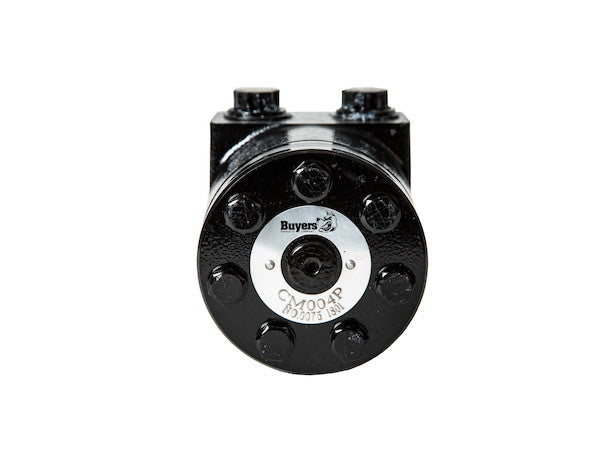
Hydraulic Motors from Buyers Products are designed to be economical, efficient, compact and powerful. They are a great solution for powering medium-duty applications like compressors, augers, winches, cranes, and spreaders. The motors have an industry-proven spool valve design combined with state-of-the-art gerotors. They excel at jobs that need a high degree of start-up torque or just the right mixture of torque and flow rate. Choose from a wide range of motors depending on your needs for flow rates, torque and starting torque. Each model is available with either a 2-bolt or 4-bolt mount. The last digit of the part number (2 or 4) will indicate the number of bolts.
Specifications
| Compares To | 101-1001-009 |
|---|---|
| Displacement | 3.1 |
| Flow (Continuous) | 12 |
| Flow (Intermittent) | 14 |
| Input Mount Type | 4 Bolt |
| Material | Cast Iron |
| Maximum Case Pressure (Without Case Drain) | 1500 |
| Maximum Speed (Continuous) | 969 |
| Maximum Speed at Continuous Flow | 969 |
| Maximum Speed at Intermittent Flow | 1130 |
| Minimum Starting Torque (Continuous Pressure) | 520 |
| Minimum Starting Torque (Intermittent Pressure) | 720 |
| Pilot Diameter | 1.75 |
| Port Size | 1/2 NPT |
| Pressure ? Bar (Continuous) | 1800 |
| Pressure ? Bar (Intermittent) | 2400 |
| Shaft Keyway | 0.25 |
| Shaft Size | 1.00 |
| Shaft Type | Straight |
| Torque Rating (Continuous) | 650 |
| Torque Rating (Intermittent) | 720 |
Advanced Technical Overview: Replacement Hydraulic 4-Bolt Spinner Motor for SaltDogg® Spreaders
This comprehensive technical description elaborates on the Replacement Hydraulic 4-Bolt Spinner Motor, specifically engineered for SaltDogg® Spreaders, a product proudly offered by Buyers Products. Drawing upon decades of hydraulic engineering expertise, this motor represents a pinnacle of design, material science, and operational efficiency, tailored for the demanding conditions inherent in commercial spreading applications.
Understanding Hydraulic Motor Fundamentals
At its core, a hydraulic motor serves as a transducer, converting hydraulic energy (fluid flow and pressure) into mechanical rotational energy (torque and speed). This conversion is achieved through a controlled displacement mechanism. In the context of this Buyers Products motor, the synergy of an industry-proven spool valve design with state-of-the-art gerotors forms the foundation of its exceptional performance. The gerotor (GEnerated ROTOR) concept, a positive displacement design, is particularly adept at generating high torque at low speeds, which is a critical requirement for applications such as powering spreader spinner discs.
The spool valve mechanism effectively controls the direction and flow of hydraulic fluid into and out of the gerotor chambers. As fluid enters, it causes the inner gerotor gear to orbit and rotate within the outer gear, creating a continuous rotational output at the motor shaft. This design offers several distinct advantages:
- High Volumetric Efficiency: The tight tolerances and sealing characteristics of the gerotor design minimize internal leakage, ensuring that a maximal portion of the input fluid flow contributes directly to shaft rotation.
- Robust Starting Torque: Unlike some other motor types, the gerotor design inherently provides excellent torque output from a standstill, enabling the motor to overcome significant static friction and inertia, particularly crucial when initiating the spreading of dense materials.
- Smooth Operation: The continuous engagement of the gerotor elements results in very low torque ripple, leading to smooth and consistent rotation of the spinner disc, which is essential for uniform material distribution.
- Compact Design: The internal geometry of the gerotor allows for a high power-to-weight ratio, contributing to the motor's overall compact footprint without sacrificing performance.
Engineered for Demanding Spreading Applications: The SaltDogg® Advantage
SaltDogg® spreaders are renowned for their ruggedness and reliability in municipal and commercial snow and ice management. The spinner motor is a vital component in these systems, directly responsible for the consistent and effective dispersal of various granular materials—from road salt and sand to specialized de-icing agents. The operational environment for these motors is inherently harsh, characterized by:
- Extreme Temperatures: Functioning reliably in sub-zero conditions, where hydraulic fluid viscosity increases and material properties are tested.
- Corrosive Agents: Constant exposure to salt, chemicals, and moisture necessitates superior material selection and sealing.
- Variable Loads: The motor must handle the inertial resistance of the spinner disc itself, the weight of the material being spread, and potential clogging or inconsistent material flow.
- Intermittent Heavy Duty Cycles: Frequent start-stop operations and sudden changes in load require a motor with exceptional transient response and robust durability.
This replacement hydraulic motor addresses these challenges directly through its optimized design and construction. Its ability to provide a high degree of start-up torque, coupled with the precise mixture of torque and flow rate, ensures that SaltDogg® spreaders maintain optimal performance even under the most adverse conditions. The 4-bolt mount, a defining feature, provides a secure and robust connection to the spreader assembly, minimizing vibration and enhancing overall structural integrity, critical for sustained operation in rugged environments.
In-Depth Analysis of Key Specifications
The detailed specifications provided are not merely numbers; they represent the meticulously engineered performance parameters that define this hydraulic motor’s capabilities and suitability for its intended application:
Compares To: 101-1001-009
This cross-reference number signifies that this Buyers Products motor is engineered to meet or exceed the performance and dimensional specifications of a recognized industry standard or original equipment manufacturer (OEM) part. This ensures seamless interchangeability and reliability for maintenance and replacement purposes, allowing operators to confidently upgrade or replace components without compatibility concerns.
Displacement: 3.1 cubic inches/revolution (cu. in./rev)
Displacement is a fundamental characteristic of any hydraulic motor, representing the theoretical volume of hydraulic fluid required to rotate the motor shaft one complete revolution. A displacement of 3.1 cu. in./rev indicates a motor well-suited for medium-duty applications where a balance between speed and torque is desired. Higher displacement motors typically provide more torque at lower speeds, while lower displacement motors achieve higher speeds for a given flow rate. This specific displacement is optimized for the rotational speed and torque required to effectively spin a spreader disc, ensuring even material distribution without excessive power consumption.
Flow (Continuous): 12 GPM (Gallons Per Minute)
Flow (Intermittent): 14 GPM
Flow rate dictates the maximum speed at which the motor can continuously or intermittently operate.
- Continuous Flow (12 GPM): This is the maximum flow rate at which the motor can operate indefinitely without overheating or experiencing premature wear. It defines the sustained operational capacity.
- Intermittent Flow (14 GPM): This higher flow rate can be tolerated for shorter, specified durations. It allows for bursts of higher speed or power when momentary demands exceed continuous ratings, such as during initial start-up with a full load or when quickly adjusting spreading width. Operating above continuous ratings for extended periods can reduce the motor’s lifespan.
Input Mount Type: 4 Bolt
The 4-bolt input mount is a crucial mechanical interface. It ensures a robust, secure, and precisely aligned connection between the hydraulic motor and the SaltDogg® spreader frame or gearbox. Compared to 2-bolt mounts, a 4-bolt configuration provides enhanced stability, greater resistance to torsional stress, and superior vibration dampening. This is particularly vital in applications involving rotating masses and continuous vibration, safeguarding both the motor and the driven equipment from premature wear and structural fatigue. The precise pilot diameter further ensures correct concentricity during installation.
Material: Cast Iron
The motor housing is constructed from high-grade cast iron. Cast iron is an exemplary material choice for hydraulic components due to its:
- High Strength and Rigidity: Provides excellent structural integrity to withstand internal hydraulic pressures and external mechanical stresses.
- Vibration Dampening Properties: Cast iron inherently absorbs and dissipates vibrations more effectively than other metals, contributing to smoother operation and reduced noise.
- Wear Resistance: Offers superior resistance to abrasive wear, crucial for components subject to moving parts and demanding environments.
- Corrosion Resistance: While not impervious, cast iron provides a good level of resistance to the corrosive agents encountered in winter spreading operations, especially when properly surface treated.
Maximum Case Pressure (Without Case Drain): 1500 psi
Case pressure refers to the pressure within the motor’s internal housing, which surrounds the rotating components and seals. This specification indicates that the motor is designed to operate safely with up to 1500 psi of internal case pressure without the need for an external case drain line. A case drain line is typically used to relieve internal leakage back to the reservoir, preventing pressure buildup that could damage shaft seals. The ability to operate without a case drain simplifies hydraulic system plumbing and installation, making it more robust and less prone to leakage points, while still maintaining seal integrity under typical operating conditions for this motor.
Maximum Speed (Continuous): 969 RPM
Maximum Speed at Continuous Flow: 969 RPM
Maximum Speed at Intermittent Flow: 1130 RPM
These specifications define the rotational velocity of the motor shaft.
- Continuous Speed (969 RPM): The maximum speed at which the motor can operate continuously without exceeding thermal or mechanical stress limits. This speed, derived from the continuous flow rate (12 GPM) and displacement (3.1 cu. in./rev), ensures consistent spreading.
- Intermittent Speed (1130 RPM): The higher speed achievable for short durations using the intermittent flow rate (14 GPM). This provides a temporary boost in spinner speed, useful for clearing clogs or achieving wider spread patterns for brief periods.
Minimum Starting Torque (Continuous Pressure): 520 in-lbs
Minimum Starting Torque (Intermittent Pressure): 720 in-lbs
Starting torque is a critical parameter, particularly for applications involving high static loads, such as a spreader disc laden with heavy, compacted material.
- Continuous Pressure (520 in-lbs): This is the guaranteed minimum torque the motor can generate at rest when supplied with its continuous rated pressure.
- Intermittent Pressure (720 in-lbs): When operating at the intermittent pressure rating, the motor can produce an even higher starting torque, essential for overcoming the initial inertia of heavily loaded spinner discs or when starting in extremely cold conditions where material may be stiff.
Pilot Diameter: 1.75 inches
The pilot diameter refers to the precisely machined cylindrical protrusion on the motor’s mounting flange that fits into a corresponding bore on the driven equipment. A 1.75-inch pilot diameter ensures precise concentric alignment between the motor shaft and the driven component (e.g., the spinner shaft or gearbox input). This accurate alignment is vital for minimizing vibration, reducing stress on bearings and seals, and prolonging the lifespan of both the motor and the spreader assembly.
Port Size: 1/2 NPT
The 1/2 NPT (National Pipe Taper) port size specifies the threading for the hydraulic fluid inlet and outlet connections. NPT is a widely recognized standard, ensuring compatibility with standard hydraulic fittings and hoses. The 1/2-inch size is appropriately selected to handle the specified flow rates (12-14 GPM) without introducing excessive pressure drop or fluid velocity, thereby maintaining system efficiency and minimizing cavitation risk. Proper hose sizing and routing are still essential to fully leverage this port design.
Pressure – Bar (Continuous): 1800 psi (approx. 124 Bar)
Pressure – Bar (Intermittent): 2400 psi (approx. 165 Bar)
Pressure is the force exerted by the hydraulic fluid, directly correlating to the torque output of the motor.
- Continuous Pressure (1800 psi / 124 Bar): The maximum pressure at which the motor can operate continuously and reliably without degradation. This pressure, in conjunction with the motor's displacement, determines its continuous torque output.
- Intermittent Pressure (2400 psi / 165 Bar): This higher pressure can be tolerated for short durations, allowing the motor to generate increased torque for demanding tasks or during peak load conditions.
Shaft Keyway: 0.25 inches (1/4 inch)
The 0.25-inch keyway is a precisely machined slot in the motor shaft. It accommodates a standard parallel key, which transmits rotational torque from the motor shaft to the driven component’s hub (e.g., a coupling or the spinner assembly itself). This positive drive mechanism is essential for reliably transferring power without slippage, especially under varying loads and high torque conditions.
Shaft Size: 1.00 inches
The 1.00-inch diameter straight shaft provides a robust and strong output interface. This size is engineered to withstand the torsional and bending stresses associated with driving a spreader spinner, ensuring reliable power transmission. A straight shaft, as opposed to a splined or tapered shaft, is commonly used with couplings that rely on a keyway and set screw, offering a straightforward and durable connection for many industrial and mobile applications.
Shaft Type: Straight
A straight shaft design, paired with the specified keyway, is a common and highly effective method for transmitting torque. Its simplicity contributes to ease of manufacturing and robust performance. While other shaft types like splined or tapered offer specific advantages in certain scenarios, the straight shaft with keyway is proven reliable for the demands of spreader applications, offering good balance of cost, strength, and ease of coupling.
Torque Rating (Continuous): 650 in-lbs
Torque Rating (Intermittent): 720 in-lbs
Torque is the rotational force produced by the motor, directly responsible for spinning the spreader disc.
- Continuous Torque (650 in-lbs): This is the maximum torque the motor can consistently produce during extended operation. It is derived from the continuous pressure and displacement and reflects the motor's sustained work capacity.
- Intermittent Torque (720 in-lbs): The higher torque available for short periods, leveraging the intermittent pressure rating. This additional torque capacity is invaluable for moments requiring extra power, such as overcoming momentary resistance or operating with exceptionally dense materials.
Operational Efficiency and Longevity
The design philosophy behind this Buyers Products hydraulic motor extends beyond mere power delivery; it encompasses overall operational efficiency and an extended service life. The selection of robust cast iron, coupled with high-precision manufacturing of the gerotor and spool valve components, minimizes wear and tear, even under continuous heavy use. Furthermore, the inherent efficiency of the gerotor design translates into less wasted energy (heat) and more effective power delivery to the spinner, contributing to fuel economy and reduced operational costs for the SaltDogg® spreader.
Proper maintenance of the hydraulic system, including regular fluid checks, filtration, and adherence to manufacturer-recommended service intervals, will further maximize the longevity and performance of this motor. The ease of interchangeability, signified by the "Compares To" specification, also simplifies future maintenance, reducing downtime and overall cost of ownership.
Conclusion
The Replacement Hydraulic 4-Bolt Spinner Motor from Buyers Products is more than just a component; it is a precisely engineered solution for the rigorous demands of SaltDogg® spreader operations. Its robust construction, high starting torque, efficient gerotor design, and carefully balanced flow and pressure ratings make it an ideal choice for ensuring consistent, reliable, and powerful material spreading. By selecting this motor, operators benefit from a product that embodies technical excellence, provides seamless compatibility, and delivers uncompromised performance and durability in the most challenging winter conditions, ultimately enhancing the operational effectiveness and longevity of their SaltDogg® spreading equipment.