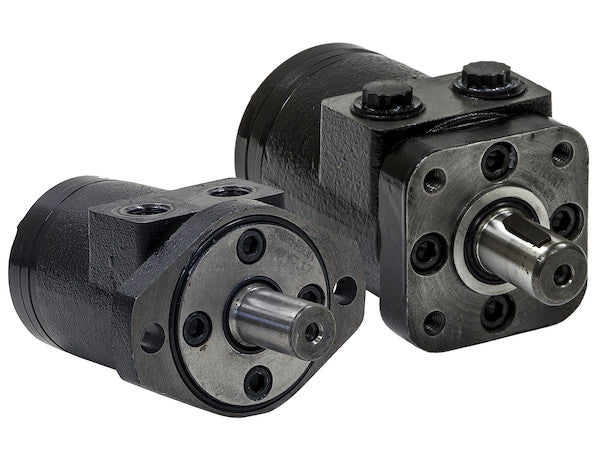
Hydraulic Motors from Buyers Products are designed to be economical, efficient, compact and powerful. They are a great solution for powering medium-duty applications like compressors, augers, winches, cranes, and spreaders. The motors have an industry-proven spool valve design combined with state-of-the-art gerotors. They excel at jobs that need a high degree of start-up torque or just the right mixture of torque and flow rate. Choose from a wide range of motors depending on your needs for flow rates, torque and starting torque. Each model is available with either a 2-bolt or 4-bolt mount. The last digit of the part number (2 or 4) will indicate the number of bolts.
Specifications
| Compares To | 101-1028-009 |
|---|---|
| Displacement | 9.6 |
| Flow (Continuous) | 15 |
| Flow (Intermittent) | 20 |
| Input Mount Type | 2 Bolt |
| Material | Cast Iron |
| Maximum Case Pressure (Without Case Drain) | 1500 |
| Maximum Speed (Continuous) | 353 |
| Maximum Speed at Continuous Flow | 353 |
| Maximum Speed at Intermittent Flow | 471 |
| Minimum Starting Torque (Continuous Pressure) | 1650 |
| Minimum Starting Torque (Intermittent Pressure) | 2320 |
| Pilot Diameter | 3.25 |
| Port Size | 1/2 NPT |
| Pressure ? Bar (Continuous) | 1650 |
| Pressure ? Bar (Intermittent) | 2250 |
| Shaft Keyway | 0.25 |
| Shaft Size | 1.00 |
| Shaft Type | Straight |
| Torque Rating (Continuous) | 2059 |
| Torque Rating (Intermittent) | 2320 |
Advanced Technical Overview: Hydraulic Motor with 9.7 Cubic Inches Displacement, 2-Bolt Mount, and NPT Threads
This detailed analysis focuses on the technical intricacies and operational advantages of the Hydraulic Motor featuring a 9.7 Cubic Inches Displacement, a 2-Bolt Mount, and NPT Threaded ports. Engineered for demanding medium-duty hydraulic applications, this motor exemplifies a robust fusion of design precision and material science, delivering exceptional performance, durability, and cost-effectiveness. Its specifications are meticulously balanced to provide optimal output for a diverse range of industrial and mobile equipment, making it a cornerstone component for systems requiring reliable rotational power.
Core Hydraulic Principles and Design Philosophy
At its heart, this hydraulic motor converts hydraulic energy (fluid pressure and flow) into mechanical rotary motion and torque. The design integrates an industry-proven spool valve with state-of-the-art gerotor technology, a combination renowned for its volumetric and mechanical efficiency. The overarching design philosophy is centered on maximizing power density within a compact footprint, ensuring consistent performance even under fluctuating load conditions and across a broad operational envelope. This approach results in a motor that is not only powerful but also remarkably efficient, minimizing energy losses and contributing to the overall sustainability of the hydraulic system.
Displacement and Performance Characteristics: The 9.7 Cubic Inch Advantage
The volumetric displacement of 9.7 cubic inches (approximately 157.3 cm³) is a critical parameter defining this motor's inherent characteristics. Displacement refers to the theoretical volume of fluid required to rotate the motor shaft one complete revolution. A displacement of 9.7 CID positions this motor ideally for applications requiring a significant balance between rotational speed and torque output. Specifically, with a continuous flow rate of 15 GPM, the motor achieves a continuous speed of 353 RPM. During intermittent operation, where flow can reach 20 GPM, the speed can elevate to 471 RPM. This flexibility allows the motor to adapt to varying operational demands, from steady-state continuous running to peak performance requirements.
The relationship between displacement, flow, and speed is fundamental: Speed (RPM) = (Flow (GPM) * 231) / Displacement (CID). Using this formula, the specified flow rates directly correspond to the impressive rotational speeds, underscoring the motor's capability to maintain high operational velocities under load. Furthermore, the motor's ability to operate effectively within these speed ranges, coupled with its robust torque delivery, makes it highly suitable for driving mechanisms that demand consistent rotational force.
Gerotor Technology: The Engine of Efficiency and Smoothness
The integration of state-of-the-art gerotors is a defining feature of this hydraulic motor. Gerotor, derived from "generated rotor," refers to a positive displacement unit comprising an inner and outer rotor. The inner rotor has one less lobe than the outer rotor, and as the inner rotor rotates, it creates expanding and contracting chambers. Hydraulic fluid entering the expanding chambers forces the outer rotor to turn, transferring energy to the output shaft. This design offers several distinct advantages:
- High Torque Density: Gerotor designs are inherently efficient at converting hydraulic pressure into torque, offering substantial power for their compact size.
- Smooth Operation: The continuous engagement of the gerotor elements ensures a very smooth and low-ripple output, which is crucial for applications requiring precise motion control or minimal vibration.
- Durability and Longevity: With fewer moving parts and a robust internal structure, gerotor motors exhibit exceptional wear resistance and extended service life, even in demanding environments.
- Efficiency: The tight tolerances and effective sealing within the gerotor set minimize internal leakage, contributing to high volumetric efficiency across a wide operating range.
- Compact Design: The inherent simplicity and efficiency of the gerotor principle allow for a smaller, lighter motor package without compromising power output.
These attributes directly contribute to the motor's suitability for applications requiring a high degree of start-up torque and reliable performance over extended operational periods.
Spool Valve Design: Precision Control and Reliability
The inclusion of an industry-proven spool valve design further enhances the motor's performance characteristics. The spool valve is integral to controlling the direction and flow of hydraulic fluid into and out of the gerotor set. Its robust design ensures:
- Reliable Fluid Direction: The spool accurately directs pressurized fluid to the expanding chambers of the gerotor and channels exhaust fluid from the contracting chambers, ensuring continuous and controlled rotation.
- Optimized Porting: The valve porting is optimized for the motor's displacement and flow rates, minimizing pressure drop and maximizing the hydraulic energy delivered to the gerotors.
- High Start-Up Torque: The spool valve's design, in conjunction with the gerotor, allows for rapid pressure buildup across the motor, facilitating a high degree of start-up torque. This is critical for applications like augers and winches that require significant initial force to overcome static friction or heavy loads.
- Durability: Manufactured to exacting standards, the spool valve resists wear and contamination, maintaining its operational integrity over the motor's lifespan.
The synergy between the spool valve and gerotor technology provides a highly responsive and powerful rotational force, making this motor a dependable choice for challenging applications.
Mounting Interface: The Robust 2-Bolt Configuration
This particular hydraulic motor is equipped with a 2-bolt mount, a widely recognized and utilized standard (often conforming to SAE A or similar industrial specifications, depending on specific dimensions like the 3.25-inch pilot diameter). The 2-bolt mount offers a balance of secure attachment and ease of installation. Its key benefits include:
- Structural Integrity: Despite having fewer bolts than a 4-bolt mount, the 2-bolt configuration, when properly torqued, provides sufficient clamping force for medium-duty applications, ensuring stable and vibration-resistant mounting.
- Compactness: It generally allows for a more compact motor-to-gearbox or motor-to-frame interface, which can be advantageous in space-constrained installations.
- Standardization: The commonality of the 2-bolt pattern simplifies integration into existing systems and reduces the complexity of sourcing compatible components.
- Ease of Installation and Service: Fewer fasteners translate to quicker installation and removal, reducing downtime during maintenance or component replacement.
The 3.25-inch pilot diameter ensures precise alignment with mating components, minimizing shaft misalignment and extending the service life of both the motor and the driven equipment. This robust mounting solution is engineered to withstand the operational stresses inherent in industrial and mobile machinery.
Porting Interface: National Pipe Taper (NPT) Threads
The motor features 1/2 NPT (National Pipe Taper) threaded ports, a common standard for hydraulic connections in North America. NPT threads are distinguished by their tapered form, which allows for mechanical sealing as the male and female threads are drawn together. Key aspects of NPT porting include:
- Self-Sealing Design: The tapered geometry, when combined with a suitable thread sealant (e.g., PTFE tape or liquid pipe sealant), creates a robust, pressure-tight seal, critical for preventing leaks in high-pressure hydraulic systems.
- Broad Compatibility: NPT is a ubiquitous standard, simplifying the connection to a vast array of hydraulic hoses, tubes, and fittings available in the market.
- Ease of Assembly: While requiring careful application of sealant and proper tightening, NPT connections are generally straightforward to assemble and disassemble in the field.
- Durability: The robust threads are designed to withstand the dynamic pressures and vibrations typical of hydraulic operations, ensuring long-term connection integrity.
The 1/2 NPT size is appropriately chosen for the specified continuous (15 GPM) and intermittent (20 GPM) flow rates, minimizing pressure drops across the porting and ensuring efficient fluid transfer to and from the motor.
Detailed Performance Specifications and Their Implications
Understanding the detailed specifications is crucial for optimal system design and operation:
- Pressure Ratings: The motor offers a continuous pressure rating of 1650 PSI and an intermittent rating of 2250 PSI. These values define the maximum sustained and short-duration peak pressures the motor can safely withstand while generating torque. Operating within these limits is paramount for motor longevity and performance.
- Torque Output: With a continuous torque rating of 2059 in-lbs and an intermittent rating of 2320 in-lbs, this motor delivers substantial rotational force. The minimum starting torque values (1650 in-lbs continuous, 2320 in-lbs intermittent) highlight its capacity to overcome high initial loads, a critical factor for applications such as augers or winches that demand immediate high torque to initiate movement.
- Speed Range: Continuous speed is rated at 353 RPM, increasing to 471 RPM under intermittent flow. This speed flexibility allows for precise control of the driven equipment's operational velocity.
- Maximum Case Pressure (Without Case Drain): A maximum case pressure of 1500 PSI without a case drain indicates the motor's robust internal sealing capabilities. While many hydraulic motors benefit from a case drain line to manage internal leakage and prevent pressure buildup in the motor housing, this specific motor's design allows for operation up to 1500 PSI without this additional line, simplifying plumbing in certain applications. However, for continuous high-pressure or high-temperature operations, or if internal leakage becomes a concern, consulting the manufacturer's guidelines for case drain recommendations is always prudent.
- Shaft Characteristics: The 1.00-inch straight shaft with a 0.25-inch keyway provides a standard interface for power transmission. A straight shaft is versatile and suitable for direct coupling or pulley/sprocket drives, while the keyway ensures positive torque transfer without slip.
- Material Composition: Constructed from robust cast iron, the motor housing offers exceptional strength, rigidity, and vibration dampening properties. Cast iron is chosen for its excellent machinability, resistance to deformation under pressure, and superior ability to dissipate heat, ensuring the motor's structural integrity and thermal stability throughout its operational life.
Application Versatility and Optimized Performance
The specific characteristics of this hydraulic motor – its 9.7 CID, high start-up torque, moderate speed range, 2-bolt mount, and NPT ports – make it exceptionally well-suited for a variety of medium-duty applications, building upon those initially mentioned:
- Compressors: Providing consistent, reliable power for air or gas compressors, especially those used in mobile service vehicles or industrial settings where continuous operation is required. The smooth torque output from the gerotor design ensures steady compressor operation.
- Augers: The high minimum starting torque (up to 2320 in-lbs intermittently) is invaluable for auger drives, enabling them to bore into challenging materials and overcome initial resistance effectively. The robust cast iron construction and dependable shaft can withstand the shock loads associated with auger operation.
- Winches: Critical for lifting and pulling applications, the strong continuous and intermittent torque ratings ensure powerful and controlled winding. The 2-bolt mount offers a secure attachment point for the winch drum or gearbox assembly.
- Cranes: For smaller crane systems or auxiliary functions on larger cranes (e.g., slew drives, auxiliary hoist functions), this motor delivers the precise and powerful motion required for safe and efficient material handling.
- Spreaders: Whether for agricultural seeders, fertilizer spreaders, or salt/sand spreaders, the motor's controlled speed and torque ensure uniform material distribution.
- Conveyor Drives: In manufacturing or material handling facilities, the motor can reliably power conveyor belts, offering consistent speed and torque to move goods efficiently.
- Agricultural Machinery: Beyond spreaders, this motor can drive various implements such as feeder systems, small harvesters, or specialized attachment drives where reliable, medium-duty hydraulic power is essential.
- Snow Removal Equipment: Ideal for powering broom attachments, chute rotators on snow blowers, or auxiliary functions on plows, where dependable cold-weather performance and robust torque are critical.
- Small Construction Equipment: Applications like trenchers, post-hole diggers, or mini-excavator attachments can benefit from this motor's balanced power output and compact design.
Each application benefits from the motor's specific configuration, providing a tailored solution that optimizes operational efficiency and extends equipment lifespan.
Integration and System Optimization
Successful implementation of this hydraulic motor hinges on its proper integration within a hydraulic system. Considerations include:
- Pump Selection: The hydraulic pump must be capable of supplying the necessary continuous and intermittent flow rates (15 GPM and 20 GPM respectively) at the required pressures (up to 2250 PSI). Matching pump output to motor requirements ensures peak performance.
- Valve Sizing and Type: Directional control valves, flow control valves, and pressure relief valves must be appropriately sized to handle the specified flow and pressure, ensuring precise control over motor speed and torque while protecting the system from overpressure.
- Filtration: High-quality hydraulic fluid filtration is crucial for prolonging the life of the motor's internal components, particularly the gerotors and spool valve, by preventing abrasive wear from contaminants.
- Reservoir Capacity and Cooling: The hydraulic fluid reservoir must be adequately sized to allow for heat dissipation and de-aeration, especially given the continuous power output of the motor. Additional cooling may be necessary for prolonged high-power applications to maintain optimal fluid temperature and viscosity.
- Hose and Fitting Sizing: The 1/2 NPT ports dictate the sizing of connecting hoses and fittings to minimize pressure drops and ensure efficient fluid transfer, preventing cavitation and maximizing power delivery.
Conclusion: A Benchmark in Medium-Duty Hydraulic Power
The Hydraulic Motor with 2-Bolt Mount/NPT Threads and 9.7 Cubic Inches Displacement from Buyers Products represents a high-performance, durable, and versatile solution for a broad spectrum of medium-duty hydraulic power requirements. Its sophisticated design, combining proven spool valve technology with advanced gerotors, delivers an exceptional balance of high start-up torque, smooth operation, and energy efficiency. Constructed from robust cast iron and featuring industry-standard mounting and porting, this motor is engineered for ease of integration and sustained reliability in challenging environments. For applications demanding precise control, significant rotational force, and long operational life, this hydraulic motor stands as an optimal choice, offering a compelling blend of technical excellence and practical utility.