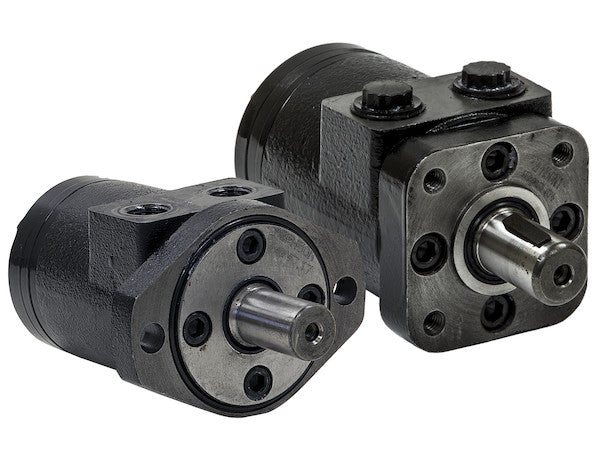
Hydraulic Motors from Buyers Products are designed to be economical, efficient, compact and powerful. They are a great solution for powering medium-duty applications like compressors, augers, winches, cranes, and spreaders. The motors have an industry-proven spool valve design combined with state-of-the-art gerotors. They excel at jobs that need a high degree of start-up torque or just the right mixture of torque and flow rate. Choose from a wide range of motors depending on your needs for flow rates, torque and starting torque. Each model is available with either a 2-bolt or 4-bolt mount. The last digit of the part number (2 or 4) will indicate the number of bolts.
Specifications
| Compares To | 101-1029-009 |
|---|---|
| Displacement | 11.9 |
| Flow (Continuous) | 15 |
| Flow (Intermittent) | 20 |
| Input Mount Type | 2 Bolt |
| Material | Cast Iron |
| Maximum Case Pressure (Without Case Drain) | 1500 |
| Maximum Speed (Continuous) | 304 |
| Maximum Speed at Continuous Flow | 304 |
| Maximum Speed at Intermittent Flow | 405 |
| Minimum Starting Torque (Continuous Pressure) | 1870 |
| Minimum Starting Torque (Intermittent Pressure) | 2590 |
| Pilot Diameter | 3.25 |
| Port Size | 1/2 NPT |
| Pressure ? Bar (Continuous) | 1600 |
| Pressure ? Bar (Intermittent) | 2150 |
| Shaft Keyway | 0.25 |
| Shaft Size | 1.00 |
| Shaft Type | Straight |
| Torque Rating (Continuous) | 2343 |
| Torque Rating (Intermittent) | 2590 |
Advanced Technical Overview: Hydraulic Motor with 2-Bolt Mount, NPT Threads, and 11.9 Cubic Inches Displacement
This detailed technical description provides an in-depth analysis of the Buyers Products hydraulic motor, specifically focusing on the model featuring a 2-bolt mount, 1/2 NPT threads, and a nominal displacement of 11.9 cubic inches. Designed for robust performance in medium-duty hydraulic systems, this motor combines proven engineering principles with modern manufacturing techniques to deliver exceptional efficiency, reliability, and power density across a spectrum of demanding applications.
Core Design Philosophy and Performance Capabilities
The design philosophy behind this hydraulic motor emphasizes a harmonious blend of economy, efficiency, compactness, and raw power. This is achieved through the integration of an industry-proven spool valve design with state-of-the-art gerotor internal components. The synergy between these elements results in a motor particularly adept at applications requiring significant starting torque, as well as those demanding a precise balance of sustained torque and consistent flow rate throughout its operational cycle. The specific model under consideration, with its 11.9 cubic inches of displacement (nominal value, often rounded to 11.3 in general product categories for marketing convenience), positions it squarely within the medium-duty spectrum, offering a substantial power output for its size.
Displacement and its Influence on Performance: 11.9 Cubic Inches
The volumetric displacement of 11.9 cubic inches (in³/rev) is a foundational specification for this hydraulic motor. This value quantifies the volume of hydraulic fluid required to rotate the motor output shaft through one complete revolution. A larger displacement generally corresponds to higher torque output per unit of pressure and lower rotational speed for a given flow rate. Conversely, a smaller displacement motor will achieve higher speeds with the same flow but produce less torque. For this 11.9 in³/rev motor, the displacement is optimized to provide a robust torque curve suitable for driving a wide array of medium-duty machinery, ensuring effective power transfer without excessive speed or insufficient torque.
To illustrate, at a continuous flow rate of 15 GPM, the motor achieves a maximum continuous speed of 304 RPM. With an intermittent flow of 20 GPM, the speed can reach up to 405 RPM. These figures are directly derived from the motor's displacement (RPM = (Flow Rate * 231) / Displacement), showcasing the precise relationship between fluid input and mechanical output. This careful calibration ensures the motor operates efficiently within its intended performance envelope.
Torque Characteristics: Power Under Load
The torque output is a critical parameter for any hydraulic motor, defining its ability to perform work. This motor demonstrates impressive torque capabilities:
- Continuous Torque Rating: 2343 lb-in (pound-inches)
- Intermittent Torque Rating: 2590 lb-in
These ratings indicate the maximum torque the motor can sustain indefinitely (continuous) versus for short, specified periods (intermittent) without compromising its lifespan or operational integrity. The higher intermittent rating allows the motor to handle transient peak loads, a common occurrence in applications like winching or augering where resistive forces can fluctuate. Furthermore, the motor's starting torque characteristics are equally compelling:
- Minimum Starting Torque (Continuous Pressure): 1870 lb-in
- Minimum Starting Torque (Intermittent Pressure): 2590 lb-in
High starting torque is paramount for applications that require immediate and substantial force to overcome static friction or initial resistance, such as lifting heavy loads with a crane or initiating rotation of a heavily laden auger. The spool valve design, coupled with the precision of the gerotors, ensures that a significant portion of the theoretical torque is available at startup, providing reliable engagement and consistent power delivery from a standstill.
Hydraulic System Integration: Flow and Pressure Dynamics
Effective integration into a hydraulic system necessitates a clear understanding of the motor's flow and pressure requirements and tolerances.
-
Flow Rates:
- Continuous Flow: 15 GPM (gallons per minute)
- Intermittent Flow: 20 GPM
-
Pressure Ratings:
- Continuous Pressure: 1600 PSI (pounds per square inch)
- Intermittent Pressure: 2150 PSI
- Maximum Case Pressure (Without Case Drain): 1500 PSI. This specification is vital for system designers. In motors designed to operate without an external case drain line, internal leakage is directed back to the low-pressure side of the system or vented internally. The 1500 PSI limit signifies the maximum permissible pressure within the motor's casing before internal seals or components might be compromised. While this motor is designed to function without an external case drain, careful system design is always recommended to manage potential pressure spikes within the motor casing, especially in dynamic applications.
Mechanical Interface and Construction
The physical design and construction of the motor are optimized for durability, ease of installation, and secure integration into machinery.
-
Mounting: 2-Bolt Input Mount Type (SAE A Flange Equivalent)
This motor features a 2-bolt input mount, adhering to common SAE (Society of Automotive Engineers) A-flange standards. This configuration is widely adopted in industrial and mobile hydraulic applications due to its simplicity, robustness, and ease of alignment. The mounting flange includes a precise 3.25-inch pilot diameter, which is essential for concentric alignment of the motor with the mating component (e.g., gearbox, pump, or equipment frame). Correct pilot alignment minimizes radial loads on the motor shaft, reducing wear on bearings and seals, thereby extending the motor's operational life and ensuring smooth power transmission.
The choice of a 2-bolt mount, as indicated by the product's part number suffix, offers a compact and secure attachment, suitable for installations where space might be a consideration, or where the forces exerted by the motor can be adequately supported by two mounting points.
-
Porting: 1/2 NPT (National Pipe Taper) Threads
Hydraulic fluid connections are facilitated by 1/2 NPT (National Pipe Taper) threads. NPT threads are a standard for pipe connections in North America, designed to create a leak-tight seal when the tapered male and female threads are mated with appropriate thread sealant. The 1/2-inch size is suitable for the specified flow rates of 15-20 GPM, ensuring minimal pressure drop across the ports. Proper installation, including the use of high-quality thread sealant or PTFE tape, is critical to maintain system integrity and prevent hydraulic fluid leaks, which are detrimental to system efficiency and environmental compliance.
-
Output Shaft: 1.00-inch Straight with 0.25-inch Keyway
The motor is equipped with a 1.00-inch diameter straight shaft, coupled with a 0.25-inch keyway. A straight shaft is a versatile and common choice, ideal for connecting to various driven components via a coupling. The 0.25-inch keyway is machined to accept a standard parallel key, creating a positive mechanical lock between the motor shaft and the hub of the driven component. This key and keyway connection is highly effective at transmitting torque and preventing rotational slippage. Common coupling types compatible with this shaft include rigid couplings, flexible jaw couplings, and gear couplings, depending on the application's alignment requirements and shock load potential. The robust shaft dimensions are designed to withstand the motor's maximum torque outputs without deformation or failure.
-
Material: Cast Iron Construction
The primary construction material for the motor housing is high-grade cast iron. Cast iron is an exemplary material for hydraulic components due to its superior properties:
- **Strength and Rigidity:** Provides excellent structural integrity to withstand high internal pressures and external mechanical stresses.
- **Vibration Damping:** Cast iron's inherent material properties help to absorb and dampen vibrations, leading to quieter operation and reduced wear on internal components.
- **Thermal Stability:** Offers good heat dissipation characteristics, assisting in maintaining optimal operating temperatures for the hydraulic fluid and internal components.
- **Durability:** Resistant to fatigue and wear, ensuring a long operational life even in harsh industrial and outdoor environments.
- **Corrosion Resistance:** With proper surface treatment, cast iron offers good resistance to environmental corrosion.
Internal Mechanism: Spool Valve and Gerotor Technology
The operational heart of this hydraulic motor lies in its advanced internal components:
- Industry-Proven Spool Valve Design: The integrated spool valve is responsible for directing the flow of hydraulic fluid to and from the gerotor set. This design is renowned for its reliability and precision. The spool valve effectively controls the start, stop, and direction of motor rotation, and in some configurations, can contribute to speed control. Its robust construction ensures consistent performance under varying load and pressure conditions, providing smooth transitions and reliable operation.
- State-of-the-Art Gerotors: Gerotor (generated rotor) technology is central to the motor's ability to convert hydraulic energy into mechanical rotational energy. A gerotor set consists of an inner rotor with 'n' teeth and an outer rotor with 'n+1' teeth. As hydraulic fluid enters the expanding pockets created between the rotating rotors, it forces the rotors to turn. The fluid is then expelled as the pockets contract.
- **High Volumetric Efficiency:** Minimizes fluid bypass, ensuring more fluid is converted into rotational motion.
- **Smooth Operation:** The continuous meshing of the gerotor teeth provides very smooth output torque, even at low speeds, reducing pulsation and vibration.
- **Compactness:** Gerotor designs offer high power density, meaning significant power output from a relatively small physical footprint.
- **High Starting Torque:** Inherently capable of generating high torque at low speeds and startup, crucial for many heavy-duty applications.
- **Durability:** Fewer moving parts compared to some other motor types, leading to reduced wear points and extended service life.
Modern gerotor designs, often referred to as orbital motors, utilize advanced tooth profiles and material science to optimize efficiency and minimize internal leakage. Key advantages include:
Application Suitability and Versatility
The characteristics of this hydraulic motor—high starting torque, balanced continuous/intermittent performance, robust construction, and specific displacement—make it an excellent choice for a variety of medium-duty mobile and industrial hydraulic applications:
- **Compressors:** Driving rotary screw or piston compressors in mobile or stationary setups, where consistent torque and speed are required.
- **Augers:** Providing the necessary high torque to turn auger bits for drilling, mixing, or spreading applications, capable of overcoming variable ground resistance or material viscosity.
- **Winches:** Offering the pulling power and control needed for winching operations on service trucks, trailers, or marine vessels, especially benefiting from the high starting torque for initial load engagement.
- **Cranes:** Powering slewing mechanisms, boom extensions, or hoist drives on small to medium-sized cranes, where precise control and reliable lifting force are paramount.
- **Spreaders:** Used in agricultural or municipal spreading equipment for fertilizers, salt, or sand, requiring steady power to drive conveyor belts or spinning discs.
- **Conveyors:** Actuating conveyor belts in material handling systems, providing consistent speed for product movement.
- **Mowers/Brush Cutters:** Powering cutting heads in heavy-duty mowing or brush-cutting attachments for tractors or skid steers.
Its versatility extends to any application demanding a controlled, high-torque rotary motion, capable of enduring varied load conditions with a reliable and economical power solution.
Efficiency, Reliability, and Longevity
The commitment to efficiency in this motor is evident in its advanced gerotor design, which minimizes internal leakage and optimizes fluid dynamics. This translates directly into lower energy consumption for a given output, reducing operational costs and heat generation within the hydraulic system. Reliability is built into every aspect, from the durable cast iron housing to the precision-engineered internal components. Rigorous quality control during manufacturing ensures that each motor meets stringent performance and durability standards.
To maximize longevity, proper system design and maintenance are crucial. This includes:
- Hydraulic Fluid Quality: Using clean, appropriate-viscosity hydraulic fluid is paramount.
- Filtration: Effective filtration to prevent contamination from abrasive particles, which can rapidly wear internal components.
- Operating Parameters: Adhering to the specified continuous and intermittent pressure, flow, and speed limits.
- Heat Management: Ensuring the hydraulic system operates within acceptable temperature ranges to protect seals and fluid properties.
- Vibration Control: Minimizing external vibrations that could stress motor components or affect coupling integrity.
By following these guidelines, users can expect extended service life and consistent peak performance from this hydraulic motor.
Conclusion
The Buyers Products Hydraulic Motor with a 2-bolt mount, 1/2 NPT threads, and an 11.9 cubic inch displacement is a meticulously engineered component designed to serve as a reliable and powerful actuator in medium-duty hydraulic systems. Its balanced performance characteristics, including high continuous and intermittent torque, impressive starting torque, and robust construction from cast iron, make it an ideal choice for a wide array of demanding applications. The integration of proven spool valve technology with advanced gerotors ensures efficient, smooth, and durable operation. This motor represents an investment in high-quality, high-performance hydraulic power, offering an economical and effective solution for critical mechanical tasks across various industries. Its specific specifications, such as comparing to model 101-1029-009, further establish its position within a well-recognized performance class.