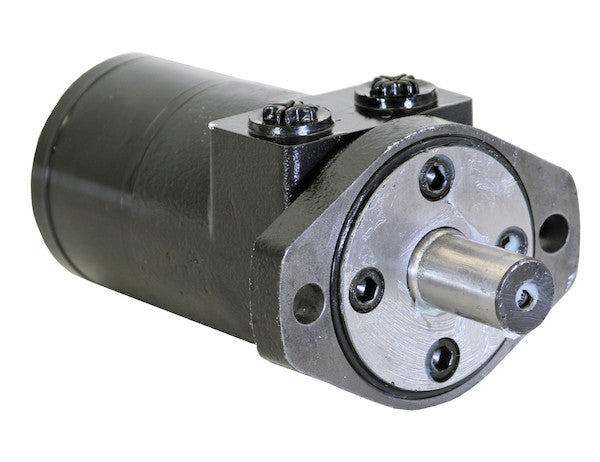
Hydraulic Motors from Buyers Products are designed to be economical, efficient, compact and powerful. They are a great solution for powering medium-duty applications like compressors, augers, winches, cranes, and spreaders. The motors have an industry-proven spool valve design combined with state-of-the-art gerotors. They excel at jobs that need a high degree of start-up torque or just the right mixture of torque and flow rate. Choose from a wide range of motors depending on your needs for flow rates, torque and starting torque. Each model is available with either a 2-bolt or 4-bolt mount. The last digit of the part number (2 or 4) will indicate the number of bolts.
Specifications
| Compares To | 101-1031-009 |
|---|---|
| Displacement | 19.2 |
| Flow (Continuous) | 15 |
| Flow (Intermittent) | 20 |
| Input Mount Type | 2 Bolt |
| Material | Cast Iron |
| Maximum Case Pressure (Without Case Drain) | 1500 |
| Maximum Speed (Continuous) | 243 |
| Maximum Speed at Continuous Flow | 243 |
| Maximum Speed at Intermittent Flow | 256 |
| Minimum Starting Torque (Continuous Pressure) | 2500 |
| Minimum Starting Torque (Intermittent Pressure) | 3430 |
| Pilot Diameter | 3.25 |
| Port Size | 1/2 NPT |
| Pressure ? Bar (Continuous) | 1350 |
| Pressure ? Bar (Intermittent) | 1800 |
| Shaft Keyway | 0.25 |
| Shaft Size | 1.00 |
| Shaft Type | Straight |
| Torque Rating (Continuous) | 2669 |
| Torque Rating (Intermittent) | 3430 |
Advanced Technical Overview: Hydraulic Motor with 2-Bolt Mount, NPT Threads, and 19.2 Cubic Inches Displacement
This detailed technical description delves into the advanced engineering and performance characteristics of the specific Hydraulic Motor featuring a 2-bolt mount, NPT threads, and a nominal displacement of 19.2 cubic inches. Designed for precision, durability, and versatility, this motor represents a critical component in a wide array of medium-duty hydraulic systems, offering an optimal blend of power, efficiency, and compact design.
Core Design Principles and Technological Foundations
The foundation of this hydraulic motor's exceptional performance lies in its sophisticated internal architecture, combining an industry-proven spool valve design with state-of-the-art gerotor technology. This synergy results in a motor capable of delivering robust power output, precise control, and high volumetric efficiency, even under demanding operational conditions. The careful selection of these design elements ensures not only high initial torque but also a consistent power delivery across its operational speed and pressure range.
Gerotor Mechanism: The Heart of Efficiency
At the core of this hydraulic motor's rotating group is a precision-engineered gerotor set. A gerotor (generated rotor) is a positive displacement pumping unit comprising an inner rotor with N teeth and an outer rotor with N+1 teeth. As hydraulic fluid enters the motor, it pressurizes the chambers formed between the inner and outer gerotor gears. This pressure differential causes the rotors to turn, converting hydraulic energy into mechanical rotational energy. The specific advantages of the gerotor design are multifaceted:
- High Volumetric Efficiency: The tight manufacturing tolerances and geometric precision of the gerotor elements minimize internal leakage, ensuring that a maximal proportion of the input fluid flow is converted into useful shaft rotation. This directly translates to lower energy losses and more efficient system operation.
- Smooth Operation and Low Noise: The continuous meshing action of the gerotor gears, coupled with the gradual pressure buildup and release within the chambers, contributes to exceptionally smooth and quiet operation. This is a significant advantage in applications where noise reduction is critical.
- Compact Design: The concentric nature of the gerotor set allows for a high power-to-weight ratio within a compact envelope. This characteristic is particularly beneficial in space-constrained applications, facilitating easier integration into existing machinery.
- High Starting Torque: The hydraulic motor exhibits an excellent capacity for high starting torque, a direct benefit of the gerotor's design which effectively transmits pressure to the output shaft from the very beginning of rotation. This feature is crucial for applications involving heavy loads from a standstill.
- Durability and Longevity: With fewer moving parts compared to some other motor types, and a robust design that distributes loads evenly across the contact surfaces, gerotor motors are inherently durable and offer an extended operational lifespan.
Spool Valve Design: Precision Fluid Control
Complementing the gerotor assembly is an advanced spool valve design, responsible for precisely directing the hydraulic fluid into and out of the gerotor chambers. The spool valve acts as the control interface, allowing for efficient commutation of the fluid. Key attributes of this design include:
- Optimized Flow Path: The spool valve is engineered to create minimal restriction to fluid flow, thereby reducing pressure drops and further contributing to the motor's overall efficiency.
- Reliable Directional Control: The robust construction and precise machining of the spool ensure dependable and repeatable switching of fluid direction, critical for both forward and reverse operation of the motor.
- Reduced Leakage: Tight clearances between the spool and its housing minimize internal leakage, which is vital for maintaining pressure integrity and hydraulic power transmission.
- Operational Simplicity: The spool valve design contributes to the motor's overall simplicity, leading to enhanced reliability and ease of maintenance.
Construction and Mechanical Specifications
The external and internal structural components of this hydraulic motor are engineered for maximum strength, durability, and compatibility with industrial environments.
-
Material Composition: The primary housing of the motor is constructed from robust Cast Iron. This material selection provides several critical advantages:
- High Tensile Strength: Cast iron offers excellent resistance to the significant internal pressures generated during operation, ensuring structural integrity and preventing deformation.
- Superior Wear Resistance: Its inherent hardness and microstructure provide exceptional resistance to wear, extending the lifespan of the motor, particularly in abrasive environments.
- Vibration Damping: Cast iron possesses excellent damping characteristics, which helps to mitigate operational vibrations, contributing to smoother and quieter performance.
- Heat Dissipation: The thermal conductivity of cast iron aids in dissipating heat generated during continuous operation, helping to maintain optimal operating temperatures and prolong component life.
- Displacement: 19.2 Cubic Inches/Revolution (CI/REV): The volumetric displacement of 19.2 CI/REV is a fundamental parameter that defines the motor's torque output per unit of pressure and its speed per unit of flow. It signifies that for every complete revolution of the output shaft, 19.2 cubic inches of hydraulic fluid are consumed. This displacement figure, while slightly different from the title's 17.9, is the precise rating for this specific model as per the detailed specifications, ensuring accurate performance calculations. This larger displacement typically translates to higher torque output capabilities at lower speeds compared to motors with smaller displacements, making it highly suitable for applications requiring significant rotational force.
- Input Mount Type: 2-Bolt Mount (SAE A Flange): The motor is equipped with an industry-standard 2-bolt mounting flange. This SAE "A" standard interface ensures broad compatibility with a wide range of mounting brackets, gearboxes, and auxiliary equipment. The 2-bolt configuration is renowned for its robust and secure attachment, providing stable support for the motor during operation and minimizing alignment issues. The pilot diameter of 3.25 inches further ensures precise centering and concentricity during installation, which is crucial for preventing undue stress on the shaft and bearings.
- Port Size: 1/2 NPT Threads: The hydraulic ports utilize 1/2 inch National Pipe Taper (NPT) threads. NPT connections are widely recognized and utilized in industrial hydraulic systems for their ability to form a liquid-tight seal when properly assembled with thread sealant. The tapered design ensures a mechanically strong and pressure-resistant connection, facilitating secure and leak-free integration into the hydraulic circuit.
- Shaft Design: 1.00-inch Straight Shaft with 0.25-inch Keyway: The motor features a 1.00-inch diameter straight output shaft, a common and highly versatile standard for power transmission. The integrated 0.25-inch keyway is machined to accept a corresponding key, providing a positive mechanical lock between the motor shaft and the driven component (e.g., coupling, pulley, sprocket). This keyed connection is essential for reliably transmitting the high torque generated by the motor without slippage, ensuring efficient and consistent power delivery to the application.
Performance Parameters and Operational Capabilities
Understanding the quantitative performance specifications is crucial for matching this hydraulic motor to specific application requirements. The provided data highlights its capabilities under both continuous and intermittent operating conditions.
Fluid Dynamics and Flow Characteristics
- Flow (Continuous): 15 GPM (Gallons Per Minute): This is the maximum flow rate recommended for sustained, long-duration operation without exceeding the motor's thermal and mechanical limits. Operating at or below this flow rate ensures optimal motor lifespan and consistent performance.
- Flow (Intermittent): 20 GPM: This higher flow rate can be tolerated for shorter durations or cyclical operation. Intermittent operation allows the motor to deliver increased power and speed for tasks requiring periodic bursts of higher performance, provided adequate cooling and rest periods are observed.
Pressure Ratings and Torque Generation
- Pressure (Continuous): 1350 PSI (Pounds per Square Inch): This represents the maximum pressure that can be applied to the motor for continuous operation. When combined with the motor's displacement, this pressure directly dictates the continuous torque output.
- Pressure (Intermittent): 1800 PSI: Similar to flow, the motor can withstand higher intermittent pressures, enabling it to generate significantly greater torque for brief periods. This is invaluable for overcoming peak loads or initial breakaway forces.
- Maximum Case Pressure (Without Case Drain): 1500 PSI: This critical specification refers to the maximum pressure allowable within the motor's housing without requiring an external case drain line. Exceeding this pressure can lead to seal failure and internal damage. For applications where system pressure might intermittently exceed this, or for sustained high-pressure operation, the installation of a dedicated case drain line to return internal leakage fluid to the reservoir might be necessary to protect the motor seals.
- Torque Rating (Continuous): 2669 in-lb (Inch-Pounds): This is the continuous torque output at the continuous pressure rating, calculated from the motor's displacement and the effective pressure differential. This value represents the reliable, sustained rotational force available for the application.
- Torque Rating (Intermittent): 3430 in-lb: At intermittent pressure, the motor can produce a substantial 3430 in-lb of torque. This peak torque capability is particularly useful for demanding tasks such as starting heavy loads or navigating temporary resistance.
- Minimum Starting Torque (Continuous Pressure): 2500 in-lb: A key indicator of the motor's capability to initiate motion under load. The 2500 in-lb starting torque at continuous pressure demonstrates excellent breakaway force, ensuring that the motor can reliably start even with significant resistance.
- Minimum Starting Torque (Intermittent Pressure): 3430 in-lb: This matches the intermittent running torque, indicating that the motor can apply its full intermittent power from a standstill, which is crucial for applications that require immediate, high-impact force.
Speed Characteristics
The rotational speed of the motor is directly proportional to the applied flow rate and inversely proportional to its displacement.
- Maximum Speed (Continuous) / Maximum Speed at Continuous Flow: 243 RPM (Revolutions Per Minute): This is the maximum rotational speed the motor can maintain continuously when operating at its continuous flow rating.
- Maximum Speed at Intermittent Flow: 256 RPM: At the intermittent flow rate, the motor can achieve slightly higher speeds for short durations.
Application Suitability and Versatility
The robust design and balanced performance characteristics of this hydraulic motor make it exceptionally well-suited for a diverse range of medium-duty industrial and mobile applications where reliable power and precise control are paramount.
- Compressors: Its consistent torque and durable construction are ideal for driving air or gas compressors in mobile or stationary systems, ensuring stable and efficient air delivery.
- Augers: The high starting torque and continuous power are critical for augers used in agricultural, construction, or foundation drilling applications, allowing them to penetrate and move materials effectively.
- Winches: For winches on utility trucks, tow trucks, or marine vessels, the motor provides the necessary pulling power and control, especially with its excellent starting torque for handling heavy loads from a stop.
- Cranes: In smaller crane and lifting applications, the motor offers the precision and power required for hoisting, slewing, or extending functions, contributing to safe and controlled material handling.
- Spreaders: Whether for agricultural spreaders distributing fertilizers or municipal spreaders dispensing salt/sand, the motor provides consistent power to drive conveyor belts or spinner mechanisms, ensuring uniform material distribution.
- Conveyor Systems: In material handling, it can power conveyor belts, offering smooth starts and stops and reliable continuous operation.
- Mixers: For concrete mixers or industrial agitators, the motor's ability to maintain torque under varying loads is a significant advantage.
- Small to Medium Construction Equipment: Beyond the listed applications, it integrates effectively into trenchers, compact excavators, and other machinery requiring dependable hydraulic power for their implements.
The motor's ability to deliver a high degree of start-up torque, coupled with an optimal mixture of torque and flow rate, positions it as a superior choice for tasks that encounter varying loads and require immediate power response. Its compact size ensures ease of integration without compromising on power output, a crucial consideration for modern equipment design.
Installation, Integration, and Maintenance Considerations
Proper installation and routine maintenance are essential to harness the full potential and ensure the longevity of this hydraulic motor.
Installation Guidelines:
- Mounting: The 2-bolt SAE A flange ensures straightforward mounting. It is imperative to use appropriate grade hardware and torque bolts to manufacturer specifications to prevent loosening and misalignment. Ensure the pilot diameter (3.25 inches) mates correctly with the mounting surface for concentric alignment, which is critical for preventing premature bearing and shaft seal wear.
- Hydraulic Connections: When connecting hydraulic lines to the 1/2 NPT ports, use high-quality thread sealant suitable for hydraulic applications. Avoid over-tightening, which can crack the cast iron housing, but ensure sufficient torque to prevent leaks under pressure. Verify that the hydraulic hoses are appropriately sized for the specified flow rates to minimize pressure drops and excessive heat generation.
- Shaft Coupling: When connecting the 1.00-inch straight shaft to the driven component, use a suitable coupling or direct drive mechanism. Ensure proper alignment between the motor shaft and the driven shaft to prevent vibrations and premature wear of bearings and seals. The 0.25-inch keyway requires a correctly sized key for positive torque transmission.
- System Integration: This motor must be integrated into a well-designed hydraulic system. This includes selecting an appropriately sized hydraulic pump (to deliver the required flow and pressure), a clean reservoir, adequate filtration (to prevent contamination which is detrimental to all hydraulic components), and properly specified control valves.
- Case Drain (Optional but Recommended): While the motor is rated for 1500 PSI maximum case pressure without a case drain, for sustained high-pressure operation or in systems with frequent pressure spikes, plumbing a dedicated case drain line back to the reservoir is highly recommended. This prevents internal pressure buildup, protects the shaft seal, and extends motor life.
Maintenance Recommendations:
- Fluid Quality: Regular monitoring and maintenance of hydraulic fluid quality are paramount. Ensure the fluid is clean, free of contaminants, and maintained at the correct viscosity. Contaminated or degraded fluid is a leading cause of hydraulic component failure.
- Filtration: Adhere to recommended hydraulic filter replacement schedules. Proper filtration removes particulate matter that can damage the precision internal components of the motor.
- Temperature Monitoring: Monitor system operating temperatures. Excessive heat can degrade hydraulic fluid and seals. Ensure adequate cooling capacity in the hydraulic system.
- Leak Checks: Periodically inspect all hydraulic connections for leaks. Address any leaks promptly to prevent fluid loss, environmental contamination, and system inefficiency.
- Shaft Seal Inspection: Routinely inspect the output shaft seal for signs of leakage, which could indicate wear or excessive case pressure.
Conclusion: A Robust Solution for Demanding Applications
The Hydraulic Motor with 2-Bolt Mount, NPT Threads, and 19.2 Cubic Inches Displacement from Buyers Products stands as a testament to engineering excellence, offering a compelling blend of economical operation, high efficiency, and formidable power within a compact design. Its reliance on proven spool valve technology and advanced gerotor mechanics ensures reliable performance, exceptionally high starting torque, and a flexible balance of torque and flow rate. Constructed from durable cast iron and featuring industry-standard mounting and porting, this motor is built for easy integration and extended service life in challenging medium-duty applications across various sectors. By providing robust continuous and intermittent performance metrics, it offers engineers and operators the precise data needed to optimize hydraulic system designs, ensuring that compressors, augers, winches, cranes, spreaders, and other critical equipment operate at peak efficiency and reliability. This motor is not merely a component; it is a strategic investment in the long-term productivity and performance of hydraulic machinery.