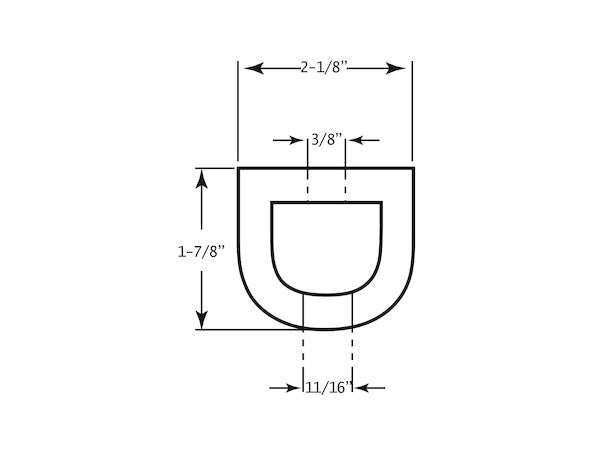
Buyers Products Extruded Rubber D-Shaped Bumpers help protect the rear of a truck or trailer when backing to an elevated loading dock. Bumpers are an ideal addition to any piece of equipment that has a high frequency of contact, such as a loading dock or delivery bay. The durable, heavy duty bumpers are available in a variety of sizes, thicknesses, and drill-hole configurations to meet your specifications.
Specifications
| A | 2-1/8 |
|---|---|
| B | 1-7/8 |
| C | 3/8 |
| C-C of Holes | 6.00 |
| D | 7/10 |
| Length | 10.00 |
| No. of Holes | 2 |
The Extruded Rubber D-Shaped Bumper with 2 Holes, precisely engineered to dimensions of 2-1/8 x 1-7/8 x 10 inches long, represents a critical component in mitigating impact damage across a diverse range of industrial and commercial applications. This product is meticulously designed for environments where regular contact between vehicles, equipment, and fixed structures is an unavoidable operational reality. Its robust construction and intelligent design serve not merely as a passive barrier, but as an active system element in extending asset lifespan, enhancing operational safety, and significantly reducing maintenance expenditures associated with impact-induced wear and tear. This detailed exposition will delve into the technical intricacies, material science, engineering advantages, and comprehensive utility of this essential protection device.
At the core of this bumper's superior performance lies its material: extruded rubber. Unlike molded or cut rubber, extrusion offers unparalleled consistency in material density, molecular alignment, and dimensional accuracy across the entire length of the profile. This process involves forcing a viscoelastic rubber compound through a die under high pressure and temperature, resulting in a continuous, uniform D-shaped cross-section. The resulting material exhibits a dense, non-porous structure, which is crucial for maximizing its physical properties. The specific rubber compound selected for these bumpers is typically a high-grade Styrene-Butadiene Rubber (SBR) or an Ethylene Propylene Diene Monomer (EPDM) blend. SBR is prized for its excellent abrasion resistance, impact strength, and low compression set, making it ideal for high-frequency, heavy-duty impact applications. EPDM, conversely, offers superior resistance to weathering, ozone, UV radiation, and a broad range of temperatures, from extreme cold to intense heat, making it suitable for outdoor environments with prolonged exposure to the elements. The exact compound choice is optimized to provide a balanced profile of durability, elasticity, and environmental resilience.
The extrusion manufacturing process itself imparts several significant advantages. Firstly, it allows for the creation of continuous lengths, from which individual 10-inch bumpers are precisely cut, minimizing material waste and ensuring cost-effectiveness. Secondly, the controlled processing conditions during extrusion lead to a uniform cure throughout the rubber, eliminating weak points and ensuring consistent mechanical properties along the entire bumper. This uniformity is vital for predictable energy absorption and rebound characteristics. Thirdly, the process facilitates the integration of internal reinforcing elements or specific durometer zones if required, although for a standard D-bumper, the primary advantage is the consistent, dense matrix that forms the protective shell. The inherent flexibility of the extrusion process also means that precise tolerances are maintained for the overall profile, ensuring that each bumper fits its intended application with exactitude, contributing to a secure and effective installation.
The D-shaped profile is not merely an aesthetic choice; it is a meticulously engineered geometric configuration that optimizes functional performance. The flat back surface of the "D" provides a stable and robust mounting plane, ensuring maximum contact with the substrate for secure fastening and efficient transfer of impact forces. The rounded, outwardly projecting face of the "D" serves as the primary impact zone. This curved surface is designed to deflect glancing blows, minimize concentrated stress points, and distribute kinetic energy across a larger area of the bumper material upon direct impact. This shape also inherently offers a larger displacement volume, allowing the rubber to compress and deform significantly, thereby absorbing substantial amounts of impact energy before rebounding to its original shape. This controlled deformation protects both the impacting object and the structure to which the bumper is mounted, significantly reducing the likelihood of structural damage, deformation, or cosmetic defacement. The inherent structural integrity of the D-shape also resists torsional stresses, preventing twisting or tearing under oblique impacts, which is a common occurrence in dynamic loading environments.
The specified dimensions of 2-1/8 x 1-7/8 x 10 inches long are critical to the bumper's functional efficacy. The 2-1/8 inch projection (Dimension A) from the mounting surface provides an optimal standoff distance, ensuring that sufficient clearance exists between the impacting object (e.g., a truck's rear chassis) and the protected structure (e.g., a loading dock wall). This projection allows for maximal compression and energy dissipation within the rubber material before any metal-on-metal or rigid-structure contact occurs. The 1-7/8 inch width (Dimension B) of the bumper's base ensures a broad and stable mounting platform, distributing fastening loads evenly across the attachment points and preventing localized stress on the mounting surface. The 10-inch length offers a substantial linear protection zone, making it suitable for covering critical impact areas on vehicles or structural elements, ensuring adequate coverage for common docking maneuvers or operational contacts. The 3/8 inch thickness (Dimension C), likely referring to the primary wall thickness of the D-profile, signifies the robust material volume available for impact absorption and structural resilience, directly correlating to the bumper's capacity to withstand repeated heavy-duty forces without premature degradation.
The integrated 2-hole configuration is fundamental to the secure and reliable installation of this bumper. The pre-drilled holes eliminate the need for on-site drilling, simplifying the mounting process and ensuring consistent placement. The center-to-center spacing of 6.00 inches for these holes is engineered to provide balanced load distribution across the mounting points, preventing uneven stress concentrations that could compromise the bumper's attachment or the integrity of the mounting surface. This precise spacing also facilitates standardization in installation procedures. The hole diameter of 7/10 inches (Dimension D) accommodates a range of robust fastening hardware, typically lag bolts, carriage bolts, or concrete anchors, ensuring a secure and permanent attachment capable of withstanding the substantial shear and pull-out forces generated during impacts. The use of two discrete fastening points along the 10-inch length creates a stable cantilevered system that effectively resists rotation and dislodgement, even under severe impact conditions. Proper selection and torqueing of fasteners are paramount to harnessing the full protective capabilities of the bumper.
Beyond its physical dimensions and shape, the bumper's advanced performance characteristics are critical to its long-term utility. Its primary function is impact resistance and shock absorption. The high elasticity and resilience of the chosen rubber compound enable the bumper to deform elastically under compressive loads, absorbing kinetic energy by converting it into strain energy within the material. Upon removal of the load, the bumper rapidly recovers its original shape, ready for subsequent impacts. This property, known as a low compression set, is vital for maintaining consistent performance over thousands of impact cycles. Furthermore, the material exhibits excellent abrasion resistance, crucial for environments where scraping or rubbing contact is common, such as when vehicles brush against docks or walls. The high tensile strength and tear resistance of the extruded rubber minimize the risk of ripping or splitting, even under harsh shear forces, ensuring the bumper retains its structural integrity throughout its operational lifespan.
Environmental resistance is another pivotal aspect of this bumper's design. For applications exposed to outdoor conditions, the rubber compound is formulated to resist degradation from ultraviolet (UV) radiation, ozone exposure, and fluctuations in temperature. UV stabilizers and anti-ozonants are often incorporated into the rubber blend to prevent hardening, cracking, and surface deterioration over time, maintaining the bumper's flexibility and impact absorption capabilities. Its inherent resistance to moisture, humidity, and common industrial chemicals such as oils, greases, road salts, and mild acids or alkalis further expands its applicability in diverse operational settings, including marine environments, chemical processing plants, and manufacturing facilities where spillage or exposure to corrosives may occur. This comprehensive environmental resilience ensures a consistently high level of protection and extends the bumper's service life, reducing the frequency of replacement.
The comprehensive application spectrum for this D-shaped bumper extends far beyond its primary role in protecting trucks and loading docks. In logistics and transportation, it's indispensable for the rear and side protection of delivery trucks, trailers, and specialized vehicles, safeguarding against damage during docking, maneuvering in tight spaces, and preventing costly repairs to vehicle bodies, taillights, and chassis components. In industrial facilities and warehouses, these bumpers are critical for protecting columns, walls, corners, and machinery from accidental impacts by forklifts, pallet jacks, and other material handling equipment, thereby preserving structural integrity and preventing operational downtime. For parking garages and multi-story parking structures, they serve to protect both vehicles and concrete infrastructure, delineating parking zones and minimizing damage from minor collisions. In marine environments, robust rubber bumpers are used on docks, piers, and boat hulls to absorb impacts during mooring, preventing damage to vessels and marine infrastructure. Their versatility makes them an invaluable asset in any scenario requiring robust, reliable impact protection.
The implementation of these extruded rubber D-shaped bumpers yields significant economic and operational advantages. By effectively absorbing impact energy, they drastically reduce the frequency and severity of damage to both moving equipment and stationary infrastructure. This translates directly into substantial cost savings from: reduced vehicle repair costs (e.g., fewer damaged taillights, bent chassis, bodywork repairs); minimized infrastructure maintenance costs (e.g., fewer cracked concrete walls, damaged loading dock edges); and extended asset lifespan for both vehicles and facilities. Furthermore, the reduction in damage incidents leads to decreased operational downtime, as equipment remains serviceable and facilities remain operational without the need for extensive repairs. From a safety perspective, these bumpers contribute to a safer working environment by preventing accidents that could injure personnel or damage valuable goods. Investing in high-quality impact protection is a proactive strategy for enhancing profitability, improving safety records, and ensuring continuous, uninterrupted operations.
For optimal performance and longevity, proper installation and maintenance protocols are paramount. The mounting surface must be structurally sound, clean, and flat to ensure maximum adhesion and stability. Appropriate fastening hardware, such as galvanized or stainless steel bolts, washers, and nuts, should be selected based on the substrate material (e.g., concrete anchors for masonry, through-bolts for steel). Fasteners should be adequately torqued to prevent loosening under vibration or impact, but not over-torqued to avoid deforming the rubber. Regular visual inspection of the bumpers is recommended to identify any signs of excessive wear, tearing, or detachment. Minor surface abrasions are typically normal and expected, but deep cuts, cracks, or significant deformation warrant attention. While extruded rubber bumpers are highly durable and generally maintenance-free, periodic cleaning can prevent the buildup of corrosive substances or debris that might prematurely degrade the material. Should a bumper become severely compromised, prompt replacement is crucial to maintain the integrity of the protection system and prevent subsequent, more costly damage.
To reiterate the technical specifications provided, the A dimension of 2-1/8 inches refers to the precise depth or projection of the bumper from its mounting surface, offering the critical standoff distance. The B dimension of 1-7/8 inches indicates the width of the flat base, ensuring a stable and secure attachment. The C dimension of 3/8 inch represents the nominal thickness of the rubber material, particularly in critical areas, which directly correlates to its energy absorption capacity and structural resilience. The Center-to-Center of Holes at 6.00 inches specifies the precise spacing of the two mounting holes, facilitating accurate installation and optimal load distribution. The D dimension of 7/10 inch defines the diameter of the pre-drilled holes, dictating the appropriate size of fastening hardware for robust attachment. The overall Length of 10.00 inches provides a substantial protective zone, while the Number of Holes, specifically 2, ensures a secure and balanced two-point fastening system, crucial for resisting both direct impacts and shear forces. Each of these specifications is meticulously engineered to ensure the bumper delivers consistent, high-performance protection in demanding industrial and commercial environments.
The manufacturing of these bumpers adheres to stringent quality assurance and compliance standards. From the sourcing of raw rubber compounds to the final extrusion and cutting processes, each stage undergoes rigorous quality control checks. This includes material composition verification, durometer testing (to ensure correct hardness), dimensional accuracy checks, and visual inspections for surface imperfections. Manufacturers typically conform to relevant industry standards for rubber products, ensuring consistency in performance and reliability. While specific regulatory compliance may vary by application (e.g., marine, automotive), the inherent robustness and safety-enhancing nature of these bumpers contribute positively to overall operational safety standards. The commitment to quality ensures that each D-shaped bumper delivered is capable of performing its protective function effectively, consistently, and for an extended operational lifetime.
In conclusion, the Extruded Rubber D-Shaped Bumper with 2 Holes, measuring 2-1/8 x 1-7/8 x 10 inches long, is a product of sophisticated material science and precision engineering. Its extruded rubber composition, combined with the energy-dissipating D-profile and secure two-hole mounting system, positions it as an indispensable asset for comprehensive impact protection. From safeguarding high-value commercial vehicles and industrial equipment to preserving critical infrastructure in loading docks, warehouses, and marine settings, this bumper provides a durable, resilient, and cost-effective solution. Its technical specifications are purpose-driven, each dimension contributing to its superior performance in absorbing kinetic energy, resisting environmental degradation, and ensuring long-term operational integrity. For any enterprise seeking to minimize damage, reduce maintenance costs, and enhance safety across its operations, this extruded rubber D-shaped bumper represents an intelligent and essential investment.