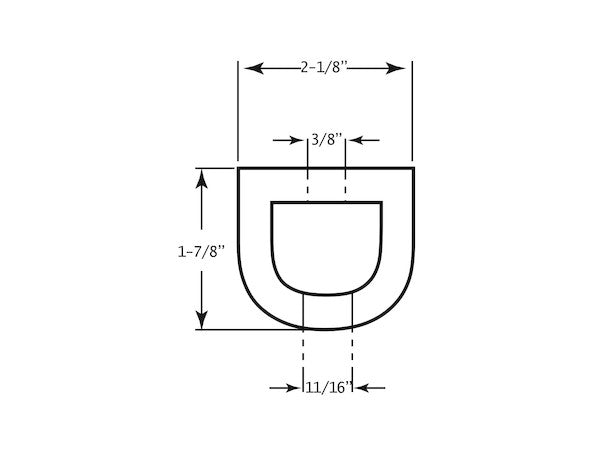
Buyers Products Extruded Rubber D-Shaped Bumpers help protect the rear of a truck or trailer when backing to an elevated loading dock. Bumpers are an ideal addition to any piece of equipment that has a high frequency of contact, such as a loading dock or delivery bay. The durable, heavy duty bumpers are available in a variety of sizes, thicknesses, and drill-hole configurations to meet your specifications.
Specifications
| A | 2-1/8 |
|---|---|
| B | 1-7/8 |
| C | 3/8 |
| C-C of Holes | 3.00 |
| D | 7/10 |
| Length | 6.00 |
| No. of Holes | 2 |
Advanced Technical Overview: Extruded Rubber D-Shaped Bumper System
The Extruded Rubber D-Shaped Bumper, meticulously engineered with two pre-drilled holes and precisely dimensioned at 2-1/8 inches by 1-7/8 inches by 6 inches long, represents a critical component in infrastructure protection and asset preservation across a diverse range of industrial and commercial applications. This technical exposition delves into the material science, manufacturing methodologies, geometric advantages, functional applications, and inherent durability that characterize this robust protective device. Designed to mitigate kinetic energy transfer during impact, these bumpers serve as indispensable buffers, safeguarding vehicles, loading docks, facilities, and valuable equipment from the stresses and damages associated with frequent contact.
Material Science and Composition: Engineering for Resilience
The superior performance of this D-shaped bumper originates from its high-grade extruded rubber composition. While specific rubber formulations can vary, typical materials employed for heavy-duty bumpers include blends of Styrene-Butadiene Rubber (SBR), Ethylene Propylene Diene Monomer (EPDM), or Natural Rubber. Each compound contributes distinct properties to the final product:
- SBR (Styrene-Butadiene Rubber): Known for its excellent abrasion resistance, high tensile strength, and good impact resilience. It offers a cost-effective solution with reliable performance in demanding environments.
- EPDM (Ethylene Propylene Diene Monomer): Valued for its outstanding resistance to weathering, ozone, UV radiation, and extreme temperatures. EPDM ensures long-term integrity and performance in outdoor applications, resisting degradation from sun exposure and atmospheric pollutants.
- Natural Rubber: Offers superior elasticity, high tear strength, and excellent dynamic properties, making it highly effective at absorbing and dissipating significant impact energy.
The chosen rubber compound is engineered to exhibit specific durometer hardness, typically in the Shore A range, optimizing the balance between shock absorption and structural integrity. A carefully selected durometer ensures that the bumper is firm enough to resist deformation under constant pressure yet elastic enough to absorb substantial kinetic energy during impact, preventing the transmission of damaging forces to the protected assets. Furthermore, the material exhibits a low compression set, meaning it retains its original shape and spring-back capabilities even after prolonged periods of compression, thereby ensuring consistent protective performance over its operational lifespan. The viscoelastic properties of the rubber enable it to dissipate impact energy through molecular friction, converting mechanical energy into heat, and thus preventing direct force transmission.
The Extrusion Process: Precision and Performance Consistency
The manufacturing process for this bumper involves rubber extrusion, a continuous and highly controlled method that yields profiles with exceptional uniformity and precision. This process begins with the raw rubber compound being fed into an extruder, where it is heated, softened, and then forced through a die shaped to the exact D-profile. As the rubber exits the die, it forms a continuous length of the desired cross-section. This extruded profile then undergoes a vulcanization (curing) process, where it is subjected to heat and pressure to chemically cross-link the polymer chains, transforming the material into a highly stable and durable elastic product. The benefits of the extrusion process for bumper manufacturing are manifold:
- Uniformity: Ensures consistent dimensions and material density throughout the entire length of the bumper, which is crucial for predictable performance and load distribution.
- Cost-Effectiveness: Enables efficient production of standard profiles in long continuous lengths, reducing material waste and manufacturing costs.
- Optimized Properties: The controlled heating and shaping during extrusion, followed by precise vulcanization, enhance the material's physical properties, including tensile strength, elongation, and tear resistance.
- Design Flexibility: While this specific product features a D-shape, extrusion allows for a wide array of complex profiles, offering versatility for different protective requirements.
For the 6-inch bumper segments, the continuous extruded profile is precisely cut to length, and then two mounting holes are accurately drilled at a 3.00-inch center-to-center (C-C) spacing. This meticulous manufacturing ensures that each bumper segment adheres to exact specifications, facilitating straightforward and consistent installation.
D-Shaped Geometry: Engineering for Optimal Impact Absorption and Protection
The distinctive D-shaped profile of this bumper is not merely aesthetic; it is a deliberate engineering choice that optimizes impact absorption and provides multifaceted protection. The specific dimensions of 2-1/8 inches (A) and 1-7/8 inches (B) denote the overall depth and height of the bumper's cross-section, respectively. These substantial dimensions provide a significant standoff distance, creating a robust protective buffer between the contacting surfaces.
- Flat Back Surface: The flat side of the 'D' provides a stable and secure mounting surface, ensuring maximum contact with the substrate (e.g., truck chassis, dock frame). This distributes the mounting forces effectively, preventing localized stress on the attachment points and enhancing the bumper's shear strength against lateral impacts.
- Rounded Front Surface: The curved front face is specifically designed to absorb and deflect impact forces. Upon contact, the rounded profile allows for gradual compression and deformation of the rubber, distributing the kinetic energy over a larger surface area and a longer duration. This progressive energy dissipation significantly reduces the peak impact force transmitted to the protected structure. Furthermore, the smooth, rounded contour minimizes the risk of snagging, gouging, or tearing of contacting surfaces, such as trailer doors or building facades.
- Internal Geometry (C and D dimensions): The specifications for 'C' (3/8 inch) and 'D' (7/10 inch) likely refer to critical internal structural elements of the D-profile, such as wall thicknesses, internal radii, or base plate thickness for the mounting flange. These dimensions are crucial for maintaining the bumper's structural integrity, preventing buckling under compression, and ensuring its durability through countless impact cycles. The precise wall thickness (C) contributes to the bumper's overall stiffness and resilience, while the base thickness (D) provides a solid foundation for secure fastening.
- Length and Hole Configuration: The 6-inch length of this bumper segment, coupled with two precisely drilled holes at a 3.00-inch C-C spacing, facilitates modular installation. This configuration allows for strategic placement of bumpers at critical impact points, or for the creation of continuous protective strips by aligning multiple segments. The two-hole design, positioned for optimal load distribution, ensures that the bumper is securely fastened to withstand both direct compressive forces and lateral shear forces associated with scraping or glancing blows. The specific C-C distance of 3.00 inches ensures that standard fasteners can be utilized, providing a strong and stable anchor.
Comprehensive Application Versatility and Performance Benefits
The Extruded Rubber D-Shaped Bumper is a versatile protective solution with applications extending far beyond its primary role at elevated loading docks. Its heavy-duty construction and resilient design make it indispensable across numerous sectors:
- Commercial Vehicle Fleets: Essential for delivery trucks, semi-trailers, refuse trucks, utility vehicles, and specialized transport equipment. It protects the rear and side chassis components, taillights, bodywork, and cargo from damage during docking, maneuvering in tight spaces, or accidental contact with obstacles.
- Loading Docks and Distribution Centers: Permanently installed on dock faces, building corners, and internal facility walls. They protect concrete, masonry, and steel structures from impact damage caused by backing vehicles, thereby preserving structural integrity, reducing maintenance costs, and maintaining operational efficiency.
- Industrial and Manufacturing Facilities: Utilized in warehouses, production lines, and material handling zones to protect machinery, support columns, conveyor systems, and sensitive equipment from forklift impacts or other vehicular traffic.
- Marine and Port Applications: Employed on smaller marine vessels, dock pilings, and piers to absorb impacts during berthing, preventing damage to both vessels and infrastructure.
- Parking Garages and Public Facilities: Installed on columns, walls, and ramps to prevent vehicle damage and protect structural elements in high-traffic parking environments.
- Construction Equipment: Integrated into various construction vehicles and temporary structures for localized impact protection.
Beyond direct damage mitigation, the bumpers provide substantial operational and safety benefits:
- Reduced Maintenance and Repair Costs: By preventing structural damage to vehicles and facilities, these bumpers drastically lower repair expenses and extend the operational lifespan of assets.
- Enhanced Safety: Absorbing impact energy protects personnel from sudden jolts and reduces the risk of injuries caused by uncontrolled impacts. It also prevents structural failures that could pose safety hazards.
- Minimized Downtime: Fewer repairs mean less time vehicles or facilities are out of service, ensuring continuous operational flow and productivity.
- Noise Reduction: The inherent properties of rubber contribute to dampening impact noise, creating a quieter working environment.
- Aesthetic Preservation: Protects the visual integrity of buildings and vehicles by preventing unsightly dents, scrapes, and gouges.
Installation Protocol and Best Practices
Proper installation is paramount to ensuring the optimal performance and longevity of the Extruded Rubber D-Shaped Bumper. The two pre-drilled holes with a 3.00-inch C-C spacing simplify the mounting process, but careful consideration of hardware and substrate is essential:
- Mounting Hardware: For secure attachment, heavy-duty fasteners are recommended. Depending on the substrate, this may include galvanized or stainless steel bolts, lag screws, or concrete anchors. The diameter of the fasteners should be appropriate for the hole size (D, 7/10 inch, likely indicating the hole diameter), allowing for a snug fit without excessive play. Flat and lock washers should be used to distribute clamping force evenly and prevent loosening under vibration or impact.
-
Substrate Compatibility:
- Steel Surfaces: Utilize high-strength bolts and nuts, ensuring proper torque specifications are met. Consider backing plates for thinner gauge steel to prevent deformation.
- Concrete/Masonry: Employ expanding anchors or chemical anchors for a secure hold. Pre-drilling accurate pilot holes is critical.
- Wood Surfaces: Heavy-duty lag screws or through-bolts with washers and nuts are suitable, particularly for thick structural timber.
- Alignment and Spacing: When installing multiple bumpers, precise alignment and consistent spacing are important, not only for aesthetics but also for ensuring uniform protection and load distribution across the entire protected area.
- Torque Specifications: Fasteners should be tightened to the manufacturer's recommended torque specifications to prevent overtightening, which can damage the rubber or the substrate, or undertightening, which can lead to bumper detachment.
The robust two-hole mounting configuration, combined with the material's inherent resistance to shear and tensile forces, ensures that the bumper remains securely in place even after repeated, high-energy impacts.
Durability, Longevity, and Environmental Resilience
The engineering behind this Extruded Rubber D-Shaped Bumper ensures exceptional durability and a long service life, even in the most challenging industrial environments. The chosen rubber compound is specifically formulated to resist:
- Abrasion: Withstands repeated scraping and rubbing, common during vehicle maneuvers.
- Tearing and Punctures: Designed to resist tearing and puncture from sharp edges or protrusions, maintaining its structural integrity.
- Weathering: Excellent resistance to rain, snow, ice, and extreme temperature fluctuations, preventing cracking, hardening, or softening.
- UV and Ozone Degradation: Essential for outdoor applications, preventing material breakdown from prolonged exposure to sunlight and atmospheric ozone.
- Chemical Exposure: Resists common industrial chemicals, oils, fuels, road salts, and cleaning agents, ensuring consistent performance without material degradation.
Minimal maintenance is required, typically limited to periodic inspection for damage and routine cleaning. The long-term value proposition of these bumpers is significant, offering a strong return on investment by drastically reducing the frequency and cost of vehicle and facility repairs, extending asset life, and maintaining a safer, more efficient operational environment. This robust construction positions the Buyers Products Extruded Rubber D-Shaped Bumper as a superior solution for sustained, heavy-duty impact protection.