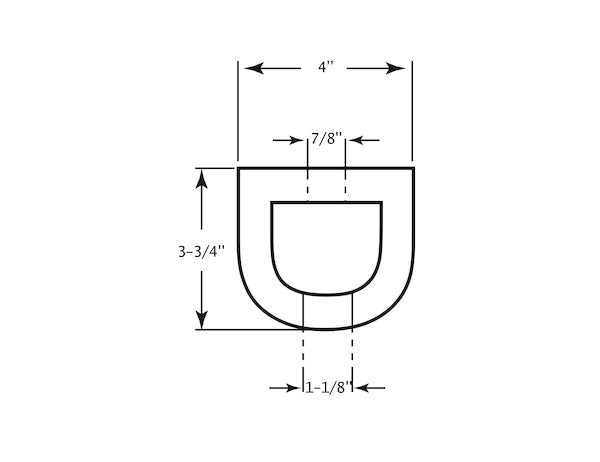
Buyers Products Extruded Rubber D-Shaped Bumpers help protect the rear of a truck or trailer when backing to an elevated loading dock. Bumpers are an ideal addition to any piece of equipment that has a high frequency of contact, such as a loading dock or delivery bay. The durable, heavy duty bumpers are available in a variety of sizes, thicknesses, and drill-hole configurations to meet your specifications.
Specifications
| A | 4.00 |
|---|---|
| B | 3-3/4 |
| C | 7/8 |
| C-C of Holes | 3-1/8 |
| D | 1-1/8 |
| Length | 6.00 |
| No. of Holes | 2 |
The Extruded Rubber D-Shaped Bumper with 2 Holes, measuring 4 x 3-3/4 x 6 inches long, represents a critical component in the comprehensive strategy for asset protection and operational efficiency across a multitude of industrial, commercial, and logistical environments. Engineered for superior impact absorption and longevity, this heavy-duty bumper mitigates the destructive forces inherent in repeated contact between vehicles, equipment, and fixed structures. Its meticulous design and robust material composition underscore its indispensable role in preventing costly damage, reducing downtime, and enhancing safety protocols in high-frequency contact zones such as loading docks, delivery bays, and operational vehicle fleets.
Central to the bumper's performance is its manufacturing process: extrusion. Extrusion involves forcing raw rubber compound through a die of the desired cross-section. This continuous process ensures a uniform profile, consistent material density, and excellent dimensional stability across the entire length of the bumper. The rubber compound, typically a high-grade blend of Styrene Butadiene Rubber (SBR), Natural Rubber (NR), or Ethylene Propylene Diene Monomer (EPDM), is chosen for its specific elastomeric properties. SBR offers excellent abrasion resistance and impact resilience, making it ideal for heavy-duty applications. NR provides superior elasticity and tear strength, contributing to the bumper's ability to recover from deformation. EPDM, when incorporated, imparts exceptional resistance to weathering, ozone, UV radiation, and extreme temperatures, ensuring the bumper maintains its structural integrity and performance characteristics in diverse outdoor and challenging environmental conditions. The extrusion process also allows for the integration of reinforcing fillers and curing agents, which are homogeneously dispersed throughout the polymer matrix, optimizing the material's mechanical properties, including hardness, tensile strength, and compression set. The subsequent vulcanization or curing phase transforms the raw rubber into a stable, highly elastic thermoset material, locking in its shape and performance attributes permanently.
The D-shaped profile is a deliberate design choice, offering specific functional advantages. The flat rear surface provides an expansive, stable mounting platform, ensuring optimal contact with the mounting substrate (e.g., steel, concrete, wood). This maximizes the shear and tensile strength of the attachment, preventing detachment under impact. The rounded, semi-circular front surface is engineered to absorb and dissipate kinetic energy efficiently. Upon impact, the curved surface allows for a gradual deformation of the rubber, distributing the force over a larger area and a longer duration. This progressive absorption reduces the peak force exerted on both the impacting object (e.g., a truck’s chassis) and the protected structure (e.g., a loading dock wall), significantly minimizing the potential for structural damage, material fatigue, and paint abrasion. The D-shape also prevents snagging or abrupt stopping, allowing for a controlled interaction during contact events. This geometric optimization is critical in applications where precise maneuvering and repeated contact are common.
The specific dimensions of this bumper – 4 inches in height (Dimension A), 3-3/4 inches in projection or width (Dimension B), and 6 inches in length – are carefully selected for a range of common applications. The 4-inch height provides substantial vertical coverage, suitable for protecting the lower rear sections of trucks, trailers, and equipment from dock edges and other ground-level obstructions. The 3-3/4-inch projection offers a significant buffer zone, ensuring that the primary structure remains clear of direct impact even during substantial compressive events. The 6-inch length makes this bumper a versatile unit for modular installation. Multiple 6-inch sections can be installed end-to-end to create continuous protective barriers of any desired length, or they can be strategically placed as individual spot protectors where concentrated impact zones are identified. This modularity allows for cost-effective replacement of damaged sections without requiring the overhaul of an entire protective strip.
The inclusion of two pre-drilled holes for mounting is a fundamental aspect of this bumper's practical design. The specified “No. of Holes: 2” signifies a standard and robust mounting configuration for this length of bumper, providing secure attachment points. The “C-C of Holes” (center-to-center of holes) dimension, at 3-1/8 inches, is crucial for proper alignment and fastener selection. This spacing ensures even distribution of mounting forces and prevents localized stress concentrations around individual fasteners. The hole diameter, indicated by “C: 7/8 inch”, specifies the appropriate size for accommodating heavy-duty bolts, typically 5/8-inch or 3/4-inch diameter, allowing for some tolerance during installation. The “D: 1-1/8 inches” likely refers to the edge distance, the measurement from the center of the hole to the nearest edge of the bumper. An adequate edge distance is vital to prevent tear-out of the rubber material under shear or tensile stress from the fasteners during impact. For secure installation, it is recommended to use high-strength, corrosion-resistant hardware such as Grade 8 bolts, oversized flat washers, and locking nuts. The oversized washers distribute the clamping force over a larger surface area of the rubber, minimizing localized compression and pull-through, especially under dynamic loads. Proper torque application for fasteners is also essential, ensuring the bumper is firmly secured without over-compressing the rubber and compromising its long-term integrity.
The functional benefits of employing such an engineered bumper are extensive and contribute directly to operational longevity and safety. Foremost is superior impact energy absorption. When a vehicle backs into a loading dock, significant kinetic energy is generated. The elastomeric nature of the D-shaped bumper allows it to deform under impact, converting this kinetic energy into strain energy, which is then slowly released as the bumper returns to its original shape. This process dissipates harmful forces that would otherwise be directly transmitted to the vehicle’s chassis, suspension, and body, as well as the structural elements of the loading dock or building. This significantly reduces maintenance costs for both vehicles and infrastructure, extending their operational lifespans. Furthermore, the material’s high abrasion resistance safeguards against the wear and tear caused by repetitive rubbing or scraping actions, which are common in busy logistical environments.
Environmental resistance is another critical performance characteristic. The chosen rubber compounds exhibit excellent resilience to environmental factors. EPDM-based compounds, for instance, offer exceptional resistance to UV radiation and ozone, preventing common issues like cracking, hardening, and degradation that plague lesser quality rubber products exposed to sunlight and atmospheric pollutants. This ensures the bumper maintains its physical properties and aesthetic appearance over prolonged periods of outdoor exposure. Temperature stability is also paramount; these bumpers are designed to perform reliably across a broad temperature range, typically from -40°F (-40°C) to 150°F (65°C), without significant loss of elasticity or becoming brittle. Resistance to moisture, de-icing salts, and common industrial chemicals (such as oils, greases, and fuels) further enhances their utility and lifespan in demanding settings, preventing material degradation that could compromise protective capabilities.
Beyond physical protection, these bumpers contribute to a safer and quieter working environment. As impact isolators, they effectively damp vibrations and significantly reduce the noise associated with vehicle-to-structure contact. This acoustic dampening is beneficial in urban environments or facilities where noise pollution is a concern. The non-marking properties of the rubber compound prevent unsightly scuffs and marks on vehicles and building surfaces, preserving the professional appearance of both assets and facilities. This is particularly important for vehicles with custom paint jobs or facilities that maintain high aesthetic standards. The comprehensive protection offered translates directly into a strong return on investment through reduced repair expenses, minimized vehicle and facility downtime, and improved worker safety by preventing injuries from unexpected impacts.
The application spectrum for the Extruded Rubber D-Shaped Bumper is remarkably diverse. In the logistics and transportation sector, they are indispensable for loading docks, providing essential cushioning for the rear of trucks, trailers, and even specialized transport vehicles like refuse haulers and delivery vans. They protect the dock structures themselves from structural fatigue and damage. Within industrial facilities, these bumpers safeguard warehouse walls, manufacturing equipment, and material handling systems from damage caused by forklifts, pallet jacks, and carts. They are also crucial for protecting valuable machinery, heavy gates, and columns within plants. The marine industry benefits greatly, with these bumpers deployed on docks, piers, and even on the hulls of smaller vessels like tugboats and barges, providing vital fendering against collisions with other boats or dock structures. In the construction and infrastructure domain, they can be affixed to heavy construction equipment, temporary barriers, bridge abutments, and parking garage columns to prevent damage from vehicle impacts. Commercial buildings utilize them in service entrances, retail loading zones, and underground parking facilities to protect architectural elements and vehicle paintwork from accidental contact.
Proper installation and periodic maintenance are crucial for maximizing the effectiveness and lifespan of these bumpers. Before installation, the mounting surface should be inspected to ensure it is clean, flat, and structurally sound. Any inconsistencies or damage to the substrate should be addressed. The specified hole patterns allow for precise alignment. As previously noted, the use of high-grade fasteners, generously sized washers, and locking nuts is critical for a secure and durable attachment. Fasteners should be tightened to the manufacturer's recommended torque specifications to prevent both under-tightening, which can lead to loosening, and over-tightening, which can compress and damage the rubber or the mounting surface. Regular visual inspections should be conducted to check for signs of wear, cuts, tears, or excessive compression set. The integrity of the fasteners should also be verified periodically to ensure they remain tightly secured. Bumpers showing significant degradation, deep gouges, or exposed mounting hardware should be promptly replaced to maintain optimal protection. Proactive replacement prevents further damage and ensures continuous operational safety.
Ultimately, the Extruded Rubber D-Shaped Bumper with 2 Holes (4 x 3-3/4 x 6 inches long) is more than just a simple rubber block; it is a meticulously engineered safety and protective component. Its design embodies a sophisticated understanding of material science, mechanical engineering, and practical application demands. By combining a durable, weather-resistant rubber compound with a force-distributing D-shaped profile and a secure, pre-drilled mounting system, this product offers an unparalleled solution for impact mitigation. Its multifaceted benefits—ranging from superior physical protection and extended asset lifespan to enhanced operational safety and reduced maintenance costs—make it an indispensable investment for any enterprise operating in environments susceptible to frequent and impactful contact. This bumper stands as a testament to thoughtful industrial design, delivering robust performance and long-term value in the most demanding conditions.