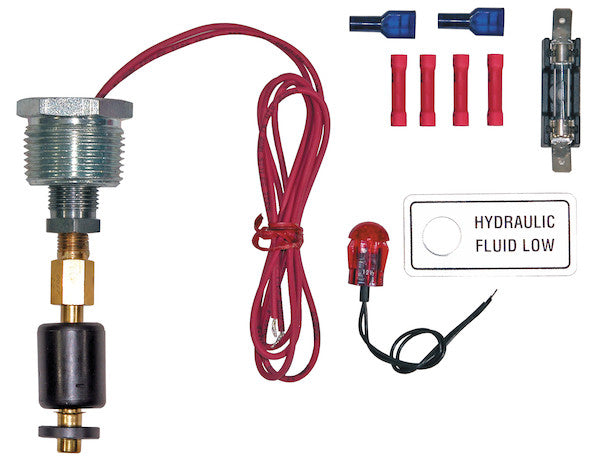
The Oil Level Sensor Kit from Buyers Products helps protect your vehicle's hydraulic system by giving you an in-cab alert, when oil level is too low. Install the kit in a 1 in. NPT port at the top of your reservoir. The indicator light will press into any 1/2 in. diameter hole.
Specifications
| Adjustable | Yes |
|---|---|
| Indicator Light | Yes |
| Mount Style | Thru Port |
| Slosh Shield | No |
| Thread | 1 NPT |
Advanced Hydraulic System Protection with the Buyers Products Oil Level Sensor Kit
In the demanding operational environments of commercial vehicles and industrial machinery, the integrity and optimal performance of hydraulic systems are paramount. These systems are the workhorses behind numerous critical functions, from lifting and dumping to steering and braking. A consistent and adequate supply of hydraulic fluid is fundamental to their longevity and efficiency. The Buyers Products Oil Level Sensor Kit represents a crucial advancement in proactive maintenance and system safeguarding, providing real-time, in-cab alerts to operators regarding critically low hydraulic oil levels. This preventative measure is designed to mitigate the risks associated with fluid depletion, ensuring continuous operational readiness and significantly reducing the potential for costly equipment damage and unexpected downtime.
The Critical Role of Hydraulic Fluid in System Integrity
Hydraulic fluid serves multiple vital functions within a system: it transmits power, lubricates moving components, dissipates heat, and flushes away contaminants. A sufficient volume of this fluid is indispensable for each of these roles. When the hydraulic fluid level falls below a safe operational threshold, the system becomes highly susceptible to a cascade of detrimental effects. The most immediate and severe consequence is often cavitation at the hydraulic pump inlet. Cavitation occurs when insufficient fluid is available, causing pressure in the pump suction line to drop below the vapor pressure of the fluid. This leads to the formation of vapor bubbles, which then violently collapse as they pass through the pump's higher pressure zones. The implosion of these bubbles generates localized shockwaves, eroding pump components, causing excessive noise, and leading to premature pump failure. Beyond the pump, inadequate fluid levels can compromise the lubrication of valves, cylinders, and motors, accelerating wear on seals, bearings, and other precision-engineered parts.
Furthermore, a reduced fluid volume diminishes the system's capacity to dissipate heat effectively. Hydraulic systems inherently generate heat during operation due to fluid friction, internal leakage, and component resistance. With less fluid, the thermal load per unit volume increases, leading to elevated operating temperatures. Excessive heat degrades the hydraulic fluid itself, breaking down its lubricating properties and accelerating oxidation, which forms sludge and varnish. These contaminants further exacerbate wear, clog filters, and can lead to sluggish system response or complete component seizure. The cumulative effect of low fluid levels, therefore, is a significant reduction in component lifespan, compromised system performance, increased maintenance frequency, and a heightened risk of catastrophic failure, all of which translate directly into increased operational costs and reduced productivity. The implementation of an immediate alert system, such as the Buyers Products Oil Level Sensor Kit, empowers operators to address these issues proactively, often before irreversible damage occurs.
Technical Functionality and Sensing Mechanism
The Buyers Products Oil Level Sensor Kit is engineered for precision and reliability, utilizing a robust sensing mechanism tailored for demanding hydraulic applications. While the specific internal workings of all level sensors vary, the "Thru Port" mounting style at the "top of your reservoir" and the "Adjustable" feature strongly suggest a float-type level sensor. In this configuration, the sensor typically comprises a sealed stem housing a reed switch and a buoyant float that encases a magnet. As the hydraulic fluid level changes, the float moves along the stem. When the float reaches a predetermined low-level threshold, the magnet inside the float actuates the reed switch, completing an electrical circuit. This action then triggers the in-cab indicator light, alerting the operator to the critical fluid status.
The "Adjustable" feature is a key differentiator, allowing for fine-tuning of the activation point. This adjustability is crucial because different hydraulic systems may have varying minimum safe operating levels, or operators may prefer different buffer zones before an alert is triggered. This customization is often achieved by repositioning the float or an internal sensing element along the stem, or by adjusting a set screw that alters the magnetic field sensitivity, thereby setting the precise point at which the electrical contact is made or broken. This flexibility ensures the sensor can be optimally calibrated for a wide range of hydraulic reservoir designs and operational parameters, providing a tailored warning system that precisely meets the needs of specific applications.
The sensor unit itself is designed for direct integration into a hydraulic reservoir via a 1 in. NPT (National Pipe Taper) port. NPT threading is a widely recognized standard in hydraulic and fluid power systems, ensuring a secure, leak-free connection when properly installed with appropriate sealing compounds. The 1-inch size provides ample mechanical strength and allows for a sufficiently robust sensor body. The "Thru Port" mounting style implies that the sensor stem extends down into the reservoir from the top, providing a reliable measurement path that is less susceptible to external interference compared to external or side-mounted solutions, particularly for low-level detection where the critical point is often well below the reservoir top surface.
Key Features, Technical Specifications, and Operational Benefits
The design and specifications of the Buyers Products Oil Level Sensor Kit are meticulously chosen to deliver maximum utility and durability in challenging operational environments:
- In-Cab Alert System: The primary function of this kit is to provide an immediate and unmistakable in-cab alert. This proactive notification empowers operators to react swiftly to low fluid conditions, either by refilling the reservoir or by safely shutting down the hydraulic system before damage occurs. This direct communication with the operator is superior to relying solely on scheduled maintenance checks or visual inspections, which may be missed or delayed during demanding work cycles. The visual indicator light, which presses into any standard 1/2 in. diameter hole, is strategically designed for easy integration into existing dashboard panels, offering a clear and visible warning without requiring complex displays or intricate wiring.
- Adjustable Threshold Setting: As highlighted, the adjustable nature of the sensor is a significant advantage. This allows for precise calibration to the specific minimum safe operating level of the hydraulic system in which it is installed. Whether a system has a critical threshold at 5% or 15% of total volume, the sensor can be configured to activate at the exact point required. This flexibility prevents nuisance alerts while ensuring that critical warnings are issued only when necessary, fostering operator trust in the system.
- 1 in. NPT Threaded Connection: The use of a 1 in. NPT thread for installation is a testament to the kit's robust and industry-standard design. NPT threads are self-sealing due to their tapered design, forming a tight mechanical seal as they are tightened. This ensures a secure, leak-proof connection to the reservoir, crucial for hydraulic systems where fluid containment is critical. The commonality of NPT ports across a wide array of hydraulic reservoirs also simplifies installation and ensures broad compatibility.
- Thru Port Mount Style: This mounting configuration places the sensor directly into the fluid path from the top of the reservoir. This method offers several benefits: it generally provides a more accurate level reading for low-level detection compared to external sight gauges, is protected from external impacts, and facilitates easier maintenance or replacement without requiring the reservoir to be drained completely if the sensor is positioned above the current fluid level during a repair.
- Slosh Shield (No): While the specification indicates "Slosh Shield: No," it's important to understand the context. For a basic low-level alert sensor mounted at the top of the reservoir, a slosh shield might be considered overkill. Slosh shields are typically more critical for continuous level sensing applications in highly dynamic environments (e.g., fuel tanks on off-road vehicles) where rapid fluid movement could cause momentary false readings. For a static low-level alarm that triggers at a specific, often lower, point, momentary sloshing is less likely to cause a false positive as the fluid would need to be persistently below the threshold for the float to remain in the alarm position.
- Durable Construction: Although not explicitly detailed in the brief description, sensors for hydraulic applications are typically constructed from materials highly resistant to corrosion, hydraulic fluids, and vibration. Common materials include stainless steel for the stem, nitrile or viton for seals, and robust polymers for floats and electrical housings. This ensures the sensor's longevity and reliable operation even in harsh industrial and mobile environments.
Applications and Compatibility
The versatility and critical function of the Buyers Products Oil Level Sensor Kit make it an indispensable component across a vast spectrum of commercial and industrial applications. Any vehicle or piece of equipment reliant on a hydraulic system for its primary functions stands to benefit significantly from this preventative measure. Key application areas include:
- Commercial Trucks: Dump trucks, refuse vehicles, tow trucks, and cement mixers all utilize hydraulic systems for their specialized functions. Ensuring optimal hydraulic fluid levels is crucial for their continuous operation and to prevent expensive repairs that can result in significant revenue loss due to downtime.
- Snow and Ice Control Equipment: Snowplows, salt spreaders, and de-icing units depend heavily on hydraulics for blade articulation, material dispersal, and equipment positioning. Operating these systems in extreme cold with insufficient fluid can exacerbate wear and increase the risk of freezing or component failure.
- Construction Machinery: Excavators, loaders, backhoes, and bulldozers are prime examples of equipment where hydraulic system health directly correlates with productivity and safety. A low oil level alert prevents critical component damage in demanding digging, lifting, and moving operations.
- Agricultural Equipment: Tractors, harvesters, and sprayers employ complex hydraulic circuits for implement control, steering, and power take-off (PTO) functions. Reliable fluid level monitoring is vital for maintaining uptime during critical planting and harvesting seasons.
- Utility Vehicles: Bucket trucks, digger derricks, and other utility service vehicles rely on hydraulics for personnel lifting and tool operation. Protecting these systems is paramount not only for equipment longevity but also for worker safety.
- Material Handling Equipment: Forklifts, reach trucks, and other warehouse equipment often use hydraulics for lifting and tilting. A low oil level sensor helps prevent damage to lifting mechanisms and ensures safe operation.
The standard 1 in. NPT thread and universal 12V or 24V compatibility (typical for most vehicle electrical systems, though not explicitly stated for this kit, it's a common assumption for in-cab alerts) further enhance its broad applicability, allowing seamless integration into new installations or as an upgrade to existing hydraulic reservoirs across diverse fleets and machinery.
Installation, Wiring, and Adjustment Procedures
The installation of the Buyers Products Oil Level Sensor Kit is straightforward, designed for efficiency while ensuring maximum reliability. However, it is recommended that installation be performed by a qualified technician familiar with hydraulic systems and vehicle electrical wiring.
Pre-Installation Checks:
- System Deactivation: Ensure the vehicle or equipment is completely shut down, and the hydraulic system is depressurized to prevent accidental activation or fluid discharge.
- Reservoir Preparation: Verify that the hydraulic reservoir has an available 1 in. NPT port at the top that can accommodate the sensor. If not, a suitable port may need to be drilled and threaded, which requires specialized tools and expertise to maintain reservoir integrity and prevent contamination.
- Fluid Compatibility: While standard, confirm the sensor's materials are compatible with the specific hydraulic fluid used in the system.
Sensor Unit Installation:
- Thread Preparation: Apply a high-quality thread sealant, such as PTFE tape or liquid pipe sealant suitable for hydraulic applications, to the 1 in. NPT threads of the sensor unit. This ensures a leak-proof seal.
- Mounting: Carefully thread the sensor unit into the designated 1 in. NPT port at the top of the hydraulic reservoir. Hand-tighten first, then use an appropriate wrench to tighten until snug, ensuring proper alignment without over-tightening, which can damage the threads or the sensor body.
Indicator Light Installation:
- Dashboard Placement: Select a visible and accessible location on the vehicle's dashboard or control panel for the 1/2 in. diameter indicator light. Ensure there is sufficient clearance behind the panel for wiring.
- Hole Drilling: Using a 1/2 in. drill bit, carefully drill a pilot hole and then the final mounting hole for the indicator light. Deburr the edges to prevent wire chafing.
- Mounting: Insert the indicator light into the drilled hole. Most such lights are designed for a snug, press-fit, or feature a locking nut to secure them in place.
Electrical Wiring:
A typical wiring scheme for this type of kit involves connecting the sensor to the indicator light and then to the vehicle's power and ground. While specific instructions will accompany the kit, a general outline includes:
- Power Source: Connect the indicator light's positive terminal to a fused 12V or 24V (depending on vehicle voltage) ignition-switched power source. This ensures the light is active only when the vehicle is running.
- Ground Connection: Connect the indicator light's negative terminal to a reliable chassis ground point.
- Sensor Connection: The oil level sensor will have output wires. One wire typically connects to the remaining input terminal of the indicator light. The other sensor wire will connect to a reliable ground. When the oil level drops below the set point, the sensor closes a circuit, allowing current to flow from the fused power source, through the indicator light, through the sensor, and to ground, illuminating the light. Ensure all electrical connections are secure, insulated, and protected from environmental exposure using heat shrink tubing, electrical tape, or appropriate connectors.
Adjustment Procedure:
After installation, the "Adjustable" feature of the sensor allows for precise calibration. This typically involves:
- Initial Fluid Level: Ensure the hydraulic reservoir is filled to its recommended operating level.
- Setting the Trip Point: With the hydraulic system at a known low, but not critical, level, the adjustment mechanism on the sensor (e.g., an external screw or a movable collar) can be manipulated until the indicator light just illuminates. This sets the desired low-level alert threshold.
- Verification: Cycle the hydraulic system, and potentially intentionally lower the fluid level slightly, to confirm that the indicator light activates consistently and accurately at the desired point.
Maintenance, Durability, and Longevity
The Buyers Products Oil Level Sensor Kit is engineered for minimal maintenance, a testament to its robust design and quality materials. However, periodic inspection can further ensure its continued reliability:
- Visual Inspection: Periodically check the sensor unit for any signs of physical damage, corrosion, or fluid leakage around the NPT connection. Ensure the indicator light in the cab is clean and clearly visible.
- Wiring Integrity: Inspect all electrical wiring for fraying, loose connections, or damaged insulation. Secure or repair any compromised wiring to prevent intermittent operation or electrical shorts.
- Functional Test: While difficult to perform without intentionally lowering the fluid level, a simple functional test involves confirming the indicator light illuminates briefly upon vehicle startup (if designed to self-test) or through system diagnostic tools if available. If the reservoir has a dedicated drain, a controlled drain to the alarm level can confirm functionality, followed by immediate refill.
The durability of the sensor is inherent in its construction. Components designed for hydraulic environments are resistant to the chemicals found in hydraulic fluids, extreme temperatures, and constant vibration. This ensures a long operational lifespan, providing reliable protection for the hydraulic system throughout the service life of the vehicle or equipment.
Conclusion
The Buyers Products Oil Level Sensor Kit is an essential investment for any operator or fleet manager prioritizing the health and longevity of their hydraulic systems. By providing a clear, immediate, and adjustable in-cab warning of critically low hydraulic fluid levels, this kit transforms reactive repair strategies into proactive maintenance protocols. It safeguards against the catastrophic failures, extensive downtime, and exorbitant repair costs associated with fluid depletion, ensuring that valuable equipment remains operational, efficient, and safe. Its robust design, industry-standard compatibility, and straightforward installation make it an indispensable upgrade for a wide array of demanding applications. Choose the Buyers Products Oil Level Sensor Kit to empower your operators with critical information and fortify your hydraulic assets against preventable damage, securing sustained performance and profitability.