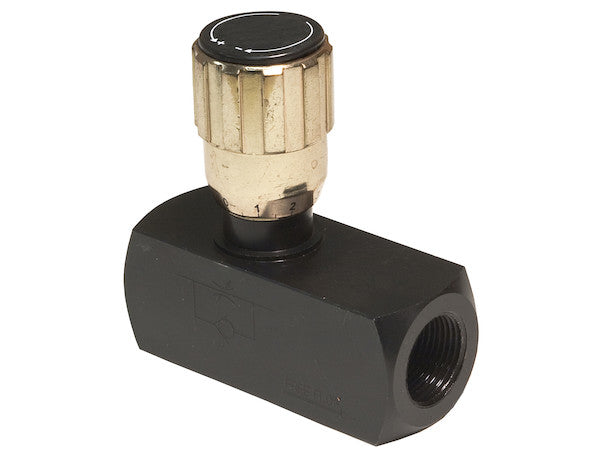
The Flow Control Valve from Buyers Products lets you speed up or slow down a function, such as plowing or dumping, for more precise and smooth control. The valve works by precisely controlling flow and shutoff in one direction, while automatically permitting full flow in the opposite direction. Choose from a range of NPT and SAE sizes in brass and steel.
Specifications
| Material | Carbon Steel |
|---|---|
| Maximum Body Pressure | 5000 |
| Maximum Flow Rate | 25 |
| Maximum Pressure | 5000 |
| Maximum Relief Pressure Setting | - |
| Number of Ports | 2 |
| Port Size | 3/4 SAE ORB (-12) |
The #12 SAE Steel Flow Control Valve: Precision Hydraulic Control for Demanding Applications
In the realm of hydraulic systems, the ability to precisely control the speed and movement of actuators is paramount for operational efficiency, safety, and the longevity of equipment. The #12 SAE Steel Flow Control Valve from Buyers Products represents a critical component engineered to meet these demands, providing unparalleled control over hydraulic fluid dynamics. This robust 2-port valve is meticulously designed to offer precise flow regulation in one direction while allowing unrestricted flow in the opposite, a fundamental capability for a vast array of mobile and industrial hydraulic applications. Its construction from high-grade carbon steel, combined with a 5000 PSI maximum pressure rating and a 25 GPM flow capacity, positions it as an indispensable solution for systems requiring durable, high-performance flow management.
Understanding Hydraulic Flow Control: Principles and Mechanisms
At its core, a flow control valve manipulates the rate at which hydraulic fluid travels through a circuit, thereby regulating the speed of hydraulic cylinders or motors. Unlike simple shut-off valves, which only open or close, flow control valves introduce a controlled restriction to the fluid path. The #12 SAE Steel Flow Control Valve operates on the principle of a metering orifice combined with an integral check valve. When fluid flows in the controlled direction, it must pass through an adjustable orifice, which can be precisely tuned to achieve the desired flow rate. This orifice effectively creates a pressure drop, thus limiting the volume of fluid passing per unit of time. The finer the adjustment, the more restricted the flow, and consequently, the slower the actuator movement.
Conversely, when fluid attempts to flow in the opposite direction, it encounters the check valve. This check valve is engineered to open automatically under reverse flow conditions, bypassing the metering orifice entirely. This ingenious design ensures that while the extension or retraction of a cylinder (or rotation of a motor) can be precisely controlled, the return stroke or reverse operation can occur at the maximum available system flow rate, without impedance from the flow control mechanism. This unidirectional control is a distinct advantage, optimizing cycle times and preventing unnecessary back pressure during uncontrolled movements. The valve’s design prioritizes both precise metering and efficient free-flow, striking a balance that is crucial for dynamic hydraulic applications.
Material Excellence: Carbon Steel for Superior Performance
The selection of material for hydraulic components is critical, directly impacting durability, pressure rating, and resistance to environmental factors. The #12 SAE Steel Flow Control Valve is constructed from high-quality carbon steel, a material renowned for its exceptional mechanical properties suitable for demanding hydraulic environments. Carbon steel offers a superior strength-to-weight ratio compared to other common valve materials like brass or aluminum, allowing it to withstand the extreme internal pressures and external stresses inherent in heavy-duty hydraulic systems. Its inherent toughness provides excellent resistance to fatigue, shock, and vibration, ensuring a long operational life even under continuous, high-cycle use.
Beyond its strength, carbon steel exhibits excellent wear resistance, which is crucial for internal valve components that experience constant fluid friction and pressure differentials. This material choice significantly minimizes erosion of the metering orifice and other internal surfaces, maintaining consistent performance and calibration over time. Furthermore, carbon steel offers good machinability, allowing for the precise manufacturing tolerances required for effective flow control and leak-free operation. While brass valves may be suitable for lower pressure or less corrosive applications, carbon steel is the unequivocal choice for the high-pressure, high-stress, and often abrasive conditions found in industrial and mobile hydraulic machinery, providing a robust and reliable foundation for the valve's overall performance.
Pressure Ratings: Engineered for High-Performance Systems
One of the standout specifications of the #12 SAE Steel Flow Control Valve is its impressive maximum body pressure and maximum pressure rating of 5000 PSI (pounds per square inch). This high-pressure capability underscores the valve's suitability for a wide spectrum of modern hydraulic systems that operate at elevated pressures to achieve greater force or torque with smaller components. A 5000 PSI rating is not merely a benchmark but a testament to the valve's robust engineering, ensuring structural integrity and reliable performance under severe operational conditions.
In practical terms, this high-pressure rating means the valve can be integrated into heavy-duty machinery such as large construction equipment, agricultural machinery, heavy-duty material handling systems, and industrial presses without fear of material failure or premature wear due to internal stresses. It also provides a significant safety margin, allowing the valve to safely handle pressure spikes or transient overpressures that can occur during system startup, sudden load changes, or emergency stops. Designing hydraulic components for pressures significantly above typical operating levels is a standard engineering practice to ensure safety and longevity, and this valve adheres to the highest standards. The ability to manage such high pressures also implies that the internal seals and connections are designed to a similar high standard, preventing leakage and maintaining system efficiency under extreme force.
Flow Rate Capacity: Optimized for Dynamic Control
With a maximum flow rate of 25 GPM (gallons per minute), the #12 SAE Steel Flow Control Valve is capable of managing a substantial volume of hydraulic fluid, making it appropriate for controlling medium to large-sized actuators. This flow capacity dictates the maximum speed at which an unladen actuator can move when the valve is fully open in the controlled direction, and more critically, it defines the range of speeds that can be achieved through metering. For instance, in applications like controlling the descent of a plow, the 25 GPM capacity allows for rapid lifting when the check valve is active, and a finely modulated descent speed through precise adjustment of the metering orifice, preventing uncontrolled free-fall.
The 25 GPM rating must be considered in conjunction with the system's pump output and the size of the actuators being controlled. For a hydraulic cylinder, the flow rate directly influences the extension or retraction speed. A higher flow rate capability in the valve ensures that it will not become a bottleneck in systems designed for higher speeds, even when only a fraction of that flow is being metered for precise control. This capacity allows for versatility across various applications, accommodating systems that might operate at lower average flows but require the potential for higher peak flows, or that utilize actuators with larger bore diameters requiring more fluid volume for movement. The combination of high-pressure and substantial flow rate capability makes this valve highly adaptable for complex hydraulic circuits.
Port Configuration: 2-Port Design with 3/4 SAE ORB (-12) Connection
The valve's 2-port configuration signifies a straightforward, inline design, facilitating easy integration into hydraulic lines. This simplicity is often preferred for applications where direct control over a single flow path is required. Each port serves a distinct function: one for fluid entry into the metering section and the other for fluid exit, ensuring clear and efficient directional flow control.
A critical technical detail is the port size: 3/4 SAE ORB (-12). SAE ORB, or SAE O-Ring Boss, connections are widely regarded as the gold standard in modern hydraulic systems, offering significant advantages over traditional pipe threads like NPT (National Pipe Taper). The "boss" portion of the fitting mates with a machined recess in the valve body, and an O-ring is compressed between the two surfaces to create a robust, leak-proof seal. The "-12" dash size designation corresponds to a 3/4-inch nominal tubing size, indicating the optimal pipe or hose diameter to match the valve's flow capacity and minimize pressure drop.
The benefits of SAE ORB connections are numerous:
- Superior Leak Resistance: The O-ring boss seal is inherently more resistant to leakage than metal-to-metal tapered thread seals (like NPT), especially under high pressure, vibration, and thermal cycling. This dramatically reduces downtime, fluid loss, and environmental contamination.
- Reduced Assembly Torque: Less torque is required to achieve an effective seal compared to NPT, minimizing the risk of over-tightening, thread damage, and cracked components.
- Reusability: SAE ORB fittings can be repeatedly disconnected and reconnected without compromising the seal, unlike NPT where thread sealant reapplication and potential thread wear are concerns.
- Vibration Resistance: The O-ring provides a degree of cushioning, making SAE ORB connections more resilient to vibration, a common issue in mobile hydraulic applications that can loosen NPT fittings.
- Cleanliness: The design minimizes potential for contamination from thread sealant or metal particles, crucial for maintaining hydraulic system cleanliness.
The adoption of the 3/4 SAE ORB (-12) standard for this flow control valve highlights its modern design and commitment to high-integrity connections, which is essential for maximizing the reliability and efficiency of any hydraulic system.
Operational Precision and Functional Benefits
The primary benefit of the #12 SAE Steel Flow Control Valve lies in its ability to provide precise and smooth control over hydraulic functions. Whether it's the controlled lowering of a snowplow blade, the gradual extension of a dump truck bed, or the finely tuned movement of an agricultural implement, this valve eliminates abrupt and jerky motions. This precision contributes significantly to:
- Enhanced Operator Control: Operators can achieve desired speeds with greater accuracy, reducing fatigue and increasing productivity.
- Improved Safety: Controlled movements prevent sudden drops or surges, minimizing the risk of accidents, equipment damage, or injury to personnel.
- Extended Equipment Life: Eliminating shock loads and sudden impacts reduces wear and tear on hydraulic cylinders, hoses, and structural components, thereby extending the overall lifespan of the machinery.
- Optimized Performance: Tasks requiring specific movement speeds, such as precision grading or material placement, can be performed with greater accuracy and consistency.
The automatic free flow in the opposite direction is equally critical. For instance, when lifting a plow, rapid movement is often desired to minimize cycle time, and the integrated check valve ensures that the return fluid encounters no unnecessary resistance, allowing the actuator to move at its maximum speed. This intelligent design optimizes both controlled and uncontrolled phases of operation, streamlining hydraulic system performance.
Diverse Applications Across Industries
The robust construction and precise control offered by the #12 SAE Steel Flow Control Valve make it suitable for an extensive range of applications across various industries:
-
Mobile Hydraulics:
- Snow and Ice Management: Precisely controlling the descent rate of plow blades, spreaders, and other attachments.
- Dump Trucks & Trailers: Regulating the lowering speed of dump beds to prevent damage or uncontrolled discharge.
- Refuse Collection: Managing the speed of compactor plates or lifter arms.
- Construction Equipment: Controlling the extension/retraction of outriggers, tilt functions on buckets, or other auxiliary movements on excavators, loaders, and backhoes.
- Utility Vehicles: Adjusting the speed of utility body cranes or aerial lifts.
-
Agricultural Equipment:
- Controlling the precise lowering of planters, cultivators, spray booms, or other implements to ensure even ground contact and application.
- Regulating the speed of hydraulic motors driving conveyors or feeders on harvesting equipment.
-
Industrial Hydraulics:
- Machine Tools: Controlling the feed rate of cutting tools or the speed of workholding clamps.
- Presses: Managing the descent speed of press platens for controlled forming or stamping operations.
- Material Handling: Regulating the speed of conveyor systems, lift tables, or robotic end effectors.
- Automation Systems: Any application requiring accurate and repeatable control over the speed of linear or rotary actuators.
Its versatility stems from its fundamental ability to govern fluid flow, a requirement common to countless hydraulic tasks where precise speed control is essential for optimal performance.
Installation, Maintenance, and System Integration Best Practices
Proper installation and routine maintenance are paramount to realizing the full potential and ensuring the longevity of the #12 SAE Steel Flow Control Valve. When integrating this valve into a hydraulic circuit, several best practices should be adhered to:
- System Cleanliness: Ensure the hydraulic system is thoroughly clean and free of contaminants before installation. Particulate matter is a leading cause of premature wear in hydraulic components, especially in metering orifices.
- Correct Orientation: Install the valve according to the directional flow arrows (if present) to ensure the metering function operates as intended in the desired direction, and the check valve provides free flow in the opposite direction.
- Proper Torque for SAE ORB Fittings: While SAE ORB connections are less prone to leakage than NPT, it is still crucial to apply the correct torque specifications to the fittings. Over-tightening can damage the O-ring or deform the metal, while under-tightening can lead to leaks. Refer to SAE J514 or manufacturer guidelines.
- Line Sizing: Ensure that the hydraulic lines leading to and from the valve are appropriately sized (e.g., 3/4-inch for -12 ORB) to match the valve's capacity and minimize pressure drops or excessive fluid velocity.
- Filtration: Integrate adequate hydraulic fluid filtration upstream of the flow control valve to protect its sensitive metering elements from abrasive particles.
Maintenance for the valve primarily involves ensuring the cleanliness of the hydraulic fluid and periodically inspecting the external body and connections for signs of leakage or damage. O-rings in SAE ORB connections are wear items and should be inspected and replaced if any signs of degradation are observed during system maintenance. The adjustability of the valve means periodic calibration or adjustment may be necessary based on specific application requirements and wear over time.
Quality Assurance and Reliability
As a product from Buyers Products, this flow control valve is manufactured to stringent quality standards, ensuring reliability and performance. Adherence to industry specifications for materials, pressure ratings, and porting (SAE ORB) guarantees compatibility and consistent operation within standard hydraulic systems. The commitment to engineering excellence translates into a component that not only meets but often exceeds the demanding operational expectations of commercial and industrial applications. This dedication to quality minimizes the risk of premature failure, reduces operational downtime, and provides a dependable solution for critical flow control needs.
Conclusion
The #12 SAE Steel Flow Control Valve is more than just a hydraulic component; it is a precision instrument designed to elevate the performance, safety, and longevity of hydraulic systems. With its robust carbon steel construction, high-pressure rating of 5000 PSI, substantial 25 GPM flow capacity, and the secure, leak-free 3/4 SAE ORB (-12) porting, this valve stands as a testament to advanced hydraulic engineering. Its ability to precisely meter flow in one direction while allowing free flow in the reverse offers unparalleled control for a myriad of functions, from heavy-duty plowing and dumping to intricate industrial automation. By ensuring smooth, controlled movements, it enhances operator efficiency, reduces equipment wear, and significantly contributes to overall operational safety. For engineers and operators seeking a reliable, high-performance solution for unidirectional hydraulic flow control in challenging environments, the #12 SAE Steel Flow Control Valve from Buyers Products represents an optimal choice, delivering precision and durability where it matters most.