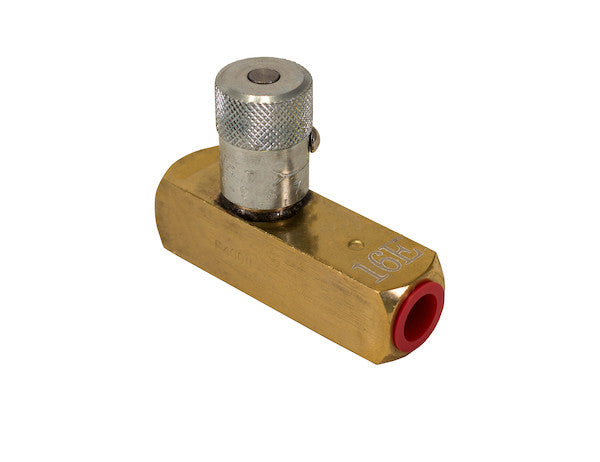
The Flow Control Valve from Buyers Products lets you speed up or slow down a function, such as plowing or dumping, for more precise and smooth control. The valve works by precisely controlling flow and shutoff in one direction, while automatically permitting full flow in the opposite direction. Choose from a range of NPT and SAE sizes in brass and steel.
Specifications
| Material | Brass |
|---|---|
| Maximum Body Pressure | 2000 |
| Maximum Flow Rate | 5 |
| Maximum Pressure | 2000 |
| Maximum Relief Pressure Setting | - |
| Number of Ports | 2 |
| Port Size | 1/4 NPTF |
The 1/4 Inch NPT Brass Flow Control Valve from Buyers Products represents a meticulously engineered solution for hydraulic systems requiring precise and adjustable control over actuator speed in a single direction, while simultaneously facilitating unimpeded fluid return flow. This component is foundational for optimizing operational efficiency, enhancing safety, and improving the tactile control of various hydraulic functions across numerous industrial, mobile, and agricultural applications. Its design, material composition, and performance specifications have been carefully selected to deliver reliable and consistent operation in demanding environments.
At its core, a flow control valve manipulates the speed of a hydraulic cylinder or motor by regulating the volumetric flow rate of hydraulic fluid entering or exiting the actuator. Unlike simple shutoff valves, flow control valves are designed for throttling, meaning they create a variable restriction to fluid flow. This specific model employs a sophisticated mechanism that provides precise metering of flow in one direction through an adjustable orifice, typically controlled by a needle valve or similar throttling element. Concurrently, it incorporates a robust check valve, allowing for full, unrestricted flow in the opposite direction. This dual functionality is critical for applications where, for instance, a hydraulic cylinder needs to extend slowly and smoothly for controlled movement, but then retract rapidly without being impeded by the flow control mechanism.
The choice of material, brass, for this particular valve body is a significant factor in its overall performance and suitability for diverse applications. Brass, an alloy primarily of copper and zinc, offers several distinct advantages in hydraulic system components. Foremost among these is its excellent corrosion resistance, especially when compared to standard carbon steel, making it ideal for use with a wide range of hydraulic fluids, including petroleum-based oils, synthetic lubricants, and some water-glycol mixtures. This corrosion resistance ensures a longer service life and maintains the integrity of internal flow passages, preventing the formation of scale or rust that could impede operation or contaminate the hydraulic system. Furthermore, brass possesses superior machinability, which allows for the creation of intricate internal geometries necessary for precise flow control and consistent performance. Its inherent strength and ductility contribute to its resistance to fatigue and stress cracking, even under repeated pressure cycling up to its rated maximum body pressure of 2000 PSI. The material's non-sparking properties can also be a consideration in specific environments.
The 1/4 Inch NPTF (National Pipe Taper Fuel) port size signifies a standard and widely utilized connection method in hydraulic and pneumatic systems. NPT threads are tapered, meaning the diameter of the thread decreases along its length, which allows for a mechanical interference fit that forms a leak-tight seal when properly assembled with a suitable sealant. The "F" in NPTF indicates that the threads are designed to create a dryseal connection, meaning they can seal without the aid of a sealant, though thread sealant or tape is still commonly recommended for added security and ease of assembly/disassembly. A 1/4 inch nominal pipe size denotes a relatively compact connection, making this valve suitable for systems with smaller flow requirements and where space is a consideration. This port size is frequently found in auxiliary circuits, pilot lines, or on smaller actuators where flow rates typically fall within the specified maximum of 5 GPM.
The specified maximum body pressure of 2000 PSI (pounds per square inch) and maximum pressure of 2000 PSI are critical performance parameters that define the operating limits of the valve. These ratings indicate that the valve is robust enough to withstand significant hydraulic system pressures without yielding, deforming, or leaking. In hydraulic system design, it is imperative to ensure that all components, including flow control valves, have pressure ratings equal to or exceeding the maximum anticipated system pressure, incorporating appropriate safety factors. Operating a valve above its rated pressure can lead to catastrophic failure, causing fluid leaks, component damage, and potential safety hazards. This 2000 PSI rating makes the valve suitable for a broad spectrum of medium-pressure hydraulic applications, encompassing many mobile equipment and light industrial machinery contexts.
With a maximum flow rate of 5 GPM (gallons per minute), this valve is precisely sized for applications where moderate to lower flow volumes are required. The flow rate capability is directly linked to the actuator speed; a 5 GPM flow rate can move a typical hydraulic cylinder of a certain bore size and rod diameter at a specific velocity. When designing a hydraulic system, the flow rate of the pump must be matched with the flow requirements of the actuators, and the flow control valve must be capable of handling the maximum desired flow while still providing effective throttling. Exceeding the rated flow can result in excessive pressure drop across the valve, leading to heat generation, reduced system efficiency, and potentially cavitation, which can damage internal components. The 5 GPM rating positions this valve perfectly for precise control of smaller cylinders or motors, or for auxiliary functions within larger systems.
The designation of "Number of Ports: 2" indicates that this is an in-line flow control valve. This means it has a single inlet port and a single outlet port, designed to be installed directly within a hydraulic line. This simplifies installation and plumbing, as it merely requires breaking an existing line and inserting the valve. Its compact two-port design minimizes the valve's footprint and makes it easy to integrate into existing hydraulic circuits without requiring complex manifolding or extensive re-plumbing. The in-line configuration is highly common for standalone flow control applications where precise speed regulation is needed for a single branch of the hydraulic system.
The operational principle of controlling flow in one direction while allowing full flow in the opposite direction is achieved through the ingenious integration of a throttling mechanism and a bypass check valve. When fluid flows in the controlled direction, it is forced through an adjustable orifice. The operator can vary the size of this orifice by rotating an adjustment screw or knob, thereby increasing or decreasing the resistance to flow and thus controlling the fluid's velocity. This throttling action causes a pressure drop across the valve, and the energy lost as fluid passes through the restriction is converted into heat. When the fluid flows in the reverse direction, the pressure of the fluid pushes against a poppet or ball within the check valve, unseating it and opening a clear, unobstructed path that bypasses the throttling orifice. This allows for rapid, uncontrolled movement in the reverse cycle, which is essential for many applications such as lifting an implement slowly and precisely, and then lowering it quickly.
Consider the applications for such a valve. In mobile hydraulics, as initially suggested, for snow plows, this valve can control the precise rate at which the plow lowers, preventing abrupt impacts with the ground and allowing for smoother engagement. For dump bodies, it ensures a controlled, gradual descent of the bed, preventing damage from sudden drops and allowing for more even material spreading. Beyond these, the valve is invaluable in agricultural machinery for functions like controlling the descent of tillage implements, the speed of conveyor belts, or the extension of hydraulic outriggers. In industrial settings, it can regulate the speed of hydraulic presses for controlled pressing operations, the travel speed of material handling equipment, or the indexing speed of workpieces on assembly lines. The ability to fine-tune these speeds contributes directly to improved product quality, reduced wear and tear on machinery, and enhanced operator safety and comfort.
The precision and smooth control offered by this flow control valve are paramount. Jerky or uncontrolled movements in hydraulic systems can lead to several problems: operator fatigue, increased stress on mechanical components, potential damage to the work piece, and safety hazards. By providing a continuously adjustable throttling mechanism, this valve allows for nuanced control, enabling operators to achieve the exact desired speed for any given task. This level of control translates into greater operational efficiency, as tasks can be performed more accurately and consistently. For example, in lifting operations, a smooth, controlled ascent prevents swinging loads and ensures accurate positioning, while a quick descent improves cycle times when the load needs to be returned to its starting point.
Installation of the 1/4 Inch NPT Brass Flow Control Valve requires careful attention to detail to ensure optimal performance and longevity. It should always be installed in the correct orientation, with the controlled flow direction aligning with the intended actuator movement. The flow direction is typically indicated by an arrow on the valve body. Proper sealing of the NPTF threads using compatible thread sealant or Teflon tape is crucial to prevent leaks, which can lead to system contamination, loss of pressure, and inefficiency. Filters should always be present upstream of the valve to protect its internal precision components from particulate contamination, which can cause wear, sticking, or erratic operation of the throttling mechanism and check valve. The valve should be readily accessible for adjustments and periodic inspection.
Maintenance of the valve is generally minimal, primarily focusing on maintaining fluid cleanliness and ensuring the integrity of connections. Hydraulic fluid should be regularly checked for contamination and changed according to manufacturer recommendations. Over time, internal components may experience wear, particularly the throttling needle and seat, which could lead to a loss of precise control. However, given the robust brass construction and simplified internal design, these valves typically offer a long service life under normal operating conditions. Should adjustment become stiff or control erratic, a thorough cleaning or replacement may be necessary. Avoiding operation beyond its maximum pressure and flow rate limits will also contribute significantly to its longevity.
Integrating this flow control valve into a complete hydraulic circuit involves strategic placement relative to the pump, directional control valve, and actuator. It is typically installed in series with the actuator. Depending on the specific application, it can be configured as a "meter-in" or "meter-out" control. In a meter-in circuit, the flow control valve is placed in the line leading to the actuator's inlet, regulating the fluid entering the actuator to control its speed. In a meter-out circuit, the valve is placed in the line exiting the actuator, controlling the fluid leaving the actuator. Both methods have distinct advantages and disadvantages depending on the load characteristics and desired control precision. The bypass check valve ensures that regardless of the throttling direction, the return stroke of the cylinder or motor is not restricted, allowing for efficient cycle times.
While this valve is designed for simplicity and reliability, understanding its inherent characteristics is beneficial for system designers. Like all throttling devices, it introduces a pressure drop into the system, which must be accounted for in overall system pressure budgeting. This pressure drop is directly proportional to the amount of flow restriction and the square of the fluid velocity. Therefore, while providing control, it also consumes energy, which manifests as heat. Proper sizing, as dictated by the 5 GPM maximum flow rate, helps to manage this heat generation and maintain system efficiency. Its operational temperature range typically aligns with that of standard hydraulic fluids, usually between -20°F and 180°F (-29°C to 82°C), though specific fluid properties should always be considered.
In conclusion, the 1/4 Inch NPT Brass Flow Control Valve from Buyers Products is a high-performance, durable, and essential component for any hydraulic system requiring precise, unidirectional speed control. Its robust brass construction ensures excellent corrosion resistance and longevity, while the 1/4 Inch NPTF connections provide secure and reliable plumbing. With a substantial maximum pressure rating of 2000 PSI and a suitable maximum flow rate of 5 GPM for its size, this two-port valve offers the ideal balance of precision, durability, and cost-effectiveness. By enabling operators to finely tune actuator movements, it significantly enhances the safety, efficiency, and overall performance of hydraulic machinery in a vast array of demanding operational environments, from heavy-duty plowing to intricate industrial processes. Its proven design and reliable operation make it a valuable investment for optimizing hydraulic system functionality.