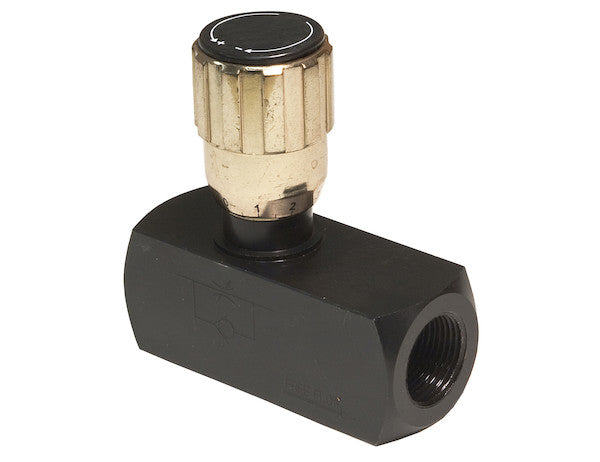
The Flow Control Valve from Buyers Products lets you speed up or slow down a function, such as plowing or dumping, for more precise and smooth control. The valve works by precisely controlling flow and shutoff in one direction, while automatically permitting full flow in the opposite direction. Choose from a range of NPT and SAE sizes in brass and steel.
Specifications
| Material | Carbon Steel |
|---|---|
| Maximum Body Pressure | 5000 |
| Maximum Flow Rate | 5 |
| Maximum Pressure | 5000 |
| Maximum Relief Pressure Setting | - |
| Number of Ports | 2 |
| Port Size | 1/4 SAE ORB (-4) |
Advanced Technical Overview: #4 SAE Steel Flow Control Valve
The #4 SAE Steel Flow Control Valve from Buyers Products represents a critical component for sophisticated hydraulic systems demanding precise velocity regulation and operational integrity. Engineered for optimal performance in demanding environments, this valve is designed to modulate fluid flow in one direction while facilitating unimpeded return flow, a functionality essential for the controlled actuation of hydraulic cylinders and motors. Its robust carbon steel construction, coupled with industry-standard SAE O-Ring Boss (ORB) ports, ensures exceptional durability, pressure resistance, and leak-free operation, making it an indispensable asset for a wide array of mobile and industrial hydraulic applications.
Core Functionality and Hydraulic Principle
At its essence, this flow control valve operates on the principle of variable orifice restriction. Within its meticulously machined body, a precisely engineered needle or spool mechanism allows for the adjustment of the effective flow path area. By altering this orifice, the valve can precisely regulate the volumetric flow rate of hydraulic fluid passing through it. This controlled restriction dictates the speed at which a connected actuator (e.g., a hydraulic cylinder extending or retracting, or a hydraulic motor rotating) performs its task. The critical distinguishing feature of this specific valve is its integrated free-reverse flow capability. While flow is precisely controlled in one direction, an internal check valve automatically opens to permit full, unrestricted flow in the opposite direction. This intelligent design simplifies hydraulic circuits, eliminating the need for a separate check valve and ensuring that system components can return to their initial position swiftly and without experiencing back pressure or controlled resistance. This bidirectional functionality with unidirectional control is paramount in applications where precise work function speed is required in one direction (e.g., lowering a plow), but rapid, uncontrolled movement is permissible or desired in the reverse direction (e.g., lifting the plow).
Robust Carbon Steel Construction
Material selection is a cornerstone of hydraulic component reliability, and the choice of carbon steel for this flow control valve underscores its suitability for rigorous industrial and mobile applications. Carbon steel offers a superior combination of high tensile strength, excellent fatigue resistance, and inherent durability, making it ideal for components subjected to high pressures and dynamic stresses. The material's robust mechanical properties ensure structural integrity under the maximum body pressure rating of 5000 PSI, providing a substantial safety margin for even the most demanding hydraulic systems. Furthermore, carbon steel exhibits excellent resistance to abrasion and wear, which is crucial for internal valve components that experience continuous fluid flow and mechanical adjustments. To enhance its performance and longevity, the carbon steel body is typically treated with a protective coating, such as zinc plating, which provides a sacrificial barrier against corrosion from environmental exposure and common hydraulic fluids. This attention to material science ensures the valve's operational lifespan is maximized, reducing downtime and maintenance costs for end-users.
Precision SAE O-Ring Boss (ORB) Connections
The #4 SAE ORB (-4) port size is a critical specification that highlights the valve's advanced design for leak-free performance and ease of integration. SAE J1926-1 / ISO 11926-1 O-Ring Boss (ORB) fittings are recognized industry-wide for their superior sealing capabilities compared to traditional tapered pipe threads (NPT). The ORB connection utilizes a precisely machined straight thread and an elastomeric O-ring that seals against a chamfered seat within the valve body. This metal-to-metal contact, reinforced by the compression of the O-ring, creates an exceptionally robust and reliable seal that is highly resistant to leaks, even under conditions of high pressure, vibration, and thermal cycling. The -4 designation corresponds to a 1/4 inch nominal port size, optimized for the valve's maximum flow rate of 5 GPM. The straight threads allow for repeated assembly and disassembly without compromising the seal, simplifying maintenance and service procedures. The adoption of SAE ORB connections minimizes the potential for fluid loss, reduces environmental contamination, and contributes significantly to the overall systemic integrity and safety of the hydraulic circuit, making it a preferred choice for high-performance applications.
Optimized Performance Specifications
The detailed specifications of this valve underscore its capacity for demanding hydraulic tasks:
- Maximum Body Pressure (5000 PSI) & Maximum Pressure (5000 PSI): These ratings are indicative of the valve's formidable structural integrity and its ability to withstand extreme hydraulic forces. A 5000 PSI (approximately 345 bar) pressure rating positions this valve squarely in the heavy-duty category, suitable for applications involving high-pressure pumps and actuators where operational reliability under stress is non-negotiable. This high-pressure capability ensures that the valve can be integrated into most modern hydraulic systems without becoming the limiting factor in terms of pressure capacity, contributing to overall system robustness and safety.
- Maximum Flow Rate (5 GPM): The 5 Gallons Per Minute (GPM) flow rate is a critical parameter for system sizing and performance. This specific flow capacity is ideal for controlling smaller to medium-sized hydraulic actuators, such as those found in compact utility equipment, auxiliary functions on larger machinery, or precise positioning systems. For instance, a 5 GPM flow rate can efficiently extend or retract a 2-inch bore cylinder at approximately 30 inches per minute, providing adequate speed for fine control without excessive velocity. The valve's design ensures that this 5 GPM flow can be precisely metered, allowing operators to achieve smooth, controlled movements essential for tasks requiring dexterity and accuracy.
- Number of Ports (2): The 2-port configuration signifies an in-line design, simplifying installation into a hydraulic circuit. This straightforward design allows the valve to be integrated directly into a single hydraulic line, controlling flow between two points, such as from a directional control valve to an actuator, or directly from a pump outlet to a specific function. Its simplicity contributes to a compact footprint and reduces the complexity of the overall hydraulic system design.
- Maximum Relief Pressure Setting (-): The absence of a maximum relief pressure setting indicates that this particular model is a standalone flow control valve without an integrated pressure relief function. This design choice provides flexibility, allowing system designers to implement separate relief valves configured specifically for the overall circuit's pressure protection requirements, optimizing safety and performance independently of flow control.
Diverse Application Spectrum
The versatility of the #4 SAE Steel Flow Control Valve makes it indispensable across a broad spectrum of hydraulic applications where precise speed control is paramount. Extending beyond the examples of "plowing or dumping," its capabilities are crucial in:
- Agricultural Machinery: Controlling the descent rate of implements such as cultivators, seeders, or spray booms, ensuring uniform ground contact and precise application. It can also manage the speed of conveyor belts on harvesting equipment or the opening/closing of gates on grain wagons.
- Construction Equipment: On mini-excavators, skid steers, and compact track loaders, this valve can control the boom and bucket movements, allowing operators to perform fine grading, precise digging, or delicate material handling. It's also vital for regulating the speed of auxiliary attachments like trenchers, augers, or hydraulic hammers.
- Material Handling: In forklifts, scissor lifts, and telescopic handlers, it ensures smooth and controlled lifting and lowering of loads, preventing abrupt movements that could lead to instability or damage. It can also regulate conveyor speeds in automated warehouses.
- Municipal and Utility Vehicles: Beyond snowplows and dump bodies, it finds use in controlling the extension and retraction of utility truck outriggers, aerial lift platforms, and specialized attachments for road maintenance or waste management, enhancing safety and operational precision.
- Industrial Automation: In fixed plant machinery, this valve can precisely control the speed of hydraulic presses, robotic arms, clamping mechanisms, or indexing tables, contributing to consistent product quality and optimized cycle times in manufacturing processes.
In each of these applications, the valve's ability to provide precise and smooth control translates directly into improved operational safety, enhanced efficiency, reduced wear on mechanical components by mitigating hydraulic shock, and greater operator comfort and productivity.
Installation and Maintenance Considerations
Proper installation and routine maintenance are vital for maximizing the operational life and performance of the #4 SAE Steel Flow Control Valve. Given its robust construction, the valve is designed for longevity, but adherence to best practices is crucial:
- System Cleanliness: Hydraulic systems must be kept meticulously clean. Contaminants are the leading cause of hydraulic component failure. Ensure that all lines, fittings, and fluids are free of debris during installation. Incorporate appropriate filtration into the hydraulic circuit upstream of the valve to protect internal components.
- Orientation: While many flow control valves are insensitive to orientation, understanding the controlled flow direction is essential. This valve controls flow in one direction and allows free flow in the reverse. Correctly identifying the inlet and outlet ports relative to the desired controlled movement ensures optimal system performance.
- Torque Specifications: When tightening the SAE ORB fittings, always adhere to the manufacturer's recommended torque specifications. Over-tightening can damage the O-ring or threads, leading to leaks, while under-tightening will result in an inadequate seal.
- Fluid Compatibility: Ensure the valve is compatible with the hydraulic fluid being used. Carbon steel is generally compatible with a wide range of petroleum-based and synthetic hydraulic fluids, but it is always prudent to verify, especially with specialized fluids.
- Regular Inspection: Periodically inspect the valve and its connections for any signs of external leakage, physical damage, or corrosion. Although O-rings are highly durable, they are wear items and should be inspected during system servicing.
Benefits of Choosing the #4 SAE Steel Flow Control Valve
Investing in the #4 SAE Steel Flow Control Valve from Buyers Products delivers a multitude of tangible benefits:
- Superior Control Precision: Enables operators to achieve smooth, predictable movements, crucial for delicate tasks and enhancing overall operational quality.
- Enhanced Safety: Precise control mitigates sudden, uncontrolled actuator movements, significantly reducing the risk of accidents, equipment damage, and operator injury.
- Optimized Efficiency: By regulating the speed of hydraulic functions, the valve helps in conserving energy, reducing cycle times for specific tasks, and improving overall productivity.
- Durability and Longevity: Constructed from high-strength carbon steel with robust SAE ORB connections, the valve is built to withstand extreme pressures and harsh operating conditions, ensuring a long and reliable service life.
- Leak-Free Performance: The SAE ORB design virtually eliminates leakage, promoting a cleaner work environment, reducing fluid loss, and protecting system components.
- Simplified System Design: The integrated free-reverse flow check valve simplifies hydraulic circuits, reducing the number of components and potential failure points.
Commitment to Quality and Engineering Excellence
Buyers Products is renowned for its unwavering commitment to engineering excellence and manufacturing quality. The #4 SAE Steel Flow Control Valve exemplifies this dedication, being subjected to rigorous testing to ensure it meets or exceeds industry standards for pressure integrity, flow characteristics, and material durability. This meticulous attention to detail at every stage of design and production guarantees that each valve delivered provides consistent, reliable performance even in the most demanding hydraulic applications. Choosing this valve is a decision to integrate a high-performance, precision-engineered component into your hydraulic system, optimizing its capabilities and ensuring sustained operational efficiency and safety for years to come.
In conclusion, the #4 SAE Steel Flow Control Valve is more than just a component; it is an essential instrument for achieving granular control over hydraulic power. Its intelligent design, premium material construction, and adherence to leading connection standards make it an invaluable asset for any system requiring dependable, precise flow regulation in challenging operational environments. For professionals who prioritize performance, reliability, and precision, this valve stands as an exemplary solution.