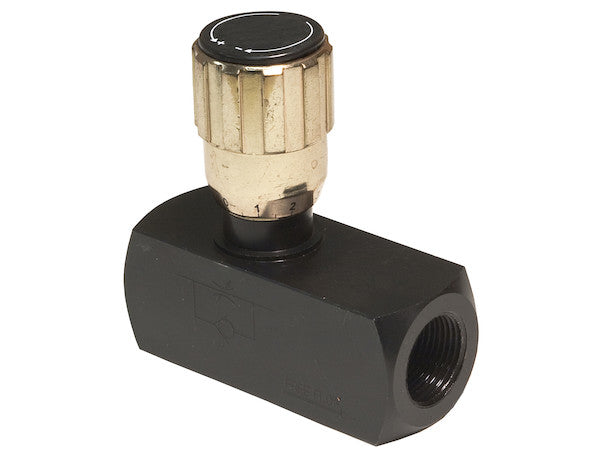
The Flow Control Valve from Buyers Products lets you speed up or slow down a function, such as plowing or dumping, for more precise and smooth control. The valve works by precisely controlling flow and shutoff in one direction, while automatically permitting full flow in the opposite direction. Choose from a range of NPT and SAE sizes in brass and steel.
Specifications
| Material | Carbon Steel |
|---|---|
| Maximum Body Pressure | 5000 |
| Maximum Flow Rate | 8 |
| Maximum Pressure | 5000 |
| Maximum Relief Pressure Setting | - |
| Number of Ports | 2 |
| Port Size | 3/8 NPTF |
Precision Hydraulic Control: An In-Depth Analysis of the 3/8 Inch NPT Steel Flow Control Valve
In the vast and complex world of hydraulic systems, the ability to precisely regulate fluid flow is paramount for achieving optimal performance, ensuring operational safety, and extending the lifespan of critical components. The 3/8 Inch NPT Steel Flow Control Valve from Buyers Products stands as a testament to this engineering principle, offering a robust and reliable solution for granular control over hydraulic actuator speeds. This expanded description will delve into the technical intricacies, application benefits, material science, and operational considerations that make this particular flow control valve an indispensable asset in both mobile and industrial hydraulic environments.
Understanding the Core Functionality: Unidirectional Flow Regulation
At its heart, a flow control valve is designed to modulate the rate at which hydraulic fluid travels through a circuit, thereby directly influencing the speed of hydraulic actuators such such as cylinders or motors. What distinguishes the Buyers Products valve is its sophisticated unidirectional control mechanism. Unlike a simple orifice that restricts flow in both directions, this valve is engineered to precisely control the flow in one designated direction while simultaneously permitting a full, unrestricted flow in the opposite direction. This critical feature is achieved through the integration of a spring-loaded check valve mechanism alongside an adjustable metering orifice.
When fluid flows in the controlled direction, it is forced through the adjustable orifice. This orifice, often a needle valve design, allows for fine-tuning of the flow rate, enabling operators to achieve the desired speed for their application—whether it's slowing down the descent of a plow or accelerating the extension of a dump bed cylinder. Conversely, when the fluid attempts to flow in the opposite direction, the internal check valve opens, providing a low-resistance bypass path around the metering orifice. This ensures that the actuator can retract or return quickly and efficiently, without being impeded by the flow restriction, thereby optimizing cycle times and enhancing overall system productivity. This intelligent design is crucial for applications where rapid return movements are necessary, or where gravity assists in the return stroke, and excessive back pressure would be detrimental.
Material Science: The Superiority of Carbon Steel
The choice of material for hydraulic components directly correlates with their durability, pressure handling capabilities, and resistance to environmental factors. This 3/8 Inch NPT Flow Control Valve is meticulously constructed from high-quality carbon steel, a material renowned for its exceptional mechanical properties and suitability for demanding hydraulic applications. Carbon steel offers a formidable combination of strength, hardness, and wear resistance, making it an ideal candidate for components subjected to high pressures and dynamic stresses.
With a Maximum Body Pressure and Maximum Pressure rating of 5000 psi (pounds per square inch), the carbon steel construction ensures the valve can safely and reliably operate in high-pressure hydraulic systems, far exceeding the requirements of many standard applications. This robustness translates to enhanced operational safety margins and extended service life, even under continuous heavy-duty use. The inherent structural integrity of carbon steel minimizes the risk of deformation or catastrophic failure under extreme hydraulic loads. Furthermore, carbon steel is generally more cost-effective than stainless steel, providing an excellent balance of performance and economic viability for a wide range of industrial and mobile equipment.
While carbon steel provides excellent mechanical strength, it is important to note that proper hydraulic fluid selection and system maintenance, including effective filtration, are crucial to prevent internal wear and corrosion. Modern hydraulic fluids often contain anti-corrosion additives that protect steel components, ensuring the longevity and consistent performance of the valve.
Porting and Connectivity: 3/8 Inch NPTF Standard
The interface between the valve and the rest of the hydraulic system is crucial for a leak-free and efficient operation. This valve features 3/8 Inch NPTF (National Pipe Taper Fuel) ports, a widely recognized and utilized thread standard in North American hydraulic and pneumatic systems. The "F" in NPTF signifies a dryseal thread, meaning it is designed to create a mechanical seal without the need for additional sealant, although thread sealants are commonly used for added security and ease of assembly.
The tapered nature of NPTF threads allows for a robust, self-sealing connection as the male and female threads are tightened, compressing the crests and roots of the threads to form a metal-to-metal seal. The 3/8 inch nominal size indicates the internal diameter of the pipe or hose connection, which is well-suited for systems operating with a Maximum Flow Rate of 8 GPM (gallons per minute). This flow rate positions the valve perfectly for auxiliary circuits, smaller actuators, or applications where precise, moderate flow control is required without excessive fluid volume. The two-port configuration means the valve is designed for inline installation, directly integrated into the flow path of a single hydraulic line, controlling flow to or from an actuator.
Detailed Technical Specifications and Their Implications
- Material: Carbon Steel - As discussed, this ensures high strength, pressure resistance, and durability suitable for harsh environments.
- Maximum Body Pressure: 5000 psi - This rating confirms the structural integrity of the valve body, capable of withstanding significant internal pressures without compromise. It offers a substantial safety margin for most hydraulic systems.
- Maximum Flow Rate: 8 GPM - This specification defines the upper limit of fluid volume the valve is designed to efficiently handle. For example, an 8 GPM flow rate can extend a 3-inch diameter cylinder at approximately 90 inches per minute, providing ample speed for many operational tasks. Understanding this allows engineers to properly size the valve for specific actuator speeds.
- Maximum Pressure: 5000 psi - This rating indicates the maximum operating pressure the internal components, including the adjusting mechanism and check valve, can withstand. It aligns with the body pressure, indicating a uniformly robust design.
- Maximum Relief Pressure Setting: - - The absence of a relief pressure setting is a key indicator that this valve is solely a flow control device, not a pressure relief valve. Its primary function is flow regulation, not over-pressure protection. Hydraulic systems must incorporate separate, appropriately sized pressure relief valves elsewhere in the circuit to protect against excessive pressure buildup and ensure system safety.
- Number of Ports: 2 - This indicates an inline design, making it straightforward to integrate into a single hydraulic line controlling an actuator.
- Port Size: 3/8 NPTF - Standardized for reliable, leak-proof connections, matching common hydraulic plumbing sizes for its flow rating.
Diverse Applications Across Industries
The versatility and robust design of the 3/8 Inch NPT Steel Flow Control Valve make it an indispensable component across a broad spectrum of hydraulic applications. Its ability to provide precise, unidirectional speed control is crucial in many scenarios:
-
Mobile Hydraulics:
- Snow Plows and Salt Spreaders: Controlling the rate of plow lift/lower, angling, or the speed of a salt spreader auger for even distribution. Slowing the descent of a heavy plow prevents jarring impacts, improving operator comfort and reducing stress on equipment.
- Dump Trucks and Trailers: Regulating the descent speed of dump beds to prevent uncontrolled lowering, which can be dangerous and damaging. The unrestricted return flow allows for quick raising.
- Lift Gates and Cranes: Ensuring smooth, controlled lifting and lowering operations for vehicle-mounted lift gates or small crane functions, preventing sudden movements that could endanger personnel or damage cargo.
- Agricultural Equipment: Adjusting the speed of implements such as tillers, cultivators, or spray booms for optimal performance based on terrain and operational requirements.
-
Industrial Hydraulics:
- Machine Tools: Fine-tuning the feed rate of cutting tools or the speed of work-holding clamps for improved machining precision and finish quality.
- Material Handling Systems: Controlling the speed of conveyor belts, robotic arms, or automated guided vehicles (AGVs) to synchronize processes and prevent collisions.
- Presses and Clamping Systems: Modulating the speed of a press ram during the approach and work stroke for controlled force application and safety.
- Automation and Robotics: Providing precise motion control for various robotic actuators where specific speeds are critical for process integrity.
Installation and System Integration Best Practices
Proper installation of the 3/8 Inch NPT Steel Flow Control Valve is critical for optimal performance and system longevity. Consideration should be given to:
- Location in the Circuit: The valve can be installed in a "meter-in" or "meter-out" configuration.
- Meter-in: The valve controls the flow of fluid *into* the actuator. This is typically used when the load is resistant to motion (e.g., lifting a weight).
- Meter-out: The valve controls the flow of fluid *out of* the actuator. This is often preferred for resistive loads, as it maintains back pressure on the actuator, preventing runaway conditions, especially with overrunning loads (e.g., lowering a weight, or during drilling operations). Given this valve's design with a check valve for free return, it is frequently employed in meter-out scenarios, allowing for controlled extension/descent and rapid retraction/lift.
- Thread Sealing: Despite NPTF being a dryseal thread, applying high-quality PTFE tape or liquid pipe thread sealant (rated for hydraulic pressures and fluids) to the male threads is highly recommended. This ensures a leak-free connection, fills potential helical leak paths, and eases future disassembly. Care must be taken to prevent sealant material from entering the hydraulic system.
- Cleanliness: Hydraulic systems are highly sensitive to contamination. All connections, hoses, and fittings must be scrupulously clean before assembly to prevent particulate matter from entering the system, which can clog orifices, wear seals, and damage components.
- Orientation: While many two-port flow controls are symmetrical regarding flow direction for the controlled path, the integrated check valve means this valve is directional for its bypass function. Ensure the valve is installed with the controlled flow direction aligning with the desired actuator movement, and the free-flow direction allowing for unrestricted return. Arrows or markings on the valve body typically indicate the controlled flow path.
- Filtration: Adequate upstream filtration is paramount. Fine particulates can easily clog the adjustable metering orifice, leading to erratic control or complete loss of function. A filter positioned upstream of the valve will protect it from system contaminants.
Operational Benefits and Advantages
The strategic incorporation of the 3/8 Inch NPT Steel Flow Control Valve into a hydraulic system yields numerous operational advantages:
- Enhanced Precision and Smoothness: By precisely regulating the flow rate, the valve eliminates jerky, uncontrolled movements of actuators. This leads to smoother operation, reduced shock loads on mechanical structures, and a more comfortable experience for operators.
- Improved Safety: Preventing rapid, unexpected actuator movements is a critical safety feature, especially in applications involving heavy loads or human interaction. The controlled descent of a dump bed or plow protects both equipment and personnel.
- Increased Component Lifespan: Smooth acceleration and deceleration reduce the wear and tear on hydraulic cylinders, motors, pumps, and other valving. Shock loads and cavitation, often caused by uncontrolled flow, are significant contributors to component degradation.
- Optimized System Efficiency: While flow controls do introduce some pressure drop, the ability to fine-tune cycle times can lead to overall efficiency gains by preventing wasted motion or excessively long operations.
- Versatility and Adaptability: The adjustable nature of the valve allows for field tuning, adapting to different loads, operating conditions, or specific task requirements without replacing hardware.
- Durability and Reliability: The carbon steel construction and robust internal design promise long-term, trouble-free operation even in the most demanding industrial and mobile environments, reducing downtime and maintenance costs.
Maintenance and Troubleshooting
While the Buyers Products Flow Control Valve is designed for durability, routine maintenance and an understanding of common troubleshooting steps can further extend its service life and ensure consistent performance:
- Regular Inspection: Periodically check for external leaks at the ports and along the body. Tighten connections if necessary, but avoid overtightening.
- Fluid Quality: Ensure the hydraulic fluid remains clean and at the appropriate level. Contaminated fluid is the primary cause of hydraulic component failure, including flow control valves. Changes in fluid viscosity due to extreme temperatures can also affect control precision.
- Adjustment Check: Verify that the adjustment mechanism is secure and that the desired flow rate remains consistent over time. Vibrations can sometimes cause adjustments to drift.
-
Troubleshooting Common Issues:
- Erratic or No Flow Control: This often indicates contamination within the valve, such as a clogged orifice or a stuck check valve. Disassembly and cleaning (or replacement) may be necessary.
- Restricted Flow in Both Directions: Suggests the check valve is failing to open, or there is an obstruction preventing its movement, leading to restriction even in the "free flow" direction.
- Leakage Past the Adjustment Stem: Indicates worn seals on the adjustment mechanism, requiring replacement.
Conclusion: An Essential Component for Precision Hydraulics
The 3/8 Inch NPT Steel Flow Control Valve from Buyers Products represents a high-performance, indispensable component for any hydraulic system requiring precise, unidirectional speed control. Its intelligent design, combining an adjustable metering orifice with an integrated check valve, ensures controlled actuation in one direction and rapid, unrestricted movement in the other. Constructed from robust carbon steel and rated for a formidable 5000 psi, this valve is built to endure the rigors of heavy-duty applications, providing unwavering reliability and safety.
From enhancing the operational smoothness of snowplows and dump trucks to optimizing the precision of industrial machinery, this valve delivers tangible benefits in terms of increased safety, improved efficiency, and extended component lifespan. By understanding its technical specifications, adhering to proper installation guidelines, and maintaining system cleanliness, operators and engineers can leverage the full potential of this exceptional flow control solution to achieve superior hydraulic system performance. The 3/8 Inch NPT Steel Flow Control Valve is not merely a component; it is a critical enabler of precise, controlled, and efficient hydraulic power.