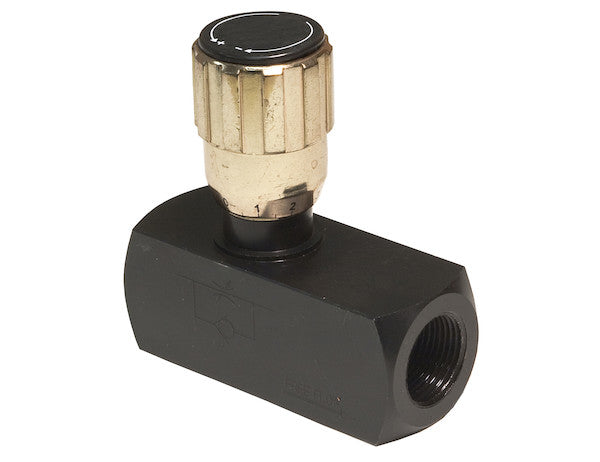
The Flow Control Valve from Buyers Products lets you speed up or slow down a function, such as plowing or dumping, for more precise and smooth control. The valve works by precisely controlling flow and shutoff in one direction, while automatically permitting full flow in the opposite direction. Choose from a range of NPT and SAE sizes in brass and steel.
Specifications
| Material | Carbon Steel |
|---|---|
| Maximum Body Pressure | 5000 |
| Maximum Flow Rate | 8 |
| Maximum Pressure | 5000 |
| Maximum Relief Pressure Setting | - |
| Number of Ports | 2 |
| Port Size | 3/8 SAE ORB (-6) |
Technical Overview: The #6 SAE Steel Flow Control Valve
The #6 SAE Steel Flow Control Valve is a critical component in hydraulic systems demanding precise control over actuator speed and motion. Engineered from robust carbon steel and featuring a 3/8 SAE ORB (-6) port, this valve is designed for challenging industrial and mobile hydraulic applications. It excels in scenarios where consistent, unidirectional flow regulation is paramount, ensuring operational accuracy and system efficiency.
Fundamental Principles of Hydraulic Flow Control
Flow control valves are essential devices in hydraulic circuits that regulate the rate of fluid movement, thereby controlling the speed of hydraulic actuators such as cylinders and motors. This specific valve operates on a principle known as "metering," which involves restricting the flow of hydraulic fluid to a desired level. Unlike simple orifices, a flow control valve typically allows for adjustable restriction, providing the operator with the ability to fine-tune the actuator's speed.
The core mechanism of this valve incorporates a precision-machined throttling element combined with an integrated check valve. The throttling element creates a variable resistance to fluid flow in one direction, while the check valve permits unimpeded, full flow in the opposite direction. This unidirectional control is a key differentiator, making it highly suitable for applications requiring controlled extension or retraction speed with rapid return.
The valve achieves its flow regulation by creating a pressure differential across its adjustable orifice. As fluid attempts to pass through the restricted opening, its velocity increases, and its pressure drops. This controlled pressure drop dictates the volumetric flow rate that reaches the actuator. The specific setting of the valve’s throttling mechanism determines the degree of restriction, directly influencing the actuator's speed. In mobile hydraulic systems, maintaining consistent control regardless of load variations is often critical, and while this valve is not pressure-compensated, its robust design provides reliable flow restriction under steady operating conditions.
Design and Construction: Carbon Steel Durability
Material selection is a cornerstone of hydraulic component longevity and performance. This #6 SAE Flow Control Valve is constructed from high-quality carbon steel, a material renowned for its exceptional strength, durability, and resistance to high pressures. Carbon steel provides superior structural integrity compared to alternative materials, making it ideal for the demanding environments often encountered in heavy machinery and industrial settings.
The inherent properties of carbon steel contribute significantly to the valve's operational resilience:
- High Tensile Strength: Carbon steel can withstand significant pulling forces without deformation or fracture, crucial for components exposed to dynamic hydraulic loads.
- Fatigue Resistance: In systems subject to continuous cycles of pressurization and depressurization, carbon steel exhibits excellent resistance to material fatigue, ensuring a prolonged service life.
- Wear Resistance: The material’s hardness helps resist wear from internal fluid erosion and external abrasions, maintaining the precision of the internal throttling mechanism over time.
- Temperature Stability: Carbon steel maintains its mechanical properties across a broad range of operating temperatures, ensuring consistent performance in varying environmental conditions.
- Compatibility: It offers excellent compatibility with a wide array of hydraulic fluids, including mineral oils and synthetic blends commonly used in modern hydraulic systems.
The robust carbon steel body is designed to safely contain system pressures up to 5000 PSI, far exceeding the typical operational pressures of many hydraulic circuits. This substantial pressure rating provides a significant safety margin, enhancing system reliability and minimizing the risk of component failure under peak load conditions or pressure spikes.
Key Specifications and Their Implications
Maximum Operating Pressure: 5000 PSI
A maximum operating pressure of 5000 PSI (Pounds per Square Inch) underscores the heavy-duty nature of this flow control valve. This high-pressure capability allows the valve to be integrated into high-performance hydraulic systems that demand considerable force and power. In practical terms, this means the valve can be used with large cylinders or motors requiring high pressure to generate necessary torque or linear force without concern for structural failure of the valve itself. This robust pressure rating contributes to overall system safety and reliability, especially in applications where sudden load changes or intense operational demands are common.
Maximum Flow Rate: 8 GPM
The specified maximum flow rate of 8 GPM (Gallons Per Minute) indicates the valve's capacity to handle a specific volume of hydraulic fluid. This parameter is directly correlated with the speed of the actuator it controls. An 8 GPM flow rate is suitable for a wide range of medium-sized actuators, providing adequate speed for functions like operating dump bed cylinders on light to medium-duty trucks, adjusting plow angles, or controlling the movement of smaller crane arms. Matching the valve’s flow rate to the actuator's displacement and desired speed is crucial for optimal system performance and energy efficiency.
Port Configuration: 2-Port, 3/8 SAE ORB (-6)
This valve features a 2-port configuration, meaning it has one inlet and one outlet, making it a series-mounted component in the hydraulic line. The port size is 3/8 SAE ORB (-6). SAE ORB, or SAE O-Ring Boss, connections are a superior choice for hydraulic systems due to their exceptional sealing capabilities. The -6 designation corresponds to a specific thread size and O-ring diameter, ensuring compatibility with standard SAE J1926/1 fittings.
Advantages of SAE ORB connections include:
- Superior Leak Resistance: The O-ring creates a positive, leak-proof seal, even under high pressure and vibration, significantly reducing fluid loss and system contamination compared to pipe thread connections.
- Reduced Assembly Torque: ORB fittings generally require less torque to achieve a reliable seal, simplifying installation and reducing the risk of overtightening and damaging components.
- Reusability: The O-ring can be easily replaced, allowing for multiple disassemblies and reassemblies without compromising the seal integrity of the port.
- Cleanliness: The design minimizes potential leak paths, contributing to a cleaner operating environment and reduced environmental impact.
The 3/8 inch nominal size is commonly found in mobile and industrial hydraulic applications where a balance between flow capacity and compact component size is required.
Unidirectional Flow Control with Integrated Check Valve
The defining characteristic of this flow control valve is its ability to precisely control flow in one direction while allowing full, unimpeded flow in the opposite direction. This is achieved through the integration of a spring-loaded check valve in parallel with the adjustable throttling mechanism.
- Controlled Flow Direction: When hydraulic fluid flows into the valve from the controlled direction, it is forced through the adjustable orifice. The operator can precisely set the degree of restriction, thereby governing the speed of the actuator. This is typically used for applications like controlling the lowering speed of a plow, the extension speed of a boom, or the descent of a dump body.
- Free Flow Direction: When fluid flows from the opposite direction, it encounters the check valve. The pressure of the incoming fluid overcomes the spring force holding the check valve closed, causing it to open fully. This allows hydraulic fluid to bypass the restricted orifice, resulting in maximum flow rate and rapid actuator movement. For instance, this enables a plow to be lifted quickly, a boom to retract swiftly, or a dump body to return to its resting position without delay.
This functionality is crucial for optimizing cycle times in many hydraulic applications, offering both precise control for critical movements and efficiency for non-critical return movements.
Applications and Operational Context
The #6 SAE Steel Flow Control Valve finds extensive utility across a broad spectrum of hydraulic systems where regulated speed and smooth motion are critical. Its robust design and unidirectional control make it particularly valuable in:
-
Mobile Hydraulics:
- Snowplows and Spreaders: Precise control over plow angle adjustments, lift/lower speeds, or spreader gate operation, enhancing operator control and safety.
- Dump Trucks: Regulating the lowering speed of the dump bed to prevent sudden impacts or uncontrolled descent, while allowing rapid lifting.
- Utility Vehicles and Aerial Lifts: Smoothing the extension and retraction of outriggers, booms, and platforms for operator safety and precise positioning.
- Agricultural Machinery: Controlling the speed of implements such as cultivators, seeders, or loaders, ensuring consistent operation and preventing damage.
-
Industrial Hydraulics:
- Material Handling Equipment: Controlling the descent of loads on forklifts, stackers, or conveyor systems to prevent jarring and ensure gentle placement.
- Machine Tools: Regulating the feed rates of hydraulic clamping devices or linear slides for precision machining operations.
- Automated Systems: Integrating into production lines to control the speed of actuators for assembly, packaging, or testing processes, enhancing repeatability and product quality.
- Construction Equipment: Managing the speed of various functions on excavators, backhoes, and loaders, such as bucket tilt or arm extension, for improved operational control and reduced stress on the machine.
In all these applications, the valve’s capacity to provide smooth, controlled motion directly translates into enhanced operational safety, reduced wear and tear on mechanical components, and improved overall productivity. Operators can execute delicate maneuvers with confidence, knowing that the hydraulic system will respond predictably and consistently.
Installation, Maintenance, and System Integration
Proper installation and routine maintenance are paramount to maximizing the lifespan and performance of any hydraulic component, and this flow control valve is no exception. Its 2-port configuration and SAE ORB connections simplify integration into existing or new hydraulic circuits.
- Orientation: It is crucial to install the valve with the correct flow direction. The controlled flow path is typically indicated by an arrow or specific port labeling on the valve body. Incorrect orientation will result in either free flow in both directions or restriction in both directions, nullifying its intended unidirectional control.
- Connection Integrity: When connecting the 3/8 SAE ORB (-6) fittings, ensure that the O-rings are clean, properly seated, and lightly lubricated with hydraulic fluid to prevent pinching or damage. Adhere to manufacturer-recommended torque specifications for fittings to achieve a leak-free seal without over-stressing the port or fitting.
- System Cleanliness: Hydraulic systems are highly sensitive to contamination. It is imperative to maintain stringent cleanliness standards during installation to prevent ingress of dirt or debris, which can impede the valve’s internal mechanisms and lead to premature wear or failure. Always use appropriate filtration in the hydraulic circuit.
- Fluid Compatibility: Ensure the hydraulic fluid used in the system is compatible with the carbon steel construction and the elastomers of the O-rings (typically Buna-N or Viton, depending on the specific valve configuration).
- Regular Inspection: Periodically inspect the valve and its connections for any signs of leakage, external damage, or unusual noise during operation. Promptly address any issues to prevent escalation. The simplicity of this valve generally means minimal internal maintenance, but external integrity is key.
By adhering to these guidelines, operators can ensure reliable and long-term performance from the #6 SAE Steel Flow Control Valve, contributing to the overall health and efficiency of the hydraulic system.
Advantages and Operational Benefits
The deployment of the #6 SAE Steel Flow Control Valve offers a multitude of advantages that enhance both system performance and operational safety:
- Enhanced Precision and Control: Enables operators to precisely regulate the speed of hydraulic actuators, leading to smoother movements, reduced shock loading, and greater accuracy in tasks such as positioning, lifting, or lowering.
- Improved Safety: Controlled actuator speeds mitigate the risk of sudden, uncontrolled movements that could lead to accidents, equipment damage, or injury to personnel. This is especially vital in applications involving heavy loads or elevated platforms.
- Optimized Cycle Times: The unidirectional free-flow feature allows for rapid return strokes or non-critical movements, significantly reducing overall cycle times and improving productivity without sacrificing precision where it matters.
- Durability and Longevity: Constructed from robust carbon steel with a 5000 PSI pressure rating, the valve is built to withstand harsh operating conditions, high pressures, and prolonged use, ensuring a long and reliable service life.
- Leak-Free Performance: Utilizing SAE ORB (-6) ports provides a superior sealing mechanism compared to tapered pipe threads, virtually eliminating leaks and contributing to a cleaner, more efficient hydraulic system.
- Cost-Effectiveness: By preventing rapid, uncontrolled movements, the valve helps reduce wear and tear on other hydraulic components and mechanical structures, thereby extending equipment lifespan and lowering maintenance costs.
- Versatility: Its standard SAE connection and moderate flow capacity make it adaptable to a wide array of mobile and industrial hydraulic applications, simplifying inventory and integration.
In summary, this flow control valve represents a strategic investment for any hydraulic system requiring dependable, precise, and unidirectional speed regulation, delivering tangible benefits in terms of safety, efficiency, and component longevity.